

Key takeaways
- A fishing knife has two jobs that pull in opposite directions. It has to slip cleanly along the backbone of a fish with enough flex to follow the.
A fishing knife has two jobs that pull in opposite directions. It has to slip cleanly along the backbone of a fish with enough flex to follow the ribs, and it also has to survive salt, slime, and a tackle box where it rattles around with hooks and pliers. Buyers shopping for the best fishing knives are really choosing between a dedicated fillet blade, a short bait knife, and a multi-piece set that covers everything from cutting line to cleaning the catch.
This guide is for anglers who clean their own fish, whether that means a handful of panfish at the end of a lake day or a cooler of coastal fillets. We narrowed the listings to six knives and sets and compared them only on what the product titles say: blade length, steel type, handle design, sheaths, and included accessories. Anywhere a title is cut off, confirm the details on the listing. Use the comparison to build a short list for the 2026 season, then think about the species, the cleaning table, and how much you want to carry.
Quick Picks
Our top picks



As an Amazon Associate we earn from qualifying purchases at no extra cost to you.
| Product | Best for | Key spec from the title |
|---|---|---|
| HOSHANHO Fillet Knife | Precise boning and fine fillet work | 7 inch, Japanese-style, high carbon stainless steel |
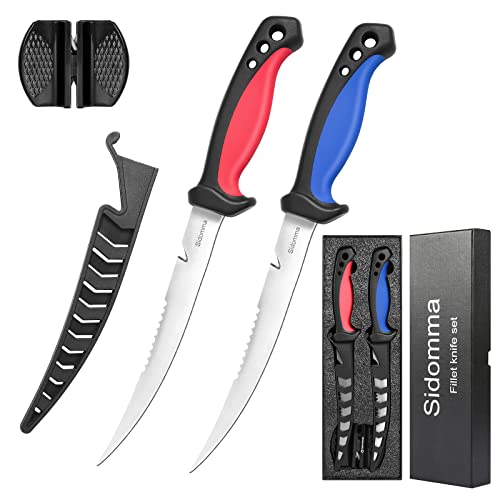
| Sidomma Fillet Knife Set | A simple two-blade starter set | 2 pieces, 6.5 inch, stainless steel |
| KNINE OUTDOORS Fillet Set | Flexible blades in two lengths | Curved flex, 7 inch and 9 inch, non-slip handles |
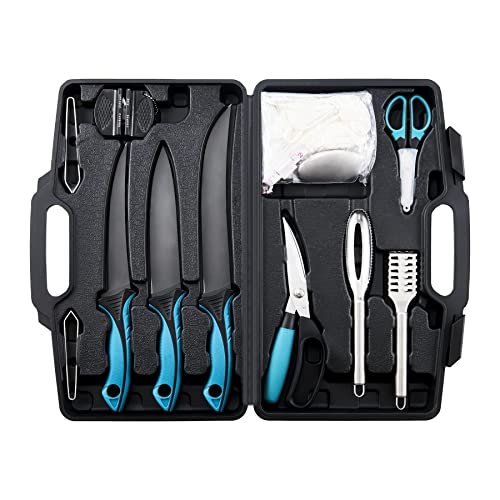
| FLISSA 4PCS Fillet Set | Camp kitchens and cleaning stations | 5, 6, 7, 9 inch knives, sharpener, roll bag, 8Cr13mov steel |
| Mossy Oak Fishing and Bait Knife | Bait cutting and small-fish work | 4 inch, 5Cr15MoV stainless, sheath |
| KastKing Speed Demon Pro | Serious fillet work on larger fish | 7 inch, G4116 German stainless, corrosion-resistant coating |
How to Choose
Blade length and flex
Match the blade to the fish. A 5 to 6 inch knife handles panfish, trout, and perch, where a long blade is awkward. Seven inches is the all-purpose length for bass, walleye, and snapper. Nine inches suits large fish such as salmon, striped bass, and catfish, because it can run the full length of a fillet in one stroke. Flexible blades follow the ribcage and leave less meat behind, while stiffer ones are better for cutting through bait and skinning heavy-skinned fish.
Steel and corrosion resistance
Steel names appear in several titles: 5Cr15MoV, 8Cr13mov, G4116 German stainless, and high carbon stainless. All are stainless variants, which matters near saltwater. Higher carbon content usually holds an edge longer but can need quicker drying, while softer stainless is easier to sharpen and more forgiving of neglect. A corrosion-resistant coating, mentioned on one knife, adds protection but can wear where you sharpen. Whatever you choose, rinse the blade with fresh water and dry it after each outing.
Handle design and safety
Fish slime and water make a slick handle dangerous. Look for non-slip grips, textured patterns, or finger guards, and make sure the handle is large enough for your hand. A protective sheath is not optional if the knife lives in a tackle bag, a kayak crate, or a boat locker. Sets that include a roll bag keep the blades organized and protect the edges from bumping each other.
Set versus single knife, and where budgets cut corners
A set is attractive because it covers different fish sizes and often adds a sharpener or scissors. The compromise is usually quality per knife. Budget models can ship with a dull factory edge, loose rivets, or a sheath that does not lock the blade. Ignore claims like “razor sharp” or “professional” unless the listing explains how the edge is finished. Plan on honing or sharpening any new knife before its first big cleaning session.
One more thing worth planning is sharpening. A fillet knife that is touched up with a few strokes before every session cuts cleaner and safer than one that is left until it tears flesh. Keep a small stone or pull-through tool with your knife, and wipe the blade dry after every fish.
The 6 Best Options
HOSHANHO Fillet Knife 7 Inch
HOSHANHO markets this knife as a Japanese-style boning and fillet blade made of high carbon stainless steel, and its description also mentions meat and poultry. At 7 inches it fits mid-sized fish, from bass to snapper, and doubles in a kitchen when needed. It suits the angler who values a precise, slim blade over a rugged utility tool.
- Strength: The 7 inch length is versatile for many species.
- Strength: A high carbon stainless blade is designed to hold a keen edge.
- Trade-off: The title does not mention a sheath, so you may need to protect the edge yourself.
Skip it if you want a full set or a knife designed around saltwater boat conditions. Confirm the remaining details on the listing, as the title is cut short.
Sidomma Fillet Knife Set
This is a two-piece fillet set with 6.5 inch stainless steel blades, listed as a gift and a fishing tool set. It suits a newer angler who wants two knives without a big commitment, perhaps one for the boat and one for the kitchen. The shorter length is comfortable for trout, perch, and panfish.
Having a second knife is more useful than it sounds, since one can stay in the boat box while the other lives in the kitchen drawer, always clean and always sharp.
- Strength: Two knives provide a spare and keep one on the water, one at home.
- Strength: The 6.5 inch length is easy to control on small fish.
- Trade-off: Both blades share the same length, so larger fish may call for something longer.
Skip it if you regularly clean big catfish or salmon, where a 9 inch blade is more efficient.
KNINE OUTDOORS Fillet Knife Set
KNINE offers curved, flexible fillet knives in 7 inch and 9 inch lengths with non-slip handles, and the set also includes fishing braid line scissors according to the title. The two-length setup covers medium and large fish, and the curved profile follows the shape of the bones. It fits a hobbyist who fishes different waters across the year.
The braid scissors are a quiet bonus, because cutting braided line with a knife dulls the edge quickly, and a separate pair of scissors keeps the fillet blades for fish.
- Strength: Two lengths cover bass-sized fish and larger catches.
- Strength: Non-slip handles help when your hands are wet.
- Trade-off: The title is cut off, so check the full accessory list and sheath details on the listing.
Skip it if you only target small fish or prefer a single dedicated knife.
FLISSA 4PCS Fillet Knife Set
FLISSA bundles four knives at 5, 6, 7, and 9 inches with a sharpener, a portable roll bag, and protective sheaths, using 8Cr13mov steel. It is the most complete package in this group and suits an angler who cleans a mix of species or shares gear among several people. The roll bag keeps everything together for camping or a boat cleaning station.
The sheaths and the roll bag matter more than they look, because loose blades in a tackle box are the usual way knives get chipped and fingers get cut.
- Strength: Four lengths cover everything from panfish to larger fillets.
- Strength: The included sharpener and roll bag add practical value.
- Trade-off: Having four blades can be more than a solo kayak angler needs to carry.
Skip it if space is tight or you prefer to buy one higher-grade knife.
Mossy Oak Fishing and Bait Knife
Mossy Oak’s 4 inch knife is a compact fishing and bait blade with a protective sheath and 5Cr15MoV stainless steel, plus an ergonomic non-slip handle. It is meant for cutting bait, trimming line, and basic cleaning rather than filleting large fish. This fits the shore angler or kayaker who wants a small knife clipped to a vest.
Cutting bait on a cutting board is far easier with a small blade, and the shorter handle length fits a kayak vest pocket without snagging.
- Strength: Short blade is easy to control and carry.
- Strength: The sheath and non-slip handle improve safety.
- Trade-off: Four inches is too short for filleting bigger fish.
Skip it if filleting is your main goal. Consider pairing it with a longer fillet blade.
KastKing Speed Demon Pro
The Speed Demon Pro is a 7 inch fillet knife made with G4116 German stainless steel, with a non-slip grip and a corrosion-resistant coating, according to the title. It is a focused tool for anglers who clean a lot of fish and care about edge quality. The mention of a protective sheath suggests it is ready to travel in a tackle bag.
Because it is a single focused blade, it pairs well with a pull-through sharpener or a ceramic rod, which keeps the edge ready for big cleaning days.
- Strength: German stainless steel is widely used for kitchen and fillet blades.
- Strength: Coating and grip features are aimed at wet, salty conditions.
- Trade-off: As a single knife, it does not include the extra tools that sets offer.
Skip it if you want a bundle with scissors or a sharpener. Confirm the remainder of the title on the listing.
Which One Fits Your Situation
You clean mixed catches at a camp or dock
The FLISSA 4PCS Fillet Knife Set gives you a blade for every size, plus a sharpener and roll bag. It is the most convenient package for a shared cleaning station.
You mainly fillet bass, walleye, or snapper
Choose the KastKing Speed Demon Pro or the HOSHANHO 7 inch. Both sit at the sweet spot for medium fish, and both offer stainless blades suited to regular use.
You fish for bigger species
The KNINE OUTDOORS set adds a 9 inch flexible blade, which handles larger fillets in fewer strokes. Keep the 7 inch for smaller fish.
You fish from a kayak or shoreline with minimal gear
The Mossy Oak 4 inch knife keeps things light for bait work and quick cuts. Pair it with a longer blade at home for full filleting.
Common Mistakes
- Using one blade length for every fish and fighting the knife on very small or very large species.
- Skipping a sheath, then dulling the edge or cutting yourself in the tackle bag.
- Leaving a knife wet after saltwater and letting corrosion start.
- Assuming a new knife arrives sharp enough without honing it first.
- Buying a large set when you will only use one knife regularly.
Related guides
- Shimano Stradic Fl Vs Daiwa Bg Spinning Reel
- Polarized Sunglasses For Kayak Fishing
- Battery Chargers For Marine Batteries
Frequently Asked Questions
What blade length is best for most anglers?
Seven inches is the most versatile choice for bass, walleye, and similar species. Go shorter for panfish and longer for salmon, catfish, or big saltwater fish.
Do I need a flexible or stiff blade?
Flexible blades follow bones and are best for filleting. Stiffer blades are better for bait, skinning thick fish, and general utility work.
How should I care for a fillet knife?
Rinse with fresh water, dry it fully, and store it in its sheath. Hone it regularly, and avoid the dishwasher, which can dull edges and damage handles.
Are fillet sets worth it?
They can be if you clean many sizes of fish and appreciate included extras such as a sharpener. If you only need one length, a single quality knife is often a better buy.
More from Amazon
Programs that pair well with the guide above. Offers and eligibility are set by Amazon and may change.
Free shipping on eligible items, Prime Video and more. Eligible new members can start with a free trial.
Start a Prime free trialA Prime membership for ages 18-24 with a trial period. Eligibility is set by Amazon.
See Prime for Young AdultsAudiobooks and podcasts to listen to on the go. Eligible new members can start with a free trial.
Try Audible freeAd-free music streaming. Eligible new subscribers can start with a free trial.
Try Music Unlimited freeAs an Amazon Associate we earn from qualifying purchases.
Write Your Review
No reviews yet. Be the first to share your experience!