

Key takeaways
- Standing on a board to cast, with a fish pulling on the line, is a very different proposition from paddling for exercise.
Standing on a board to cast, with a fish pulling on the line, is a very different proposition from paddling for exercise. The question behind “best fishing paddle boards” is whether a board can stay stable when you shift your weight, carry a rod, a crate and maybe a second person, and still pack into a trunk. Width, length, deck layout and included accessories matter far more here than they do for a yoga or touring board.
This guide is written for anglers weighing inflatable stand-up boards that are marketed for fishing, from wide 12-footers with seats to lighter 11-foot models with rod holders. All details come from the product titles, such as lengths, widths, capacity numbers and included gear, and several titles are truncated, so confirm anything not stated before ordering. In 2026 inflatable boards dominate this space because they store in a closet and tolerate rocky shorelines better than most hard boards, but the gap between a wobbly board and a stable platform is mostly width and thickness.
Quick Picks
Our top picks




As an Amazon Associate we earn from qualifying purchases at no extra cost to you.
| Product | Best for | Key spec from the title |
|---|---|---|
| TAOSTAR Adventure 12 ft | Beginners who want a seat and room | 12 ft by 39 inch, includes seat, 5 fins |
| Tuxedo Sailor 12 ft | Families or a shared board | Extra large, 2+1 people, anti-slip EVA deck |
| Spatium Fishing Paddle Board with Motor | Covering water without paddling | Motor included, wide stable design |
| Napatron Inflatable Fishing Board | Maximum width for standing casts | 11 ft by 47 inch, built-in rod holders |
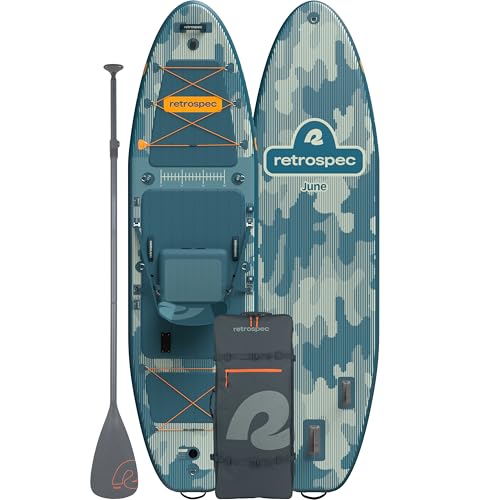
| Retrospec June 11 ft 6 in | Puncture resistance and rod holders | Removable seat, rod holders, non-slip deck |
| MYBOAT 11 ft 6 in | Standing stability on a lake | 34 inch wide, 6 inch thick, rod holder, kayak seat |
| Wetarjoyfre 11 ft | Light carry weight | 17 lb, 550 lb capacity, 33 inch wide |
How to Choose
Width and thickness set your stability
For fishing, aim for at least 33 to 34 inches wide for casual standing, and 36 inches or more if you plan to cast and fight fish on your feet. Six inches is the standard thickness for inflatable boards, and it keeps the platform rigid enough to support a standing adult. Boards in the 30-inch range are quicker but will feel tippy when you reach for a net. Extra-wide boards in the mid-40s give you kayak-like stability but paddle slower.
Length and capacity
Eleven to twelve feet is the sweet spot: long enough to track straight and carry gear, short enough to pack. Capacity numbers should comfortably exceed your body weight plus gear plus whatever you plan to carry. If a title lists a capacity, subtract your own weight and see how much room remains for a crate, cooler and anchor. If it lists none, confirm on the listing before buying.
Deck layout, seat and rod holders
A removable seat turns the board into a sit-down kayak-style platform for long sessions, and bungee cargo zones secure a crate or bag at the bow or stern. Built-in rod holders and D-rings are useful if they are positioned where you can reach them. Non-slip EVA pads protect your feet when you stand and wet-footed cast. Be wary of boards that advertise many accessories but do not describe the deck itself.
Pump, repair and motor options
Check what ships in the bag: pump, paddle, leash, repair patch and carry bag. Dual-action pumps cut inflation time. Motorized boards add weight, a battery and more things to rinse and charge, but they let you cover distance without arm fatigue. Budget bundles cut corners on pump quality and paddle strength, so plan on upgrading the paddle first if the supplied one feels flexible.
A last practical filter is storage and launch logistics. An inflated 12-foot board needs a roof rack or a spot to carry it; a deflated one fits a duffel but takes ten minutes to pump up at the water. Anglers who fish after work in short windows often prefer the lighter, smaller boards for that reason. Anglers who spend full days on a lake lean toward wider, seated setups, accepting the extra bulk for comfort. Neither choice is wrong, but deciding in advance prevents a purchase that sits unused in the garage.
The 7 Best Options
TAOSTAR Adventure 12 ft by 39 in Inflatable SUP
The title advertises a 12-foot length, a 39-inch width, a seat, an extra wide stable design and five fins. That width is generous, and the seat makes it adaptable for anglers who want to sit between casts. The listing also points to fishing, youth and all skill levels, so it fits a beginner or a family sharing one board. Check the listing for the complete accessory list since the title is truncated.
- Strength: 39-inch width is very stable for standing.
- Strength: includes a seat for flexible positions.
- Trade-off: wide boards paddle slower in wind.
Skip it if you want a narrow, fast board for covering long distances.
Tuxedo Sailor 12 ft Extra Large Inflatable Paddle Board
Marketed for two plus one people, this 12-foot board with SUP accessories and an anti-slip EVA deck is for anglers who want to bring a partner or a child. The title mentions yoga and fishing, so it is a flexible all-rounder instead of a specialist. It suits calm lakes and slow rivers where stability and carrying capacity count more than speed. Confirm the stated weight capacity on the listing before loading it with two adults and tackle, since the title does not give a number.
- Strength: sized for multiple riders.
- Strength: anti-slip EVA deck for stable footing.
- Trade-off: general-purpose design lacks dedicated fishing details in the title.
Skip it if you want integrated rod holders and fishing-specific layout.
Spatium Fishing Paddle Board with Motor
The title bundles a motor with a wide stable design, non-slip deck and all accessories, and also calls it an inflatable fishing kayak. That makes it an interesting choice for anglers who want to troll or cover distance without constant paddling. Motorization adds convenience but also weight, a battery to charge and more rinsing after saltwater trips. Confirm motor specs and battery details on the listing, because the title does not give them.
- Strength: motor reduces paddling effort.
- Strength: wide, stable platform with non-slip deck.
- Trade-off: added weight and charging requirements.
Skip it if you want the simplest, lightest board.
Napatron Inflatable Fishing Paddle Board 11 ft by 47 in
With a 47-inch width, this is the broadest board in the group, closer to a kayak than a typical SUP. The title lists heavy-duty construction, built-in rod holders, a carry bag and use in saltwater or freshwater lakes. If your priority is a stable platform for standing and casting, this width gives you real margin. It will not win any races, but that is not the point. Anglers who plan to fish from a seated position most of the day will especially appreciate how much room the wider deck leaves for a crate and a net.
- Strength: very wide for confident standing.
- Strength: built-in rod holders.
- Trade-off: bulky when inflated and slower to paddle.
Skip it if you plan long paddles to distant spots.
Retrospec June Inflatable Fishing Paddle Board 11 ft 6 in
The June comes with a removable seat, rod holders, a non-slip deck and a puncture-resistant description, all in an 11 foot 6 inch length. That mix suits anglers who fish from shore access points where the board might scrape rocks or oyster shells. A removable seat lets you switch between standing and sitting. The listing is truncated, so confirm width and capacity on the product page.
- Strength: puncture-resistant claim and rod holders.
- Strength: removable seat for versatility.
- Trade-off: width is not stated in the title.
Skip it if you need specifications confirmed up front.
MYBOAT 11 ft 6 in by 34 in by 6 in Inflatable Paddle Board
The MYBOAT title gives dimensions in full: 11 feet 6 inches long, 34 inches wide and 6 inches thick, with a fishing rod holder, kayak seat and removable fins. Those numbers sit in the comfortable middle of fishing board specs, balancing stability and speed. It suits a lake angler who wants to stand part of the time, sit part of the time and still paddle without a fight.
- Strength: dimensions are clear in the title.
- Strength: includes a rod holder and a kayak seat.
- Trade-off: narrower than the extra-wide boards, so less forgiving.
Skip it if you are new to standing boards and want maximum stability.
Wetarjoyfre Inflatable Paddle Board 11 ft
Listed at 11 feet by 33 inches by 6 inches, 17 pounds and a 550-pound capacity, this one emphasizes carrying ease. The ultra-light claim is helpful if you hike to a quiet cove or have a long walk from the car. A 550-pound stated capacity leaves plenty of room for an angler plus gear. The 33-inch width is workable but leaves less margin than wider alternatives.
- Strength: light weight makes transport easier.
- Strength: high stated capacity with a non-slip deck.
- Trade-off: narrower width demands better balance.
Skip it if you want a very wide, stable platform for a beginner.
Which One Fits Your Situation
You are new to standing boards
The TAOSTAR at 39 inches or the Napatron at 47 inches give the most forgiving platforms. Start with a seat in place and stand once you feel comfortable.
You fish with a partner or child
The Tuxedo Sailor is described for two plus one people, which makes it a natural family fishing platform. Keep gear organized so the deck stays clear.
You hike to your spot
The Wetarjoyfre at 17 pounds is the practical choice for a long carry, while the MYBOAT adds a seat if you want to sit.
You want to cover water
The Spatium with a motor handles distance, and the Retrospec June is a good alternative if you prefer paddling with rod holders ready.
Common Mistakes
- Choosing a narrow board for standing casts and then fishing from your knees.
- Ignoring capacity once gear, a cooler and a second person are added.
- Under-inflating the board, which makes it flex and feel unstable.
- Skipping a leash and a personal flotation device.
- Assuming the included paddle is good enough for long days.
Related guides
- Shimano Stradic Fl Vs Daiwa Bg Spinning Reel
- Polarized Sunglasses For Kayak Fishing
- Battery Chargers For Marine Batteries
Frequently Asked Questions
How wide should a fishing paddle board be?
Thirty-four inches is a practical minimum for casual standing, and 36 inches or more is better if you plan to fight fish on your feet.
Can I fish from an inflatable board in saltwater?
Yes, provided you rinse it with fresh water afterward, dry it fully and store it unfolded or loosely rolled. Salt and sand in the valve can cause slow leaks, so flush the valve area and keep the cap clean. Always check the listing for any saltwater guidance from the maker.
Do I need a seat?
A seat is not required, but it makes long sessions more comfortable and lets you lower your center of gravity in wind or chop. It also gives you a place to rest between drifts, and a removable one costs you nothing when you prefer to stand all day.
What safety gear do I need?
Wear a personal flotation device and use a leash. Carry a whistle and, in cooler water, dress for immersion.
More from Amazon
Programs that pair well with the guide above. Offers and eligibility are set by Amazon and may change.
Free shipping on eligible items, Prime Video and more. Eligible new members can start with a free trial.
Start a Prime free trialA Prime membership for ages 18-24 with a trial period. Eligibility is set by Amazon.
See Prime for Young AdultsAudiobooks and podcasts to listen to on the go. Eligible new members can start with a free trial.
Try Audible freeAd-free music streaming. Eligible new subscribers can start with a free trial.
Try Music Unlimited freeAs an Amazon Associate we earn from qualifying purchases.

Write Your Review
No reviews yet. Be the first to share your experience!