

Key takeaways
- Adding a motor to a fishing kayak changes the whole day. You stop burning energy on the paddle.
Adding a motor to a fishing kayak changes the whole day. You stop burning energy on the paddle, you can hold a position in wind and current while you work a bank, and you can cover water that would have taken hours by hand. The question behind “best trolling motors for kayaks” is rarely just thrust. It is how the motor mounts to your hull, what battery it needs, whether the shaft reaches the water from your seat, and how much weight the boat can carry without turning tippy.
This guide is for anglers who already own a sit-on-top or sit-in fishing kayak, and who are weighing a small transom or bow-mount electric motor against a pedal-style or integrated system. The six picks include thrust ratings from 36 to 65 pounds, 12-volt and 24-volt options, and one premium unit with chartplotter integration. Every judgment is drawn from the listing titles only, so confirm shaft length, voltage, mount type, and included hardware before you order in 2026. Think about your battery, your transom or bow space, and your budget tier before you compare thrust numbers.
Quick Picks
Our top picks


As an Amazon Associate we earn from qualifying purchases at no extra cost to you.
| Product | Best for | Key spec from the title |
|---|---|---|
| Newport Kayak Series 55 lb | Transom mount with strong thrust | 55 lb thrust, saltwater, 24-inch shaft |
| Garmin Force Current | Premium integrated setup | Chartplotter integration, stow and deploy |
| Minn Kota Riptide Terrova | Bow-mount with GPS | 55 lb thrust, 36-inch shaft, GPS, saltwater |
| BKC Kayak Trolling Motor | Sit-on-top kayaks | Hands-free propulsion, corrosion-resistant |
| Newport NV-Series 36 lb | Lighter 12-volt setup | 36 lb thrust, 12V, 30-inch shaft |
| Newport NK180 HD 24V | Maximum power | 65 lb thrust, 600W brushless, 24V |
How to Choose
Thrust, voltage, and battery weight
Thrust in pounds tells you how hard the motor pushes. For a loaded fishing kayak, 36 pounds is enough for calm water at moderate speed, while 55 to 65 pounds suits wind, current, and heavier rigs. Voltage drives the battery choice: a 12-volt motor runs from a single battery, while a 24-volt motor needs two, which adds weight. Every pound of battery sits low in the hull, but a heavy battery crowds a small kayak, so size the power to the boat. Check the kayak’s maximum capacity, then subtract yourself, your gear, the battery, and the motor to see how much margin is left. A kayak that sits low in the water paddles badly and handles waves poorly.
Mount type: transom, bow, or kayak-specific bracket
Transom motors clamp to the stern, a bracket, or a plate, and they are the most common for small boats. Bow-mount motors pull the kayak, which improves tracking, but they require a mount and a stow-and-deploy design. Some kayaks need a dedicated motor mount that bolts to scupper holes or tracks, and a separate bracket may be required. Confirm the hull’s mounting points and whether the motor ships with the mount. Think about steering too: a transom motor is steered with a tiller or by turning the whole head, which can be awkward from a seated position, while a bow-mount system may offer a foot pedal or remote.
Shaft length and saltwater use
A shaft that is too short lifts the propeller out of the water in chop, and one that is too long drags in shallows. Shaft lengths in this group run from 24 to 36 inches. Saltwater-rated motors use sealed housings and corrosion-resistant materials, which matters for coastal anglers. Rinse the motor after every salt trip regardless, since sealed does not mean immune. Look at the cable length and how the motor stows, because a long shaft that cannot be lifted out of the water drags in shallow spots and snags weeds.
Features and where budget motors cut corners
An LED battery indicator warns you before the power drops. Variable speed control lets you troll slowly or push upwind. Chartplotter integration and GPS features add convenience but also cost. Budget motors tend to have simple switches, brushed motors that wear faster, and thinner shafts that flex under load. Check the cable gauge and the connectors too, since weak wiring loses power before it reaches the prop. Also look at the warranty terms, because brand support matters more on a motor than on most kayak accessories, and a motor you cannot get serviced is a motor you will replace.
The 6 Best Options
Newport Kayak Series 55 lb
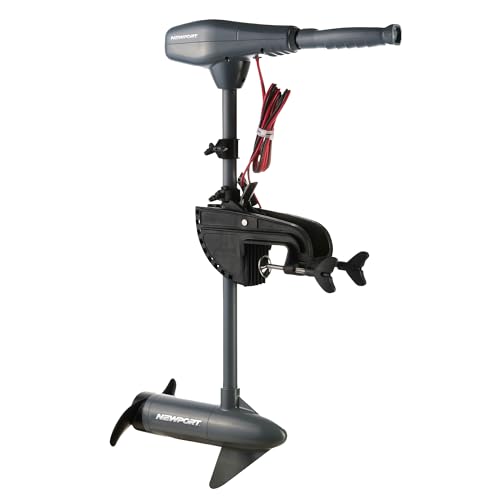
This transom-mounted saltwater electric motor delivers 55 pounds of thrust, has an LED battery indicator, and uses a 24-inch shaft. The title positions it as part of a kayak-specific series. That label helps narrow the search, though you still need to confirm that its clamp or bracket fits your hull.
- 55 pounds of thrust suits loaded fishing kayaks and windy days.
- A saltwater design and an LED battery indicator add practical safeguards, so you know when it is time to head back before the power runs low.
- Trade-off: a 24-inch shaft may be short for a high stern or choppy water.
Skip it if you need a bow-mount pulling setup. It suits anglers who want a straightforward transom motor, a clear step from paddle power without the complexity of a pedal drive.
Garmin Force Current
The Garmin Force Current is a kayak trolling motor with simple installation, superior maneuverability, chartplotter integration, and a stow-and-deploy design. It is the premium pick among these six.
- Chartplotter integration ties the motor into a Garmin electronics setup.
- A stow-and-deploy design keeps the propeller out of the way when paddling, and lets you raise it quickly in shallow water or near weeds.
- Trade-off: it sits in a premium tier, so it is a big step up in cost from the other motors.
Skip it if you do not use a compatible chartplotter. It suits anglers who value integrated navigation and are willing to invest, and who already run Garmin gear on the same boat.
Minn Kota Riptide Terrova
The Minn Kota Riptide Terrova is a bow-mount electric motor with GPS, 55 pounds of thrust, a 36-inch shaft, and a saltwater design. The kayak label suggests it is sized for smaller boats, though a bow mount still takes careful planning on a narrow hull.
- The GPS feature in the title points to navigation help when working a spot in wind.
- A 36-inch shaft keeps the propeller deep in chop.
- Trade-off: bow-mount installation is more involved than a transom clamp.
Skip it if you want a quick, bolt-on transom motor. It suits anglers who fish saltwater and want GPS features.
BKC Kayak Trolling Motor
The BKC motor is described as an electric trolling motor for sit-on-top fishing kayaks that provides hands-free propulsion and corrosion resistance, aimed at lakes and rivers. The title is cut off, so confirm thrust, voltage, and shaft length on the listing.
- It is designed with sit-on-top kayaks in mind, which simplifies matching.
- Corrosion resistance supports regular use around water.
- Trade-off: key specs are missing from the title, so research thrust and mounting before buying.
Skip it if you need specific thrust or voltage figures upfront. It suits anglers who fish sit-on-top boats on calm water, and who are comfortable verifying specs on the product page before they buy.
Newport NV-Series 36 lb
This 12-volt motor delivers 36 pounds of thrust, is a saltwater transom mount for kayaks, canoes, and small boats, and includes an LED battery indicator and a 30-inch shaft.
- A 12-volt system needs only a single battery, saving weight.
- A 30-inch shaft offers more reach than the 24-inch models.
- Trade-off: 36 pounds of thrust may feel underpowered against wind or current.
Skip it if you fish big water or carry a heavy load. It suits lighter kayaks on lakes and sheltered bays, where wind is rarely the main problem.
Newport NK180 HD 24V
The NK180 HD is a 24-volt electric kayak motor with 65 pounds of thrust, a 600-watt brushless direct-drive motor, variable speed control, and a saltwater-ready design. It is the most powerful unit here.
- Brushless direct drive points to durability and efficiency, since there are fewer parts to wear than in a brushed design.
- Variable speed control gives fine control at trolling speeds, which is where a slow, quiet approach pays off with wary fish.
- Trade-off: a 24-volt system needs two batteries, adding weight to a kayak.
Skip it if your kayak has limited load capacity. It suits anglers who need maximum power, such as those who fish big rivers or push a heavily loaded rig against wind.
Which One Fits Your Situation
You fish calm lakes with a light kayak
The Newport NV-Series 36 lb is a sensible fit. Its 12-volt setup and single battery keep weight down, and the 30-inch shaft reaches the water from most seat heights.
You fish coastal water with wind and current
The Minn Kota Riptide Terrova or the Newport Kayak Series 55 lb suit those conditions. Choose the Terrova for GPS holding, and the Newport for a simpler mount.
You want an integrated electronics setup
The Garmin Force Current ties into a chartplotter and stows cleanly. Confirm that your electronics are compatible.
You carry a heavy rig and want power to spare
The Newport NK180 HD 24V is the strongest listed motor. Make sure the kayak can handle the two-battery load, and plan where the weight will sit so the boat stays level.
Common Mistakes
- Buying more thrust than the hull can use, then fighting the weight of the batteries.
- Ignoring shaft length and lifting the prop out of the water in chop.
- Skipping a motor mount and assuming the kayak can handle clamps.
- Forgetting a fuse and proper wiring between the battery and the motor.
- Skipping a freshwater rinse after saltwater use.
Related guides
- Shimano Stradic Fl Vs Daiwa Bg Spinning Reel
- Polarized Sunglasses For Kayak Fishing
- Battery Chargers For Marine Batteries
Frequently Asked Questions
How much thrust does a kayak need?
Many anglers find that 36 to 55 pounds is enough for typical conditions, with higher numbers for wind and heavy loads. Match thrust to your boat weight rather than chasing the biggest number. Run time depends on the battery capacity, how fast you travel, and the wind, so treat any quoted hours as a rough guide and confirm on the listing.
Can I use a car battery?
Deep-cycle batteries are designed for steady loads and are the standard choice. A lightweight lithium battery saves weight, but confirm compatibility with the motor. Use a fuse or circuit breaker near the battery and keep the battery in a sealed, secured box so a capsize does not leave it loose in the hull.
Do I need a special mount?
Often yes, because most kayaks lack a flat transom. Look for a kayak-specific bracket or a track-mounted plate. The listing for the aluminum bracket style of mount is a separate product, so read whether the motor you buy includes one before assuming it does.
Is a motor legal everywhere?
Rules vary by water body and state, and some lakes ban motors or require registration. Check local regulations before you install, and carry any required registration or permits on the water. Some lakes limit horsepower or thrust, so a smaller motor can be the legal choice as well as the lighter one.
More from Amazon
Programs that pair well with the guide above. Offers and eligibility are set by Amazon and may change.
Free shipping on eligible items, Prime Video and more. Eligible new members can start with a free trial.
Start a Prime free trialA Prime membership for ages 18-24 with a trial period. Eligibility is set by Amazon.
See Prime for Young AdultsAudiobooks and podcasts to listen to on the go. Eligible new members can start with a free trial.
Try Audible freeAd-free music streaming. Eligible new subscribers can start with a free trial.
Try Music Unlimited freeAs an Amazon Associate we earn from qualifying purchases.

Write Your Review
No reviews yet. Be the first to share your experience!