

Key takeaways
- Capacity: Use the motorcycle’s actual weight, including accessories and fuel, rather than the dry-weight figure. Leave a margin for the lift and any load shift; never exceed the manufacturer’s rating.
- Contact points: Measure the clearance beneath the frame or approved lifting point. Compare it with the lift’s collapsed height, including any adapter. Exhausts, fairings, oil pans, and plastic panels are not suitable supports.
- Platform size: A small scissor top supports a chosen frame point; a table supports the tires and usually offers more stable positioning. Check wheelbase, tire width, and where the chock will sit.
- Maximum height: Compare the lift’s maximum height with the work you plan to do and your own comfortable reach. The listed maximum may be measured at the top surface, not at the motorcycle’s frame or a particular component.
- Locking and stability: Prefer a lift with mechanical safety locks or locking bars at multiple heights. Hydraulic pressure alone is not a long-term support system. Chock and tie-down arrangements must suit the bike and the lift’s design.
- Floor and footprint: Check that the concrete is sound, level, and able to support the concentrated load. A long table takes more space but can be easier to load and more stable for full-bike service.
Best Motorcycle Lifts for Home Garages: The Right Pick Depends on Your Bike and Workspace
The best motorcycle lifts for most home garages are hydraulic scissor lifts in the 1,000–1,500 lb capacity class, but the right choice depends on your motorcycle’s weight, frame clearance, service height, and how much floor space you can spare. A compact lift is easier to store; a wider, longer platform with a wheel chock is more reassuring for heavy cruisers and frequent maintenance.
Below is a comparison of common lift formats and representative real products, followed by a fit check that matters more than choosing the biggest capacity number. Verify current specifications and included accessories with the manufacturer before buying: capacities, platform dimensions, and supplied chocks can vary by model or revision.
Our top picks


As an Amazon Associate we earn from qualifying purchases at no extra cost to you. Ratings are shown as listed on Amazon.
Lift types compared
| Lift or example | Rated capacity | Platform or lifting surface | Height / setup notes | Best fit |
|---|---|---|---|---|
| Harbor Freight Pittsburgh Motorcycle Lift | 1,000 lb | Approximately 14.5 × 16.5 in lifting top; compact scissor design | Approximately 4.5–16.5 in lift range | Occasional service on lighter motorcycles; compact storage |
| Black Widow BW-1500A-DC | 1,500 lb | Approximately 16 × 16 in lifting top | Approximately 3.75–16.5 in; removable handle and safety lock positions | General-purpose lifting when a compact scissor footprint is preferred |
| Black Widow MC-JACK | 1,100 lb | Approximately 14 × 14 in lifting top | Low-profile jack; height varies by configuration | Targeted lifting under a frame or engine lifting point, not full-bike platform support |
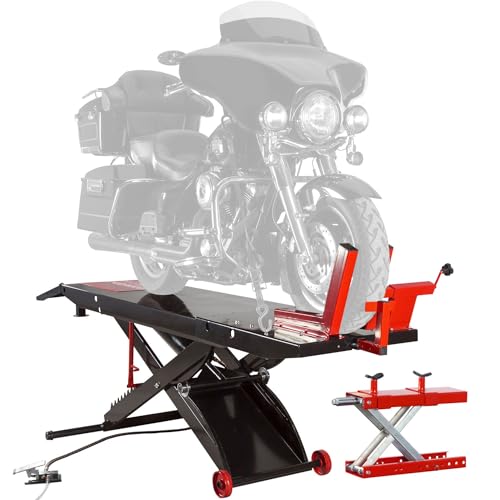
| Black Widow hydraulic table lift (standard table models) | Common models rated around 1,000 lb | Long table, roughly 86 × 24 in on representative models | Raises the motorcycle to a working height; ramp and chock configuration varies | Regular maintenance, longer bikes, and users who want the whole bike supported |
| Condor Pit-Stop/Trailer-Stop-style wheel chock (accessory, not a lift) | Depends on the specific model and anchoring setup | Wheel cradle rather than a lifting platform | Secures the front wheel; does not raise the motorcycle by itself | Stabilizing a bike on a suitable table or trailer |
Dimensions and height ranges above are approximate reference figures for representative models, not a promise that every version is identical. A scissor lift’s rated capacity also does not mean every motorcycle can be safely lifted at every point: the frame contact area and balance still matter.
Choose by motorcycle and job
For a lightweight dirt bike or small dual-sport
A 1,000 lb scissor lift is often ample on capacity, and its small footprint is convenient in a crowded garage. Check the bike’s frame or skid-plate arrangement before lifting. A narrow top can work well with a suitable adapter, but a plastic skid plate or uneven underside is not a safe lifting point. Dirt bikes may be easier to service on a dedicated stand when the task is routine wheel or suspension work.
For a standard, sport bike, or middleweight
A 1,000–1,500 lb scissor lift gives useful capacity headroom without requiring a full-length table. Look for a low collapsed height, a top wide enough for a stable adapter, and positive mechanical locking positions. A wheel chock is helpful for positioning, but on a scissor lift it does not replace proper frame support or tie-downs.
For a heavy cruiser or touring bike
Favor a long table lift with a rated capacity comfortably above the motorcycle’s ready-to-ride weight. Confirm that the table length accommodates the wheelbase and that the ramp can be removed or positioned without interfering with work. Use a front wheel chock and rated tie-down points where appropriate. A compact jack may lift one end, but it is not a substitute for a stable table when the whole motorcycle must remain elevated.
For occasional use in a tight garage
A compact hydraulic scissor lift is usually the practical compromise. Measure not just the lift, but also the room needed to roll the bike onto it, operate the handle or pedal, and reach both sides. If the lift will be stored upright or on its side, follow its manual; hydraulic equipment should not be stored in an orientation the manufacturer prohibits.
Fit check before you buy
- Capacity: Use the motorcycle’s actual weight, including accessories and fuel, rather than the dry-weight figure. Leave a margin for the lift and any load shift; never exceed the manufacturer’s rating.
- Contact points: Measure the clearance beneath the frame or approved lifting point. Compare it with the lift’s collapsed height, including any adapter. Exhausts, fairings, oil pans, and plastic panels are not suitable supports.
- Platform size: A small scissor top supports a chosen frame point; a table supports the tires and usually offers more stable positioning. Check wheelbase, tire width, and where the chock will sit.
- Maximum height: Compare the lift’s maximum height with the work you plan to do and your own comfortable reach. The listed maximum may be measured at the top surface, not at the motorcycle’s frame or a particular component.
- Locking and stability: Prefer a lift with mechanical safety locks or locking bars at multiple heights. Hydraulic pressure alone is not a long-term support system. Chock and tie-down arrangements must suit the bike and the lift’s design.
- Floor and footprint: Check that the concrete is sound, level, and able to support the concentrated load. A long table takes more space but can be easier to load and more stable for full-bike service.
What wears, and how to keep a lift dependable
On hydraulic lifts, seals and hydraulic fluid are the parts most likely to need attention over time. Slow sinking, visible fluid, or inconsistent lifting can indicate a problem; stop using the lift until it is inspected and repaired according to its manual. Scissor pivots and pins can collect grit, while wheels, release mechanisms, and safety locks may loosen or wear with repeated use.
Keep the lifting surface and frame adapters clean so they do not slip. Inspect welds, fasteners, hoses, pins, and locks before each use. Do not lubricate friction surfaces or alter the release valve unless the manufacturer directs it. Never work under a motorcycle supported only by hydraulic pressure; engage the mechanical lock and use additional support appropriate to the job.
A common mistake is buying by capacity alone. A high-rated lift that cannot fit beneath the bike, support its frame correctly, or accommodate its wheelbase is the wrong lift. Another is treating the front chock as a complete restraint: it helps hold the wheel in position, but the motorcycle may still tip or shift unless the lift and tie-down setup are suitable.
Bottom line
For a lightweight bike and limited storage, choose a compact 1,000 lb-class scissor lift after confirming the contact-point fit. For a heavier standard or sport bike, a 1,500 lb-class scissor lift offers more capacity headroom in a similarly compact format. For a large cruiser, touring motorcycle, or frequent whole-bike service, a long hydraulic table with a compatible wheel chock is the more stable and versatile choice. Whichever style you choose, prioritize frame fit, mechanical locks, and a suitable floor over extra capacity on paper.




Write Your Review
No reviews yet. Be the first to share your experience!