

Key takeaways
- Compare the best fly tying vises by jaw type, rotary action, hook range and base, from a budget starter kit to premium bench vises built to last.
- Top Pick: Regal Medallion Series Fly Tying Vise (C-Clamp)
- Runner-up: PEAK Rotary Vise (PRV-G2) with Pedestal Base
- Also consider: Griffin Odyssey Spider Fly Tying Vise
If you want one answer up front: the PEAK Rotary Vise is the safest all-round buy for most tiers, because its tempered tool steel jaws, true rotary action and heavy pedestal base cover everything from tiny midges to saltwater streamers without add-ons. If fast hook changes matter more than rotary wrapping, the Regal Medallion grips any hook with zero jaw adjustment. On a tighter budget, the Kingfisher Clarkfork kit pairs a true rotary vise with a starter tool set, while the Griffin Odyssey Spider and the Danica Danvise give mid-range tiers two very different takes on rotary tying.
As an Amazon Associate, we earn from qualifying purchases.
Table of Contents
- Why the Vise Is the Heart of the Bench
- How to Choose a Fly Tying Vise
- Quick Comparison
- The 5 Best Fly Tying Vises
1. Regal Medallion Series Fly Tying Vise (C-Clamp)
2. PEAK Rotary Vise (PRV-G2) with Pedestal Base
3. Griffin Odyssey Spider Fly Tying Vise
4. Danica Danvise Cam Fly Tying Vise
5. Kingfisher Clarkfork Fly Tying Vise Kit with Tools - Frequently Asked Questions
- Conclusion
Why the Vise Is the Heart of the Bench
Every fly you tie starts with a hook held perfectly still. A vise that lets the hook slip mid-wrap ruins thread tension, shifts materials and turns a ten-minute pattern into a frustrating rebuild. A good vise does three jobs at once: it clamps the hook hard enough that it cannot rotate under thread pressure, it presents the hook at a comfortable height and angle for hours of work, and on rotary models it spins the hook on its own axis so you can wrap materials evenly and inspect the fly from every side.
The five vises below span the main designs on the market. There is a spring-jaw vise that needs no adjustment at all, two machined-metal true rotary vises, a lightweight composite rotary vise, and a complete starter kit. Between them they cover hook sizes from the smallest midge patterns up to big saltwater hooks, C-clamp and pedestal mounting, and every tying style from production streamer work to careful dry-fly tying.
How to Choose a Fly Tying Vise
Jaw design comes first
Jaws decide how a vise feels every single fly. Cam and collet jaws, like the ones on the PEAK and the Griffin, close with a lever or threaded draw and need a small adjustment when you jump between very different hook sizes. Regal’s spring-loaded jaw is the outlier: squeeze the lever, drop the hook in, release, and the spring clamps it with no adjustment at all. Spring jaws are the fastest for mixed-size production tying, while cam jaws give you fine control over clamping pressure on delicate hooks.
True rotary versus rotating head
A true rotary vise spins the hook exactly on its shank axis, so materials wrap evenly and the fly stays centered while you turn it. The PEAK, Griffin, Danvise and Clarkfork are all true rotary designs. The Regal Medallion takes a different approach: its head revolves 360 degrees and tilts up and down through 220 degrees for viewing and access, but it does not spin the hook in line for rotary wrapping. If you tie with rotary techniques, choose a true rotary model; if you mostly want to inspect the fly from all sides, the Regal approach works well.
Hook range and jaw options
Match the jaw to the flies you actually tie. Trout tiers working between size 28 midges and size 10 streamers are covered by almost every vise here. If you tie both tiny dries and large saltwater patterns, look for interchangeable jaws or heads: Regal sells midge, standard, big game and stainless heads for the Medallion, and the PEAK accepts optional jaw sizes. A single fixed jaw stretched across that whole range usually means a compromise at one end of it.
Base style and bench setup
Pedestal bases sit anywhere on the bench and travel easily, but they need enough weight to resist the pull of thread and materials. C-clamps lock the vise rigidly to the bench edge and never walk, but they limit where you can set up and need a bench edge of suitable thickness. The PEAK’s heavy pedestal with its built-in hook and bead pocket suits a permanent bench; the clamp-mounted Griffin, Danvise and Regal suit tiers who pack the vise away or tie at a club table.
Materials and warranty
Vises are buy-once tools, so construction matters. Machined stainless steel, brass and tool steel, as used by PEAK and Regal, shrug off decades of use. Hard-anodized aluminum keeps the Clarkfork light without giving up corrosion resistance. Composite construction on the Danvise keeps weight and cost down while the steel jaws do the gripping. Check the warranty as well: Regal and Griffin both back their vises with lifetime coverage against defects, which tells you how the makers expect them to age.
Quick Comparison
| Vise | Tier | Rotary type | Mount | Standout trait |
|---|---|---|---|---|
| Regal Medallion (C-Clamp) | Premium | Rotating, tilting head | C-clamp | Spring jaw, no adjustment between hook sizes |
| PEAK Rotary Vise (PRV-G2) | Premium | True rotary | Pedestal | Machined metal build, huge hook range |
| Griffin Odyssey Spider | Mid-range | True rotary | C-clamp | Wide jaw capacity, bobbin cradle included |
| Danica Danvise | Mid-range | True rotary | C-clamp | Lightweight, suits right or left hand |
| Kingfisher Clarkfork Kit | Budget | True rotary | Pedestal | Vise plus starter tool set in one box |
The 5 Best Fly Tying Vises
1. Regal Medallion Series Fly Tying Vise (C-Clamp)
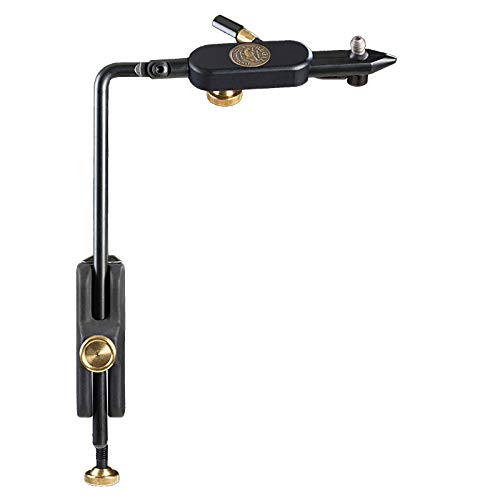
Tier: Premium | Best for: fast hook changes across mixed sizes
The Medallion is built around the most distinctive jaw in fly tying. Instead of a cam or screw, its jaws are held closed by a spring: press the lever and the jaws open, place the hook, let go, and the vise clamps it. There is nothing to adjust when you move from a size 18 dry fly to a size 10 nymph, which is why production tiers and guides who tie dozens of patterns in a sitting have used Regals for decades. The company has built vises in Massachusetts since 1954.
The head revolves a full 360 degrees and articulates 220 degrees up and down, so you can view the fly from any angle, even though this is not an in-line rotary vise for wrapping. The system is modular: the standard head on this C-clamp model can be swapped for midge, big game or stainless steel heads, and Regal covers its vises with a limited lifetime warranty against defects in materials and workmanship.
Specs
– Jaw type: spring-loaded cam-action jaw, no adjustment between hook sizes
– Hook range (standard head): size 22 to 1/0
– Rotation: head revolves 360 degrees and articulates 220 degrees up and down
– Mount: C-clamp
– Interchangeable heads: standard, midge, big game and stainless steel options
– Origin: made in the USA (Orange, Massachusetts)
– Warranty: limited lifetime warranty
This vise is the right match if you tie many hook sizes in one session and want the fastest possible hook changes. Skip it if true rotary wrapping is central to your tying style.
2. PEAK Rotary Vise (PRV-G2) with Pedestal Base
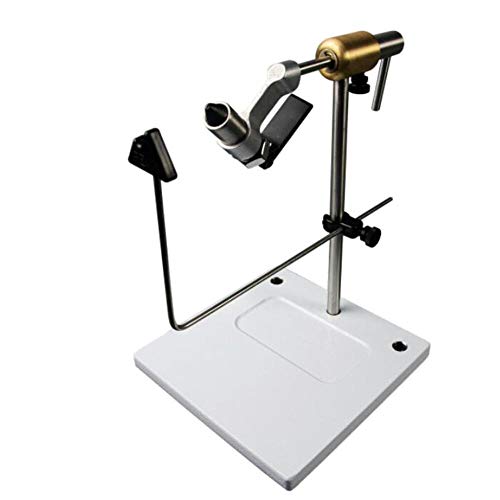
Tier: Premium | Best for: one vise for everything from midges to saltwater
The PEAK Rotary is the vise most often recommended as a lifetime purchase, and its specification explains why. It is machined from stainless steel, brass, tool steel and aircraft aluminum, with hardened and tempered tool steel jaws that hold hooks from 2/0 down to the smallest sizes a tier is likely to use. The rotary action turns on the hook’s axis with adjustable tension, so you can set it to spin freely for wrapping or hold position while you work.
This listing is the pedestal version, model PRV-G2. The heavy base has an integrated pocket that keeps hooks and beads from rolling off the bench, plus two mounting holes for accessories such as a light or a material clip post. Optional jaw sizes extend the range further for dedicated midge or saltwater tying, and a C-clamp version of the same vise is sold under a separate listing if you prefer to clamp down.
Specs
– Model: PRV-G2
– Construction: stainless steel, brass, tool steel and aircraft aluminum
– Jaws: hardened, tempered tool steel
– Hook range: 2/0 down to the smallest hook sizes
– Rotation: true rotary with adjustable tension
– Base: pedestal with integrated hook and bead pocket and two accessory post mounting holes
– Warranty: not stated
This vise is the right match if you want a single bench vise that covers trout flies and saltwater patterns for years. Skip it if you need a clamp-mounted vise for a thin club table, unless you order the clamp version instead.
3. Griffin Odyssey Spider Fly Tying Vise
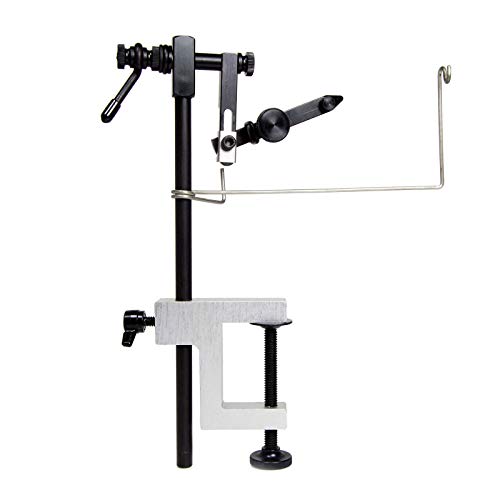
Tier: Mid-range | Best for: true rotary tying with a wide jaw capacity
The Odyssey Spider is Griffin’s long-running rotary vise, built in the USA and backed by the company’s lifetime warranty. Its cam-operated jaws rotate on the hook’s central axis for genuine in-line rotary tying, and the jaw capacity runs from size 28 up to 4/0, which covers delicate spring-creek midges and substantial streamers on one set of jaws.
The vise mounts with the included C-clamp and ships with a bobbin cradle, the two accessories rotary tiers reach for first. Some older write-ups describe the Spider as a non-rotary vise, but Griffin’s own description is clear that the jaws rotate on the hook’s axis; it is a true rotary design. For tiers who want American-made rotary performance without moving into the premium tier, it has been a standard recommendation for years.
Specs
– Rotation: true rotary, on the hook’s central axis
– Jaws: cam-operated
– Hook range: size 28 to 4/0
– Mount: C-clamp (included)
– Included accessories: bobbin cradle
– Origin: made in the USA
– Warranty: lifetime warranty
This vise is the right match if you tie rotary style across a wide spread of hook sizes and want a vise that is ready out of the box. Skip it if your bench has no suitable edge for a C-clamp.
4. Danica Danvise Cam Fly Tying Vise

Tier: Mid-range | Best for: lightweight rotary tying and travel
The Danvise, from Danish maker Danica Innovation, takes the opposite approach to the all-metal vises above. Its body is molded from Delrin composite, which keeps it strikingly light for a full rotary vise, while the cam-operated steel jaws do the actual gripping. The head rotates on two bearings with adjustable tension, and the cam lever design multiplies clamping force so hooks stay put under firm thread pressure.
Unusually, the Danvise can be set up for right-handed or left-handed tying, and the package includes the C-clamp, a bobbin cradle and a material clip. That combination of low weight, a proper clamp and full rotary function is why it keeps showing up as a travel and club-night vise: it packs small, sets up in seconds and still ties like a bench vise. Exact hook range figures vary between sources, so they are listed as not stated below rather than guessed.
Specs
– Rotation: true rotary on two bearings, adjustable tension
– Jaws: cam-operated steel jaws
– Construction: Delrin composite body
– Hook range: not stated
– Mount: C-clamp (included)
– Included accessories: bobbin cradle and material clip
– Handedness: configurable for right- or left-handed tying
– Warranty: not stated
This vise is the right match if you tie away from a fixed bench, or if you are left-handed and tired of adapting to right-hand vises. Skip it if you prefer the planted, all-metal feel of a heavy pedestal vise.
5. Kingfisher Clarkfork Fly Tying Vise Kit with Tools

Tier: Budget | Best for: beginners who need the whole starter setup
Most budget vises make you shop twice: once for the vise, then again for scissors, a bobbin, a whip finisher and the other tools no fly can be tied without. This Kingfisher kit puts the Clarkfork vise and a fly tying tool set in one box, which makes it the simplest starting point on this list. Kingfisher is the house brand of a Montana fly shop, and the Clarkfork is its best-known product.
The vise itself is a genuine true rotary design that turns on two ball bearings, with hardened tool steel jaws rated for hooks from size 26 to 4/0 and a pedestal base. The arms, housing, handle and shaft are hard-anodized marine-grade aluminum, a sensible choice for a vise that may travel to the coast. Note that this listing is the kit with tools; the Clarkfork vise on its own, in a gold finish, is a separate listing with its own identifier.
Specs
– Rotation: true rotary on two ball bearings
– Jaws: hardened tool steel
– Hook range: size 26 to 4/0
– Construction: hard-anodized marine-grade aluminum arms, housing, handle and shaft
– Base: pedestal
– Kit contents: Clarkfork vise plus fly tying tool set
– Package dimensions: 11.65 x 9.25 x 2.36 in
– Warranty: manufacturer warranty stated on the listing
This kit is the right match if you are starting from zero and want one purchase to cover the vise and the core tools. Skip it if you already own tying tools and only need the vise; look at the vise-only Clarkfork listing instead.
Frequently Asked Questions
Do I need a true rotary vise to tie good flies?
No. Generations of excellent flies were tied on fixed vises, and the Regal Medallion shows that a rotating, tilting head covers inspection and access for most patterns. True rotary function earns its keep when you wrap materials like chenille, dubbing brushes or palmered hackle, and when you want to view the fly from every side without removing it. If your tying is mostly nymphs and dries tied in hand, a non-rotary design is a perfectly sound choice.
What hook sizes should my vise handle?
Cover the flies you tie most, with a little room either side. A jaw rated from the mid-20s up to 2/0 or 4/0 handles nearly all trout, bass and light saltwater work. Tiers who specialize at the extremes, tiny midges below size 24 or saltwater hooks above 4/0, are better served by a vise with interchangeable jaws or heads, like the PEAK or the Regal, than by stretching one standard jaw across the whole range.
Is a C-clamp or a pedestal base better?
Neither is better in absolute terms. A C-clamp locks the vise to the bench so it cannot shift under thread tension, which suits heavy streamer tying, but it needs a bench edge of the right thickness and keeps the vise in one spot. A pedestal base can be placed anywhere and travels well, and a heavy pedestal like the PEAK’s stays planted in normal use. Choose based on where you tie: fixed bench, clamp; kitchen table or travel, pedestal.
How long should a fly tying vise last?
A well-made vise is a decades-long tool. The wear points are the jaw faces, which can groove after years of clamping, and any bearings or springs. Makers such as Regal and Griffin support their vises with lifetime defect warranties and replacement heads and jaws, so a grooved jaw is a service job rather than a new vise. Buying a vise with available spare jaws is the simplest way to make sure it outlasts your interest in tying.
Conclusion
For most tiers, the PEAK Rotary Vise is the buy-once answer: machined metal construction, true rotary action and a hook range that runs from the smallest patterns to 2/0. Choose the Regal Medallion instead if your tying sessions jump constantly between hook sizes and you value instant, adjustment-free hook changes over rotary wrapping. The Griffin Odyssey Spider delivers true rotary performance and a 28 to 4/0 jaw capacity in the mid-range, the Danica Danvise is the lightweight, ambidextrous option for travel and club tying, and the Kingfisher Clarkfork kit is the most complete starting point for a beginner. Match the jaw and the base to the flies you tie and the bench you tie them at, and any of these five will hold a hook exactly where you put it.
More from Amazon
Programs that pair well with the guide above. Offers and eligibility are set by Amazon and may change.
Free shipping on eligible items, Prime Video and more. Eligible new members can start with a free trial.
Start a Prime free trialA Prime membership for ages 18-24 with a trial period. Eligibility is set by Amazon.
See Prime for Young AdultsAudiobooks and podcasts to listen to on the go. Eligible new members can start with a free trial.
Try Audible freeAd-free music streaming. Eligible new subscribers can start with a free trial.
Try Music Unlimited freeAs an Amazon Associate we earn from qualifying purchases.
Write Your Review
No reviews yet. Be the first to share your experience!