

Our Top Picks
 PEET Original Portable Electric Boot & Shoe Dryer2.5 lbs9.5 x 9.5 x 22 inches2.7 PoundsCheck on Amazon

- Top Pick: KOODER Boot Dryer
- Runner-up: JobSite Boot Dryer
- Also consider: PEET Original Dryer
Wading boots and bootfoot waders rarely dry on their own. Neoprene, felt soles, and padded linings hold water deep inside the boot, and a pair left in a garage corner can stay damp for days, growing odor and breaking down adhesives and stitching. An electric boot dryer solves that with gentle warmed air, rising silently through the boot on convection or pushed in by a small fan, so gear is dry for the next trip instead of still cold and wet from the last one.
The five dryers below cover the main designs anglers actually use. Two are fanless convection models built for quiet overnight drying, two are forced-air units that dry two pairs at once and finish much faster, and one is a compact insert pair that drops inside individual boots. Each pick is matched to published specifications such as drying method, capacity, tube length, timer, and power draw.
As an Amazon Associate, we earn from qualifying purchases.
Quick answer
For most anglers, a forced-air dryer such as the DryGuy Force Dry DX or MaxxDry Heavy Duty is the practical pick: both dry two pairs at once, include extension tubes for tall boots, and finish in a few hours. For quiet overnight drying of one pair, choose the PEET Original. Budget options are the KOODER inserts and the JobSite fanless dryer.
KOODER Boot Dryer

The KOODER Boot Dryer is the simplest design in this roundup: two slim heating inserts connected by a cord, one sliding into each boot. Instead of standing boots on ports, the heat source sits inside the footwear itself, which makes the pair easy to pack for a fishing lodge or gear bag. The inserts use a PTC heating element, a self-regulating type that holds a steady temperature, and the listing describes heat distributed around the full insert so the toe box dries along with the ankle.
Because there is no fan and no base unit, this is a budget-tier option aimed at one pair at a time. The published guidance suggests about an hour for slightly damp shoes and three hours or more for wet boots, with overnight drying for fully soaked pairs. That pace suits deck boots and wading shoes after a wet day on the water. It is less suited to heavy insulated boots or chest waders, where the short inserts cannot reach far enough up the leg.
Specs:
– Drying method: PTC insert heaters, no fan
– Capacity: 1 pair
– Model: HXQ-02
– Power: 110V corded electric
– Unit size: 7.2 x 2 x 2.1 inches per insert
– Weight: 0.61 pounds for the pair
– Materials: Plastic and stainless steel
JobSite Boot Dryer
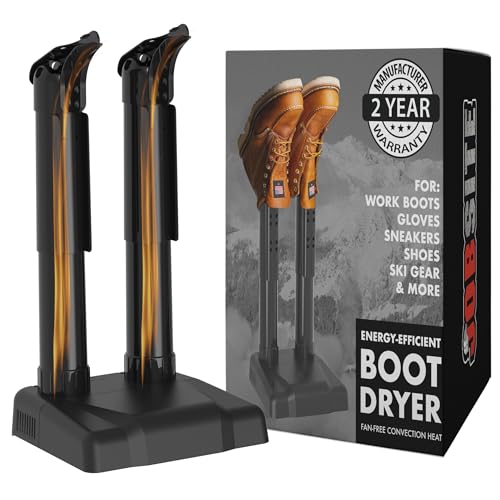
The JobSite Boot Dryer takes the opposite approach to the inserts: a compact fanless base with two upright ports that boots slide over. It runs on thermal convection, warming air that rises naturally through the footwear, so there is no motor, no fan, and no moving parts to wear out or make noise. At a published 36 watts, it draws about as much power as a small light bulb, making it cheap to leave running overnight in a mudroom.
Drying times follow the usual convection pattern. The listing guidance puts warm-up at about 30 minutes, damp footwear at roughly 8 hours, and fully wet boots at an overnight cycle. For anglers who fish several days a week, that set-and-forget rhythm works well: boots go on the ports after each trip and come off dry the next morning. The trade-off is speed and reach. There is no timer and no extension set, so this is a budget to mid-range pick for standard wading boots and deck boots rather than chest waders.
Specs:
– Drying method: Fanless thermal convection
– Capacity: 1 pair
– Model: 54091
– Power: 36 watts, corded electric
– Weight: About 2 pounds
– Timer: None, manual switch
– Extras: Also sized for gloves and liners
PEET Original Dryer
The PEET Original is the longest-running design in the category and the reference point for convection drying. Its patented DryPort system warms air in a base chamber and lets it rise through two ports into the boots, running silently and continuously with no fan. PEET rates the unit at 36 watts and builds it in the USA, and the published warranty is 25 years with registration, far longer than anything else in this roundup.
For fishing use, the key detail is expandability. Boots taller than about 11 inches need the optional 12-inch DryPort extensions, sold separately, and stacking two sets converts the same base into a wader dryer that reaches up the legs of hip and chest waders. That makes the PEET a mid-range buy that can grow with your gear. Drying is an overnight affair, and the always-on design means there is no timer to set or cycle to restart.
Specs:
– Drying method: Fanless convection with DryPorts
– Capacity: 1 pair, expandable with attachments
– Model: M97-FSB
– Power: 36 watts, 120V
– Base size: 10.5 x 10.5 x 2 inches
– Weight: 2.7 pounds
– Warranty: 25 years with registration
DryGuy Force Dry DX

The DryGuy Force Dry DX is a forced-air dryer built for households drying more than one pair at a time. A central blower pushes air through four ports, so it can handle two pairs of boots, or a pair of boots plus gloves, in a single cycle. The listing states a drying time of about 1 to 3 hours, with heated air at 105 degrees Fahrenheit and a switch that also lets you run air with no heat for delicate linings.
Two included extension tubes raise the ports for boots up to 16 inches, which covers most wading boots and hunting boots, and accessory tubes are offered for taller gear and waders. A 3-hour automatic shut-off timer means the dryer can be started at night without running until morning. This is a premium-tier pick, and its value shows when two anglers share one unit or when boots need to be dry again the same day. The fan is described as quiet, but it will not match the total silence of the convection models.
Specs:
– Drying method: Forced air with central blower
– Capacity: 4 ports, 2 pairs
– Model: 02129
– Heat: 105 degrees Fahrenheit, heat or no-heat switch
– Timer: 3-hour automatic shut-off
– Size: 12 x 15 x 7.5 inches
– Weight: 5 pounds
– Warranty: 1 year
MaxxDry Heavy Duty Boot, Shoe, and Glove Dryer
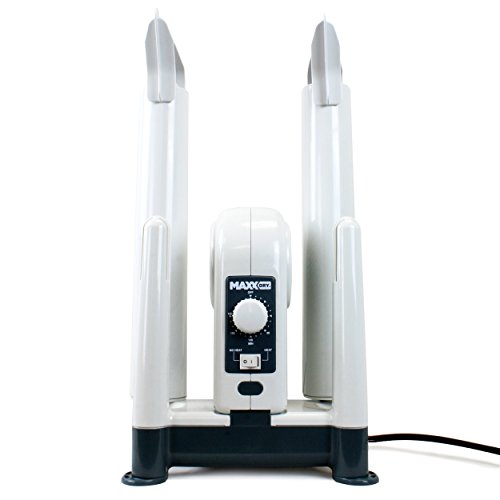
The MaxxDry Heavy Duty is the other four-port forced-air option here, aimed at users who dry a mix of tall and short gear. Its manufacturer description says it dries four garments in about an hour using forced air, and the package includes extension tubes so tall boots and gloves, or two pairs of boots, can dry in the same cycle. Like the DryGuy, it offers a heat or no-heat choice, with heated air up to 105 degrees Fahrenheit, listed as safe for neoprene, leather, canvas, rubber, and synthetic linings.
A 3-hour timer and a long power cord round out a practical garage or camp setup, and accessory attachments are available for waders and helmets. As a premium-tier dryer, it competes directly with the Force Dry DX on capacity and speed; choosing between them usually comes down to footprint and which extension system you prefer. Very tall chest waders still need the accessory tubes rather than the included set.
Specs:
– Drying method: Forced air
– Capacity: 4 garments, 2 pairs
– Model: IML02146 (2146)
– Heat: Up to 105 degrees Fahrenheit, heat or no-heat
– Timer: 3-hour shut-off
– Size: 15 x 12.5 x 7.5 inches
– Warranty: 1 year
How to choose
Start with drying method. Fanless convection dryers like the PEET Original and JobSite are silent, draw very little power, and are gentle on leather, felt, and glued seams, but they need an overnight cycle. Forced-air dryers like the DryGuy DX and MaxxDry Heavy Duty finish in roughly 1 to 3 hours and handle two pairs at once, at the cost of fan noise and a bigger footprint. Insert dryers like the KOODER are the most portable and the slowest, best treated as travel tools.
Next, match tube length to your tallest gear. Standard ports suit wading boots and deck boots. Boots over about 11 to 16 inches need extension tubes, which the DryGuy and MaxxDry include and PEET sells as add-ons. Chest waders need the longest reach of all, so confirm the dryer includes long extensions or accepts them before buying.
Then check capacity and controls. A solo angler drying one pair nightly is well served by a two-port convection unit. Two anglers, or anyone drying gloves alongside boots, should look at four ports. A timer with automatic shut-off is worth having on forced-air models, while a heat or no-heat switch matters for leather boots or heat-sensitive liners. Finally, confirm your gear’s materials are listed as safe on the product page.
Who should skip
Skip boot dryers entirely if your footwear is rarely more than surface-damp and already dries fully between trips in a ventilated room; a boot rack and airflow may be enough. Also skip the insert and short-port models if your main gear is chest waders, since short tubes cannot move air through the full leg. Anglers without reliable access to an outlet at camp should skip every model here, since all five are corded electric designs. Finally, skip heated settings if your boot or liner manufacturer warns against applied heat for a specific model.
FAQ
Can a boot dryer damage waders or leather boots?
The dryers here use low temperatures, with the forced-air models stating heated air at 105 degrees Fahrenheit and the convection models using gentle warmed air. That range is widely listed as safe for neoprene, rubber, canvas, and leather, but follow the boot maker’s instructions, and use the no-heat setting where offered if a lining is heat-sensitive.
How long does it take to dry soaked wading boots?
Published guidance varies by design. Forced-air models list about 1 to 3 hours for most footwear, while fanless convection models are an overnight solution, roughly 8 to 12 hours for fully wet boots. Actual time depends on how saturated the lining and felt soles are, so plan on the longer end after a deep wading day.
Do I need extensions for chest waders?
Yes, in most cases. Standard ports reach into ordinary boots, but chest waders need long extension tubes so air reaches the feet. The PEET system accepts stacked 12-inch extensions, and the DryGuy and MaxxDry lines offer accessory tubes for taller gear.
Can these dryers handle gloves and hats as well?
The four-port forced-air models can dry a pair of boots and a pair of gloves in the same cycle, and the JobSite and PEET bases accept glove attachments or are sized for liners and gloves. The KOODER inserts are shaped for footwear only, so they are the exception here.
Final verdict
For a fishing household, the DryGuy Force Dry DX is the most complete pick: two-pair capacity, included extensions, a timer, and a no-heat option cover nearly every drying job in a few hours. The MaxxDry Heavy Duty runs it close for mixed tall and short gear. If you fish solo and value silence and longevity, the PEET Original remains the benchmark convection dryer, with extensions available when waders enter the picture. The JobSite covers quiet single-pair drying in the budget to mid-range tier, and the KOODER inserts are the travel-friendly budget choice.
More from Amazon
Programs that pair well with the guide above. Offers and eligibility are set by Amazon and may change.
Free shipping on eligible items, Prime Video and more. Eligible new members can start with a free trial.
Start a Prime free trialA Prime membership for ages 18-24 with a trial period. Eligibility is set by Amazon.
See Prime for Young AdultsAudiobooks and podcasts to listen to on the go. Eligible new members can start with a free trial.
Try Audible freeAd-free music streaming. Eligible new subscribers can start with a free trial.
Try Music Unlimited freeAs an Amazon Associate we earn from qualifying purchases.
Write Your Review
No reviews yet. Be the first to share your experience!