

Key takeaways
- Compare the best catfish reels for blue, channel and flathead catfish, with the specs that matter: drag, line capacity, gear ratio and clicker design.
The best catfish reel for most anglers is the Abu Garcia Ambassadeur C3 Catfish Special in the 6500 size, a Swedish-made round baitcaster built on the C3 platform with a Carbon Matrix drag rated at 15 lb, a synchronized level wind and an extended bent handle with a power knob, because it was designed from the spool out for exactly this fishing. Anglers who would rather fish a spinning reel with the rod in a holder should look at the Shimano Baitrunner 6000D, whose second rear drag lets a catfish take a bait and move off before the main 20 lb front drag engages. The Abu Garcia Ambassadeur Catfish Pro, also in 6500, is the premium round reel here, with four stainless steel ball bearings plus a roller bearing and the same Carbon Matrix drag in a more refined build. The KastKing Rover 60 is the budget round reel, an all-metal conventional design with brass gears and a carbon fiber drag at a fraction of the Swedish reels’ cost, and the Okuma Avenger ABF-8000 is the budget baitfeeder, a large spinning reel whose auto-trip baitfeeding system and 26 lb of maximum drag cover big-river bait fishing. Each reel below is named in the exact size and hand orientation its listing covers, because in this category the size and the retrieve side are the specification everything else hangs on.
Every reel in this roundup was checked against the maker’s published specifications and current Amazon listing data before it was included. Several widely recommended catfish reels, including the Penn Spinfisher Live Liner, the KastKing Sharky Baitfeeder and the Daiwa BG in its larger sizes, were researched for this roundup and left out because a verifiable Amazon listing for one specific size could not be confirmed for any of them; a reel you cannot order in the exact size described is not a useful recommendation. Adult catfish reels carry no recall history of the kind that affects powered tackle: the historical lead-paint recalls in fishing tackle covered children’s fishing poles, not adult reels, and no current recall covers any reel named here. Some reels in this class do carry California Proposition 65 lead warnings on their listings, and the checks section at the end covers that along with the hand-orientation and trim checks that matter before ordering.
As an Amazon Associate, we earn from qualifying purchases.
Table of Contents
- Why Catfish Reels Are Their Own Category
- How to Choose the Best Catfish Reel
- Quick Comparison
- The 5 Best Catfish Reels
- Safety and Checks Before You Order
- Frequently Asked Questions
- Conclusion
- Product and ASIN Reference
Why Catfish Reels Are Their Own Category
Catfish are not caught the way bass are caught. The standard catfish presentation is a bait — cut shad, a live bluegill, a ball of prepared bait — fished on or near the bottom, often at anchor or from a bank, and left to sit until a fish finds it. The reel’s job is therefore different from a lure reel’s job. It has to hold a lot of heavy line, because catfish rigs are fished on 15 to 30 lb monofilament or 30 to 65 lb braid. It has to pay line out under control when a fish picks up the bait and moves, which is why clickers and baitfeeder drags exist. And when the fish turns, it has to apply smooth, sustained drag pressure against an animal that does not jump or shake hooks loose so much as it simply pulls, rolls and heads for the nearest submerged timber.
Size is the second difference. A reel that is generous for bass is undersized for a flathead. The round reels in this roundup are 6500-class Ambassadeurs and a 60-size KastKing, and the spinning reels run to a 6000 Shimano and an 8000 Okuma, because catfish line capacity is measured in hundreds of yards of heavy line rather than in how little line a spool can get away with. A big blue catfish in river current is a line-management problem as much as a strength problem: the fish uses the current, the boat or bank angle gives it leverage, and the spool has to have line in reserve when the run finally slows.
The third difference is durability under neglect. Catfish gear fishes at night, in mud, in rain, in boats that double as bait tanks. It gets set down in sand, splashed with shad scales and left in rod holders for hours. The reels that survive that life are the ones with metal frames or sealed drags, simple bearing layouts that tolerate grit, and designs that have been in production long enough for parts to exist. That is why this roundup is built from long-running platforms — the Ambassadeur C3 family, the Baitrunner line, the Avenger line — rather than from whichever reel launched most recently.
How to Choose the Best Catfish Reel
Start With Size and Line Capacity
Match the reel to the largest catfish you realistically expect, then check the capacity figure for the line you will actually spool. Channel catfish in lakes and moderate rivers are covered by a 4000 to 6000 spinning reel or a 40 to 60 size round reel fished with 12 to 20 lb line. Blue and flathead catfish in big rivers push the choice up: a 6500 round reel or a 6000 to 8000 spinning reel, holding 250 to 400 yards of 15 to 20 lb monofilament or 300-plus yards of 30 to 50 lb braid. Read the capacity in the line class you use, not the headline number. The Catfish Special below holds 390 yards of 10 lb mono but 225 yards of 17 lb, and it is the second figure, not the first, that describes how it will fish on a river rig.
Drag Is About Control, Not Just the Maximum Figure
The maximum drag numbers in this roundup run from 15 lb on the two Abu Garcia round reels to 26 lb on the Okuma. Those figures are ceilings, not settings: a drag is normally fished at roughly a quarter to a third of the line’s breaking strain, so 15 lb of maximum drag is correctly matched to 30 to 50 lb line, which is the heart of catfish work. What separates a good catfish drag from a poor one is not the ceiling but the start-up and the middle of the range — whether pressure builds smoothly when a fish first moves, and whether it stays even when the spool is half empty and a flathead is rolling. Carbon washer systems, the Carbon Matrix drags on the Abu Garcia reels and the carbon fiber drag on the KastKing, are valued here because carbon holds its friction character when it gets hot during a long run. The Okuma’s multi-disc felt drag is the older technology and perfectly serviceable at baitfeeder prices, provided it is kept clean and dry.
Round Baitcaster or Spinning Reel
Round baitcasters dominate serious catfish fishing for three reasons. Their winch-like gearing and direct drive suit heavy line and heavy sinkers. Their level winds lay thick line evenly without the line-roller wear a spinning reel suffers. And their clickers — a mechanical alarm that sounds as line leaves the spool — are built for rods fished in holders. The trade is casting skill: a round reel casting a 4 oz sinker and a chunk of cut bait will punish a sloppy thumb, though the centrifugal brakes on the Abu Garcia and KastKing reels here tame that considerably. Spinning reels ask nothing of the thumb, cast light channel-cat rigs further with less effort, and are the natural choice for anglers who fish one outfit for several species. If your catfishing is anchored, heavy and deliberate, buy the round reel. If it is mixed with casting and bank work with lighter rigs, buy the spinning reel.
Baitfeeder Systems for Bait-and-Wait Fishing
Two reels in this roundup, the Shimano Baitrunner and the Okuma Avenger ABF, carry a second drag system at the rear of the reel. With the baitfeeder engaged, the spool turns under a light, separately adjustable resistance while the bail stays closed, so a catfish can pick up a bait and move away without feeling the full fighting drag. Turning the handle — or flipping the lever off — drops the baitfeeder out and brings the preset front drag in for the hookset. It is the spinning-reel answer to the round reel’s clicker, and for circle-hook fishing it is arguably the better tool, because the fish loads the rod and hooks itself against a steadily increasing resistance. If you fish bait in holders with spinning gear, this feature is worth more than an extra bearing or a lighter body. If you hold the rod and fish actively, it is weight and complexity you will never use.
Gear Ratio and Gearing
Catfish reels are geared low on purpose. The ratios here run from 4.5:1 on the Okuma to 5.3:1 on the round reels, because the retrieve that matters is not speed but torque: winching a heavy sinker rig back against current, and gaining line on a fish that is using its weight and the river rather than its speed. What the gears are made of matters more than the ratio’s second decimal. Brass main gears, as in the KastKing Rover and the machine-cut brass pinion in the Okuma, tolerate the sustained loads of catfish work better than lighter gear materials, and the Ambassadeur family’s decades of parts availability mean a worn gear is a repair, not a replacement reel.
Clickers, Alarms and Night Fishing
Much catfishing happens after dark, with several rods spread along a bank or across a boat’s rod holders, and the angler watching none of them directly. A line-out clicker turns the reel into its own alarm: line leaving the spool clicks audibly, and the sound changes character when a tentative pickup becomes a committed run. Both Abu Garcia round reels and the KastKing Rover carry clickers, and their firmness is a genuine selection point — a clicker that is too light false-alarms in current, and one that is too stiff can pull a light rig out of position. The baitfeeder spinning reels solve the same problem silently, by letting the fish take line against light resistance until the angler picks the rod up. Choose the system that matches how you fish: clicker for round reels and active monitoring, baitfeeder for set-line spinning work.
Quick Comparison
| Product | Type | Gear Ratio | Max Drag | Line Capacity | Tier |
|---|---|---|---|---|---|
| Abu Garcia Ambassadeur C3 Catfish Special, 6500 | Round baitcasting | 5.3:1 | 15 lb | 320 yd of 12 lb mono | Mid-range |
| Abu Garcia Ambassadeur Catfish Pro, 6500 | Round baitcasting | 5.3:1 | 15 lb | 310 yd of 30 lb braid | Premium |
| Shimano Baitrunner 6000D | Baitfeeder spinning | 4.8:1 | 20 lb | 300 yd of 10 lb mono | Premium |
| KastKing Rover 60 | Round baitcasting | 5.3:1 | 20 lb | About 250 yd of 15 lb mono | Budget |
| Okuma Avenger ABF-8000 | Baitfeeder spinning | 4.5:1 | 26 lb | 460 yd of 40 lb braid | Budget |
The 5 Best Catfish Reels
1. Abu Garcia Ambassadeur C3 Catfish Special, 6500 — Best Overall

Tier: Mid-range
The C3 Catfish Special is the reel Abu Garcia builds when it starts from the question of what a catfish reel actually needs, and the answer begins with the C3 platform: a Swedish-made round baitcaster that has been the default serious catfish reel for decades. The configuration pinned here is the 6500 size in right hand. Onto that platform Abu Garcia fits the tackle this fishing asks for — a Carbon Matrix drag, a synchronized level wind that lays heavy line evenly across the spool, a six-pin centrifugal brake for casting loaded rigs, and an extended bent handle with a power knob that gives the cranking leverage a big fish in current demands.
The published numbers describe a winch rather than a caster. The 5.3:1 gear ratio recovers 26 in of line per crank, the drag ceiling is 15 lb, and the spool holds 390 yards of 10 lb mono, 320 yards of 12 lb or 225 yards of 17 lb, with a braid figure of 415 yards of 20 lb in the listing data. Three stainless steel ball bearings plus a roller bearing is a modest count by bass-reel standards, and that is the point: every bearing in a round catfish reel is a bearing that has to survive grit, and this layout is the one the platform’s long service record is built on. At 10.9 oz it is also lighter than its size suggests, which matters on a rod that sits in a holder but still has to be picked up and fished at the end of every run.
The clicker deserves its own sentence, because on this reel it is a primary feature rather than an afterthought: it is loud and firm enough to register over river noise and to distinguish a bait being worried from a fish that has taken and turned. For anchored spreads fished at night on circle hooks, that alarm plus the level wind’s tolerance for heavy line and big leader knots is the whole case for the reel, and it is a strong one.
Specs
- Type: Round baitcasting reel, right hand
- Size: 6500
- Gear ratio: 5.3:1
- Retrieve: 26 in per crank
- Bearings: 3 stainless steel ball bearings plus 1 roller bearing
- Drag: Carbon Matrix, 15 lb maximum
- Mono capacity: 390 yd of 10 lb, 320 yd of 12 lb, 225 yd of 17 lb
- Brake: 6-pin centrifugal
- Level wind: Synchronized
- Handle: Extended bent handle with power knob
- Weight: 10.9 oz
- Origin: Made in Sweden
Choose the C3 Catfish Special if you fish anchored or bank spreads for blues and flatheads and want the proven catfish-specific round reel. Skip it if you are left-hand retrieve only in this configuration, or if your catfishing is mostly light channel-cat casting, where a smaller and cheaper reel does the same work.
2. Abu Garcia Ambassadeur Catfish Pro, 6500 — Best Premium Round Reel
Tier: Premium
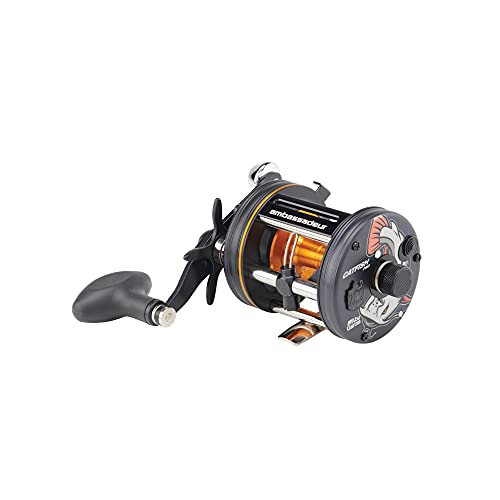
The Catfish Pro is the flagship of Abu Garcia’s catfish line, built in Sweden on the same round-reel philosophy as the Catfish Special but with the specification sheet filled in further. The configuration pinned here is again the 6500 size. It carries four stainless steel ball bearings plus a roller bearing — one more ball bearing than the C3-based Special — behind the same 5.3:1 gearing and the same Carbon Matrix drag system, and it pairs them with an extended bent power handle and a six-pin centrifugal brake.
Where the Pro earns its premium is in the accumulation of working details rather than in any single headline figure. The drag ceiling is the same 15 lb as the Special’s, which is the honest number for the platform: matched to 30 to 50 lb line, it is all the drag a catfish rig can use, and the Carbon Matrix washers deliver it without the start-up grab that tears circle hooks free at the moment of the hookset. The braid capacity of 310 yards of 30 lb reflects how these reels are actually fished on big rivers, where braid’s thin diameter buys capacity and its lack of stretch telegraphs a pickup through a clicker-quiet setup. The synchronized level wind keeps that braid laid flat, which is what keeps the next cast from digging in.
Think of the choice between the two Abu Garcia reels this way: the Special is the platform’s catfish specification at its most accessible, and the Pro is the same specification with the smoother bearing layout, the more powerful handle and the finer finish. Anglers who fish several nights a week, or who keep a reel for a decade rather than a season, are the ones who recover the difference.
Specs
- Type: Round baitcasting reel, right hand
- Size: 6500
- Gear ratio: 5.3:1
- Bearings: 4 stainless steel ball bearings plus 1 roller bearing
- Drag: Carbon Matrix, 15 lb maximum
- Braid capacity: 310 yd of 30 lb
- Brake: 6-pin centrifugal
- Level wind: Synchronized
- Handle: Extended bent power handle
- Origin: Made in Sweden
Choose the Catfish Pro if you fish heavy river water for trophy blues and want the most refined version of the Swedish round reel. Skip it if the Catfish Special’s specification already covers your water, because the drag ceiling and gearing are shared, and the premium buys refinement rather than a different class of reel.
3. Shimano Baitrunner 6000D — Best Baitfeeder Spinning Reel

Tier: Premium
The Baitrunner is the original baitfeeder spinning reel, and the 6000D is the size the line is known by. Its defining mechanism is the second drag at the rear of the reel: flip the lever, and the spool pays line against a light, separately adjusted resistance with the bail closed, so a catfish can take a cut bait and move off with it. One turn of the handle trips the system back to the main front drag — set in advance to fighting pressure — and the hookset happens against a drag that was never loosened. Shimano’s own positioning for the D series names large baits for catfish among its intended uses, alongside live bait for striped bass, which tells you the size of bait and fish the mechanism was built around.
The 6000D’s published specification is a heavy spinning reel’s: a 4.8:1 gear ratio retrieving 35 in of line per crank, a maximum drag of 20 lb, three ball bearings plus a roller bearing, and a weight of 20.7 oz. The spool is cold-forged aluminum with Shimano’s Propulsion line management design, and the capacities suit the fishing: 300 yards of 10 lb mono, 265 yards of 12 lb or 170 yards of 16 lb, and in braid 245 yards of 30 lb, 210 yards of 50 lb or 130 yards of 65 lb. The drag is water-resistant, the bail is a one-piece design, and the baitrunner tension at the rear adjusts across a wider range than the earlier generations of the system, which is the adjustment that decides whether a wary flathead feels anything at all before the hookset.
That weight is the honest trade. Twenty ounces of reel on a rod in a holder is nothing; twenty ounces on a rod you are casting and holding for hours is a great deal. The Baitrunner earns it only when the baitfeeder is the point — set-line bait fishing from bank, pier or anchored boat, on circle hooks, where the fish is expected to hook itself. Fished that way, it is the most complete tool in this roundup.
Specs
- Type: Baitfeeder spinning reel, front drag with rear Baitrunner drag
- Size: 6000
- Gear ratio: 4.8:1
- Retrieve: 35 in per crank
- Bearings: 3 ball bearings plus 1 roller bearing
- Max drag: 20 lb
- Mono capacity: 300 yd of 10 lb, 265 yd of 12 lb, 170 yd of 16 lb
- Braid capacity: 245 yd of 30 lb, 210 yd of 50 lb, 130 yd of 65 lb
- Spool: Cold-forged aluminum
- Weight: 20.7 oz
Choose the Baitrunner 6000D if you fish bait in holders on spinning gear and want the fish to hook itself against a preset drag. Skip it if you cast lures or hold the rod all session, because the baitfeeder mechanism is weight you will carry without using.
4. KastKing Rover 60 — Best Budget Round Reel
Tier: Budget
The Rover is KastKing’s answer to a fair question: how much of the Swedish round reel’s formula can be built at a budget tier? The configuration pinned here is the 60 size in right hand, and the construction list is the strongest part of the case. The side plates are thicker hard-anodized aluminum, the spool is CNC-machined, the gears are precision-cut brass, the worm gear driving the level wind is stainless steel where the class usually uses something cheaper, and the drag is a carbon fiber system built around the maker’s Cymbal Washer design. This is an all-metal reel in a category where budget rivals are frequently graphite-framed.
The numbers are catfish numbers. The 60 size runs a 5.3:1 gear ratio with six double-shielded stainless steel ball bearings plus a roller bearing — the 40 through 60 sizes carry that 6+1 layout, while the big 70 through 90 sizes drop to 4+1 — and current listing data rates the 60 size’s carbon fiber drag at 20 lb, with the maker’s line-wide copy quoting up to 30 lb for the largest sizes. Capacity runs to roughly 240 to 250 yards of 15 lb monofilament, the listing weight is 14.1 oz, and the working features are all present: a two-pin centrifugal brake on the casting sizes, a thumb bar spool release, an oversized nonslip grip, and a line-out clicker for holder fishing. The series runs from size 40 to size 90, so an angler who starts with the 60 can match a smaller or larger version to a second rod without learning a new reel.
What the budget gives up is refinement and record. The drag and the clicker do their jobs without the C3’s polish, the finish will show bank life sooner, and the platform does not have the Ambassadeurs’ decades of parts support behind it. Against that, it is the only reel here that lets a new catfish angler put metal round reels on two rods for the cost of one Swedish reel, and for anchored bait fishing that arithmetic is hard to argue with.
Specs
- Type: Round baitcasting (conventional) reel, right hand
- Size: 60
- Gear ratio: 5.3:1
- Bearings: 6 plus 1 double-shielded stainless steel
- Drag: Carbon fiber, 20 lb for the 60 size in current listing data
- Line capacity: About 240 to 250 yd of 15 lb mono
- Construction: Hard-anodized aluminum side plates, CNC-machined spool, brass gears, stainless steel worm gear
- Brake: 2-pin centrifugal
- Features: All-alloy level wind, line-out clicker, thumb bar spool release
- Weight: 14.1 oz
Choose the Rover 60 if you want the round-reel formula — metal build, clicker, level wind, carbon drag — at a budget tier, for anchored bait and trolling work. Skip it if you expect a decade of hard service from one reel, because the Swedish reels’ parts support and finish are what their premium buys.
5. Okuma Avenger ABF-8000 — Best Budget Baitfeeder
Tier: Budget
The Avenger ABF is Okuma’s long-running baitfeeder line, and the 8000 is its largest size — the one that turns a budget baitfeeder into a genuine big-river tool. The baitfeeding system works on the same principle as the Shimano’s: a lever at the rear engages a secondary, micro-adjustable drag that lets a fish take line with the bail closed, and Okuma’s version trips automatically back to the main drag the moment the handle turns. For bank anglers fishing slip-sinker rigs on a budget, that mechanism is the reel.
The 8000’s published figures are the largest in this roundup where it counts. Maximum drag is 26 lb from a multi-disc Japanese oiled felt system, the gear ratio is 4.5:1 for a 34.1 in retrieve per crank, and the spool holds 460 yards of 40 lb braid or 390 yards of 50 lb, with the listing’s mono figure at 245 yards of 20 lb. Six stainless steel ball bearings plus a roller bearing is a generous count at this tier, and the internals behind them are the right ones for the work: a machine-cut brass pinion gear, a machined aluminum two-tone anodized spool, and a corrosion-resistant graphite body that keeps the weight to 17.8 oz despite the size — lighter than the smaller Shimano in this roundup. Okuma’s Cyclonic Flow Rotor, designed to dry the rotor as it turns, is aimed at exactly the wet, muddy life a bank reel lives.
The compromises are feel and finesse. The felt drag is smooth but not carbon-smooth at the top of its range, the baitfeeder’s lightest settings take more care to dial in than the Shimano’s, and a graphite body flexes in a way a metal frame does not when a big fish is winched against current. None of that stops it fishing: as a second or third rod in a bank spread, or a first baitfeeder for an angler learning the method, the 8000 covers more water per dollar than anything else here.
Specs
- Type: Baitfeeder spinning reel with on/off auto-trip baitfeeding system
- Size: 8000
- Gear ratio: 4.5:1
- Retrieve: 34.1 in per crank
- Bearings: 6 stainless steel ball bearings plus 1 roller bearing
- Max drag: 26 lb
- Drag: Multi-disc Japanese oiled felt front drag, micro-adjustable rear baitfeeder drag
- Braid capacity: 460 yd of 40 lb, 390 yd of 50 lb
- Body: Corrosion-resistant graphite with Cyclonic Flow Rotor
- Spool: Machined aluminum, two-tone anodized
- Weight: 17.8 oz
Choose the Avenger ABF-8000 if you want baitfeeder function and big-river capacity at a budget tier. Skip it if you fish salt water daily or winch fish against heavy current as your main method, where a metal-framed reel holds up better over seasons.
Safety and Checks Before You Order
Match the hand orientation before ordering. The three round reels in this roundup are pinned to their right-hand listings, and the retrieve side is not a setting — it is the reel. The Ambassadeur and Rover families are also sold in left-hand versions under separate listings with their own reference entries, so a listing that simply says 6500 or 60 without stating the hand is a listing to leave alone. The two spinning reels switch retrieve sides by moving the handle, which is one of the format’s genuine conveniences.
Check the trim on the Abu Garcia listings. The C3 platform is sold in several trims that share a silhouette: the standard C3, this Catfish Special, and a Striper Special aimed at a different fishery. The current Amazon listing for the Catfish Special carries it under a species-special headline in the Catfish Pro color, so match the reel by its model field — which ends in CATSPC — and by the specification set in the section above (Carbon Matrix drag, 15 lb maximum, 390 yards of 10 lb mono), not by the headline wording alone. The Catfish Pro is a separate model again, with the 4 plus 1 bearing layout; if a listing shows 3 plus 1 bearings, it is not the Pro.
Set both drags on a baitfeeder, and set them with a scale. A baitfeeder reel has two drag settings that do different jobs, and both need setting before the first bait goes out. Set the front fighting drag with a spring scale to roughly a third of your line’s rated strength, then set the rear baitfeeder tension just firmly enough that current and the weight of the rig do not pull line off the spool on their own. Too light a rear setting lets a running fish empty the spool before you reach the rod; too firm, and a cautious fish feels the resistance and drops the bait, which is the failure the whole system exists to prevent.
Check the clicker, level wind and spool on arrival. On the round reels, engage the clicker and pull line by hand: the sound should be even, with no silent spots that would hide a pickup. Watch the level wind travel the full width of the spool as you crank, and check the pawl for roughness, because a worn pawl is the most common round-reel fault and the cheapest to catch early. On all five reels, turn the handle slowly through a full rotation feeling for a tight spot, work the drag knob or star through its range, and pull line against the drag to feel for pulsing. If you spool braid on a round reel, put a few turns of monofilament or a wrap of tape on the spool first — braid under load can slip as a mass on a bare metal spool, which feels exactly like a failed drag at the worst possible moment.
Know the recall and warning picture for this category. No current recall covers any reel named here, and the historical recalls in this corner of fishing tackle covered children’s fishing poles for lead paint, in 2005 and 2009, plus a children’s caster product in 2023 — none of them touches an adult catfish reel. The warning that does appear in this category is California’s Proposition 65: some reels and tackle listings carry a lead warning, because lead can appear in certain component finishes and in the sinkers these reels are fished with. If that matters to you, read the warning field on the product page before ordering, wash hands after handling tackle, and keep sinkers and reels stored away from children, which is sound practice with any fishing gear.
Frequently Asked Questions
What size reel do I need for catfish?
Match the size to the fish and the line, in that order. For channel catfish on lakes and moderate rivers, a 4000 to 6000 spinning reel or a 40 to 60 round reel on 12 to 20 lb line covers the species completely. For blue and flathead catfish, and for any river with real current, step up to the class this roundup is built around: a 6500 round reel like the two Abu Garcia models, a 6000 baitfeeder like the Shimano, or an 8000 like the Okuma, holding at least 250 yards of 15 to 20 lb mono or 300 yards of 30 to 50 lb braid. The capacity figure is the one to read most carefully, because a big fish in current is beaten with line in reserve, not with drag alone.
Is a round baitcaster or a spinning reel better for catfish?
Neither is better outright; they are better at different halves of the fishing. Round baitcasters win on anchored, heavy work: they handle thick line and heavy sinkers without strain, their level winds lay that line evenly, their gearing winches fish out of cover, and their clickers alarm a rod spread fished at night. Spinning reels win on ease and versatility: they cast lighter channel-cat rigs without any thumb skill, they switch retrieve hands, and in baitfeeder form they let a fish take a bait against light resistance and hook itself on a circle hook. Many serious catfish anglers own both — round reels for the heavy river rods, a baitfeeder spinner for the bank rod — and this roundup is organized so the two formats can be compared on the same specification sheet.
What is a baitfeeder reel, and is it worth it for catfish?
A baitfeeder is a spinning reel with a second, lighter drag at the rear, engaged by a lever. With it on, a fish can take a bait and move away while the bail stays closed, feeling only the light rear-drag resistance you dialed in. Turning the handle trips the system off and brings in the main front drag, already set to fighting pressure, so the hookset happens at full drag without any adjustment mid-fight. For catfish — a bait fishery, often fished with rods in holders and circle hooks — it is one of the few reel features that changes how many pickups become hooked fish, and both spinning reels in this roundup carry a version of it. It is worth it if you fish bait passively; it is dead weight if you hold the rod and fish actively.
How much drag does a catfish reel need?
Less than the marketing suggests, and smoother than the headline number implies. A drag is fished at roughly a quarter to a third of the line’s breaking strain, so the 15 lb maximum on the Abu Garcia round reels is correctly matched to the 30 to 50 lb lines those reels are spooled with, and the 20 to 26 lb ceilings on the spinning reels here cover the heaviest braid a catfish rig uses. What actually lands fish is the quality of the pressure: a drag that starts without a grab, so a circle hook sets rather than tears out, and that stays even as the spool empties and its leverage changes. That is why this roundup weights the drag system — Carbon Matrix, carbon fiber, or multi-disc felt — as heavily as the number beside it.
Conclusion
The best catfish reels are sized by line capacity, judged by their drags, and chosen by how the bait will be fished. The Abu Garcia C3 Catfish Special in 6500 is the catfish-specific round reel and the best overall pick here, with the Catfish Pro above it as the premium version of the same Swedish formula. The Shimano Baitrunner 6000D is the spinning choice for bait fished in holders, and the Okuma Avenger ABF-8000 brings the same baitfeeder idea to a budget tier with the largest capacity in the roundup. The KastKing Rover 60 is the budget round reel, all metal with a carbon drag. Match the size to the largest fish your water holds, confirm the hand orientation and trim on the product page, and run the clicker, level wind and drag checks when the reel arrives, and any of the five will fish the night shift the way it was designed to.
More from Amazon
Programs that pair well with the guide above. Offers and eligibility are set by Amazon and may change.
Free shipping on eligible items, Prime Video and more. Eligible new members can start with a free trial.
Start a Prime free trialA Prime membership for ages 18-24 with a trial period. Eligibility is set by Amazon.
See Prime for Young AdultsAudiobooks and podcasts to listen to on the go. Eligible new members can start with a free trial.
Try Audible freeAd-free music streaming. Eligible new subscribers can start with a free trial.
Try Music Unlimited freeAs an Amazon Associate we earn from qualifying purchases.
Write Your Review
No reviews yet. Be the first to share your experience!