

Key takeaways
- Compare five fishing tackle bags for bank, boat and kayak fishing, with tray capacity, fabric, carry straps, rod holders and waterproof bases explained.
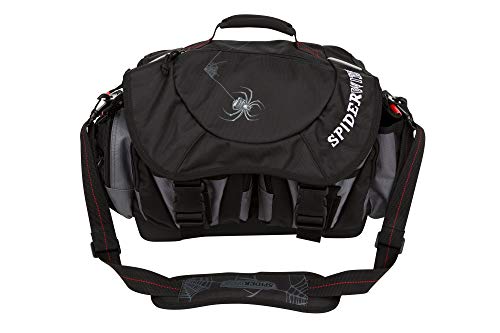
- Top Pick: Plano Guide Series 3700 XL Tackle Bag
- Runner-up: Spiderwire Wolf Tackle Bag, 38.8-Liter
- Also consider: KastKing Lunker Large Tackle Bag
The best fishing tackle bag for most anglers is the KastKing Lunker Large: a saltwater-resistant bag in 420D rip-stop nylon, sized at 19.7 by 13 by 10.6 inches with a 39-liter capacity, a molded waterproof base and a padded anti-slip shoulder strap, built to carry full-size 3700 trays from the bank, the boat or the pier. Anglers who want the most room for the load should look at the Plano Guide Series 3700 XL, the largest bag in this guide at 19.5 by 12 by 14.75 inches, with seven 3700-size and three 3600-size StowAway boxes included, a magnetic Dropzone top, stowable backpack straps and two expandable rod pockets. Anglers who want a proven soft bag with trays included should look at the Spiderwire Wolf, a 38.8-liter bag in 1680-denier polyester with a waterproof molded base, four large tackle trays included, removable line dispensers and a lifetime manufacturer warranty. Anglers who want a light, simple bag for a small kit should look at the Berkley Tackle Bag, a shoulder-strap bag with a web handle and two small tackle trays included. Anglers who fish saltwater and want a rod holder on the bag should look at the Ghosthorn Fishing Tackle Bag, a saltwater- and freshwater-resistant bag with a rod holder and an adjustable padded shoulder strap.
This guide compares five fishing tackle bags on the figures that decide whether a bag fits the fishing: tray capacity and size, fabric and base construction, carry options, and the pockets and holders that keep tools within reach. Every figure below comes from the manufacturers’ published specification data and listing data, so you can match a bag to the water you fish without guessing.
As an Amazon Associate, we earn from qualifying purchases.
Table of Contents
- Why a Tackle Bag Beats a Hard Box
- How to Choose a Fishing Tackle Bag
- Quick Comparison
- The 5 Best Fishing Tackle Bags
- Safety and Checks Before You Order
- Frequently Asked Questions
- Conclusion
- Product and ASIN Reference
Why a Tackle Bag Beats a Hard Box
A tackle bag is a soft-sided carrier built around utility trays, and that layout is what makes it the mobile angler’s tackle system. A hard tackle box is a rigid case with fixed compartments, and it protects lures well, but it is heavy, it does not conform to a boat compartment or a car trunk, and it carries only what fits in its molded trays. A tackle bag holds the same utility trays inside a soft shell, so the angler swaps trays in and out for the day’s fishing, carries the bag on a shoulder strap, and stows it in a space a hard box will not fit. The five bags in this guide are all soft tackle bags for that reason: they cover bank, boat, pier and kayak fishing with the most flexible storage.
Tray size is the first thing a tackle bag buyer should understand, because trays are the unit of tackle storage. A 3700-size tray is the full-size utility tray, about 14 inches long and 9 inches wide, and it holds large crankbaits, spinnerbaits, jigs and soft-plastic packs. A 3600-size tray is the mid-size tray, about 11 inches long and 7 inches wide, and it holds smaller lures, hooks, weights and terminal tackle. A 3500-size tray is the compact tray, and it holds small jigs, flies and terminal tackle. The bags in this guide are built around these sizes: the Plano Guide Series 3700 XL includes seven 3700-size and three 3600-size boxes, the Spiderwire Wolf includes four large trays, the Berkley bag includes two small trays, and the KastKing Lunker and the Ghosthorn are sold without trays, so the angler fills them with trays already owned. Buying a bag without trays is the right move when the angler already owns a tray collection, and buying a bag with trays included is the right move when the angler is starting from nothing.
Capacity is the second thing that matters, and it is measured in liters or in tray count. A bag in the 15- to 20-liter range is a light day bag, built for a bank session with a few trays and a small tool kit. A bag in the 38- to 40-liter range is a full-day bag, built for a boat or pier session with four or more large trays, terminal tackle, tools and a rain jacket. The Spiderwire Wolf in this guide is a 38.8-liter bag, and the KastKing Lunker is a 39-liter bag, so both are full-day bags. The Plano Guide Series 3700 XL is the largest bag in this guide by dimensions, and it holds ten trays, so it is the bag for an angler who carries a large lure collection. The Berkley bag is the smallest bag in this guide, built for a light kit, and the Ghosthorn sits in the middle, built for a working set of trays with a rod holder on the side. Match the capacity to the fishing, because a bag fished half empty slides around and wastes space, and a bag fished overfull will not close.
The third difference is what a tackle bag is not. It is not a tackle backpack, which carries the load on two shoulder straps and is built for hiking into a spot, and it is not a sling pack, which carries the load on one strap across the chest and is built for wading. A tackle bag is carried by a shoulder strap or a handle, and it is set down on the bank, the boat deck or the pier while the angler fishes. The tackle backpack and sling pack articles on this site cover those carry styles in detail. This guide stays with shoulder-carry tackle bags: five bags that sit on the deck or the bank and keep trays, tools and terminal tackle organized in one place.
How to Choose a Fishing Tackle Bag
Start With Tray Capacity
Tray capacity decides what the bag can carry before any other figure matters. A bag that holds four large trays covers a full day of bass fishing, because four 3700-size trays hold crankbaits, spinnerbaits, jigs and soft plastics with room for terminal tackle in the pockets. A bag that holds ten trays covers a tournament or a multi-species trip, because ten trays hold a lure collection for several techniques at once. A bag that holds two small trays covers a short bank session, because two trays hold the lures for one technique and the terminal tackle to rig them. The Plano Guide Series 3700 XL in this guide holds ten trays, the Spiderwire Wolf holds four large trays, the Berkley bag holds two small trays, and the KastKing Lunker and the Ghosthorn are filled with trays the angler already owns, so their capacity is decided by the trays chosen. Count the trays owned before ordering, because a bag that cannot hold the trays already on the shelf is the wrong bag.
Tray size follows the lures, not the bag. A 3700-size tray is the answer for large crankbaits, spinnerbaits and swimbaits, which need a deep tray and a long compartment. A 3600-size tray is the answer for jigs, hooks, weights and small crankbaits, which need a mid-size tray with adjustable dividers. A bag built for 3700 trays will also hold 3600 trays, because the smaller tray fits in the larger compartment, but a bag built for 3600 trays will not hold a 3700 tray. Buy the bag for the largest tray owned, because a tray that does not fit is a tray left at home. The bags in this guide are all built for 3700-size trays except the Berkley bag, which is built around two small trays, so an angler with a 3700 tray collection should look at the KastKing Lunker, the Spiderwire Wolf, the Plano Guide Series 3700 XL or the Ghosthorn.
Fabric and Base Decide Durability
Fabric is the material the bag shell is built from, and it decides weight, water resistance and durability. Denier is the measure of fabric weight: a higher denier number means a heavier, tougher fabric. A 420D rip-stop nylon is a light, tough fabric with a rip-stop weave that stops a small tear from spreading, and it is the fabric of the KastKing Lunker in this guide. A 600D Oxford fabric is a mid-weight fabric with a water-resistant coating, and it is the fabric of many mid-range tackle bags. A 1680D polyester is a heavy fabric with a PVC backing, and it is the fabric of the Spiderwire Wolf and the Plano Guide Series 3700 XL in this guide, so those two bags are the toughest shells here. A heavier fabric lasts longer on a boat deck and a gravel bank, and a lighter fabric is easier to carry on a long walk to the water.
The base is the bottom of the bag, and it decides whether the bag survives wet decks. A molded base is a hard, shaped bottom that keeps the bag upright, keeps water out of the lowest compartment, and keeps the bag from sagging when it is set down. The KastKing Lunker, the Spiderwire Wolf and the Plano Guide Series 3700 XL in this guide all have molded bases, and the Plano adds non-skid pads to the base so the bag does not slide on a wet deck. A bag without a molded base will sag and soak through on a wet surface, which is the fastest way to ruin terminal tackle. Check the base before ordering, because a bag that cannot stand on its own on a boat deck will spend the day falling over.
Carry Options and Pockets
A tackle bag is carried, not worn, and the carry options decide how comfortable the walk to the water is. A padded shoulder strap is the standard carry option, and every bag in this guide has one, with the KastKing Lunker adding an anti-slip grip to the strap so it stays on the shoulder. A web handle is the short carry option, for lifting the bag from the car to the boat, and the Berkley bag in this guide has a web handle. Backpack straps are the long carry option, for walking a distance with a heavy load, and the Plano Guide Series 3700 XL in this guide has stowable backpack straps that tuck away when they are not needed. Side handles are the two-handed carry option, for lifting a heavy bag with both hands, and the Plano has handled side pockets that double as a carry option.
Pockets are the small storage that keeps tools within reach. A front pocket holds pliers, line cutters and hook removers. A side pocket holds a water bottle or a spare spool of line. A mesh pocket holds a phone, keys or a wallet. A waterproof pouch holds a phone or a license. A magnetic top holds lures and tools for a moment while the angler ties a knot. The Plano Guide Series 3700 XL in this guide has the most pocket features: a magnetic Dropzone top, a waterproof cell phone holder, a license holder, a carabiner and laser-cut MOLLE webbing for attaching accessories. The Spiderwire Wolf has two front pockets, two tool holsters, a mesh back pocket and removable line dispensers. The KastKing Lunker has internal and external pockets for terminal tackle and personal items. The Ghosthorn has a rod holder on the side, which is the pocket that matters most for an angler who carries a rod in one hand and a bag in the other. Count the pockets against the tools carried, because a bag with no place for pliers is a bag that leaves pliers in a tray.
Trays Included or Sold Separately
Trays included or sold separately is the last buying decision, and it is a simple one. A bag sold with trays included is ready to fish on arrival, because the trays are in the bag and the angler fills them. A bag sold without trays is cheaper to buy and lighter to ship, but it needs trays the angler already owns. The Plano Guide Series 3700 XL in this guide includes ten StowAway boxes, the Spiderwire Wolf includes four large trays, and the Berkley bag includes two small trays, so those three bags are ready to fish. The KastKing Lunker and the Ghosthorn are sold without trays, so the angler fills them with trays already owned. If the angler owns no trays, buy a bag with trays included. If the angler owns a tray collection, buy a bag without trays and fill it with the trays that match the day’s fishing.
Quick Comparison
| Product | Capacity | Trays Included | Fabric | Carry |
|---|---|---|---|---|
| KastKing Lunker Large | 39 liters | None, trays sold separately | 420D rip-stop nylon | Padded anti-slip shoulder strap |
| Spiderwire Wolf | 38.8 liters | 4 large trays | 1680D polyester, PVC backing | Padded shoulder strap |
| Plano Guide Series 3700 XL | 10 trays | 7 x 3700, 3 x 3600 | 1680D fabric | Shoulder strap, stowable backpack straps |
| Berkley Tackle Bag | 2 small trays | 2 small trays | Not stated in listing data | Shoulder strap, web handle |
| Ghosthorn Fishing Tackle Bag | Not stated in listing data | Not stated in listing data | Water-resistant | Adjustable padded shoulder strap |

The 5 Best Fishing Tackle Bags
1. KastKing Lunker Large — Best All-Around Tackle Bag
Tier: Mid-range
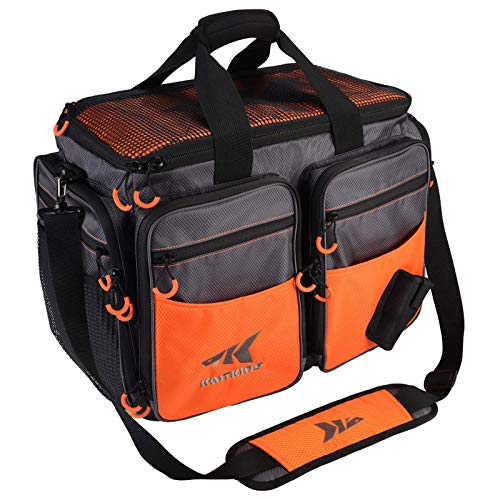
The KastKing Lunker Large is the best all-around tackle bag in this guide, and it is the bag most anglers should start with. It is a saltwater-resistant tackle bag built from durable 420D rip-stop nylon, with a waterproof non-slip compression molded bottom, no-rust self-healing zippers and a Neo-grip anti-slip shoulder strap. The large Lunker measures 19.7 by 13 by 10.6 inches with a 39-liter capacity, and it is built to carry full-size 3700 trays in the main compartment, with internal and external pockets for terminal tackle, tools and personal items. Trays are sold separately, so the angler fills the bag with the trays already owned.
The all-around case is capacity and toughness at the mid-range tier. A 39-liter bag holds a full day of bass fishing: full-size trays in the main compartment, terminal tackle in the pockets, and tools within reach. The 420D rip-stop nylon is light enough to carry on a long walk to the water and tough enough to survive a boat deck, a gravel bank and a truck bed, and the rip-stop weave stops a small tear from spreading into a large one. The molded bottom keeps the bag upright on a wet deck and keeps water out of the lowest compartment, and the no-rust zippers keep working after seasons of saltwater spray. The anti-slip shoulder strap stays on the shoulder when the bag is loaded, which matters on a walk from the car to the pier with a full bag.
The trade against the Plano Guide Series 3700 XL below is trays and pockets. The Lunker is sold without trays, so an angler who owns no trays must buy them separately, while the Plano includes ten StowAway boxes. The Lunker also has fewer named pocket features than the Plano, which has a magnetic Dropzone top, a waterproof cell phone holder and MOLLE webbing. The trade against the Spiderwire Wolf below is included trays: the Wolf includes four large trays, so it is ready to fish on arrival, while the Lunker needs trays from the angler’s shelf. The listing record for this bag is a parent listing with several sizes on one page, so confirm the exact variant on the selector before ordering: this pick is the Large-Lunker without trays, and other sizes run in different dimensions and capacities.
Choose the KastKing Lunker Large if you want one tackle bag for bank, boat and pier fishing, already own 3700 trays, and value a tough, saltwater-resistant shell with a molded base. Skip it if you own no trays, where the Spiderwire Wolf or the Plano Guide Series 3700 XL below are the ready-to-fish answers, or if you want the smallest bag available, where the Berkley Tackle Bag below is the light answer.
Specs
- Type: soft tackle bag
- Size: Large-Lunker
- Dimensions: 19.7 by 13 by 10.6 in
- Capacity: 39 liters
- Material: 420D rip-stop nylon, saltwater resistant
- Base: waterproof non-slip compression molded bottom
- Zippers: no-rust, self-healing
- Strap: Neo-grip anti-slip shoulder strap
- Trays: sold separately
- Best for: all-around bank, boat and pier fishing with owned trays
2. Spiderwire Wolf — Best Tackle Bag With Trays Included
Tier: Mid-range
The Spiderwire Wolf is the tackle bag with trays included in this guide, and it is the pick for anglers who want a bag that is ready to fish on arrival. It is a soft tackle bag built from 1680-denier polyester with a PVC backing, with a waterproof molded base, a padded shoulder strap and a lifetime manufacturer warranty. The Wolf measures 15.75 by 10.8 by 8.2 inches with a 38.8-liter capacity, and it includes four large tackle trays in the main compartment, with adjustable dividers so the compartments fit the lures carried. The bag weighs 2.62 pounds empty, so it is light to carry even when it is loaded with four trays.
The ready-to-fish case is trays, capacity and toughness in one bag. Four large trays hold a full day of fishing: crankbaits, spinnerbaits, jigs and soft plastics in the trays, terminal tackle in the pockets, and tools in the holsters. The 1680-denier polyester with a PVC backing is the toughest fabric in this guide alongside the Plano, and it resists punctures from hooks and abrasion from boat decks. The waterproof molded base keeps the bag upright and dry on a wet deck, and the skid-resistant base keeps the bag from sliding. The two front pockets, the mesh back pocket and the two tool holsters keep pliers, knives and small tools within reach, and the removable line dispensers on the sides keep fluorocarbon leader handy without opening the bag.
The trade against the KastKing Lunker above is size and strap. The Wolf is smaller in every dimension than the Lunker, so it holds fewer trays in the main compartment, and it has a standard padded shoulder strap rather than the Lunker’s anti-slip grip. The trade against the Plano Guide Series 3700 XL below is tray count and pockets: the Plano holds ten trays and has a magnetic top and MOLLE webbing, while the Wolf holds four trays and has no magnetic top. The Wolf is also an older design, and the listing record rests on older evidence, so confirm the live offer before ordering. The bag is a single-size bag, so there is no larger or smaller Wolf to step up or down to.
Choose the Spiderwire Wolf if you want a tackle bag that arrives with four large trays, value a tough 1680-denier shell with a molded base, and want a lifetime manufacturer warranty. Skip it if you carry more than four large trays, where the Plano Guide Series 3700 XL below is the larger answer, or if you already own a tray collection and want a larger shell, where the KastKing Lunker above is the all-around answer.
Specs
- Type: soft tackle bag
- Dimensions: 15.75 by 10.8 by 8.2 in
- Capacity: 38.8 liters
- Weight: 2.62 lb empty
- Material: 1680-denier polyester, PVC backing
- Base: waterproof molded base, skid-resistant
- Trays included: 4 large tackle trays, adjustable dividers
- Pockets: 2 front pockets, mesh back pocket, 2 tool holsters
- Extras: removable line dispensers on both sides
- Strap: padded shoulder strap
- Warranty: lifetime manufacturer warranty
- Best for: ready-to-fish bank and boat fishing with included trays
3. Plano Guide Series 3700 XL — Best Large Tackle Bag
Tier: Premium
The Plano Guide Series 3700 XL is the large tackle bag in this guide, and it is the pick for anglers who carry a large lure collection. It is the largest bag in the Plano Guide Series, built from hard-backed 1680-denier fabric with a molded HDPE base and non-skid TPR overmolded pads, a magnetic Dropzone top, laser-cut MOLLE webbing and oversized molded zippers. The 3700 XL measures 19.5 by 12 by 14.75 inches, and it includes seven 3700-size and three 3600-size StowAway utility boxes, so it holds ten trays in one bag. The bag carries a 1-year limited warranty from the maker.
The large-bag case is tray count and pocket features no other bag in this guide matches. Ten trays hold a lure collection for several techniques at once: crankbaits, spinnerbaits, jigs, soft plastics and terminal tackle in the trays, with the pockets free for tools and personal items. The magnetic Dropzone top holds lures and tools for a moment while the angler ties a knot, which is the small feature that saves the most time on the water. The waterproof cell phone holder, license holder and carabiner keep valuables safe, and the laser-cut MOLLE webbing takes accessories the angler adds later. The two expandable rod pockets hold rods on the sides of the bag, and the stowable backpack straps tuck into a back zippered compartment when they are not needed, so the bag carries as a shoulder bag on short walks and as a backpack on long walks.
The trade against the KastKing Lunker above is size and weight. The 3700 XL is the largest and heaviest bag in this guide, so it is not the pick for a short bank session or a light kit, where the Berkley bag below is the answer. The trade against the Spiderwire Wolf above is the carry: the Wolf is a smaller, lighter bag that is easier to carry on a long walk, while the Plano is a boat and tournament bag that rewards an angler who fishes from a deck with room to set it down. The listing record for this bag is a parent listing with several Guide Series sizes on one page, so confirm the exact variant on the selector before ordering: this pick is the 3700 XL, and the smaller 3500, 3600 and 3700 sizes hold fewer trays. The bag itself is not fully waterproof or submersible, so protect moisture-sensitive gear inside it.
Choose the Plano Guide Series 3700 XL if you carry a large lure collection, fish tournaments or multi-species trips, and want ten trays, a magnetic top and rod pockets in one bag. Skip it if you fish short bank sessions, where the Berkley Tackle Bag below is the light answer, or if you want a smaller bag that is easier to carry, where the Spiderwire Wolf above is the mid-size answer.
Specs
- Type: soft tackle bag, large
- Dimensions: 19.5 by 12 by 14.75 in
- Material: hard-backed 1680-denier fabric
- Base: molded HDPE base, non-skid TPR overmolded pads
- Top: patented magnetic Dropzone
- Trays included: 7 x 3700-size StowAway, 3 x 3600-size StowAway
- Pockets: waterproof cell phone holder, license holder, laser-cut MOLLE webbing
- Rod holders: 2 expandable rod pockets
- Carry: padded adjustable shoulder strap, stowable backpack straps, handled side pockets
- Extras: carabiner, oversized molded zippers
- Warranty: limited 1 year
- Best for: tournaments, multi-species trips and large lure collections
4. Berkley Tackle Bag — Best Light Tackle Bag

Tier: Budget
The Berkley Tackle Bag is the light tackle bag in this guide, and it is the pick for anglers who fish a short bank session with a small kit. It is a shoulder-strap tackle bag from Berkley, built by Pure Fishing, with a zipper closure, a web handle and two small tackle trays included. The bag weighs 1.2 pounds, so it is the lightest bag in this guide by a wide margin, and it carries by a shoulder strap or by the web handle. The bag is sold in a red color, and the listing data does not state its dimensions or tray size, so confirm the fit of owned trays against the two included trays before ordering.
The light-bag case is simplicity and low weight at the budget tier. A short bank session needs a few lures, a small terminal tackle kit and a pair of pliers, and a large bag is the wrong tool for that fishing: it is heavy to carry, it slides around half empty, and it takes up room on the bank. The Berkley bag holds two small trays, which is enough for one technique and the terminal tackle to rig it, and the shoulder strap leaves both hands free for a rod and a landing net. The web handle lifts the bag from the car to the bank, and the zipper closure keeps the trays inside when the bag is set down on a slope. An angler who fishes a local pond or a short stretch of river after work will use this bag more often than a large tournament bag, because it is the bag that is easy to grab and go.
The trade against the KastKing Lunker above is capacity and toughness. The Berkley bag holds two small trays where the Lunker holds full-size 3700 trays, and the listing data does not state a heavy-denier fabric or a molded base for the Berkley bag, so it is not the pick for a full day on a boat or a pier. The trade against the Spiderwire Wolf above is trays and features: the Wolf includes four large trays, a molded base and a lifetime warranty, while the Berkley bag is a simple bag with two small trays. The listing record for this bag rests on older evidence, so confirm the live offer and the exact variant before ordering, because the listing data does not state dimensions or tray size.
Choose the Berkley Tackle Bag if you fish short bank sessions, want the lightest bag in this guide, and carry a small kit for one technique. Skip it if you carry full-size 3700 trays, where the KastKing Lunker above is the all-around answer, or if you want a bag with trays for a full day, where the Spiderwire Wolf above is the ready-to-fish answer.
Specs
- Type: soft tackle bag, light
- Weight: 1.2 lb
- Closure: zipper
- Strap: shoulder strap
- Handle: web handle
- Trays included: 2 small tackle trays
- Color: red
- Brand: Berkley, manufacturer Pure Fishing
- Dimensions: not stated in the published listing data
- Tray size: not stated in the published listing data
- Best for: short bank sessions and light kits
5. Ghosthorn Fishing Tackle Bag — Best Tackle Bag With a Rod Holder

Tier: Budget
The Ghosthorn Fishing Tackle Bag is the tackle bag with a rod holder in this guide, and it is the pick for anglers who fish saltwater and want the rod carried on the bag. It is a saltwater- and freshwater-resistant tackle bag with a rod holder, an adjustable padded shoulder strap and a black camouflage finish. The bag is sold in several sizes, with the large size as the flagship model, and the listing data does not state its dimensions, capacity or included trays, so confirm the size, the tray fit and the included items on the selector before ordering. This pick is the black camouflage variant.
The rod-holder case is hands-free carry on the walk to the water. An angler who fishes a pier or a jetty carries a rod in one hand, a bag in the other, and a landing net under an arm, and the walk is awkward before the fishing starts. A rod holder on the bag frees a hand, so the angler carries the rod on the bag and the net in the free hand. The saltwater- and freshwater-resistant shell handles spray on a pier and rain on a bank, and the adjustable padded shoulder strap spreads the load across the shoulder. The black camouflage finish keeps the bag discreet on the bank, and the bag is built to carry a working set of trays with terminal tackle and tools in the pockets.
The trade against the KastKing Lunker above is published specification data. The Lunker lists its dimensions, capacity, fabric and base in the listing data, while the Ghosthorn listing data does not state dimensions, capacity or tray inclusion, so the buyer must confirm those figures on the selector. The trade against the Plano Guide Series 3700 XL above is rod pockets and trays: the Plano has two expandable rod pockets and ten trays included, while the Ghosthorn has a single rod holder and no stated tray inclusion. The listing record for this bag rests on older evidence, so confirm the live offer before ordering. The bag is also sold in other colors, so confirm the black camouflage variant on the selector.
Choose the Ghosthorn Fishing Tackle Bag if you fish saltwater piers and jetties, want a rod holder on the bag, and value a water-resistant shell with a padded shoulder strap. Skip it if you want fully published dimensions and capacity, where the KastKing Lunker above is the documented answer, or if you want ten trays included, where the Plano Guide Series 3700 XL above is the large answer.
Specs
- Type: soft tackle bag
- Finish: black camouflage
- Resistance: saltwater and freshwater resistant
- Rod holder: yes, on the bag
- Strap: adjustable padded shoulder strap
- Dimensions: not stated in the published listing data
- Capacity: not stated in the published listing data
- Trays included: not stated in the published listing data
- Best for: saltwater pier and jetty fishing with a rod holder
Safety and Checks Before You Order
No CPSC recall covers fishing tackle bags as a product class, and none of the five bags in this guide is subject to a recall. The fishing recalls on record are narrow, and they are worth knowing about precisely so their scope is not confused with the picks here. In 2018, Shimano recalled the Stella FJ spinning reel, a premium reel built for a different class of angler, because of a defect in that model only. The Stella FJ is not in this guide, and none of the bags here shares its design. In 2013, Orvis recalled Battenkill and Mirage fly reels, which are fly reels with a completely different mechanism from a tackle bag, and none of the picks here is a reel.
The children’s fishing recalls are also worth scoping, because tackle is often bought for young anglers. In April 2023, Lil Anglers recalled about 78,500 children’s fishing rods sold with Kid Casters No Tangle Combos, because the rods contained lead above the federal limit. In April 2005, Zebco recalled children’s fishing poles with cartoon-character reels, because the paint on the rods contained lead, and in March 2009, Zebco recalled about 2,700 Advanced Youth rod-and-reel combo sets with orange reels, for the same reason. In June 2005, Shakespeare recalled about 438,000 children’s fishing kits with bright red and yellow rods, because the paint on the rods contained lead, and in March 2009, Shakespeare recalled about 2,600 Casting Game and Fishing Kits, because a surface coating on the rod contained high levels of lead. Every one of those recalls covers a children’s rod or combo sold years ago. The five bags in this guide are adult tackle bags sold on their own, and none of them is covered by any of those recalls.
The other fishing recalls on record are for different products entirely. In 2021, Rapala recalled its rechargeable fillet knives, because the batteries could overheat, which is a fillet knife issue, not a tackle bag issue, and no Rapala rechargeable fillet knife is in this guide. In March 2023, YETI recalled its Hopper M30 and M20 soft coolers and its SideKick Dry gear case, because the magnet closures could fail, which is a cooler issue. In February 2025, Igloo recalled its 90-quart Flip and Tow rolling cooler, because the tow handle could pinch a finger, which is a cooler issue. None of those products is a tackle bag, and none of the bags in this guide is covered.
The standing safety issue with a tackle bag is not a recall but the load itself. A bag loaded with ten trays is heavy, so lift it with both hands or use the backpack straps, and never swing a loaded bag by one strap. Check the zippers before every trip, because a failed zipper spills trays on a boat deck. Check the shoulder strap stitching before every trip, because a strap that fails on a pier drops the bag. Before ordering, run three checks. First, bags are sold in multi-variant listings with several sizes and colors on one page, so confirm the exact size and color on the variant you select against the figures in this guide: the KastKing Lunker Large without trays, the Spiderwire Wolf 38.8-liter bag with four trays, the Plano Guide Series 3700 XL with ten StowAway boxes, the Berkley Tackle Bag in red with two small trays, and the Ghosthorn Fishing Tackle Bag in black camouflage with a rod holder are each one variant among many. Second, confirm the live offer on the Spiderwire Wolf, the Berkley bag and the Ghosthorn bag, because their listing records rest on older evidence. Third, confirm the dimensions, capacity and tray inclusion for the Berkley bag and the Ghosthorn bag, because those figures are not stated in the published listing data for those two picks, and count owned trays against the bag before ordering.
Frequently Asked Questions
What size tackle bag should I buy?
Buy the bag for the largest tray owned, and count the trays before ordering. A bag that holds four large trays covers a full day of bass fishing, and the Spiderwire Wolf in this guide is that bag, with four large trays included and a 38.8-liter capacity. A bag that holds ten trays covers a tournament or a multi-species trip, and the Plano Guide Series 3700 XL in this guide is that bag, with seven 3700-size and three 3600-size boxes included. A bag that holds two small trays covers a short bank session, and the Berkley Tackle Bag in this guide is that bag. A bag sold without trays, like the KastKing Lunker Large or the Ghosthorn bag in this guide, is filled with trays already owned, so count the trays on the shelf and buy the bag that holds them.
Should I buy a tackle bag with trays included or without trays?
Buy a bag with trays included when starting from nothing, and buy a bag without trays when a tray collection already exists. A bag with trays included is ready to fish on arrival, because the trays are in the bag and the angler fills them: the Plano Guide Series 3700 XL includes ten StowAway boxes, the Spiderwire Wolf includes four large trays, and the Berkley bag includes two small trays. A bag without trays is the right move when the angler already owns trays, because the angler fills it with the trays that match the day’s fishing: the KastKing Lunker Large and the Ghosthorn bag in this guide are sold without trays. A bag built for 3700 trays will also hold 3600 trays, because the smaller tray fits in the larger compartment, but a bag built for 3600 trays will not hold a 3700 tray.
What is the difference between a tackle bag, a tackle backpack and a sling pack?
A tackle bag is carried by a shoulder strap or a handle and set down on the bank, the boat deck or the pier while the angler fishes. A tackle backpack is worn on two shoulder straps and built for hiking into a spot with the load on the back. A sling pack is worn on one strap across the chest and built for wading, with the bag swung around to the front for access. The five bags in this guide are all shoulder-carry tackle bags. An angler who hikes a long distance to the water should look at a tackle backpack, and an angler who wades a river should look at a sling pack, while an angler who fishes from a bank, a boat or a pier should look at a tackle bag.
How do I keep a tackle bag dry on a boat?
Choose a bag with a molded base, keep the bag off the deck when possible, and protect moisture-sensitive gear inside the bag. The KastKing Lunker Large, the Spiderwire Wolf and the Plano Guide Series 3700 XL in this guide all have molded bases that keep water out of the lowest compartment and keep the bag upright on a wet deck, and the Plano adds non-skid pads so the bag does not slide. A water-resistant fabric sheds spray and rain, but no bag in this guide is fully waterproof or submersible, so keep phones, licenses and terminal tackle in sealed pouches inside the bag. Store the bag with the zippers closed and the trays inside, and dry the bag after a wet day so the fabric and zippers last.
Conclusion
Each of these five bags solves a different tackle storage problem. The KastKing Lunker Large is the best all-around pick, a 39-liter saltwater-resistant bag in 420D rip-stop nylon with a molded base and an anti-slip shoulder strap. The Spiderwire Wolf is the ready-to-fish pick, a 38.8-liter bag in 1680-denier polyester with four large trays included and a lifetime manufacturer warranty. The Plano Guide Series 3700 XL is the large pick, a ten-tray bag with a magnetic Dropzone top, stowable backpack straps and two expandable rod pockets. The Berkley Tackle Bag is the light pick, a 1.2-pound shoulder-strap bag with two small trays included for short bank sessions. The Ghosthorn Fishing Tackle Bag is the rod-holder pick, a saltwater- and freshwater-resistant bag with a rod holder and an adjustable padded shoulder strap. Pick by the trays owned and the water fished, confirm the exact variant and the live offer before you order, and any of them will arrive ready to be loaded and fished.
More from Amazon
Programs that pair well with the guide above. Offers and eligibility are set by Amazon and may change.
Free shipping on eligible items, Prime Video and more. Eligible new members can start with a free trial.
Start a Prime free trialA Prime membership for ages 18-24 with a trial period. Eligibility is set by Amazon.
See Prime for Young AdultsAudiobooks and podcasts to listen to on the go. Eligible new members can start with a free trial.
Try Audible freeAd-free music streaming. Eligible new subscribers can start with a free trial.
Try Music Unlimited freeAs an Amazon Associate we earn from qualifying purchases.
Write Your Review
No reviews yet. Be the first to share your experience!