

Key takeaways
- Steel or reinforced aluminum poles with a diameter of about 2.5 to 4 inches.
- A top cable and bottom rope that distribute tension across the net.
- Guyline straps extending diagonally from the poles.
- Ground stakes for soil, or filled bases and sandbags for hard surfaces.
- Wide feet or sleeves that prevent the poles from twisting under load.
The best volleyball systems depend on whether you need a full-size competition court, a quickly movable backyard net, or a durable setup that can stay outdoors; for most homes, a height-adjustable system with steel poles, guyline support, and a 30–32-foot net is the most useful choice.
Our top picks

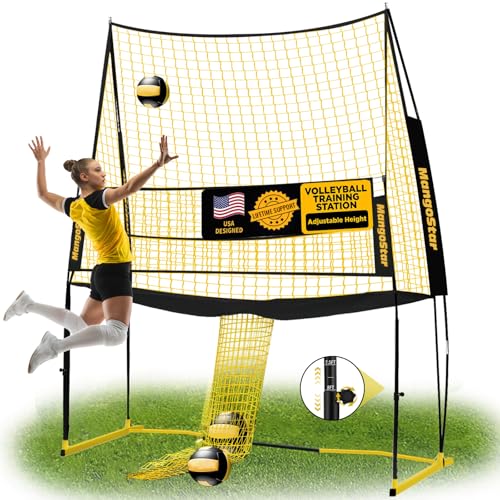


As an Amazon Associate we earn from qualifying purchases at no extra cost to you. Ratings are shown as listed on Amazon.
Quick picks by playing situation
| Situation | Best system type | Recommended specifications | Why it fits |
|---|---|---|---|
| Occasional family games | Portable backyard set | 18–24 ft net, 1.5–2 in steel poles, 20–40 lb total ballast | Fast setup, lower cost, and easier storage |
| Regular recreational play | Heavy-duty adjustable system | 30–32 ft net, 2.5–3.5 in poles, guyline support, 6–8 height settings | Better tension, usable court width, and less movement |
| Club or tournament practice | Competition-style system | 32 ft net, 3.5–4 in poles, 60 x 30 ft court, boundary lines, weighted bases or sleeves | Closest to regulation dimensions and match conditions |
| Small yard or driveway | Compact adjustable net | 10–18 ft net, 4–7 ft height range, freestanding base | Leaves room for clearance and avoids permanent anchors |
| Frequent outdoor installation | Weather-resistant permanent or semi-permanent system | Galvanized or powder-coated steel, UV-treated net, ground sleeves, drainage | Reduces corrosion, sagging, and repeated assembly |
What separates the best volleyball systems
Net height adjustment
A system that only has one height is limiting. Regulation men’s volleyball is played with the top of the net at 7 feet 11 5/8 inches, women’s volleyball at 7 feet 4 1/8 inches, and many mixed or recreational games use approximately 7 feet 8 inches. Children’s games may use substantially lower settings.
Look for telescoping poles or numbered adjustment holes rather than a net that must be tied at a new height each time. A useful system should cover roughly 4 feet to 8 feet, although some compact backyard systems stop below regulation height. Check whether the advertised height measures the top cable or the center of the net; the center is normally slightly lower once the net is tensioned.
Net and court size
A regulation net is 32 feet long and 3 feet high. Many family sets use an 18- or 20-foot net, which is easier to fit into a yard but creates a noticeably narrower game. A 24-foot net is a sensible compromise for recreational doubles. If you want realistic club practice, choose a 30- or 32-foot net and mark a full court.
The official indoor court is 59 feet 1 inch by 29 feet 6 inches, commonly rounded to 60 by 30 feet. Beach volleyball uses an 8 by 16 meter court, approximately 26 feet 3 inches by 52 feet 6 inches. A backyard system does not need those exact dimensions, but players still need several feet of clearance behind the end lines and along the sidelines. A 32-foot net in a 40-foot-wide yard leaves too little safe space for a properly marked full court.
Frame stability and tension
Frame movement is the most frustrating weakness in inexpensive volleyball sets. Thin poles can bend when players contact the net, while lightweight bases may slide across grass or asphalt. Stability comes from several parts working together:
- Steel or reinforced aluminum poles with a diameter of about 2.5 to 4 inches.
- A top cable and bottom rope that distribute tension across the net.
- Guyline straps extending diagonally from the poles.
- Ground stakes for soil, or filled bases and sandbags for hard surfaces.
- Wide feet or sleeves that prevent the poles from twisting under load.
Do not judge stability by pole diameter alone. A 3-inch pole with poor anchors can move more than a 2.5-inch pole installed correctly. Never use the net as a climbing frame or allow players to hang from it; recreational systems are designed to hold net tension, not body weight.
Head-to-head: compact, heavy-duty, and competition systems
| System category | Typical net length | Setup time | Typical packed weight | Boundary lines | Outdoor durability |
|---|---|---|---|---|---|
| Compact backyard | 10–18 ft | 5–15 minutes | 8–20 lb | Usually absent or 20 x 30 ft | Fair; store dry after use |
| Recreational heavy-duty | 18–32 ft | 15–30 minutes | 20–45 lb | Often included, approximately 30 x 60 ft | Good with covered storage |
| Competition-style portable | 32 ft | 25–45 minutes | 40–90 lb | Usually included or sold as a kit | Very good when dismantled between uses |
| Permanent or semi-permanent | 32 ft | 1–3 hours initially | Varies; posts remain installed | Must be measured separately | Best, provided posts drain and receive maintenance |
Named recreational examples include the Park & Sun Sports Spectrum Classic and the Baden Champions Volleyball Set. Product configurations can vary by package and seller, so check the current pole diameter, net length, included anchors, and line kit rather than relying on the model name alone. These systems are more appropriate for backyard recreation than for replacing a permanently installed school or tournament structure.
Setup time is part of the buying decision
A portable system can look inexpensive until every game requires a complicated assembly. Before buying, confirm whether the poles are color-coded, whether the net remains attached during storage, and whether the carry bag holds the anchors and boundary lines.
- Measure the playing area and mark the center line before unpacking the system.
- Place the poles at the intended net length, keeping them parallel.
- Install stakes or fill the bases before applying full tension.
- Attach the top cable first, then the bottom rope or strap.
- Raise the net in small increments on both sides so one pole is not overloaded.
- Measure the net height at the center and both sidelines.
- Walk around the court and remove trip hazards before play.
For a 32-foot net, allow at least 15 feet beyond each pole if you intend to mark a conventional 60-foot court. The poles themselves should sit outside the sideline area, not directly on the boundary line.
Boundary lines: the commonly missed feature
Included lines save time, but their dimensions matter. Look for flat, brightly colored webbing at least 1.5 inches wide, reinforced corner connections, and adjustable sliders that keep the lines tight. Thin cord can disappear in grass and become a trip hazard.
Some sets include only a small 20-by-30-foot rectangle even though the net is full length. That is not necessarily a problem for casual doubles, but it is unsuitable if you want regulation-style drills. If lines are not included, a basic boundary kit commonly adds a general market cost of about $20–$60. Measure the court with a tape measure rather than estimating from the net.
Outdoor durability and ownership costs
Sunlight, water, and tension damage different parts of a system. The net’s upper tape and stitched edge usually wear first, followed by guyline straps, stake loops, and hook-and-loop fasteners. Steel poles can develop rust at scratches, joints, and hollow ends. Sand or dirt trapped inside telescoping sections can also prevent smooth adjustment.
- Remove the net after each session if the system is not specifically rated for permanent outdoor use.
- Let wet netting dry fully before placing it in the storage bag.
- Rinse salt, mud, and lawn chemicals from poles and anchors with clean water.
- Inspect seams and guyline stitching before tightening the net.
- Do not leave a tensioned net up during storms or strong wind.
- Replace frayed ropes and bent stakes instead of compensating by overtightening.
As a rough ownership calculation, a $180 recreational system used 30 times in a season costs $6 per session before replacement parts. Used 75 times, the same system costs $2.40 per session. This is why a faster, sturdier system can be better value for a regular group even when its purchase price is higher.
Which system should you buy?
Choose a compact system if storage space and setup speed matter more than regulation dimensions. Choose a heavy-duty adjustable system if adults and children will share the net or if you expect weekly use. Choose a competition-style 32-foot system when accurate height, full-court drills, and firm tension are priorities. For a net that will remain in one location all summer, a semi-permanent system with galvanized hardware, drainage, and replaceable net components is usually the most durable option.
The best volleyball systems are not simply the tallest or cheapest. Match the net length to the available court, verify every height setting, examine the anchoring method, and confirm whether usable boundary lines are included. Those details determine whether the system feels stable and convenient after the first few games—or becomes difficult equipment that stays in storage.

Write Your Review
No reviews yet. Be the first to share your experience!