

Key takeaways
- Compare the best marine oil change pumps, from 12V bucket systems to manual vacuum extractors, by capacity, power source and dipstick fit for boats.
As an Amazon Associate we earn from qualifying purchases.
Changing oil on a boat is rarely like changing oil on a truck. The drain plug is often buried above a bilge you cannot reach, the engine sits low in a tight compartment, and any spill goes straight into bilge water instead of onto a shop floor. That is why marine oil change pumps work from the top: a probe goes down the dipstick tube, or a hand pump screws onto the drain fitting, and warm oil is pulled into a sealed container you can carry off the boat without dripping.
This guide covers five genuinely different marine oil extractors: a 12-volt bucket system and a compact brass hand pump from Jabsco, a large manual evacuator that can also dispense from Mityvac, a steel-can vacuum classic long trusted by boaters from Airpower America, and a 12-volt system with its own tank from SEAFLO. Match the container size to your sump first, then choose electric or manual power for how and where you actually do the job.
Disclosure: This article contains affiliate links. If you buy through them, we may earn a commission at no extra cost to you.
1. Jabsco 17850-1012 DIY Engine Oil Change System — Best 12V Bucket System
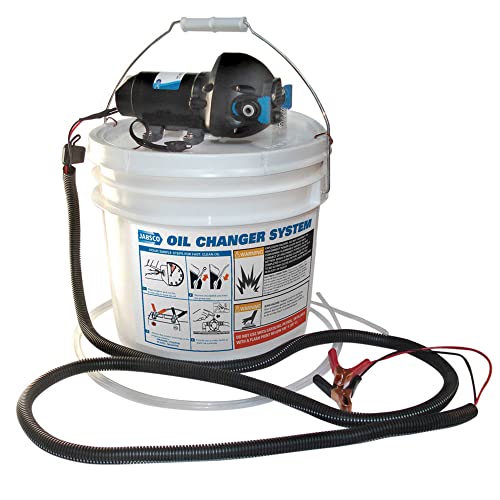
The 17850-1012 is the classic do-it-yourself boat solution: a self-priming diaphragm pump mounted on a 3.5-gallon bucket, with battery leads ending in alligator clips and a long, oil- and heat-resistant suction tube for the dipstick. Clip it to the boat battery, warm the engine, insert the probe, and flip the switch on the motor. Because the pump can run dry and is built with oil-resistant diaphragm and valve materials, it tolerates the stop-start probing needed to find the last oil at the bottom of the pan.
Choose this one for a single inboard or stern-drive engine serviced at the dock or on a trailer, where 12-volt power is already on board. The bucket doubles as the transport container, so there is no separate jug to decant into before a recycling run.
Specs
- Brand: Jabsco
- Model: 17850-1012 DIY Engine Oil Change System
- ASIN: B001CX0WX4
- Capacity: 3.5 gallons
- Power: 12V DC, battery clips
- Pump: Self-priming diaphragm, run-dry capable
- Best for: Inboard and stern-drive boats serviced from their own battery
2. Mityvac MV7201 Fluid Evacuator Plus — Best Manual Evacuator That Also Dispenses

The MV7201 uses a hand pump to build vacuum in a 2.3-gallon polyethylene reservoir, then evacuates oil through the dipstick tube with no battery or shop air required. Its distinguishing feature is the push-button selector that reverses the unit from evacuating to dispensing, so the same tank that pulled old oil out can push new fluid back in a controlled way. Automatic overflow prevention and a quick-drain spout help keep the transfer clean, and the large base keeps the tall reservoir stable on a dock or cockpit sole.
Pick the MV7201 if you maintain a boat plus other engines and want one manual unit that handles crankcases, transmissions, and differentials without hunting for power. Warm the oil thoroughly first — manual vacuum works noticeably harder on cold, thick oil.
Specs
- Brand: Mityvac
- Model: MV7201 Fluid Evacuator Plus (7201)
- ASIN: B0002SR7TC
- Capacity: 2.3 gallons (8.8 liters)
- Power: Manual hand pump, no electricity required
- Operation: Evacuates and dispenses, push-button selector
- Best for: Boat owners who want manual extraction plus dispensing
3. Airpower America 5060TS Topsider — Best Simple Steel-Can Vacuum Pump

The Topsider has been a boater staple for years because it is so simple: a steel pump on a heavy-duty steel 8-quart tank, a suction probe, and a pinch clamp. Pump to create vacuum, slide the probe down the dipstick hole, release the clamp, and let vacuum draw the oil into the can. There is no electricity, no impeller to damage by running dry, and no plastic reservoir to tip — the wide stance is designed to sit stably while it works.
This is the right pick for outboards and smaller inboards, trailer boats serviced in a driveway, and anyone who values a metal tank that stores used oil safely until disposal. Capacity is the limit: a large V8 sump will fill it, so check your sump volume before choosing the smaller can.
Specs
- Brand: Airpower America
- Model: 5060TS Topsider Multi-Purpose Fluid Removing System
- ASIN: B001445IZ8
- Capacity: 8 quarts
- Power: Manual vacuum, no electricity required
- Tank: Steel holding tank with steel pump
- Best for: Outboards and small inboards, no-power oil changes
4. SEAFLO 12V Oil Change System — Best Compact Electric System with Tank

SEAFLO packages a 12-volt extraction pump as a complete system with a 3.7-gallon collection container, suction hose, battery leads, and switch, aimed directly at boats and RVs. Like the Jabsco bucket, it removes oil through the dipstick without crawling under the engine, but in a more compact, portable form that stows easily in a dock box or engine compartment locker. It suits owners who want electric speed without permanently plumbing a pump and manifold into the engine room.
Choose it for routine changes on a single marine engine where a self-contained electric kit is more convenient than hand pumping, and where its tank size comfortably exceeds your sump capacity with room to spare for foaming and tilt.
Specs
- Brand: SEAFLO
- Model: 12V 3.7 Gallon Oil Change System
- ASIN: B0BPW11LQS
- Capacity: 3.7 gallons
- Power: 12V DC
- Vehicle service type: Boat, RV
- Best for: Single-engine boats wanting a compact all-in-one electric kit
5. Jabsco 34060-0130 Marine Engine Oil Drain Hand Pump — Best for Threaded Drain Fittings

Not every marine engine is best served through the dipstick. Many inboards have a drain hose or threaded fitting at the pan, and the 34060-0130 is built for exactly that job: a compact brass hand pump, about 10.25 inches long, that connects to the engine drain and pumps oil out by hand into your own container. There is no reservoir to size, no battery to clip, and almost nothing to store — it disappears into a toolbox drawer between changes.
Use it if your engine already has the matching drain fitting and you do changes slowly and deliberately, boat by boat. It is not a dipstick extractor, so confirm your engine has the compatible drain connection before relying on it as your only pump.
Specs
- Brand: Jabsco
- Model: 34060-0130 Marine Engine Oil Drain Hand Pump
- ASIN: B000O8F0SU
- Type: Manual hand pump, brass
- Connection: Engine oil drain fitting, hose fitting
- Container: None — pumps into a separate container
- Best for: Inboards with a threaded oil drain hose or fitting
How to Choose a Marine Oil Change Pump
Start with access. If you can reach only the dipstick tube, you need a dipstick extractor — electric bucket, manual evacuator, or vacuum can. If your engine has a drain hose brought up to an accessible point, or a threaded pan fitting, a drain hand pump can be simpler and leaves less oil behind. Check which route your engine maker intended before buying.
Size the container to the sump, with margin. The reservoir must hold the full sump volume plus room for the oil to settle without reaching the pump inlet. An 8-quart can is fine for many outboards and small inboards; larger stern drives and diesels need the 2.3-gallon and 3.5-gallon class or larger. Emptying mid-job breaks vacuum and invites spills.
Electric or manual? A 12-volt pump is faster and easier on warm oil in a big sump, and every boat already carries its power supply. Manual vacuum needs no battery, cannot spark, and stores anywhere, but it rewards patience and properly warmed oil. Never use a pump that is not ignition-protected or maker’s-rated for engine compartments where fuel vapor may be present, and keep clips and switches away from fuel fittings.
Warm the oil, always. Run the engine for a few minutes so the oil flows and carries suspended contaminants with it, then shut it off before extracting. Cold oil can stall a small pump, collapse a probe, or leave a large fraction of the sump behind, making the whole exercise pointless.
Plan the disposal leg. A sealed bucket or tank that doubles as the transport container is worth more than a slightly faster pump that drains into an open pan. Carry the used oil off in the same vessel it was extracted into, wipe the probe as you withdraw it, and keep absorbent pads under the dipstick tube for the one drip that always escapes.
Comparison at a Glance
The two electric systems split by form: the Jabsco 17850-1012 on its 3.5-gallon bucket is the proven dockside workhorse, while the SEAFLO system offers a similar 3.7-gallon idea in a compact package. Among manual units, the Mityvac MV7201 is the largest and the only one here that also dispenses, the Topsider is the simplest and toughest with its steel 8-quart can, and the Jabsco hand pump is a different tool entirely — no tank, made for engines with a drain fitting. Power source and access route, not headline capacity alone, should make the decision.
FAQ
Do oil extractors get all the oil out of a marine engine?
A dipstick extractor removes nearly all the oil when the oil is warm, the probe reaches the lowest point of the pan, and you work the probe gently to find the last pools. Some engines retain a small amount in galleries and coolers regardless of method — draining through a pan fitting can leave less behind, which is why engines fitted for it suit a drain pump.
How long does a pump-out usually take?
With warm oil, a typical single-engine change takes minutes of actual pumping for an electric system and somewhat longer for a manual vacuum unit, plus setup and cleanup. Cold oil is the main cause of slow extraction, so warming the engine first matters more than the pump type.
Can I use the same pump for gear oil or transmission fluid?
Many of these extractors handle transmission fluid and other non-flammable fluids as well as engine oil, but check the maker’s fluid compatibility for the specific model, and never use an oil extractor for gasoline or other flammable liquids unless it is explicitly rated for them. Keep a separate, clearly marked unit if you also service fuel systems.
Why does my probe not reach the bottom of the pan?
Dipstick tubes can curve, narrow, or end above the pan floor. Use the probe size the pump maker supplies, insert it slowly until it just touches bottom, and never force it — a stuck or kinked probe is a far bigger problem than a small amount of oil left behind. If your tube will not pass a probe at all, use the drain-fitting route instead.
How do I keep the job from making a mess in the bilge?
Extract into a sealed container, keep the container lower than or level with the engine as directed, close clamps and caps before moving anything, and wipe the probe into a rag as it comes out. Lay absorbent pads around the dipstick and filler before you start, not after the first drip.
Conclusion
For most inboard and stern-drive owners, start with the Jabsco 17850-1012 bucket system for fast, proven 12-volt extraction. If you prefer no power at all, take the Mityvac MV7201 for its size and dispensing ability, or the Topsider for a simple steel can on smaller engines. The SEAFLO system is the compact electric alternative, and the Jabsco 34060-0130 hand pump is the specialist for engines with a proper drain fitting. Confirm your access route and sump size first, warm the oil, and any of these five will turn the dirtiest routine job on a boat into a clean, top-side task.
More from Amazon
Programs that pair well with the guide above. Offers and eligibility are set by Amazon and may change.
Free shipping on eligible items, Prime Video and more. Eligible new members can start with a free trial.
Start a Prime free trialA Prime membership for ages 18-24 with a trial period. Eligibility is set by Amazon.
See Prime for Young AdultsAudiobooks and podcasts to listen to on the go. Eligible new members can start with a free trial.
Try Audible freeAd-free music streaming. Eligible new subscribers can start with a free trial.
Try Music Unlimited freeAs an Amazon Associate we earn from qualifying purchases.


Write Your Review
No reviews yet. Be the first to share your experience!