

Key takeaways
- Occasional equipment refills: A 30–40-gallon tank is easier to fit and keeps the loaded weight manageable.
- Regular farm use: A 50–75-gallon tank can reduce supply runs if the truck has enough payload and bed space.
- High-volume or stationary use: Consider a larger stationary tank or a dedicated fuel-delivery setup rather than putting a very heavy tank in a pickup.
- Gasoline: Buy a tank and pump specifically approved for gasoline. A diesel transfer tank is not automatically suitable for gasoline.
The best fuel transfer tanks depend on what you haul, how often you refuel, and whether you need a tank for diesel, gasoline, or both: for most pickup-based diesel users, a baffled 40–60-gallon aluminum tank with a 12-volt pump is a practical balance of payload, corrosion resistance, and refill speed.
Our top picks


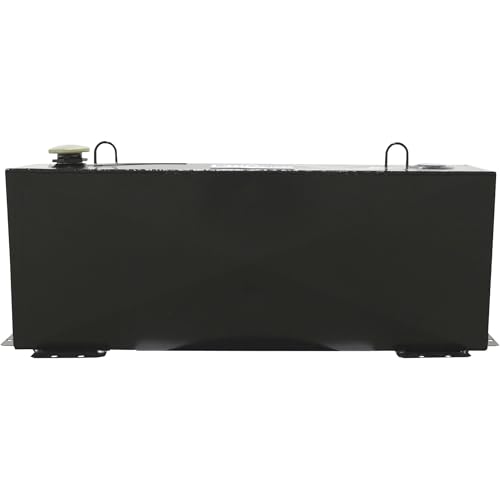

As an Amazon Associate we earn from qualifying purchases at no extra cost to you. Ratings are shown as listed on Amazon.
Choose by job, not by advertised capacity
A larger tank cuts trips to the fuel supplier, but its fuel weight adds up quickly. Diesel weighs about 7.1 pounds per gallon; gasoline is about 6.1 pounds per gallon. A 50-gallon diesel load therefore weighs roughly 355 pounds before adding the tank, pump, and mounting hardware. Check your truck’s payload rating and axle limits, and allow for passengers, tools, and other cargo.
- Occasional equipment refills: A 30–40-gallon tank is easier to fit and keeps the loaded weight manageable.
- Regular farm use: A 50–75-gallon tank can reduce supply runs if the truck has enough payload and bed space.
- High-volume or stationary use: Consider a larger stationary tank or a dedicated fuel-delivery setup rather than putting a very heavy tank in a pickup.
- Gasoline: Buy a tank and pump specifically approved for gasoline. A diesel transfer tank is not automatically suitable for gasoline.
Tank materials and practical trade-offs
| Tank type | Typical useful size | Approximate empty weight | Best fit | Ownership trade-off |
|---|---|---|---|---|
| Aluminum, baffled | 30–100 gallons | About 50–150 lb | Pickup owners prioritizing lower empty weight and corrosion resistance | Can dent; inspect welds, fittings, and mounting points after rough use |
| Steel | 50–100+ gallons | About 100–250 lb | Farm or work-truck use where rugged construction and value matter | Heavier; damaged coatings can rust, especially around seams and fittings |
| Polyethylene | About 15–100 gallons, depending on design | About 25–100 lb | Portable or application-specific setups where the tank is explicitly fuel-rated | UV exposure, chemical compatibility, and fuel approval vary; verify the exact model’s permitted fuel |
Weights are broad estimates, not specifications for a particular tank. Wall thickness, shape, baffles, and fittings change the actual figure. Use the manufacturer’s listed empty weight for payload calculations. Baffles matter in any tank: they reduce fuel slosh that can affect handling, though they do not make an overloaded or poorly secured truck safe.
Compare pump flow to the equipment you fuel
For a small tractor or occasional top-offs, a pump rated around 10–15 gallons per minute (GPM) is often adequate. For frequent refills of larger equipment, a 15–20 GPM pump can save time. Actual delivery is usually lower than the advertised open-flow rate once hose length, nozzle, filter, lift height, and fuel temperature are considered.
| Nominal pump flow | Approximate time for 30 gallons | Good match |
|---|---|---|
| 10 GPM | 3 minutes | Occasional refills and smaller equipment |
| 15 GPM | 2 minutes | Regular farm or jobsite refueling |
| 20 GPM | 1.5 minutes | Frequent, higher-volume transfers |
These are idealized calculations: gallons divided by rated GPM. Allow more time in real use, and check the pump’s duty cycle. Some pumps are designed for intermittent operation and need cooling time between transfers. A longer hose or restrictive filter can also reduce flow.
Diesel versus gasoline: verify the whole system
For diesel, select a diesel-rated pump, hose, seals, filter, and nozzle. For gasoline, every component that contacts fuel must be approved for gasoline and used according to its instructions. Gasoline’s greater volatility makes vapor control, ignition-source avoidance, grounding or bonding requirements, and approved containers especially important. Do not assume that a tank marketed for diesel can be converted by changing the pump.
Check the tank’s product label and documentation for its permitted fuel, intended use, and transport status. A transfer tank, an auxiliary vehicle tank, and a portable fuel container are not interchangeable categories. If gasoline is involved, or the setup will travel on public roads, confirm the applicable federal, state, and local requirements before buying.
DOT compliance and secure installation
“DOT approved” is not a blanket guarantee that a tank can carry any fuel in any vehicle. Requirements depend on fuel type, quantity, tank design, use, and how the tank is installed or transported. Ask the manufacturer for documentation covering the exact model and intended use; check current Department of Transportation and local rules, and consult your carrier or regulator if the application is commercial. A tank labeled “transfer tank” may have restrictions that do not apply to a compliant auxiliary fuel tank.
- Use the specified mounting points and suitable hardware; do not rely on friction or a loose strap as the primary restraint.
- Position the load to respect truck payload and axle limits, and account for fuel, tank, pump, and accessories together.
- Protect wiring with the correct fuse and route it away from sharp edges, heat, and moving parts.
- Keep the tank, venting, nozzle, and hose configured as the manufacturer directs. Never improvise a sealed tank or bypass safety features.
Best fit by situation
| Your situation | Practical starting point | Why |
|---|---|---|
| Occasional use; limited bed space | 30–40-gallon baffled aluminum tank, diesel-rated 10–15 GPM pump | Lower loaded weight and a manageable footprint |
| Frequent diesel refills on a capable work truck | 50–75-gallon steel or aluminum tank, 15–20 GPM pump | Balances fewer resupply trips with useful transfer speed |
| Gasoline transfer | Purpose-built gasoline-rated system in the required transport category | Compatibility and regulatory details are critical; do not repurpose diesel equipment |
| Tank stays at the farm | Stationary tank sized to consumption and site requirements | A pickup-mounted tank may add needless vehicle weight and handling risk |
Before buying: calculate the loaded weight
Suppose a 50-gallon diesel tank weighs 90 pounds empty, and its pump and mounting hardware add 25 pounds. At about 7.1 pounds per gallon, the full setup weighs approximately 90 + 25 + (50 × 7.1) = 470 pounds. Compare that figure with available payload, not just the tank’s advertised capacity. If the truck will also carry a driver, passengers, tools, or a trailer’s tongue load, include those in the calculation.
Maintenance that prevents avoidable trouble
Inspect mounting hardware, welds, hoses, wiring, nozzle, and seals regularly; vibration and repeated hose handling often reveal wear before the tank itself fails. Replace a cracked hose or leaking seal with a compatible part rather than patching it. Keep the pump filter clean, use fuel appropriate to the tank, and follow the manufacturer’s storage and cleaning directions. Water or debris in fuel can clog filters and damage equipment, so keep caps closed and avoid transferring fuel with visibly contaminated hoses or containers.
For most pickup owners moving diesel to farm equipment, the sensible shortlist is a properly rated 40–60-gallon baffled aluminum tank and a 10–15 GPM pump for occasional work or 15–20 GPM for frequent refills. Choose steel when its weight and corrosion-care requirements suit the job; choose poly only when the exact tank is approved for the fuel and transport use. Verify payload and compliance before choosing capacity.

Write Your Review
No reviews yet. Be the first to share your experience!