

Key takeaways
- A kayak that comes loose on the highway is one of the worst things that can happen to an angler.
A kayak that comes loose on the highway is one of the worst things that can happen to an angler. At speed, a hull acts like a wing, and a slipping strap or a flapping bow line can ruin a boat, a roof rack, or the car behind you. The word “tie downs” covers more than one job: some products secure the kayak to the vehicle, others lock gear and accessories to the kayak itself, and a few handle bow and stern anchoring that stops the hull from shifting forward or back.
This guide is for anglers who car-top a kayak or tie down gear on a track system, and who want to know what to look for in straps, rope ratchets, and eyelets. We compared six options using only the facts in each title: length, strap style, hook type, break strength, and material. Some titles are messy or cut off, so confirm the exact contents on the listing. Treat this as a 2026 shortlist, then match it to your roof rack, your kayak length, and the distance you drive.
Quick Picks
Our top picks


As an Amazon Associate we earn from qualifying purchases at no extra cost to you.
| Product | Best for | Key spec from the title |
|---|---|---|
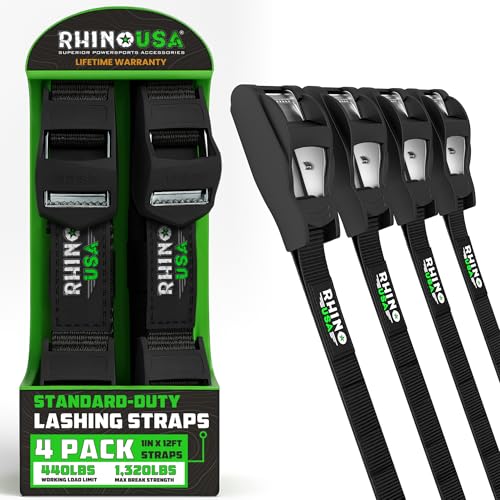
| Rhino USA Lashing Straps | Roof rack cam buckle straps | 4 pack, 1 inch by 12 ft, 1,320 lb break strength |
| Ratchet Strap Kayak Tie Downs | Anglers who want ratchets and hooks | 12 ft, 4 pack, lock S hooks |
| GRTMLZ Kayak Straps | Protecting finish and carrying bigger loads | 4 pack, 16.4 ft, cam buckle, sponge pads |
| Atader Track Mount Tie Downs | Securing a cooler or crate to a track | 2 pcs, vertical, track mount |
| 4PCS Rope Ratchet Tie Downs | Bow and stern anchoring | 1/8 inch by 6 ft, safety S hook, ratchet |
| Kayak Track Eyelet 6 Pack | Adding tie-off points to a track | 316 stainless steel, 6 pack |
How to Choose
Strap length, width, and break strength
Straps for a roof rack need enough length to loop over the kayak and around the crossbar, with extra to tie off. Twelve feet works for most single kayaks, while 16 foot straps help with wider hulls or two boats side by side. A 1 inch webbing strap with a listed break strength above 1,000 lb is a common starting point for car-top use. Break strength is not working load, so treat it as a ceiling, not a target. Avoid straps that do not state any strength figure at all.
Cam buckle, ratchet, or rope
Cam buckles are fast and gentle on plastic hulls because you control the tightness by hand. Ratchet straps tighten harder and are easy to over-tighten, which can dent or deform a thin-walled kayak. Rope ratchet systems such as the 1/8 inch lines in this group are meant for bow and stern anchoring rather than main hold-down. Choose cam buckles for main straps, and add ratchet bow and stern lines for highway driving. Always finish with a half hitch in the tail of the strap so it cannot flap.
Hardware, pads, and corrosion
Metal hooks can scratch paint or hulls, so look for coated hooks, buckle covers, or pads. Sponge pads under straps, as in the GRTMLZ kit, protect the finish and reduce strap vibration noise. Stainless steel hardware, such as 316-grade eyelets, resists corrosion around saltwater. Cheap hooks can bend under load, so avoid using them as primary anchors. Wash straps after salt exposure and replace any that fray or fade.
Where track hardware fits
Not every item here goes on the car. Track mount tie downs and eyelets attach to the gear track on a fishing kayak, giving you secure points for coolers, crates, and rods. Check the track width and the screw or slider size before buying. Ignore generic language like “heavy duty” without a stated strength, and be wary of bargains that cut corners on stitching, buckle springs, and hook welds.
Strap care deserves a moment as well. Wash webbing with fresh water after salt exposure, hang it to dry out of direct sun, and coil it loosely rather than leaving a knotted tangle in the trunk. Straps that stay clean and dry last through many seasons and fail less often at the worst moment.
Finally, give every strap a quick pull test at the first fuel stop. New webbing settles and cam buckles can creep, so a loose strap after the first twenty miles is normal. A thirty-second check is far cheaper than watching a hull slide on the highway.
The 6 Best Options
Rhino USA Lashing Straps
Rhino USA sells a four-pack of 1 inch by 12 ft cam buckle straps with a listed 1,320 lb break strength. They are meant for kayaks and cargo, which makes them a straightforward choice for a roof rack setup. This pack suits anglers with a single boat who want two straps for the hull and spares for gear.
Because the straps are the same length, you can use two on the boat and keep the others for a cooler, a paddle bundle, or a second kayak when a friend rides along.
- Strength: Cam buckles are fast to set and kind to hull surfaces.
- Strength: A stated break strength gives you a number to compare.
- Trade-off: Cam buckles can slip if not tightened correctly, so check them often.
Skip it if you want extra long straps for wider loads or a bow and stern line system.
Ratchet Strap Kayak Tie Downs
This four-pack is described as adjustable ratchet tie downs, 12 ft long, with lock S hooks and a roof rack strap design. It suits drivers who like the leverage of ratchets and want hooks to attach to tie-down points. The title mixes sizes and wording, so check the width and strap material on the listing.
If you pick ratchets, snug the strap until the kayak stops moving and then stop. A hull that flexes under the strap is already too tight, and thin plastic hulls can hold a dent.
- Strength: Ratchets allow tight, repeatable tension.
- Strength: Lock S hooks add a secure attachment option.
- Trade-off: Ratchets can overtighten and dent a thin hull if you are heavy-handed.
Skip it if you prefer the gentler control of cam buckles.
GRTMLZ Kayak Straps
GRTMLZ offers a four-pack of 16.4 ft cam buckle straps with thick sponge pads, designed for roof racks and suitable for canoes, SUPs, surfboards, and motorcycles. The longer length helps with large or multiple boats, and the pads protect finishes. It fits anglers with bigger boats or those carrying two craft together.
The pads also help with noise, since a bare strap can hum on a highway drive, and they keep metal buckles from resting directly against the hull.
- Strength: Extra length offers more flexibility for wide loads.
- Strength: Sponge pads reduce scuffing and vibration.
- Trade-off: Long straps leave more tail to tuck away and secure.
Skip it if you only carry a single short kayak and prefer shorter straps.
Atader Track Mount Tie Downs
Atader makes a two-piece set of vertical tie downs built for kayak tracks, aimed at securing coolers, crates, and other accessories. They suit fishing kayak owners who want gear that stays put in chop or when launching through surf. These are not vehicle straps, so they work as a companion to roof tie downs.
Securing a crate to the track also helps in a rollover, since loose gear is easier to lose than a boat. Check each tie down before launch and after any rough landing.
- Strength: Vertical design is meant for track systems.
- Strength: Helps hold bulky gear in place during paddling.
- Trade-off: Only two pieces, so you may need more for a full gear setup.
Skip it if your kayak has no gear track or you need car-top straps.
4PCS Rope Ratchet Tie Downs
This set offers four 1/8 inch by 6 ft rope ratchets with safety S hooks, intended for bow and stern tie down on kayaks and canoes. The thin rope compresses into a small bag and is easy to adjust. It suits drivers who want to prevent the boat from sliding fore or aft during highway driving.
Look for a clear anchor point on the bumper area or tow hook, and avoid attaching to plastic trim or anything that is not built to carry load.
- Strength: Compact and light, it stores easily in a glove box.
- Strength: Ratchet adjustment makes tensioning simple.
- Trade-off: Thin rope is not a substitute for primary hold-down straps.
Skip it if you want a main strap solution. Pair with cam buckles instead.
Kayak Track Eyelet 6 Pack
This is a six-pack of 316 stainless steel eyelets for kayak tracks, offering corrosion resistance and tie-off points for ropes. They suit anglers who customize their rigging and need extra anchor points for dry bags, rod leashes, and accessories. The stainless material is a notable plus near saltwater.
Stainless hardware also looks neater, and a few extra eyelets let you tie off a landing net, a paddle leash, and a drift sock without running ropes across the deck.
- Strength: 316 stainless steel resists corrosion.
- Strength: Six pieces give plenty of flexibility for custom rigging.
- Trade-off: Eyelets are small hardware, not a replacement for roof straps.
Skip it if you only need car-top tie downs. Confirm that the track size matches your kayak.
Which One Fits Your Situation
You car-top a single kayak on a standard rack
Rhino USA Lashing Straps are a clean, simple answer. Pair them with a set of bow and stern lines for highway trips.
You haul two boats or a wide hull
The GRTMLZ 16.4 ft straps give you the extra length, and the pads help protect finishes. Take care to cross the straps neatly and secure the tails.
You drive long distances at highway speed
Add the 4PCS Rope Ratchet set for bow and stern anchoring, on top of main cam buckle straps. This dual approach limits fore-aft movement.
You rig a fishing kayak with gear
The Atader tie downs and the stainless eyelet pack let you secure coolers, crates, and accessories on the track. Check the track size before ordering.
Common Mistakes
- Overtightening ratchet straps and denting the hull.
- Skipping bow and stern lines on highway trips.
- Letting strap tails flap, which can fray the webbing or hit the car.
- Using eyelets or track hardware as the main vehicle hold-down.
- Ignoring frayed webbing, sun damage, or rusted buckles when reusing straps.
Related guides
- Shimano Stradic Fl Vs Daiwa Bg Spinning Reel
- Polarized Sunglasses For Kayak Fishing
- Battery Chargers For Marine Batteries
Frequently Asked Questions
How many straps do I need for one kayak?
Two main straps over the hull are standard, one at each crossbar. Add bow and stern lines for highway driving. More straps help with heavy or large boats.
Are cam buckles safer than ratchets?
Neither is automatically safer. Cam buckles are gentler on hulls, while ratchets hold more tension but can crush thin walls. Use whichever you can tighten correctly, and check tension during stops.
Should I twist the strap?
A twist or two in the length between the rack and the kayak can reduce humming in the wind. Keep the twist away from the buckle and the contact points on the hull.
How often should I replace straps?
Replace them when webbing frays, fades, or stiffens, or when buckles corrode or fail to hold. Sun and salt age straps, so inspect them before each season.
More from Amazon
Programs that pair well with the guide above. Offers and eligibility are set by Amazon and may change.
Free shipping on eligible items, Prime Video and more. Eligible new members can start with a free trial.
Start a Prime free trialA Prime membership for ages 18-24 with a trial period. Eligibility is set by Amazon.
See Prime for Young AdultsAudiobooks and podcasts to listen to on the go. Eligible new members can start with a free trial.
Try Audible freeAd-free music streaming. Eligible new subscribers can start with a free trial.
Try Music Unlimited freeAs an Amazon Associate we earn from qualifying purchases.
Write Your Review
No reviews yet. Be the first to share your experience!