

Key takeaways
- A kayak that feels light on the water can feel brutally heavy once you have to drag it a quarter mile from the parking lot, across sand.
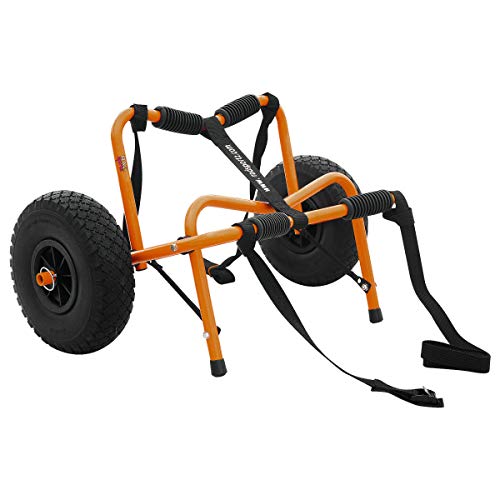
A kayak that feels light on the water can feel brutally heavy once you have to drag it a quarter mile from the parking lot, across sand, up a boat ramp, or along a gravel path to a hidden pond. That is the whole reason a kayak cart exists, and it is also why “best kayak wheels” is a more specific question than it sounds. The real decision is where you roll: hard pavement and packed dirt are happy with small solid wheels, while soft beach sand and loose gravel need big balloon-style tires that float over the surface instead of digging in.
This guide is for anglers who haul fishing kayaks, canoes, and paddleboards by themselves and want a cart that folds small enough for the car and strong enough for a fully rigged boat. The six picks run from a light 150-pound folding cart to a heavy-duty detachable trolley with 13-inch beach wheels. Every judgment is based on the listing titles alone, so confirm frame dimensions, axle size, and what is included before you buy. Whatever you choose in 2026, start with the weight of your loaded kayak, the surface you roll across, and how much trunk space you can spare.
Quick Picks
Our top picks


As an Amazon Associate we earn from qualifying purchases at no extra cost to you.
| Product | Best for | Key spec from the title |
|---|---|---|
| Rad Sportz Kayak Cart | Light boats and easy storage | 150 lb capacity, airless tires, foldable aluminum |
| VEVOR Kayak Cart 250 lb | Mid-range everyday hauling | 250 lb, 10-inch solid tires, foldable aluminum |
| GanFindX Kayak Cart | Adjustable width, sturdy build | 240 lb, stainless steel, adjustable width |
| Bonnlo Plug-in Cart | Hard-packed trails | 12-inch solid tires, width adjustable 6.3-18.7 in, kickstand |
| VEVOR Heavy Duty 350 lb | Sand and heavy rigs | 350 lb, 13-inch beach wheels, detachable |
| Yes4All U-Shape Cart | Strap-secured boats | 200 lb, aluminum, 4 straps, PU wheels |
How to Choose
Load capacity against your real boat weight
Add the hull weight, the seat, the battery if you run one, the crate, and the rods. A fully rigged fishing kayak can run well past the bare-hull number printed in the specs, and a cart rated barely above that number will flex at the axle. Listings in this group range from 150 to 350 pounds. Pick a capacity at least a quarter above your loaded weight to leave margin for bumps and uneven ground. Remember that the cart rating covers the boat, not you leaning on the stern while you steer, and that hills multiply the strain on the axle far more than flat ground does.
Wheel size and tire type
Ten-inch solid tires work on pavement, packed dirt, and boat ramps. Twelve- and thirteen-inch balloon or beach wheels roll over soft sand, wet gravel, and roots because the larger diameter climbs obstacles and the wider footprint spreads weight. Solid and airless tires never go flat, which is a major advantage for something that lives in a trunk, but they ride harder than air-filled ones. If your route includes sand, size up on the wheel before you size up on the frame. Wide tires also matter: a narrow hard wheel cuts a groove in sand, while a fat one rides on top and needs far less effort to pull.
Frame style, width, and how the boat sits
A U-shaped frame cradles the hull and holds it with straps, while a post-style cart pushes plug-in posts into the scupper holes of a sit-on-top. Posts are quick to use but only fit kayaks with scuppers in the right spot, and the post diameter must match the hole. Adjustable width helps a cart fit different hull shapes, and rubber pads or sleeves protect the finish. Check that the cart folds or breaks down to fit your vehicle. If you carry the kayak on a roof rack, you also need somewhere to put the cart once the boat is loaded, and a cart that comes apart into a few pieces usually slides into a hatch or the back seat.
Where budget carts cut corners
Low-cost carts tend to have thin axle tubing, loose locking pins, and wheels that wobble on their bearings. A kickstand is a nice extra that makes loading easier, but it should not replace a solid frame. Look for stainless steel or anodized aluminum hardware, since salt and sand chew through cheap plating quickly, and rinse the cart after every beach trip. Also test the wheel retention: push pins or clips that work loose on a bumpy path will leave you carrying the boat the rest of the way.
The 6 Best Options
Rad Sportz Kayak Cart
The Rad Sportz is a lighter-duty cart rated at 150 pounds, with airless tires, a foldable aluminum frame, and a carrying bag. The title is aimed at personal kayaks and canoes, which suggests an easy-transport mindset. It is the sort of cart that disappears into a closet between trips and takes a minute to set up at the water.
- Airless tires never go flat, which suits a cart that sits in storage for weeks.
- A foldable frame and carrying bag make it simple to stow in a car.
- Trade-off: a 150 pound capacity may be tight for a fully loaded fishing kayak.
Skip it if your kayak is heavy or you cross soft sand. It fits a light recreational boat or a paddleboard owner who walks a short, flat path from the car to the shore.
VEVOR Kayak Cart 250 lb
This VEVOR cart lists a 250 pound load capacity, a foldable aluminum frame, and 10-inch solid tires. It targets kayaks, canoes, and paddleboards and sits in the middle of the group.
- A 250 pound rating leaves room for a moderately loaded fishing kayak.
- Solid 10-inch tires avoid flats and handle pavement and packed paths.
- Trade-off: 10-inch solid wheels dig into soft sand.
Skip it if your launch is a beach or loose gravel. It suits anglers who roll across parking lots and boat ramps, with enough capacity to spare for a crate and a few rods.
GanFindX Kayak Cart
The GanFindX is a heavy-duty stainless steel cart with a 240 pound capacity, adjustable width, and rubber sleeves. The title mentions kayaks and fishing boats, and the stainless build points toward corrosion resistance.
- Stainless steel resists rust in salty or humid conditions.
- Adjustable width fits a range of hull shapes.
- Trade-off: steel is typically heavier than aluminum, so confirm weight and wheel size on the listing.
Skip it if every pound matters when lifting the cart into the car. It suits saltwater anglers who want a sturdy frame and do not mind carrying a few extra pounds in the cart itself.
Bonnlo Plug-in Cart
The Bonnlo plug-in cart uses 1-inch diameter posts, 12-inch solid tires, a kickstand, and a width adjustable from 6.3 to 18.7 inches. The title describes a detachable canoe cart, so the pieces come apart for storage.
- A kickstand holds the cart upright while you load the boat.
- The 12-inch wheels roll over more obstacles than smaller ones.
- Trade-off: plug-in posts only work with kayaks that have scupper holes sized for 1-inch posts.
Skip it if your kayak has no scuppers or if you want a cradle-style frame. It suits sit-on-top owners with compatible holes who want a cart that comes apart and rides in a small trunk.
VEVOR Heavy Duty 350 lb
This VEVOR trolley lists a 350 pound capacity with 13-inch beach wheels and a detachable design. It is aimed at kayaks, canoes, paddleboards, float mats, and jon boats, making it the most capable cart here.
- A 350 pound rating suits heavy fishing kayaks and small jon boats.
- Thirteen-inch beach wheels float over soft sand.
- Trade-off: larger wheels and a heavier frame take more trunk space.
Skip it if you haul a light recreational kayak on pavement only. It suits beach launches and heavy rigs, including a fishing kayak with a battery, crate, and anchor system on board.
Yes4All U-Shape Cart
The Yes4All is a U-shaped aluminum cart with a 200 pound capacity, thick PU wheels, four fixing straps, and a foldable canoe-cart design. The U shape cradles a hull rather than relying on scupper posts.
- A U-shape cradle works with kayaks that lack scupper holes.
- Included straps secure the boat during the roll.
- Trade-off: PU wheels roll well on firm ground but offer less float on soft sand than large balloon tires.
Skip it if your route is mostly sand. It suits anglers who want a flexible cradle for different boats, such as a kayak one weekend and a small canoe the next.
Which One Fits Your Situation
You launch from a paved ramp or lot
The VEVOR 250 lb cart or the Yes4All U-Shape cart suits you. VEVOR adds more capacity, while Yes4All adds straps and a cradle.
You cross soft sand to reach the water
The VEVOR Heavy Duty 350 lb with 13-inch beach wheels is the clear choice. The Bonnlo plug-in with 12-inch tires is a second option for firmer sand.
You paddle in salt water
The GanFindX stainless steel cart stands up to corrosion better than painted steel. Rinse it after every trip regardless, and check the wheel bearings for grit now and then.
You keep a light kayak and little storage space
The Rad Sportz folds into a carrying bag and uses airless tires. It is the simplest option for small vehicles.
Common Mistakes
- Choosing a cart based on the empty kayak weight instead of the loaded weight.
- Buying small solid wheels for a sandy beach.
- Ordering a plug-in cart for a kayak without matching scupper holes.
- Skipping straps, then watching the boat shift on a bumpy path.
- Leaving the cart wet and unrinsed after a salt trip, which lets sand and salt grind into the bearings.
Related guides
- Shimano Stradic Fl Vs Daiwa Bg Spinning Reel
- Polarized Sunglasses For Kayak Fishing
- Battery Chargers For Marine Batteries
Frequently Asked Questions
Are solid tires better than air-filled ones?
Solid tires never go flat and need no maintenance, but they ride harder. Air-filled balloon tires float better over sand but can lose pressure or puncture. If you choose air-filled wheels, carry a small pump and check the pressure before each trip so the cart rolls easily.
How do I know if a plug-in cart fits my kayak?
Measure the scupper hole diameter and the distance between holes, and compare them with the post size and the width range on the listing. If the numbers do not match, choose a cradle-style cart. Check the post length too, since a short post may slip out of a deep scupper when the boat bounces.
Can I use a cart on a paddleboard or canoe?
Many carts list canoes and paddleboards, but the fit depends on the hull shape. Confirm the supported boat types on the listing before ordering.
How should I store a kayak cart?
Rinse it with fresh water, dry it, and fold it or take it apart. Store it out of direct sun so rubber pads and plastic parts do not crack. Lubricate the axle pins lightly once a season and tighten any hardware that has worked loose.
More from Amazon
Programs that pair well with the guide above. Offers and eligibility are set by Amazon and may change.
Free shipping on eligible items, Prime Video and more. Eligible new members can start with a free trial.
Start a Prime free trialA Prime membership for ages 18-24 with a trial period. Eligibility is set by Amazon.
See Prime for Young AdultsAudiobooks and podcasts to listen to on the go. Eligible new members can start with a free trial.
Try Audible freeAd-free music streaming. Eligible new subscribers can start with a free trial.
Try Music Unlimited freeAs an Amazon Associate we earn from qualifying purchases.

Write Your Review
No reviews yet. Be the first to share your experience!