

The best deck boot for most anglers is a 6-inch ankle-height rubber boot with a non-marking siped outsole, and the XTRATUF Ankle Deck Boot and Huk Rogue Wave are the two names that come up most often in 2026 roundups. Go taller (Grundéns Tough Seas, XTRATUF 15-inch Legacy) for cold, wet commercial-style work, and go lower or lighter for warm-weather skiff fishing.
This guide is research-based: it draws on manufacturer spec sheets and published reviews. Prices are shown only as market tiers because they change often.
Our top picks


As an Amazon Associate we earn from qualifying purchases at no extra cost to you.
Quick comparison of the top deck boots
| Pick | Best for | Height | Upper | Outsole | Price tier |
|---|---|---|---|---|---|
| XTRATUF Ankle Deck Boot | Best overall | 6 in | Neoprene-lined rubber | Non-marking, siped | Mid |
| Huk Rogue Wave | Best all-rounder for skiffs | Ankle/mid | Rubber and neoprene | GripX Wet Traction, non-marking | Mid |
| Grundéns Deck-Boss Ankle | Best durability | 6 in class | Rubber | Slip-resistant, non-marking | Mid |
| Grundéns Tough Seas Ankle | Best for rough water | Ankle | Rubber, neoprene lining | Wet-deck grip | Mid to upper |
| Simms Challenger 7-Inch Deck Boot | Best premium | 7 in | Rubber/neoprene | Siped, non-marking | Upper |
| XTRATUF 15-inch Legacy | Best for cold, wet days | 15 in | Neoprene-lined rubber | Non-marking | Upper |
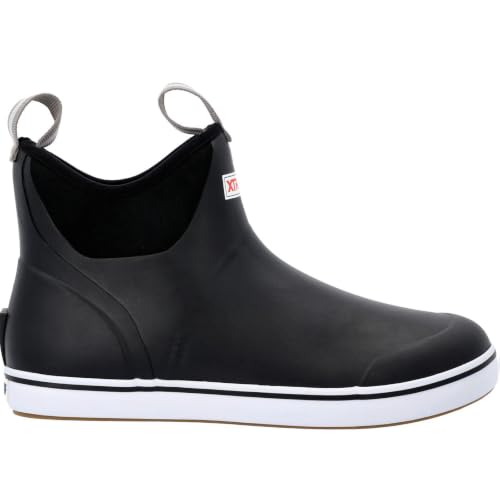
Best overall: XTRATUF Ankle Deck Boot
This is the boot that charter captains and Alaska deckhands made famous, and reviewers still describe it as the benchmark for ankle-height deck boots. The 6-inch shaft keeps spray and bilge water out without the heat and weight of a tall boot, and the Sport version is reported at roughly one pound per boot in men’s size 10. Flylords lists limited half-size availability and so-so long-term durability as the main drawbacks, and some anglers swap in an aftermarket insole because the stock footbed is thin.
Trade-off: comfort over a full 10-hour day depends on the insole you add.
Best all-rounder for skiffs and bay boats: Huk Rogue Wave
Huk’s Rogue Wave pairs a waterproof rubber and neoprene upper with the brand’s GripX Wet Traction non-marking outsole. Several 2026 roundups name it their top overall pick, mainly for the balance of grip and all-day comfort on fiberglass decks. It suits anglers who step in and out of water, then stand on a clean deck.
Trade-off: neoprene lining traps heat in summer, so it is better from spring through fall than on a July flats day.
Best for durability: Grundéns Deck-Boss Ankle
Grundéns is a commercial-fishing brand, and the Deck-Boss is the one reviewers call the most durable of the mainstream ankle boots. It sits in the same price tier as the XTRATUF and Huk, which makes it a strong pick if you wear through boots.
Trade-off: a stiffer feel out of the box than the lightweight XTRATUF Sport.
Best for rough water: Grundéns Tough Seas Ankle
Flylords names the Tough Seas Ankle its durability pick, and The Outdoor Champ recommends it for commercial work. If you run offshore, fish in chop and want a boot built for sustained wet exposure, this sits near the top of the list.
Trade-off: heavier and warmer than the lightweight options.
Best premium: Simms Challenger 7-Inch Deck Boot
Simms makes the Challenger one inch taller than the usual 6-inch standard, which adds splash protection. Published weight is around 50 ounces per pair in size 9, making it heavier than average. Reviewers list it as an honorable mention for extreme conditions.
Trade-off: the heaviest ankle-class option here, and you pay for the Simms name.
Best for cold, wet days: XTRATUF 15-inch Legacy
For winter fishing, cold-water crabbing or hosing down a deck, the tall Legacy boot is a commercial staple. It keeps water out to mid-calf and you can fold it down in mild weather.
Trade-off: too hot and bulky for summer, and tall boots are harder to pull on and off quickly.
How to choose: a decision matrix
| Your situation | Choose | Why |
|---|---|---|
| Warm-weather skiff or bay boat | Huk Rogue Wave or XTRATUF Sport | Lighter, less heat build-up |
| Offshore, rough seas, cold | Grundéns Tough Seas or 15-inch Legacy | More coverage and lining |
| Hard use, replace boots often | Grundéns Deck-Boss | Reputation for durability |
| Long standing days | Any pick plus a cushioned insole | Stock footbeds are thin |
| Shore and bank fishing | Muck Excursion Pro class | Built for mud and uneven ground |
What to check before buying
- Outsole: look for “non-marking” and fine siping (thin slits) for wet-fiberglass grip. A deep lugged outsole grips mud but tracks it on deck and can scuff gelcoat.
- Height: 6 inches is the standard. Choose 7 to 15 inches only when you expect to stand in water.
- Sizing: several models lack half sizes. If you wear thick socks, size up a full number rather than down.
- Weight: a boot near one pound feels very different to a pair near 25 ounces after eight hours.
- Care: rinse with fresh water after saltwater use and dry out of direct sun, since UV and heat age rubber and neoprene.
Cost per season: a quick worked example
If a mid-tier boot lasts two seasons of 40 fishing days (80 days) and a premium boot lasts four seasons (160 days), the premium boot costs half as much per day of use even at double the price. Durability claims vary, so treat that as a way to compare, not a guarantee.
Fit, socks and insoles: getting the details right
Most complaints about deck boots are about fit, not quality. Rubber boots do not stretch, so the length and the calf opening are fixed at the factory. Try them on in the afternoon, when feet are slightly swollen, and wear the socks you actually fish in. A thin sock in cool weather and a thick merino or neoprene sock in cold water can change the fit by a full size.
Check heel lift when you walk. A boot that lets your heel rise more than about half an inch will rub on long days. If the heel slips but the length is right, a thicker insole or a heel grip often fixes it. If the toes touch the end when you step down a ladder, go up a size.
Insoles are the cheapest upgrade. Many anglers replace the stock footbed with a cushioned or arch-supporting insole; trim it to the factory insole template so the boot’s drainage and flex stay unchanged.
Common mistakes to avoid
- Buying a lugged hiking-style sole for a boat. Deep lugs hold grit and scuff decks, and they grip wet fiberglass worse than siped rubber.
- Skipping the rinse. Salt dries inside the lining and seams and speeds up cracking at the flex points.
- Storing in a hot truck. Heat softens neoprene glue lines and ages rubber. Store boots in a shaded, ventilated spot.
- Ignoring a worn sole. When the sipes have worn down, the boot is a slip risk even if the upper is fine.
- Choosing by look alone. Color and logo matter less than outsole type, height and fit.
Frequently Asked Questions
Are deck boots waterproof?
Yes, rubber and neoprene deck boots are waterproof up to the top of the shaft. Water entering over the top is the usual failure, so choose a height that matches how deep you stand.
Can I use deck boots for wading?
Only in very shallow water. Deck boots have no ankle support or wading-style traction for rocks, so use proper wading boots for streams.
Do deck boots need a break-in period?
Most rubber boots feel stiff for the first few outings. Wear them around the house with the socks you fish in for a day or two before a long trip.
How do I stop deck boots from smelling?
Turn them upside down to dry fully after each trip, rinse the inside occasionally with mild soap and use a replaceable insole you can wash or swap.
Are 6-inch or tall deck boots better?
Six-inch boots are lighter and cooler, making them the default for most anglers. Tall boots suit cold water, heavy spray and commercial deck work.
More from Amazon
Programs that pair well with the guide above. Offers and eligibility are set by Amazon and may change.
Free shipping on eligible items, Prime Video and more. Eligible new members can start with a free trial.
Start a Prime free trialA Prime membership for ages 18-24 with a trial period. Eligibility is set by Amazon.
See Prime for Young AdultsAudiobooks and podcasts to listen to on the go. Eligible new members can start with a free trial.
Try Audible freeAd-free music streaming. Eligible new subscribers can start with a free trial.
Try Music Unlimited freeAs an Amazon Associate we earn from qualifying purchases.
Write Your Review
No reviews yet. Be the first to share your experience!