

Key takeaways
- Five non-lithium picks for the best marine batteries for trolling motors, comparing AGM and dual-purpose models by capacity, group size and runtime.
As an Amazon Associate we earn from qualifying purchases.
A trolling motor draws steady current for hours, often at low and medium speeds, and it needs that current delivered without the voltage sag that makes a motor feel weak late in the day. The best marine batteries for trolling motors are therefore deep-cycle batteries first: they are built to be discharged and recharged repeatedly, rather than to deliver one short burst for engine starting and then sit at full charge.
This guide takes a deliberately non-lithium approach. Every pick below uses proven lead-acid chemistry — AGM or dual-purpose AGM. That suits anglers who want a battery that works with a standard marine charger, tolerates cold mornings, can be replaced at almost any marine dealer, and keeps wiring and chargers simple on a boat that already runs lead-acid batteries.
Disclosure: This article contains affiliate links. If you buy through them, we may earn a commission at no extra cost to you.
How to Choose a Marine Battery for a Trolling Motor
Start with capacity, expressed in amp-hours (Ah). A motor drawing 25 amps will run for about two hours on 50 usable amp-hours. Lead-acid batteries should not routinely be discharged below about half of their rated capacity if you want a long service life, so a 100Ah AGM battery realistically offers around 50 usable amp-hours. For a single 12-volt motor in the 30 to 55 lb thrust range, a 100Ah class battery is the common sweet spot. For 24-volt systems, run two 12-volt batteries in series, and for 36-volt systems, three — always matched batteries of the same model, age, and capacity.
Next, check the group size against your battery tray. Group 27 and Group 31 are the most common sizes for trolling motor service. A Group 31 battery is longer and usually heavier, with more capacity or higher cranking ratings, but it only helps if it fits with room for cables and a hold-down. Measure the tray, check the height under the hatch, and confirm the terminal layout before ordering.
Chemistry and construction come next. AGM batteries hold their electrolyte in glass mat separators, so they are sealed, spill-proof, and maintenance-free, with no watering and flexible mounting positions. That makes AGM the default choice here for boats that trailer over rough roads or store batteries in enclosed compartments. Flooded deep-cycle batteries remain a valid budget option, but they need ventilation, level mounting, and periodic water checks. Gel batteries are sealed as well, though they are less common in trolling motor sizes and need a charger profile that respects their lower charging voltage. Dual-purpose AGM batteries add strong cranking output on top of deep-cycle plates, suiting a boat that must start an outboard and run a bow motor from the same bank.
Reserve capacity (RC), in minutes at a 25-amp draw, is a useful cross-check alongside amp-hours. Cold cranking amps (CCA) and marine cranking amps (MCA) matter mainly if the same battery also starts an engine. Finally, plan the charger with the battery: use an AGM profile and recharge soon after each trip.
1. VMAXTANKS MR127-100 — Dedicated Group 27 AGM for Trolling
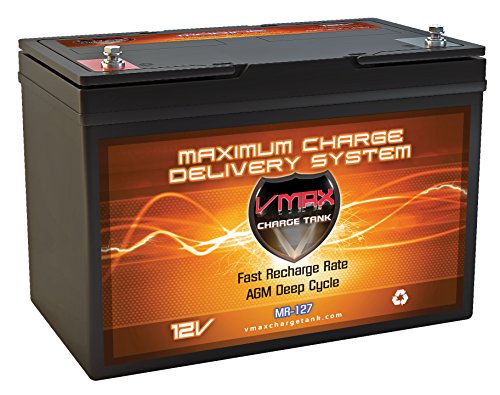
The VMAXTANKS MR127-100 is the most trolling-focused battery in this roundup. VMAXTANKS describes it as a Group 27 marine deep-cycle AGM battery compatible with 12-volt trolling motors in the 40 to 100 lb thrust range, covering most bow-mount and transom-mount motors on bass boats, walleye rigs, and larger jon boats. Its 100Ah rating and 200 minutes of reserve capacity suit a full day of spot-locking, working a shoreline, or trolling at modest speeds on a single 12-volt motor, and two matched units in series serve a 24-volt system.
The sealed AGM construction means no watering and no acid spills in the compartment. Battery Equivalents lists heavy-duty lead-tin plates, low self-discharge, and a long shelf life for this model, along with a recommended charging current of 7 to 30 amps and an end charging voltage between 14.4 and 14.6 volts — figures that line up with a typical multi-stage AGM charger. At about 68 pounds it is substantial, so a secure tray and hold-down matter, but that weight is normal for a 100Ah lead-acid unit. Choose it if your trolling motor has its own dedicated bank and you want a purpose-built deep-cycle battery rather than a starting compromise.
Specs
- Brand: VMAXTANKS; Model: MR127-100; ASIN: B0087FBT3M; Chemistry: AGM deep-cycle sealed lead-acid; Voltage: 12V; Capacity: 100Ah; Reserve capacity: 200 minutes; Marine cranking amps: 800 MCA; Group size: 27; Dimensions: 12.1 x 6.7 x 8.2 inches; Weight: 68 pounds
2. Mighty Max Battery ML100-12 — Value 100Ah AGM Deep-Cycle
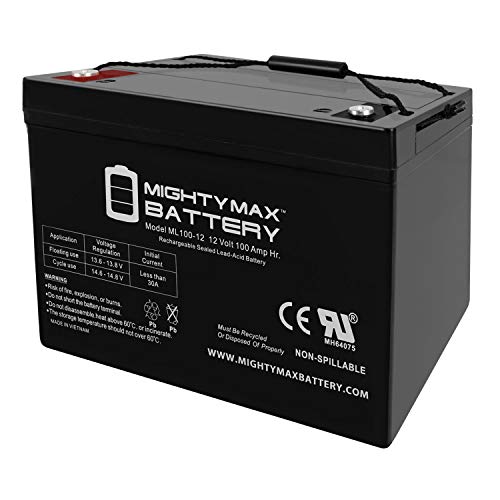
The Mighty Max Battery ML100-12 takes the second slot as a straightforward value option: a 12-volt, 100Ah rechargeable SLA AGM battery with internal thread (INT) terminals, sold with mounting screws. Battery Equivalents describes it as a Group 27 AGM battery designed for deep-cycle, off-grid applications, and notes that it is not well suited to starting or cranking work but works well as a trolling motor battery — exactly the job profile in this guide.
Construction is maintenance-free and spill-proof, with a heavy-duty calcium-alloy grid, and the sealed case can be mounted in any position and resists shocks and vibration. Its case measures about 12.09 by 6.65 by 8.48 inches, so it fits the same Group 27 class trays as the VMAXTANKS above, while its internal-thread terminals take the supplied screws rather than posts. At 63.9 pounds it carries like every other 100Ah lead-acid battery here, so plan on a secure hold-down. Choose it if you want a dedicated trolling bank at the simpler end of the range and do not need cranking output from the same battery.
Specs
- Brand: Mighty Max Battery; Model: ML100-12; ASIN: B00S1QCK94; Chemistry: AGM deep-cycle sealed lead-acid (SLA); Voltage: 12V; Capacity: 100Ah; Group size: 27; Terminals: Internal thread (INT); Dimensions: 12.09 x 6.65 x 8.48 inches; Weight: 63.9 pounds
3. Renogy Deep Cycle AGM 100Ah — Documented Ratings, Slow Self-Discharge

Renogy is best known for solar equipment, and its Deep Cycle AGM battery applies the same documentation-first approach to a 12-volt, 100Ah lead-acid battery listed for RV, camping, cabin, marine, and off-grid use. The listing identifies the cell composition as lead-acid AGM and the model as RNG-BATT-AGM12-100-US, and Renogy rates the capacity at 100Ah at the 10-hour rate to 10.5 volts — a more demanding rating basis than the 20-hour figures quoted elsewhere, so compare like with like when judging runtime.
The listing quotes a maximum discharge current of 1100 amps and a self-discharge rate of 3 percent, which suits a trolling bank that sits between trips, though a maintainer remains the better habit. The case measures 13.1 by 6.9 by 8.6 inches at 63.9 pounds, so measure a Group 27 tray carefully: the case is closer to Group 31 length. The listing also notes a two-year prorated material and workmanship warranty. Choose it if published ratings and slow self-discharge matter to you and your tray can take the longer case.
Specs
- Brand: Renogy; Model: RNG-BATT-AGM12-100-US; ASIN: B075RFXHYK; Chemistry: AGM deep-cycle sealed lead-acid; Voltage: 12V; Capacity: 100Ah (10-hour rate); Maximum discharge current: 1100A; Self-discharge rate: 3 percent; Dimensions: 13.1 x 6.9 x 8.6 inches; Weight: 63.9 pounds
4. Universal Power Group UB121000 — Straightforward 100Ah AGM Value

The Universal Power Group UB121000, also identified by UPG number 45978, is a no-frills 100Ah AGM deep-cycle battery sold for years across solar, RV, marine, and backup-power channels. For trolling use, its appeal is simple: a full 100Ah of sealed capacity in a Group 27 class case, with valve-regulated, spill-proof construction that can be mounted in any position and resists shocks and vibration, according to the product description. It is a dedicated energy reservoir for the trolling motor and accessories.
The UPG specification sheet lists 100Ah at the 20-hour rate, 93Ah at the 10-hour rate, and 85Ah at the 5-hour rate — a useful reminder that faster draws return fewer total amp-hours from any lead-acid battery. It also lists cycle-use charging voltage of 14.6 to 14.8 volts and float voltage of 13.6 to 13.8 volts, so a charger with a proper AGM profile is a good match. Listing dimensions are 12.17 by 6.61 by 9.16 inches at 63.93 pounds, with a one-year warranty. Choose the UB121000 if you want a dedicated trolling battery with standard specifications and broad replacement availability.
Specs
- Brand: Universal Power Group; Model: UB121000 (UPG 45978); ASIN: B00S1RT58C; Chemistry: AGM deep-cycle sealed lead-acid, valve-regulated (VRLA); Voltage: 12V; Capacity: 100Ah at the 20-hour rate; Group size: 27 class (Group 30H listing designation); Dimensions: 12.17 x 6.61 x 9.16 inches; Weight: 63.93 pounds
5. WEIZE 12V 100Ah Deep Cycle — Group 31 AGM for Larger Trays

The WEIZE 12V 100Ah Deep Cycle battery is the Group 31 option in this roundup. The listing identifies it by model QS12-100-T in a Group Size 31 case for RV, solar, camping, cabin, marine, and off-grid systems, and the WEIZE product page describes the same Group 31 battery as an AGM design with sealed lead-acid cells, suitable for trolling motors and intended for energy storage rather than engine starting.
Published figures include a maximum discharge current of 1150 amps for five seconds and a self-discharge rate of 3 percent per month. The brand page also publishes its charging window — cycle use at 14.5 to 14.8 volts and float at 13.5 to 13.8 volts — which lines up with a standard AGM charger profile. The case measures 12.99 by 6.73 by 8.34 inches, so it needs the longer Group 31 tray, a format widely stocked as a replacement size. Choose it if your boat has a Group 31 tray and you want a dedicated 100Ah AGM bank in that footprint.
Specs
- Brand: WEIZE; Model: QS12-100-T; ASIN: B0BGKHQQTP; Chemistry: AGM deep-cycle sealed lead-acid; Voltage: 12V; Capacity: 100Ah; Group size: 31; Maximum discharge current: 1150A (5 seconds); Self-discharge rate: 3 percent per month; Dimensions: 12.99 x 6.73 x 8.34 inches; Weight: 60 pounds
Frequently Asked Questions
How many amp-hours do I need for a 12-volt trolling motor?
For most 12-volt motors in the 30 to 55 lb thrust range, a single 100Ah lead-acid battery is the practical starting point. Plan on using about half of the rated capacity regularly, which gives roughly 50 usable amp-hours — enough for several hours of low to medium speed work, depending on wind, current, and boat weight. Anglers who use spot-lock heavily or fish long days should consider two batteries in parallel for 12-volt use.
Can one dual-purpose battery run both my outboard and trolling motor?
It can on smaller boats, but none of the five picks in this guide is built for that combined job — all five are dedicated deep-cycle AGM batteries, and models such as the Mighty Max ML100-12 are not designed as starting batteries. The trade-off with any shared bank is shared capacity: starting, pumps, electronics, and trolling all draw from the same reservoir, so a long day of trolling leaves less margin for starting. If you want one bank to do both jobs, shop the separate dual-purpose marine category; if your boat already has a starting battery, a dedicated trolling bank like the ones above is the simpler arrangement.
How should I charge and store an AGM trolling motor battery?
Use a charger with an AGM profile and follow the voltage guidance in the specification — for example, the UB121000 sheet lists 14.6 to 14.8 volts for cycle use and 13.6 to 13.8 volts for float. Recharge promptly after each trip, and avoid routinely draining it below about half capacity unless the manufacturer specifies a deeper rating. For storage, charge it fully, keep it cool, and use a maintainer or periodic top-up charges.
What is the difference between Group 27 and Group 31 marine batteries?
Group size is a standardized case dimension, not a capacity rating. Group 31 batteries are longer than Group 27 batteries and often carry higher capacity or cranking ratings, but they need a bigger tray and more hatch clearance, and they usually weigh more. Either size can serve a trolling motor well. Choose the one that fits your tray and hold-down, matches the capacity you require, and — for 24-volt or 36-volt systems — can be bought as matched units of the same model.
Conclusion
Staying with lead-acid is choosing the chemistry that matches standard marine chargers, cold-weather simplicity, and easy replacement almost anywhere boats are serviced. Within that field, the five batteries above cover the main ways anglers fish. The VMAXTANKS MR127-100 is the dedicated deep-cycle choice shaped specifically around trolling motors. The Mighty Max ML100-12 and the Renogy Deep Cycle AGM keep the same 100Ah dedicated format, one with internal-thread terminals, the other with closely published discharge ratings. The Universal Power Group UB121000 keeps things simple with standard 100Ah AGM specifications and broad availability. The WEIZE 12V 100Ah covers boats fitted with the larger Group 31 tray.
Size any model for your motor and longest day, use matched batteries for higher-voltage systems, and recharge promptly.
More from Amazon
Programs that pair well with the guide above. Offers and eligibility are set by Amazon and may change.
Free shipping on eligible items, Prime Video and more. Eligible new members can start with a free trial.
Start a Prime free trialA Prime membership for ages 18-24 with a trial period. Eligibility is set by Amazon.
See Prime for Young AdultsAudiobooks and podcasts to listen to on the go. Eligible new members can start with a free trial.
Try Audible freeAd-free music streaming. Eligible new subscribers can start with a free trial.
Try Music Unlimited freeAs an Amazon Associate we earn from qualifying purchases.


Write Your Review
No reviews yet. Be the first to share your experience!