

Key takeaways
- Every kayak angler has a story about watching a paddle drift away while a fish ran the line, or a rod slip overboard during a hookset.
Every kayak angler has a story about watching a paddle drift away while a fish ran the line, or a rod slip overboard during a hookset. A leash is the cheapest insurance in the sport. The keyword is about a small decision with outsized consequences: which tether keeps the paddle, the rod, or both attached to the boat or your body without tangling in the line or snagging on your seat when you need to move.
Most leashes in this group do double duty as paddle leashes and rod leashes, and the differences come down to length, stretch, and attachment style. Coiled leashes stay compact when relaxed, bungee leashes stretch farther, and retractable designs reel in slack. For 2026 shopping, the practical questions are how much length you need, whether the leash clips to your boat or your belt, and how it behaves when you are casting. Details come from the titles, so check lengths and clip hardware on each listing.
Quick Picks
Our top picks


As an Amazon Associate we earn from qualifying purchases at no extra cost to you.
| Product | Best for | Key spec from the title |
|---|---|---|
| MOPHOEXII Coiled Paddle Leash | A compact, tangle-resistant tether | Stretchable coiled lanyard, orange |
| OCEANBROAD Paddle Leash with D-Ring | A long bungee for paddle or rod | 4-7 feet, stretchable bungee, D-ring |
| Booms Fishing T02 Tether | Belt-mounted rod or tool tether | 5.9 inch belt, 2 pcs, heavy duty |
| HERCULES Fishing Pole Tether | Rods, pliers, and paddles | 17.7 inch, heavy duty lanyard |
| Go Pal PS1 Retractable Tether | Reeling in slack automatically | Retractable, 5.9 inch belt, heavy duty |
| MOOCY Paddle Leash | Adjustable length for paddle and rod | 3-7 ft stretchable strap lanyard |
How to Choose
Decide what the leash must hold
A paddle is light, long, and awkward, while a rod with a reel is heavier and can snag lines. A leash rated for paddles may not be suitable for a loaded combo in rough water. Check the listing for both uses, and plan one leash per item rather than sharing one tether between a rod and a paddle.
Think about failure modes. A paddle that floats away in wind can leave you stranded faster than you can swim after it, while a rod that goes over the side is a loss of money and a hazard to wildlife if the line stays in the water. Both are preventable with a leash that costs a fraction of the gear it protects. Treat the tether as part of your safety kit, not a nice-to-have.
Length and stretch
Stretchable leashes listed at 3 to 7 feet give you reach to paddle, cast, and still keep the item attached. Coiled models stay shorter when relaxed, which cuts the chance of tangles around a seat. A leash that is too long can catch on a rod holder or a cleat, and one that is too short pulls your cast.
As a rule of thumb, measure the distance from the anchor point to where the item sits when you use it, then add a few inches for movement. A paddle leash that lets the blade swing freely across the cockpit will tangle, while one that holds it close to the hull will not. For rods, the leash should let you reach the water with the tip but not let the reel drag in the bilge.
Attachment point and hardware
D-rings, carabiners, and belts all come up in these titles. Clip a leash to a strong anchor on the kayak, not to a flimsy accessory rail that could pull loose. Belt-style tethers fix the item to you rather than the boat, which helps if you capsize and the kayak drifts away.
Material matters on the water. Bungee cord and coiled urethane both resist saltwater, but cheap clips can corrode, and bare metal D-rings can stain or rust on a sit-on-top. Rinse leashes with fresh water after saltwater trips, and replace them when the stretch feels slack or the cord shows cracks. Sun also weakens elastic over a season or two.
Quick release and safety
Any leash can become a hazard in a capsize, particularly a stretchy one that wraps your arm. Use a quick-release attachment or a breakaway point whenever possible, and avoid wrapping a leash around your wrist in moving water. Budget leashes often cut corners on stitching and clip springs, so test them under load before trusting them on a trip.
The 6 Best Options
MOPHOEXII Coiled Paddle Leash
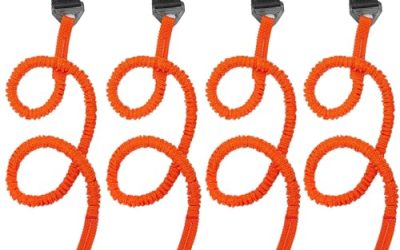
MOPHOEXII lists a stretchable coiled lanyard for paddles and rods, in orange for visibility. Coiled leashes compress when slack, so they stay out of the way and reduce the chance of snagging on your lap or a rod holder. The orange color helps you spot a dropped paddle in the water.
- Strength: coiled design stays compact.
- Strength: bright color aids visibility.
- Trade-off: coils offer less reach than long bungees.
Skip it if you need a leash longer than the coil’s extended range. The title also lists other pack sizes, so if you plan to leash a paddle, a rod, and a net, look at the multi-pack under a similar name. Coils tend to feel springy when you pull, which some paddlers like because they absorb sudden tugs.
OCEANBROAD Paddle Leash with D-Ring
The OCEANBROAD offers a stretchable bungee strap lanyard with a D-ring, listed for 4 to 7 feet and for paddle or fishing rod use. The D-ring makes it easy to clip onto an anchor point, and the range accommodates larger paddles and boats with high decks.
- Strength: 4-7 foot stretch range.
- Strength: D-ring simplifies clipping.
- Trade-off: a long bungee can tangle if left loose.
Skip it if you prefer a short, coiled tether. A two-pack version is also listed under a similar title, which makes sense for anglers who want to leash both a paddle and a rod. Because the range is long, trim the slack with a simple loop or knot so it does not drift around the cockpit.
Booms Fishing T02 Tether with Belt
Booms Fishing sells a heavy duty lanyard with a 5.9 inch belt, designed for tools, rods, and paddles, in black, as a pack of two. The belt design wraps around a rod handle or tool, then clips to a strong point. A pair covers a rod and a paddle, or two rods.
- Strength: belt attachment secures rods and tools.
- Strength: two pieces per pack.
- Trade-off: the belt length suits slim handles, so check your gear.
Skip it if you want one long leash instead of a short tether. Pairing a belt tether with a rod holder gives double protection: the holder keeps the rod upright, and the tether stops it if the holder fails. Anglers who run pliers and a fish gripper off the same tether style keep their kit organized.
HERCULES Fishing Pole Tether
HERCULES emphasizes versatility. The title calls it a fishing pole tether and kayak paddle leash, heavy duty, suitable for rods, pliers, boating, and paddles, with a 17.7 inch size. That makes it a general-purpose tool lanyard for a kayak angler who needs to secure several items.
- Strength: flexible use for rods, pliers, and paddles.
- Strength: heavy duty construction is listed.
- Trade-off: the 17.7 inch measurement may be the shortened length, so confirm stretch range.
Skip it if you need a long reach for a paddle. It fits best as a tool lanyard that stays clipped to your vest or the boat, so pliers, scissors, and a fish gripper are always one pull away. Test the clip under load before trusting it with an expensive item.
Go Pal PS1 Retractable Kayak Paddle Leash
Go Pal offers a heavy duty retractable tether with a 5.9 inch belt. Retractable leashes reel in slack, so the line stays tight against the boat and does not trail in the water. They shine when you cast frequently and want the tether out of the way.
- Strength: retractable design keeps slack under control.
- Strength: belt attachment secures the item.
- Trade-off: moving parts add complexity and potential wear.
Skip it if you want a simple, fixed-length lanyard with no mechanism. Keep sand and grit out of the housing by rinsing it after every trip, and watch for kinks in the line, since a retractable that sticks halfway out can be more annoying than a plain bungee.
MOOCY Kayak Paddle Leash
MOOCY describes a stretchable strap lanyard rope of 3 to 7 feet, for paddle or rod, with fishing accessories in mind. It is a general adjustable option for kayakers and SUP users who want a leash that handles a range of boats.
- Strength: 3-7 foot range suits many setups.
- Strength: dual use for paddles and rods.
- Trade-off: the title provides few hardware details.
Skip it if you want a documented D-ring or belt style. Because it is adjustable and sold without much detail in the title, read the product images to see the end fittings and the way the strap closes around a shaft, and make sure the loop is large enough for your paddle shaft or rod butt.
Which One Fits Your Situation
You fish with a baitcaster and worry about hooksets
The Booms Fishing T02 tether secures the rod handle, and the Go Pal PS1 retractable design helps keep slack from catching.
You paddle long distances
The MOPHOEXII Coiled Paddle Leash keeps the paddle close without extra line.
You want one leash for different boats
The OCEANBROAD or MOOCY stretch leash adjusts across a range of lengths.
You carry pliers, scissors, and tools
The HERCULES tether is a flexible choice for multiple items.
You fish in a crowded launch or around brush
A compact option such as the MOPHOEXII coiled leash or the Go Pal retractable tether keeps loose line out of snags and out of other anglers’ casts.
Whatever you pick, set it up at the dock before launching. Clip it to the boat, hold the item at arm’s length, and move through your normal paddle and casting motions. If the leash tugs, binds, or catches on your seat, adjust the anchor point or shorten the tether before you leave shore. A few minutes of adjustment saves a lot of frustration on the water, and it makes the leash something you stop noticing instead of something you fight.
Common Mistakes
- Wrapping a leash around a wrist, creating an entanglement hazard.
- Clipping to a weak anchor that could tear free.
- Choosing a leash too long, then fighting tangles with rod holders.
- Using one leash for both a heavy rod and a paddle.
- Ignoring wear on the clip and stitching after a season of use.
Related guides
- Shimano Stradic Fl Vs Daiwa Bg Spinning Reel
- Polarized Sunglasses For Kayak Fishing
- Battery Chargers For Marine Batteries
Frequently Asked Questions
Should I attach the leash to me or the kayak?
Attaching to the kayak keeps the gear near the boat. Attaching to your body keeps it near you. Many anglers choose the boat anchor for paddles and a belt tether for rods.
Do coiled leashes work better than bungee?
Coiled leashes stay compact and tangle less. Bungee leashes stretch farther and suit long reach.
Can a leash be dangerous?
Yes, if it tangles around a limb in moving water. Use quick-release hardware and avoid leashing yourself to the boat in current.
How many leashes do I need?
One for the paddle and one for each rod is a good rule. Add one for pliers and tools if you carry them.
More from Amazon
Programs that pair well with the guide above. Offers and eligibility are set by Amazon and may change.
Free shipping on eligible items, Prime Video and more. Eligible new members can start with a free trial.
Start a Prime free trialA Prime membership for ages 18-24 with a trial period. Eligibility is set by Amazon.
See Prime for Young AdultsAudiobooks and podcasts to listen to on the go. Eligible new members can start with a free trial.
Try Audible freeAd-free music streaming. Eligible new subscribers can start with a free trial.
Try Music Unlimited freeAs an Amazon Associate we earn from qualifying purchases.
Write Your Review
No reviews yet. Be the first to share your experience!