

Key takeaways
- Bed knife and reel edges: Contact with stones, sticks, and edging can nick the cutting surfaces. Keep the reel clear of debris and use proper sharpening or backlapping equipment when the mower starts tearing rather than slicing.
- Wheel gears and bushings: These transfer wheel rotation to the reel and can collect grass or dirt. Clean underneath the side covers when the reel begins turning inconsistently.
- Height-adjustment hardware: Lever pivots and threaded adjusters can seize if packed with dried clippings. Brush them clean before applying a manufacturer-approved lubricant.
- Handle fasteners: Vibration and repeated folding can loosen bolts. Check them periodically, especially before pushing a heavier mower uphill.
- Grass buildup: Wet clippings increase drag and can hide damage. Let the mower dry, brush it clean, and avoid storing it with damp material on the reel.
The best reel push mowers are the ones whose reel width, blade count, cutting-height range, weight, and grass compatibility match your lawn—not simply the model with the most blades or the lowest price.
Our top picks



As an Amazon Associate we earn from qualifying purchases at no extra cost to you. Ratings are shown as listed on Amazon.
Quick picks by lawn and mowing situation
| Situation | Most practical choice | Useful target specifications | Why it fits |
|---|---|---|---|
| Small, flat lawn under 2,000 sq. ft. | Compact reel mower | 14–16-inch reel, 5 blades, 20–30 lb | Easy to store, turn, and push through narrow spaces |
| Typical suburban lawn of 2,000–5,000 sq. ft. | Adjustable 16–18-inch mower | 16–18-inch reel, 5–7 blades, 25–40 lb | Balances maneuverability with fewer passes |
| Dense, frequently cut fine grass | Higher-blade-count reel mower | 7–10 blades, low height setting, sharp bed knife | Produces a finer cut when the grass is not overgrown |
| Occasional mowing or longer grass | Wide, height-adjustable mower | 18-inch reel, 5 blades, roughly 1–3 inches of adjustment | Handles a wider range of conditions, though it still dislikes tall weeds |
| Uneven ground or slopes | Lighter narrow mower | 14–16 inches, under 30 lb, large traction wheels | Less tiring to control and easier to keep aligned |
What matters most when choosing a reel mower
Reel width: coverage versus control
A wider reel cuts more grass per pass, but it also requires more force to start, turn, and push through thick growth. A 14-inch mower needs about 14% more passes than a 16-inch mower over the same straight-line distance, while an 18-inch mower reduces pass count further. That advantage matters on larger lawns, but it can disappear if the wider mower bogs down in damp or tall grass.
For a compact yard with garden borders, trees, or gates, 14 to 16 inches is usually easier to live with. For an open lawn of several thousand square feet, 16 to 18 inches is a more efficient compromise. Measure shed doors and storage space before choosing an 18-inch model.
Blade count: smoothness is not the whole story
Most consumer reel mowers use five blades. They are versatile, relatively easy to push, and suitable for common cool-season and warm-season lawn grasses when mowing is regular. Seven or more blades place more cutting edges along the reel, which can improve the finish on short, fine grass such as closely maintained fescue or certain warm-season turf types.
More blades do not automatically make a mower better. A high-blade-count reel can be harder to push through long growth, and its cutting system must remain accurately adjusted. If your lawn is often more than a third taller than your chosen mowing height, a five-blade design is generally more forgiving.
Cutting-height range
Look for tool-free or simple lever adjustment with clearly marked settings. A range around 0.5 to 1.75 inches suits short, frequently mowed turf. A range around 1 to 3 inches is more flexible for mixed residential lawns, though the highest setting may not be ideal for every grass type.
Do not choose the minimum height solely because it gives a traditional striped appearance. Removing too much leaf in one session makes pushing harder and can leave clippings clumped on the surface. A reel mower works best when it removes no more than roughly one-third of the grass blade at a time.
Best reel push mower types for different grasses
Fine, closely maintained turf
Choose a 7- or 10-blade reel when the lawn is already maintained at a short height and mowed frequently. These mowers can deliver a clean finish, but they are less tolerant of missed mowing sessions, sticks, thatch, and seed heads.
Common cool-season lawn grass
For Kentucky bluegrass, perennial ryegrass, and tall fescue, a five-blade mower with a useful height range is usually the sensible choice. Keep the grass within the mower’s adjustment range and mow often enough that the reel does not have to chew through a large volume at once.
Warm-season grass
Bermudagrass and similar fine-textured turf can suit a higher-blade-count reel when maintained short. St. Augustinegrass and other coarser grasses may be more difficult for a small reel mower, especially when thick, wet, or allowed to grow tall. In those conditions, a powered mower may be more practical.
Weedy or neglected lawns
A reel mower is a poor substitute for brush-cutting equipment. Tall weeds, vines, woody stems, pinecones, and hidden sticks can stop the reel or damage the bed knife. Clear the lawn first and expect to make two passes at different angles if the grass has become uneven.
Head-to-head: common reel mower configurations
| Configuration | Typical width | Typical weight | Best use | Main compromise |
|---|---|---|---|---|
| Compact five-blade | 14 inches | 20–25 lb | Small, flat lawns and limited storage | More passes and a narrower cutting path |
| Standard five-blade | 16 inches | 25–35 lb | General residential mowing | Less refined on very short fine turf |
| Wide five-blade | 18 inches | 35–45 lb | Open lawns and regular mowing | Heavier steering and more storage space |
| Seven- to ten-blade | 16–18 inches | 30–45 lb | Short, fine grass and frequent mowing | Less tolerant of tall or coarse growth |
Reliable models and what they illustrate
The Fiskars StaySharp Max demonstrates the wide, adjustable residential design: it has an 18-inch cutting width, a height range commonly listed from about 1 to 4 inches, and a heavier frame than basic compact mowers. Its manual cutting system is intended to reduce frequent blade sharpening, although it still needs cleaning and adjustment.
The Scotts 304-14S represents the compact five-blade category. Its 14-inch width and light build suit small lawns, pathways, and users who prioritize easy storage. The narrow reel means more passes, but its size is an advantage around landscaping.
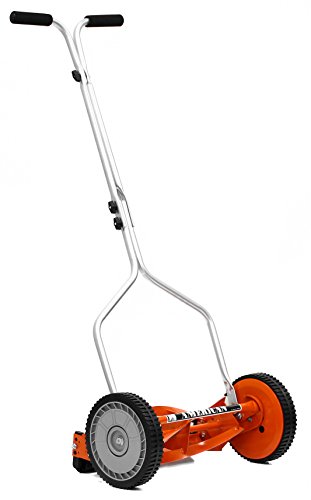
The American Lawn Mower Company 1204-14 is another example of a simple 14-inch, five-blade mower. Models in this category are often inexpensive, with general market prices commonly around $70–$130. They are useful when the lawn is small and regularly cut, but their basic height adjustment and lightweight wheels may feel less substantial on uneven ground.
An 18-inch American Lawn Mower Company model such as the 1815-18 illustrates the wider five-blade format. It covers more ground than a 14-inch mower, but the added width and mass make it a better match for an open lawn than a cramped yard with frequent turns. Prices for sturdier reel mowers commonly fall in the approximate $70–$200 range, depending on construction and adjustment features.
A simple sizing calculation
Suppose a rectangular lawn is 50 feet by 60 feet, or 3,000 square feet. Ignoring overlap and obstacles, a 14-inch mower has a 1.17-foot cutting path and requires about 51 passes across the 60-foot dimension. A 16-inch mower needs about 45 passes, while an 18-inch mower needs about 40 passes.
Real mowing requires overlap, turning, and trimming around edges, so the actual difference is smaller than the calculation suggests. Still, the example shows why a 14-inch mower can be pleasant on a tiny lawn but tedious on a broad open one. If the ground is uneven or the operator has limited pushing strength, the lighter mower may remain the better choice despite the extra passes.
Ownership realities: what wears first
- Bed knife and reel edges: Contact with stones, sticks, and edging can nick the cutting surfaces. Keep the reel clear of debris and use proper sharpening or backlapping equipment when the mower starts tearing rather than slicing.
- Wheel gears and bushings: These transfer wheel rotation to the reel and can collect grass or dirt. Clean underneath the side covers when the reel begins turning inconsistently.
- Height-adjustment hardware: Lever pivots and threaded adjusters can seize if packed with dried clippings. Brush them clean before applying a manufacturer-approved lubricant.
- Handle fasteners: Vibration and repeated folding can loosen bolts. Check them periodically, especially before pushing a heavier mower uphill.
- Grass buildup: Wet clippings increase drag and can hide damage. Let the mower dry, brush it clean, and avoid storing it with damp material on the reel.
The most common mistake is waiting until the grass is too tall. A reel mower cuts with a scissor-like action, so a sharp, correctly adjusted reel is essential. If the reel spins but leaves ragged blades, check adjustment before assuming the entire mower needs replacement.
How to choose in five steps
- Measure the lawn and access points. Pick 14–16 inches for tight spaces and 16–18 inches for open areas.
- Identify the grass and normal mowing height. Match the mower’s adjustment range rather than choosing by blade count alone.
- Consider mowing frequency. Weekly or more frequent mowing supports a reel mower; irregular mowing favors a more tolerant five-blade design or a powered alternative.
- Check weight against the terrain. A heavier mower may track better on level ground, while a lighter mower is easier on slopes and during turns.
- Inspect serviceability. Prefer accessible adjustment points, replaceable hardware, and clear sharpening instructions.
Bottom line
For most homeowners, the best reel push mowers are 16-inch, five-blade models with a useful height range and a manageable weight. Choose a compact 14-inch mower for a small or crowded lawn, an 18-inch model for an open yard, and a seven- or higher-blade design only when you consistently maintain short, fine grass. The right match will cut quietly and cleanly; the wrong one will make every missed mowing session feel like a mechanical problem.

Write Your Review
No reviews yet. Be the first to share your experience!