

Key takeaways
- Up to 2 acres: A 42- to 54-inch deck is usually easier to store and maneuver.
- 2 to 4 acres: A 48- to 54-inch deck offers a good balance of speed and access.
- 4 to 8 acres: A 54- to 61-inch deck is usually more productive, especially on open ground.
- More than 8 acres: Consider a commercial-style zero-turn mower, a larger fuel tank, serviceable hydrostatic transmissions, and a deck built for frequent use.
Best Zero-Turn Mowers for Large Yards
The best zero turn mowers for large yards are the Scag Liberty Z for tough, frequent mowing, the Ferris ISX 800 for comfort on rough ground, the Toro Titan for an all-around residential choice, and the John Deere Z530R for homeowners who want a refined, easy-to-use machine.
For most properties, a 54- to 61-inch deck is the useful middle ground. A 60-inch mower can reduce mowing time substantially, but only if gates, landscaping, slopes, and storage space can accommodate its width. Engine power, deck construction, fuel capacity, and operator comfort matter more than a single headline speed figure when mowing several acres.
Our top picks
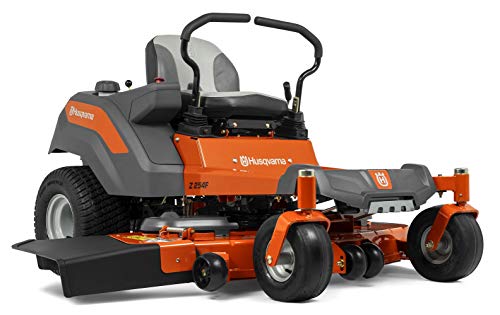


As an Amazon Associate we earn from qualifying purchases at no extra cost to you. Ratings are shown as listed on Amazon.
Quick comparison of leading large-yard choices
| Mower | Typical cutting width | Engine output | Fuel capacity | Deck construction | Best suited to |
|---|---|---|---|---|---|
| Scag Liberty Z | 48, 52, or 61 inches | About 23–27 hp, depending on configuration | Approximately 5 gallons | Welded steel, commonly 10-gauge | Large residential yards and demanding weekly use |
| Ferris ISX 800 | 48, 52, or 61 inches | About 27 hp on larger configurations | Approximately 5 gallons | Welded fabricated steel | Uneven ground and comfort-focused mowing |
| Toro Titan | 48, 54, or 60 inches | About 24–26 hp, depending on engine | Approximately 5 gallons | Fabricated steel, commonly 10-gauge | Homeowners mowing roughly 2–5 acres |
| John Deere Z530R | 48, 54, or 60 inches | About 24 hp on common configurations | Approximately 4.5 gallons | Welded, fabricated steel deck | Comfortable residential mowing and frequent use |
| Cub Cadet Ultima ZT2 | 50, 54, or 60 inches | About 23–24 hp on larger configurations | Approximately 3.5 gallons | Fabricated steel | Value-conscious buyers with moderately large yards |
These are representative specifications for commonly sold configurations rather than a guarantee for every model-year variation. Engine suppliers, deck sizes, and equipment packages can change by dealer and region.
Best overall: Toro Titan
The Toro Titan is a strong all-around choice when the yard is too large for a basic residential mower but does not require a commercial machine. Its 54- and 60-inch decks cover ground quickly, while the fabricated deck is more resistant to flexing and impact damage than a thin stamped deck.
The Titan’s controls are approachable for a first-time zero-turn owner, and its high-back seat and armrests make long mowing sessions less tiring. The larger configurations generally have enough engine power for normal grass, moderate hills, and bagging without feeling underpowered.
Choose the Titan when you mow one to five acres several times per month and want a durable residential machine without moving into the highest commercial price range. A typical market range is roughly $5,000 to $8,000, depending on deck size, engine, suspension features, and dealer pricing.
Best for rough ground: Ferris ISX 800
The Ferris ISX 800 stands out because its suspension system addresses a problem that a larger engine cannot solve: repeated impacts from uneven terrain. Suspension at the seat and front end can reduce jolts over roots, ruts, and rolling ground, making it a sensible pick for large properties that are not smoothly graded.
Its 61-inch configuration is aimed at fast coverage, and larger-engine versions provide useful reserve power when grass is thick or the operator is using a grass catcher. The tradeoff is cost and complexity. More suspension components mean more pivot points, bushings, and hardware to inspect than on a simple fixed-frame mower.
This is the better choice when comfort and ground-following behavior matter more than the lowest purchase price. It is also attractive for owners who mow frequently enough that reduced fatigue has practical value.
Best for durability: Scag Liberty Z
The Scag Liberty Z is worth considering when deck longevity and commercial-style construction are priorities. Its welded steel deck, robust spindle assemblies, and available 61-inch configuration make it well suited to large lawns with long mowing seasons.
Scag’s steering response is predictable, but a heavier mower can feel less nimble around small garden beds than a lighter residential machine. The Liberty Z is best when the property has broad open areas where its cutting width can be used efficiently.
Buyers should compare the local dealer’s parts and service support before choosing it. A durable deck still needs spindle lubrication where specified, blade replacement, belt inspection, and cleaning beneath the deck. Expect a general market range of approximately $6,000 to $10,000, depending on configuration and regional pricing.
Best refined residential choice: John Deere Z530R
The John Deere Z530R is a good fit for homeowners who value a comfortable seat, intuitive controls, a polished operator station, and straightforward dealer support. The 54-inch deck is often the most practical size for a large residential yard because it offers strong productivity without becoming difficult to maneuver through gates.
The 60-inch model makes more sense on open acreage with few obstacles. With roughly 24 horsepower in common configurations, it is appropriately matched to routine residential mowing, although very thick grass, steep hills, or frequent bagging may justify comparing engine torque and deck discharge performance rather than looking only at horsepower.
John Deere residential zero-turn models commonly cost about $5,500 to $8,500. The brand’s dealer network can be an advantage, but local service quality and parts availability should still be checked before purchase.
Best value: Cub Cadet Ultima ZT2
The Cub Cadet Ultima ZT2 is a practical value option for homeowners who want a fabricated deck and a 50- to 60-inch cutting width without paying for a commercial-grade chassis. The 54-inch version is a particularly sensible compromise for properties around two to four acres.
Its smaller fuel tank can mean more refueling on very large properties, especially when mowing thick grass or using a bagger. That is not a major drawback for occasional use, but it matters if the mower runs for several hours every week.
Look for a typical price range of approximately $4,000 to $6,500. It is most appropriate for owners who maintain their own equipment and want good deck construction at a moderate upfront cost.
How to choose the right deck width
Use the property’s usable mowing area, not its total deeded acreage. Buildings, ponds, woods, steep slopes, and planted beds can remove a large portion of the area that the mower actually covers.
- Up to 2 acres: A 42- to 54-inch deck is usually easier to store and maneuver.
- 2 to 4 acres: A 48- to 54-inch deck offers a good balance of speed and access.
- 4 to 8 acres: A 54- to 61-inch deck is usually more productive, especially on open ground.
- More than 8 acres: Consider a commercial-style zero-turn mower, a larger fuel tank, serviceable hydrostatic transmissions, and a deck built for frequent use.
For a simple coverage estimate, assume a 60-inch mower has an effective mowing width of 56 inches after allowing for overlap. At an average ground speed of 5 miles per hour, its theoretical coverage is about 2.33 acres per hour. If turning, obstacles, and overlap reduce efficiency to 70 percent, practical coverage is about 1.6 acres per hour. A 3-acre open lawn could therefore require roughly two hours, while a fragmented property may take considerably longer.
What matters more than maximum speed
Engine power
For a 54- to 61-inch deck, approximately 23 to 27 horsepower is a useful range for residential work. More power helps in tall, damp grass and when bagging, but it does not compensate for a poorly matched deck, dull blades, low tire pressure, or mowing too quickly.
Hydrostatic transmissions and turning
Zero-turn steering saves time around trees and beds, but aggressive pivot turns can tear turf, especially when the ground is wet. Smooth control levers and correctly matched rear-tire pressure produce cleaner turns than simply choosing the fastest mower. On slopes, avoid turning downhill or making abrupt direction changes; a riding mower’s stability depends on terrain, tire grip, and the manufacturer’s operating limits.
Deck durability
A fabricated, welded steel deck is generally preferable for large-yard use because it resists bending and cracking better than a lightweight stamped deck. Still, deck thickness is not the only consideration. Inspect spindle housings, discharge-chute hinges, blade access, anti-scalp wheels, and the underside for areas where wet clippings can accumulate.
Comfort and access
For mowing sessions longer than an hour, prioritize a high-back adjustable seat, armrests, a wide foot platform, low vibration, and controls that remain easy to operate after fatigue sets in. A suspension seat is particularly useful on rough acreage, while a simple fixed seat may be adequate on a smooth, level lawn.
Ownership realities and maintenance
The parts that commonly wear first are blades, deck belts, idler pulleys, spindle bearings, tires, and seat or control-linkage hardware. Budget for at least one or two blade changes per season if the property contains hidden sticks, sandy soil, or frequent debris. Keep spare shear bolts or fasteners recommended by the manufacturer available, and do not mow over objects that cannot be clearly seen.
- Remove clippings from the deck after mowing, especially when grass is wet.
- Check engine oil, air filtration, tire pressure, and blade condition before long mowing sessions.
- Grease specified fittings at the interval in the owner’s manual.
- Keep both rear tires at matching pressure so the mower tracks and turns evenly.
- Use a fuel stabilizer when gasoline will sit during the off-season.
- Never assume a zero-turn mower is safe on a slope just because it has wide rear tires.
Final buying recommendation
Choose the Toro Titan for the best balance of price, comfort, deck size, and capability. Choose the Ferris ISX 800 for rough ground, the Scag Liberty Z for heavier-duty construction, the John Deere Z530R for a refined residential experience, and the Cub Cadet Ultima ZT2 when purchase price is the main constraint.
Before buying, measure the narrowest gate, confirm storage-door clearance, calculate usable acreage, and compare the nearest service dealer. A mower that fits the property and can be maintained locally is usually a better long-term choice than a wider or faster model that cannot comfortably reach every section of the yard.

Write Your Review
No reviews yet. Be the first to share your experience!