

Key takeaways
- Rifle and optic: 14 pounds
- Front rest or bipod: 8 pounds
- Rear bag and ammunition: 6 pounds
- Spotting scope and accessories: 10 pounds
- Downward or sideways support force: approximately 50 pounds
Best Shooting Benches for Stable, Precise Practice
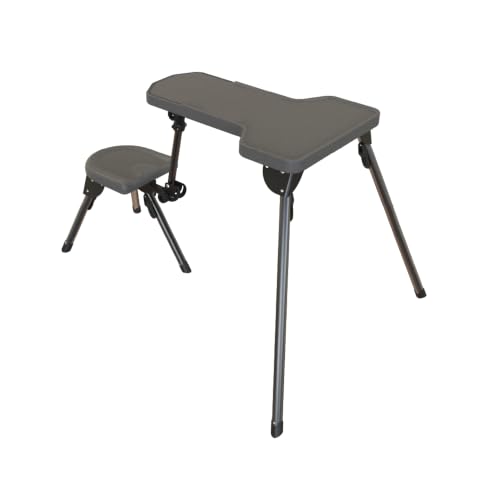
The best shooting benches are rigid enough to resist movement, large enough to support your rifle and accessories, and adjustable enough to level securely on uneven ground; for most range users, a steel-framed bench with a 36-by-23-inch top, at least 300 pounds of capacity, and adjustable feet is the strongest all-around choice.
A bench can improve repeatability, but it cannot compensate for a wobbly top, an uncomfortable shooting-side layout, or a setup that shifts between groups. The right choice depends on whether you leave equipment at a permanent range, transport the bench in a vehicle, or need a compact platform for occasional practice.
Our top picks


As an Amazon Associate we earn from qualifying purchases at no extra cost to you. Ratings are shown as listed on Amazon.
Best shooting bench types by situation
| Range situation | Best bench type | Target specifications | Main compromise |
|---|---|---|---|
| Permanent or semi-permanent range setup | Heavy steel or steel-and-concrete bench | 150–300 lb; 36–48 in. top; 500 lb or greater capacity | Difficult to move and may require anchoring |
| Regular transport to a public range | Folding steel-frame bench | 35–70 lb; 32–40 in. top; 300–500 lb capacity | Less rigid than a permanent structure |
| Occasional use, limited storage, or short walks from a vehicle | Lightweight folding bench | 15–35 lb; 28–36 in. top; 200–300 lb capacity | More sensitive to recoil and uneven ground |
| Precision load development or long-range practice | Wide, heavy bench with extensive leveling | 40–100 lb; 36–48 in. top; independent leg adjustment | Bulkier and slower to position |
What separates a stable bench from a merely usable one?
Frame stiffness and contact with the ground
Look first at the frame, not the advertised tabletop size. A bench with a thick steel frame, triangulated supports, and positive leg locks will usually remain steadier than a larger bench with thin tubing and a flexible hinge. Four legs offer better support for broad tabletops, while a three-leg design can sit firmly on irregular ground without rocking if its leveling system is well made.
Feet should have broad, non-slip contact surfaces. Narrow metal feet can sink into soil or skate across concrete. Adjustable feet are particularly valuable on outdoor ranges, where a difference of even half an inch between corners can make the shooting position uncomfortable and introduce movement as you shift your weight.
Tabletop dimensions and usable depth
A 36-by-23-inch tabletop is a practical minimum for a rifle, front rest or bipod, rear bag, ammunition, and a spotting scope. A 48-by-24-inch top gives more room for a second rifle or larger optics, but adds weight and can become awkward in a confined firing point.
Depth matters as much as width. Less than 20 inches can force the rifle too close to the front edge, leaving little space for a rear bag. More than 26 inches may be comfortable for equipment but can make it harder to reach controls while maintaining a consistent position. Rounded front corners reduce the chance of catching clothing or resting an elbow against a sharp edge.
Weight capacity and real-world loading
Do not choose capacity based only on the rifle. Add the weight of the optic, bipod or front rest, rear bag, ammunition, spotting scope, and the pressure applied by the shooter. For example:
- Rifle and optic: 14 pounds
- Front rest or bipod: 8 pounds
- Rear bag and ammunition: 6 pounds
- Spotting scope and accessories: 10 pounds
- Downward or sideways support force: approximately 50 pounds
This produces about 88 pounds of practical loading. A bench rated for 150 pounds may hold it, but a 300-pound rating provides a more useful margin against flexing and premature wear. Capacity is not a substitute for rigidity: a bench can support a large static load and still move when a shooter leans into it.
Head-to-head: permanent, folding, and lightweight benches
Permanent benches
Heavy benches are the stability leaders. Steel or concrete construction resists recoil-related movement and makes it easier to reproduce the same rifle position from session to session. They are best for a private range or a club that can dedicate a firing point.
The disadvantages are practical rather than ballistic. Moving a bench may require two people or a cart, and untreated steel can rust around welds, fasteners, and drainage points. If the bench is anchored, confirm that its height and shooting-side orientation suit both right- and left-handed users before drilling.
Folding steel benches
Folding benches offer the best balance for many shooters. A 35-to-70-pound model can usually be transported in a vehicle while providing enough mass for rimfire, pistol-caliber carbine, and many centerfire practice applications. Check that the legs lock mechanically rather than relying only on friction or an elastic strap.
Hinges and locking pins are the first areas to inspect. Play at a hinge may be barely noticeable when the bench is empty but obvious when the shooter presses forward during recoil. A replaceable pin, captive hardware, and a frame that does not twist when lifted from one corner are useful signs of a maintainable design.
Lightweight benches
Light benches are convenient for informal practice and ranges with long walks from parking areas. They can be a good choice for smaller rifles, air rifles, and low-volume sessions. However, a 15-to-25-pound platform may move when used with a heavy rifle or when the shooter changes position.
If portability is the priority, choose a bench with a low center of gravity, wide feet, and room to place a sandbag or other non-damaging ballast beneath the frame. Never exceed the manufacturer’s capacity or use improvised weights that can interfere with leg locks.
Shooting-side layout: right-handed, left-handed, or shared?
Many benches are not truly ambidextrous. A straight front edge works for either hand, while a cutout or wraparound top may favor one shoulder. A right-handed shooter generally benefits from open space on the right for the trigger hand and from a front rest positioned slightly left of center. A left-handed shooter may need the reverse.
Before buying, measure the usable area rather than the outside dimensions. Some frames occupy several inches beneath the tabletop and can obstruct knees or prevent a rear bag from sitting where it belongs. A shared bench should have unobstructed legroom, no fixed accessory tray on only one side, and enough width for the rifle to move safely between firing positions.
Weather-resistant construction and ownership costs
Outdoor benches face rain, condensation, dust, ultraviolet exposure, and grit in folding joints. Powder-coated steel is generally more practical than bare steel, but coating damage must be repaired before corrosion spreads. Aluminum resists rust and reduces carrying weight, although thin aluminum sections can flex more than steel and threaded holes can wear if repeatedly over-tightened.
A weather-resistant top should be sealed against water absorption. Wood can work well when sealed on every surface, including edges and drilled holes, but it needs periodic inspection for swelling, splitting, and loose fasteners. Plastic or composite tops do not rust, yet they may bend under a concentrated load unless supported by a substantial frame.
After each wet outing, unfold the bench and dry the hinges and underside rather than storing it immediately. Brush grit from locking pins, apply a light corrosion-inhibiting lubricant to suitable metal joints, and avoid coating surfaces that must grip. Tighten loose bolts gradually and evenly; overtightening can crush composite material or deform thin tubing.
A simple buying decision matrix
| Your priority | Choose | Avoid |
|---|---|---|
| Lowest cost and occasional use | Basic folding steel bench with a 28–36 inch top | Oversized permanent benches that will remain in storage |
| Maximum precision | Heavy frame, leveling feet, 36-inch-or-wider top, 300-pound-plus capacity | Light frames with flexible center hinges |
| Small vehicle or limited storage | Bench under 40 pounds with a compact folded profile | Fixed shelves and non-removable accessory arms |
| Frequent outdoor use | Powder-coated steel or corrosion-resistant aluminum with sealed top | Bare steel and absorbent unsealed wood |
| Multiple shooters | Ambidextrous straight-edge top with clear legroom | One-sided cutouts or permanently offset accessories |
How to set up a shooting bench for repeatable groups
- Place the legs on firm ground. Remove loose gravel, mud, and vegetation beneath each foot. A level bench on a soft surface can still shift.
- Level the tabletop. Adjust each foot or reposition the bench until it does not rock when pressure is applied to opposite corners.
- Center the rifle support. Keep the front rest or bipod aligned with the bench frame instead of placing all the load on a thin overhanging edge.
- Set the rear bag and chair height. Your shoulders should remain relaxed, with the rifle pointing naturally toward the target rather than being forced sideways.
- Check every lock before loading. Confirm leg pins, hinges, height collars, and accessory clamps are fully engaged.
A useful fit check is to place the rifle, rear bag, ammunition, and spotting scope on the bench before shooting. If the scope occupies the only clear space for your support hand, the tabletop is functionally too small even if its advertised dimensions look adequate.
Final buying guidance
For most shooters, the best shooting bench is a folding steel model with a 32-to-40-inch tabletop, at least 300 pounds of rated capacity, positive leg locks, independent leveling, and an open, ambidextrous shooting side. Choose a heavier permanent bench when stability matters more than transport, and a lightweight model only when carrying distance or storage space outweighs maximum rigidity.
Prioritize frame stiffness, usable tabletop area, and reliable ground contact before extras such as cup holders or accessory trays. Those fundamentals have the greatest effect on consistent practice and will usually determine whether the bench remains useful after the novelty of the first range trip wears off.


Write Your Review
No reviews yet. Be the first to share your experience!