

Key takeaways
- 10–12 feet: best for one or two people, short trips, and compact storage. Motor and load limits are modest.
- 13–15 feet: a useful size for two or three anglers on inland water, especially with a 15–40 hp outboard or electric propulsion system.
- 16–18 feet: the most versatile range for families, larger lakes, and serious freshwater fishing. Plan for a stronger trailer and a larger storage footprint.
- 19 feet and above: better for coastal use, rougher conditions, and larger crews, but ownership costs rise quickly.
The best fishing boats are the ones whose length, hull shape, draft, carrying capacity, storage, motor system, and transport method match the water you actually fish—not simply the boat with the biggest deck or engine.
Our top picks


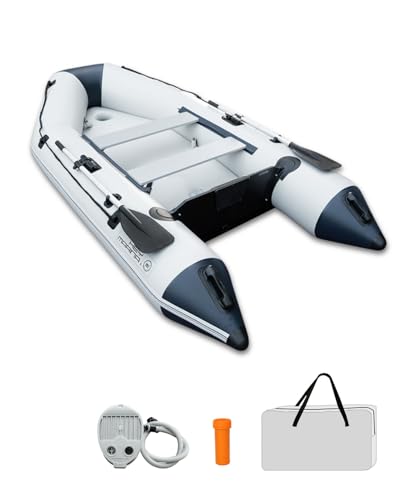
As an Amazon Associate we earn from qualifying purchases at no extra cost to you. Ratings are shown as listed on Amazon.
Quick picks by fishing situation
| Fishing situation | Best boat type | Useful target specifications | Why it fits |
|---|---|---|---|
| Small lakes and ponds | Aluminum jon boat, small utility boat, or fishing kayak | 10–14 ft; 250–700 lb hull; 2–3 people; 4–8 in draft | Lightweight, shallow-running, and inexpensive to launch |
| Large lakes and reservoirs | Deep-V aluminum boat or fiberglass bass boat | 16–19 ft; 900–1,500 lb hull; 4–5 people; 18–24 in draft | Better stability and control when wind creates chop |
| Slow rivers and backwaters | Flat-bottom jon boat or modified-V boat | 12–16 ft; 3–4 people; 6–12 in draft; 15–40 hp | Handles shallow water, stumps, mud, and frequent beaching |
| Fast, rocky, or winding rivers | Modified-V aluminum boat or drift boat | 14–18 ft; reinforced keel; 3–4 people; 8–16 in draft | More directional stability and impact tolerance than a flat bottom |
| Protected coastal bays | Deep-V aluminum boat, bay boat, or center console | 17–21 ft; 1,200–2,200 lb hull; 4–6 people; 12–24 in draft | Higher freeboard, safer seating, and useful casting space |
| Nearshore coastal fishing | Center console or offshore-capable deep-V | 19–24 ft; self-bailing cockpit; 5–8 people; 115–250 hp | Improved rough-water handling, fuel range, and emergency capacity |
How water type changes the right hull
Lakes: prioritize wind stability and comfortable casting
A small flat-bottom boat is efficient on calm water, but it can feel twitchy when a lake breeze builds. For ponds and sheltered lakes, a 10- to 14-foot jon boat is often enough for one or two anglers. A wide beam—roughly 48 to 60 inches on smaller boats—provides useful standing stability, but beam alone does not make a boat safe in waves.
For larger lakes and reservoirs, a modified-V or deep-V hull is usually the better choice. The angled bow cuts through chop instead of slamming into it, while a deeper interior keeps spray and water away from passengers. A 16- to 18-foot aluminum deep-V commonly offers a practical compromise between stability, towing weight, and fishing room.
If casting balance matters more than carrying several passengers, a bass boat can provide a large, level deck and substantial tackle storage. Its low freeboard and performance-oriented layout, however, are less forgiving in rough open water than a deep-V utility boat.
Rivers: draft and impact resistance matter more than speed
On slow, shallow rivers, a flat-bottom jon boat has clear advantages. It can operate in roughly 6 to 10 inches of water depending on load, and its squared bow leaves room for coolers, batteries, and tackle boxes. The trade-off is a harsher ride and less predictable behavior in current or side waves.
A modified-V boat is a stronger all-around river choice when the route includes gravel bars, moderate current, or changing water depth. The V-shaped bow improves tracking and softens impacts, while a relatively flat rear section preserves shallow-water performance. Look for a protected keel, welded seams, and a bottom thickness of approximately 0.080 inch or more for regular contact with rough launches and submerged obstacles.
Drift boats are purpose-built for rowing through current and offer excellent directional control, but they are not the default choice for long-distance motoring or wide open water. Match the hull to the river’s current, not just its average depth.
Coastal water: freeboard, drainage, and reserve power come first
Saltwater exposes weaknesses that may not appear on inland trips. A coastal boat needs more freeboard, corrosion-resistant hardware, sealed electrical connections, and a cockpit that drains rapidly. For protected bays, a 17- to 21-foot center console or deep-V aluminum boat is a versatile target. For exposed nearshore trips, length, hull depth, fuel range, and weather margin become more important than shallow draft.
Do not treat a boat’s maximum passenger rating as a comfortable fishing capacity. Six adults may fit legally in a 20-foot boat, but four anglers with rods, coolers, fuel, batteries, and safety equipment may be the realistic fishing limit.
Size, stability, and carrying capacity
Boat length affects more than deck space. A longer hull generally bridges short waves better, tracks more smoothly, and distributes weight more effectively. It also adds trailer weight, storage difficulty, launch time, and maintenance.
- 10–12 feet: best for one or two people, short trips, and compact storage. Motor and load limits are modest.
- 13–15 feet: a useful size for two or three anglers on inland water, especially with a 15–40 hp outboard or electric propulsion system.
- 16–18 feet: the most versatile range for families, larger lakes, and serious freshwater fishing. Plan for a stronger trailer and a larger storage footprint.
- 19 feet and above: better for coastal use, rougher conditions, and larger crews, but ownership costs rise quickly.
Calculate payload before buying. Add passengers, fuel, batteries, motor, gear, and safety equipment. For example, two 190-pound anglers, a 60-pound trolling battery, a 100-pound outboard, 40 pounds of fuel, and 100 pounds of tackle total 870 pounds before counting the hull. A boat rated for 1,000 pounds would have little practical reserve, even if it technically meets the calculation.
Motor compatibility and electrical planning
Stay within the manufacturer’s horsepower and weight limits. An underpowered boat may struggle against wind and current, while an oversized motor can create unsafe handling and overload the transom. For a 14- to 16-foot inland aluminum boat, a 20- to 50-horsepower outboard is common, though the correct figure depends on hull design and its capacity plate.
Electric trolling motors are useful for quiet positioning but are not automatically a substitute for the main propulsion system. A 55-pound-thrust motor drawing about 50 amps from a 12-volt, 100-amp-hour battery has a theoretical runtime of:
100 amp-hours ÷ 50 amps = 2 hours.
Real runtime is often lower because batteries should not always be fully discharged, and wind, current, weeds, and high throttle increase consumption. A 24-volt system can deliver more efficient high-thrust performance, but it requires two 12-volt batteries or a compatible 24-volt battery, a suitable charger, heavier planning, and additional weight.
Transport and storage can eliminate the wrong choice
Before choosing a boat, measure the garage door, side-yard width, storage height, and trailer parking area. Include the trailer, outboard position, tongue swing, and any removable windscreen. A 16-foot boat on a trailer may require approximately 22 to 25 feet of total parking length.
Check the tow vehicle’s rated capacity rather than estimating from the hull weight alone. A boat package weighing 2,500 pounds can approach 3,000 pounds after fuel, batteries, equipment, and trailer accessories. Keep the loaded trailer below the vehicle’s rated towing and tongue-weight limits, and allow for wet ramps and steep launches.
| Ownership priority | Recommended direction | Compromise to expect |
|---|---|---|
| Lowest purchase and transport cost | 12–14 ft aluminum jon boat with small outboard | Less weather protection and rough-water capability |
| Occasional solo fishing | Fishing kayak or compact boat under 14 ft | Limited gear, speed, and passenger capacity |
| Two anglers every weekend | 14–16 ft modified-V aluminum boat | Requires a trailer and more storage space |
| Family freshwater use | 16–18 ft deep-V with four- to five-person capacity | Higher fuel, maintenance, and towing costs |
| Regular coastal use | 19–21 ft center console with self-draining cockpit | More expensive electronics, corrosion care, and insurance |
Durability and maintenance realities
On aluminum boats, inspect welded seams, transom joints, keel strips, and areas where the hull contacts a trailer roller. On fiberglass boats, look for soft deck areas, stress cracks, damaged gelcoat, and water intrusion around fittings. On any boat, the transom and trailer deserve particular attention because they carry concentrated loads and experience repeated launching impacts.
- Rinse saltwater from the hull, trailer, motor, steering hardware, and electrical connectors after every coastal trip.
- Charge and maintain batteries promptly; leaving them discharged shortens service life.
- Inspect propellers for bends and fishing line around the shaft before each outing.
- Replace worn trailer-bow straps, winch straps, tie-downs, and safety cables rather than waiting for failure.
- Keep drain plugs, bilge pumps, navigation lights, and flotation equipment in working order.
- Do not overload the boat simply because extra seats are available.
The most common buying mistake is selecting for maximum capacity instead of the conditions and load carried most often. Choose a boat that leaves meaningful capacity in reserve, can be transported without stress, and remains stable in the roughest water you regularly expect—not the calmest day shown in a listing photograph.

Write Your Review
No reviews yet. Be the first to share your experience!