

Key takeaways
- Outer cover: Dragging the tube over concrete, rough docks, or gravel can abrade the nylon or polyester cover quickly.
- Handles and seams: Repeatedly pulling riders aboard places more stress on handles than ordinary towing. Reinforced stitching and padded grips are worth prioritizing.
- Valve areas: Dirt under a valve cap or over-tightening an adapter can cause slow leaks.
- Bottom panels: Flat-bottomed tubes often receive the most wear when they are pulled onto a beach or dock.
- Foam pads: Sun and trapped moisture can cause fading, peeling, or odor if the tube is stored wet.
The best towable tubes for family fun are stable, multi-rider models with reinforced tow points, several seating positions, and enough surface area to keep younger riders supported at moderate boat speeds.
Our top picks


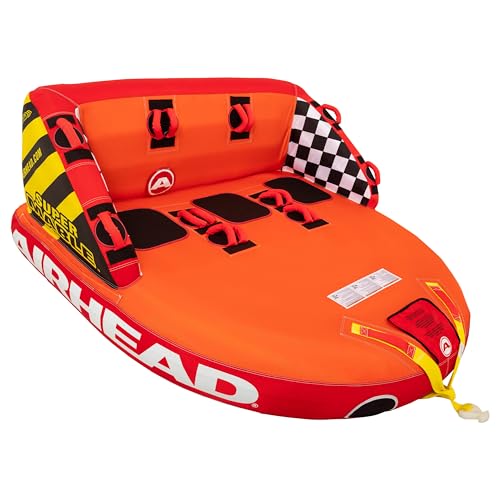

As an Amazon Associate we earn from qualifying purchases at no extra cost to you. Ratings are shown as listed on Amazon.
Quick picks by family situation
| Family situation | Best tube type | Useful target specifications | Why it fits |
|---|---|---|---|
| Young children and mixed abilities | Wide deck-style or cockpit tube | 2–4 riders, 60–80 in. width, 1–3 tow positions | Low seating positions and broad flotation feel more secure at low speed |
| Two teenagers who want more excitement | Deck tube or winged deck tube | 2 riders, 54–70 in. width, 2–4 handles | Allows kneeling, lying, or holding on from different angles |
| Large family sharing one tube | Large cockpit or circular multi-rider tube | 3–4 riders, 80–96 in. diameter or length, 340–680 lb capacity | More room prevents riders from crowding one another |
| Small boat or limited storage | Compact 1–2 rider deck tube | 1–2 riders, 50–65 in. width, 10–20 lb packed weight | Easier to inflate, carry, and store than a large multi-rider model |
| Frequent use throughout summer | Heavy-duty nylon-covered tube | Double-stitched cover, EVA pads, 30-gauge or thicker bladder | Better protection against dock edges, sand, and repeated boarding |
What makes the best towable tubes different?
Capacity is the first filter, but it should not be the only one. A tube rated for four people may technically hold four average-size riders while leaving little room for movement. For comfortable family use, choose a model whose stated capacity exceeds your normal group by one rider when possible. A family of four will usually have a better experience on a four-rider tube designed with separate seating areas than on a tightly packed circular tube.
Also check the manufacturer’s combined weight limit. A four-rider rating does not necessarily mean four large adults are suitable. Add the riders’ weights, then leave a practical margin rather than operating at the maximum. The boat must also be rated to tow the load, and the tow rope should match the tube’s rider capacity.
Seating positions and rider control
Deck tubes place riders on top of the inflatable, usually on padded panels with multiple handles. They offer the most varied positions: lying flat, kneeling, sitting backward, or holding on from the sides. They can be exciting because the tube moves across the water rather than simply sliding behind the boat, but riders are more exposed to bouncing.
Cockpit tubes place riders partly inside the tube. They generally provide better back and side support for children, beginners, and riders who prefer a calmer position. The trade-off is less freedom to shift weight and a more difficult boarding process if the cockpit is deep.
Traditional round tubes are often the simplest and least expensive option. They are comfortable for relaxed towing, but the rider may rotate unpredictably unless the tube has a shaped bottom, a central tow point, or dedicated seating positions.
Tow points: a small feature with a large effect
Look for a reinforced tow point connected to the tube’s internal load-bearing structure, not merely sewn to a thin outer cover. A quick-connect tow harness is useful when the boat has two stern eyes and the tube’s tow point sits below the waterline. It spreads the pull across the boat and can make the tube track more evenly.
Multiple tow points allow a tube to be configured for different handling. A front tow point generally produces predictable tracking. A rear or alternate tow point may raise the front of a deck tube and create a livelier ride, but it can also increase bouncing and steering sensitivity. For family use, begin with the manufacturer’s recommended point and change configurations only after the riders are comfortable.
Head-to-head: deck tubes versus cockpit tubes
| Characteristic | Deck tube | Cockpit tube |
|---|---|---|
| Typical capacity | 1–3 riders | 1–4 riders |
| Common width or diameter | 50–80 inches | 60–96 inches |
| Boarding | Usually easier from the water | Can require climbing into a recessed seat |
| Best seating style | Prone, kneeling, or seated on top | Seated or partly reclined |
| Low-speed stability | Good when wide and flat | Usually excellent |
| High-speed liveliness | Often high | Moderate, depending on hull shape |
| Best for | Older children and teens seeking variety | Mixed-age families and relaxed rides |
How boat speed changes the ride
There is no single ideal speed for every tube. Begin around 10–12 mph for young riders or anyone unfamiliar with the tube. At this pace, a wide cockpit model should remain composed, while a lightweight deck tube may still provide enough movement to be entertaining.
Most families will find a comfortable range of approximately 12–18 mph, depending on water conditions, rider size, and the tube’s design. Above that range, the tube may bounce aggressively over wakes, especially if it has a flat underside or raised wing sections. Larger tubes do not automatically become more stable at higher speeds; their extra surface area can create stronger lift and sharper reactions when they cross a wake at an angle.
Speed should be reduced when the water becomes choppy, riders are separated, or the tube begins to oscillate from side to side. The driver should keep the tow line clear of the propeller, maintain a wide view of the riders, and follow local boating rules. A spotter is essential when required by local law and is useful even when not required.
Inflation time and practical ownership
A 60–70 inch one- or two-rider tube commonly takes about 3–6 minutes to inflate with a 12-volt electric inflator. Large 80–96 inch multi-rider tubes can take approximately 6–12 minutes, depending on the pump and valve design. A hand pump may take two to four times longer and is tiring for large tubes.
Use the correct valve adapter and inflate in stages: fill the main bladder until the tube is firm, then inflate separate floor, backrest, or bolster chambers. Stop before the material becomes drum-tight. Air expands as the tube warms in the sun, so a tube inflated on a cool morning may become excessively pressurized later. Do not use a high-pressure compressor unless the manufacturer specifically permits it.
For a rough planning calculation, suppose a family uses a tube 18 days per summer and the tube costs $180. The initial equipment cost is about $10 per use before counting rope, pump, or repairs ($180 divided by 18). A $300 heavy-duty tube used for five summers at the same frequency costs about $3.33 per use, which can justify stronger materials for frequent boaters.
Durability: what usually wears out first
- Outer cover: Dragging the tube over concrete, rough docks, or gravel can abrade the nylon or polyester cover quickly.
- Handles and seams: Repeatedly pulling riders aboard places more stress on handles than ordinary towing. Reinforced stitching and padded grips are worth prioritizing.
- Valve areas: Dirt under a valve cap or over-tightening an adapter can cause slow leaks.
- Bottom panels: Flat-bottomed tubes often receive the most wear when they are pulled onto a beach or dock.
- Foam pads: Sun and trapped moisture can cause fading, peeling, or odor if the tube is stored wet.
After every outing, rinse away salt, sand, and lake residue with fresh water. Dry the tube completely before folding it loosely in a cool, dry place. Avoid storing it compressed under heavy gear, and keep it away from fuel, solvents, sharp hardware, and rodents. A small repair kit designed for the tube’s bladder material is useful, but a patch is not a substitute for replacing a damaged tow point or load-bearing seam.
Recommended specifications by rider group
For children and beginners
Choose a cockpit or wide circular tube with low seating, a padded interior, and at least four substantial handles. A 2–4 rider model with a 60–80 inch width is usually easier to control than a narrow, high-lift deck tube. Prioritize stability and easy boarding over maximum speed.
For teens and confident adults
A deck tube with multiple tow points and several handle positions offers more variety. Models around 54–70 inches wide are easier to store and still lively behind a typical recreational boat. Check that the combined weight capacity suits the intended riders rather than relying only on the rider count.
For large groups
Choose a large circular or cockpit tube with independent seating zones, a reinforced central tow point, and a high-capacity rope. More room reduces collisions between riders, but it also creates more drag; confirm that the boat has adequate power and a suitable towing rating.
Bottom line
The best towable tubes balance capacity with usable space, stable seating with the level of excitement your family wants, and reinforced construction with storage realities. For mixed ages, a wide cockpit tube is the safest starting point for predictable low- to medium-speed rides. For older children and teens, a deck tube with multiple handles and tow configurations provides more entertainment. Whichever style you choose, correct inflation, a suitable tow rope, moderate initial speeds, and careful drying will matter as much to long-term enjoyment as the tube’s headline rider count.

Write Your Review
No reviews yet. Be the first to share your experience!