

Key takeaways
- Use RCA analogue output when the player’s built-in DAC is convenient and your amplifier has normal line inputs.
- Use optical or coaxial output when you prefer an external DAC, AV receiver, or digital preamplifier to perform conversion.
- Prefer coaxial over optical only when convenient. Neither is automatically higher quality for ordinary CD playback; cable routing and equipment compatibility are more important.
- Check headphone output power separately. A CD player may include a headphone socket without being ideal for difficult-to-drive planar or high-impedance headphones.
- Do not confuse transport and player. A CD transport supplies digital data but needs an external DAC. A complete CD player provides analogue outputs as well.
The best CD players are the Yamaha CD-S303 for an affordable home stereo, the Marantz CD6007 for a more capable hi-fi system, the Cambridge Audio AXC35 for a simple bookshelf setup, and the FiiO DM13 when portability and Bluetooth matter most.
The right choice depends less on the disc mechanism than on the connections around it. Decide whether you need a built-in digital-to-analogue converter (DAC), optical or coaxial digital output, Bluetooth, USB playback, a headphone amplifier, or a battery. Then check the player’s physical depth: many “compact” CD players are still around 28–35 cm deep and may not fit a shallow shelf.
Our top picks


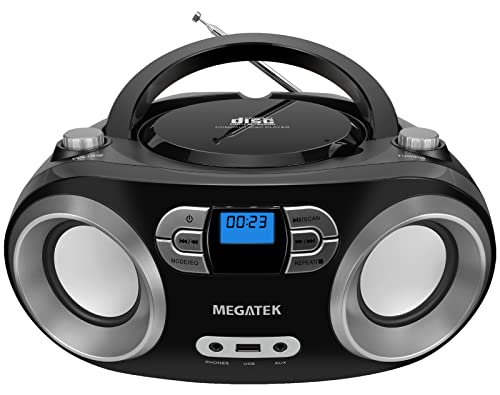

As an Amazon Associate we earn from qualifying purchases at no extra cost to you. Ratings are shown as listed on Amazon.
Quick comparison of the best CD players
| Player | Best for | Key connections | DAC / format highlights | Approx. size and weight | Typical market range |
|---|---|---|---|---|---|
| Yamaha CD-S303 | Affordable home stereo | RCA analogue, optical digital, USB-A | CD, MP3 and WMA from disc or USB; onboard DAC | 435 × 87 × 260 mm; about 3.5 kg | About $300–$400 |
| Marantz CD6007 | Detailed two-channel hi-fi | RCA analogue, optical and coaxial digital, headphone output | AK4490 DAC; selectable digital filter; CD and MP3/WMA USB playback | 439 × 104 × 340 mm; about 6.5 kg | About $600–$800 |
| Cambridge Audio AXC35 | Bookshelf systems and integrated amplifiers | RCA analogue, coaxial digital | Wolfson WM8728 DAC; CD, CD-R/RW and MP3/WMA support | 430 × 75 × 305 mm; about 4.3 kg | About $400–$500 |
| Denon DCD-900NE | Modern stereo systems with USB audio | RCA analogue, optical and coaxial digital, front USB-A | AL32 Processing Plus; high-resolution USB playback up to 192 kHz/24-bit | 434 × 107 × 328 mm; about 4.9 kg | About $500–$700 |
| FiiO DM13 | Portable listening and Bluetooth systems | Bluetooth transmit/receive, USB-C, 3.5 mm, line out, optical out | CD playback; Bluetooth codecs vary by mode and receiving device | About 145 × 170 × 28 mm; roughly 0.5 kg | About $150–$250 |
Dimensions and prices can vary slightly by region and revision. Allow extra space behind a mains-powered player for cables and ventilation; the listed depth is not the same as the shelf depth you need.
Best CD players by listening situation
Best budget home stereo: Yamaha CD-S303
The Yamaha CD-S303 is the easiest recommendation when you want a conventional full-size CD player without paying for audiophile extras. Its analogue RCA outputs connect directly to an amplifier, while optical output lets a newer amplifier or external DAC handle conversion instead. The front USB port is useful for MP3 and WMA files on a USB drive, although it is not a substitute for a general-purpose computer music player.
Choose it for a living-room system, a receiver-based setup, or a first serious stereo. Its 260 mm depth is notably easier to accommodate than deeper hi-fi decks. It is less suitable if you need Bluetooth, SACD playback, a balanced output, or a dedicated high-end headphone stage.
Best for a revealing hi-fi system: Marantz CD6007
The Marantz CD6007 is the stronger choice when the player will remain a central part of a two-channel system. It includes both optical and coaxial digital outputs, a good-quality internal DAC section, a front USB input, and a dedicated headphone output with gain settings. The selectable digital filter is a useful refinement for listeners who want to compare presentation options, but it should not be treated as a dramatic sound-quality upgrade.
Its 340 mm depth and 6.5 kg weight demand a stable shelf. Buy it for a conventional amplifier and passive-speaker system, particularly if you also want to listen through headphones. Do not buy it solely because of the DAC name: the amplifier, speakers, room, and recording quality usually have a larger audible effect.
Best simple bookshelf-system match: Cambridge Audio AXC35
The AXC35 makes sense with a Cambridge Audio AX-series amplifier or another compact integrated amplifier. It has a clean, uncomplicated layout, coaxial digital output, and support for ordinary audio CDs as well as compatible MP3 and WMA discs. Its relatively low 75 mm height suits a narrow equipment shelf.
It does not include Bluetooth, a front USB port, or a headphone socket. That narrow feature set is a benefit if you want a player that does one job without adding menu complexity. If you need wireless playback or USB files, the Yamaha or Denon is a better fit.
Best for USB and modern digital systems: Denon DCD-900NE
The DCD-900NE is aimed at listeners who use both discs and digital files. In addition to its CD transport, it provides a front USB input and high-resolution USB audio support, plus optical and coaxial outputs. Its analogue output can feed an integrated amplifier, while the digital outputs make it easy to use a separate DAC or a receiver with its own conversion stage.
This is a sensible middle ground for a system that includes a network streamer, USB storage, and a traditional CD collection. It is larger than a genuinely compact player, and its extra processing features are unnecessary if you only play standard CDs through a basic amplifier.
Best portable CD player: FiiO DM13
The FiiO DM13 is the most versatile option for portable use. It is rechargeable rather than dependent on replaceable AA batteries, and it can send CD audio over Bluetooth to compatible headphones or speakers. It also offers wired headphone and line outputs, USB-C-related functionality, and optical connectivity, depending on the selected operating mode and firmware.
Portable CD players involve compromises. Battery runtime depends on volume, Bluetooth transmission, display use, and disc condition; expect roughly a full day of intermittent listening rather than assuming a fixed figure. Anti-skip buffering also works best when the unit is not being shaken continuously. For walking or exercise, a phone with locally stored lossless files is usually more robust. The DM13 is better for travel, a desk, a hotel room, or connecting a CD collection to wireless speakers.
DAC quality, outputs, and what actually matters
A CD stores 16-bit, 44.1 kHz audio. A player’s DAC converts that data into the analogue signal sent to an amplifier. Better DAC implementation can reduce noise and distortion, but published chip numbers alone do not determine the complete result: analogue output design, power supply, clocking, and output level matter too.
- Use RCA analogue output when the player’s built-in DAC is convenient and your amplifier has normal line inputs.
- Use optical or coaxial output when you prefer an external DAC, AV receiver, or digital preamplifier to perform conversion.
- Prefer coaxial over optical only when convenient. Neither is automatically higher quality for ordinary CD playback; cable routing and equipment compatibility are more important.
- Check headphone output power separately. A CD player may include a headphone socket without being ideal for difficult-to-drive planar or high-impedance headphones.
- Do not confuse transport and player. A CD transport supplies digital data but needs an external DAC. A complete CD player provides analogue outputs as well.
Decision matrix
| Your situation | Recommended type | Why | What to avoid paying for |
|---|---|---|---|
| Under about $400, normal stereo, occasional CDs | Yamaha CD-S303 | Useful digital and USB connections at a reasonable size | Premium transport claims |
| Frequent listening, quality amplifier and speakers | Marantz CD6007 | Strong output flexibility and headphone facilities | Bluetooth if you already use wired listening |
| Shallow bookshelf or compact amplifier | Cambridge Audio AXC35 | Simple operation and modest height | USB features you will not use |
| CDs plus files on USB storage | Denon DCD-900NE or Yamaha CD-S303 | Front USB playback and digital outputs | A separate transport unless you already own a DAC |
| Travel, desk, or wireless speaker use | FiiO DM13 | Rechargeable, compact, and Bluetooth-capable | Full-size hi-fi decks with no battery |
Setup and ownership tips
Measure the shelf before buying. A 305 mm-deep shelf is not suitable for a 340 mm player once rear cables and ventilation space are included. As a practical calculation, a player measuring 328 mm deep plus 40 mm for plugs needs about 368 mm of usable depth. Leave the top ventilation area unobstructed, especially around amplifiers.
- Connect RCA outputs to a line-level input such as “CD” or “AUX,” never to a phono input.
- Set the amplifier volume low before pressing play, then raise it gradually.
- If using an external DAC, connect one digital cable and select the matching input; do not expect the player’s RCA connection to pass through that DAC.
- Keep discs in cases and hold them by the edge. Fingerprints usually cause read errors before the mechanism itself fails.
- Clean a disc from the centre outward with a soft lint-free cloth. Circular rubbing can make an existing scratch harder for the error correction system to handle.
The laser pickup and loading belt or tray mechanism are usually the parts that wear first. Avoid forcing a tray, stacking equipment on the player, or using badly warped discs. Lens-cleaning discs are not a universal fix and can stress some mechanisms; if several known-good discs skip, professional servicing is more sensible than repeatedly cleaning the lens.
Final recommendation
Choose the Yamaha CD-S303 for the best balance of price, connectivity, and manageable size. Step up to the Marantz CD6007 when headphone listening and a more ambitious stereo justify the cost. Pick the Cambridge Audio AXC35 for a simple bookshelf system, the Denon DCD-900NE for USB-heavy setups, and the FiiO DM13 when portability and Bluetooth are central rather than optional.

Write Your Review
No reviews yet. Be the first to share your experience!