

Key takeaways
- Add up your loaded weight. Include your body, tackle, cooler, battery, anchor, clothing and any pedal or motor system.
- Leave a margin. Aim for a capacity well above that total so the hull rides higher and handles better.
- Look at width. Wider hulls add initial stability, which helps when casting or shifting your weight.
- Check seat comfort and height. A raised, supportive seat helps hips and knees on long days.
- Consider standing. If you want to stand and cast, look for a wide, flat deck and a designed standing position.
For a larger angler, the best fishing kayak is usually a wide hardshell sit-on-top with a stated capacity well above your body weight plus gear, such as the Old Town Topwater 120, Wilderness Systems Recon 120 or ATAK 140, or the Vibe Sea Ghost 130, while an inflatable like the Sea Eagle 385fta FastTrack Angler suits buyers who need the highest capacity or easy storage. Reviewers repeat one rule: pick a boat with a beam of roughly 33 inches or more and a capacity at least 100 pounds above your loaded weight. This guide compares the models that reviewers mention most and explains how to size a kayak to a bigger body.
How Reviewers Size a Kayak for a Heavy Paddler
Weight capacity is the starting point, but it is not the whole story. Several roundup authors note that a kayak loaded close to its limit sits low in the water, tracks poorly and takes on spray. One guide suggests a 300 pound paddler should look for a capacity of at least 400 pounds. Another reminds readers that capacity alone does not determine stability: hull shape, width and seat height matter too.
- Add up your loaded weight. Include your body, tackle, cooler, battery, anchor, clothing and any pedal or motor system.
- Leave a margin. Aim for a capacity well above that total so the hull rides higher and handles better.
- Look at width. Wider hulls add initial stability, which helps when casting or shifting your weight.
- Check seat comfort and height. A raised, supportive seat helps hips and knees on long days.
- Consider standing. If you want to stand and cast, look for a wide, flat deck and a designed standing position.
Models Reviewers Mention, With Stated Specs
The figures below come from reviewer roundups and spec tables, and some roundups differ slightly on numbers for the same boat. Confirm each figure on the maker’s page before ordering, because manufacturers update hulls and ratings.
| Kayak | Stated capacity | Width | Length | Type | Notes |
|---|---|---|---|---|---|
| Wilderness Systems Recon 120 | 450 lb | 38 in | 12 ft 2 in | Hardshell sit-on-top | Very wide, aimed at stability |
| Wilderness Systems ATAK 140 | 550 lb | Not confirmed here | 14 ft | Hardshell sit-on-top | Longer, higher capacity |
| Vibe Sea Ghost 130 | 550 lb | 33.5 in | 13 ft | Hardshell sit-on-top | Popular paddle or upgradeable option |
| Vibe Shearwater 125 | 475 lb | 35 in | 12 ft 5 in | Hardshell sit-on-top | Wide and stable |
| Old Town Topwater 120 | 500 lb | 33.5 in | 12 ft | Hardshell sit-on-top | About 82 lb, budget-friendly capacity |
| Perception Outlaw 11.5 | 425 lb | 35 in | 11 ft 6 in | Hardshell sit-on-top | About 77 lb, a budget pick |
| Bonafide SS127 | 475 lb | 33.5 in | 12 ft 7 in | Hardshell sit-on-top | Standing-friendly design |
| Three Waters Big Fish 108 | 450 lb | 38 in | 10 ft 8 in (per model name) | Pedal hardshell | Short and wide, pedal drive |
| Perception Showdown 11.5 | 450 lb | Wide deck | 11 ft 6 in | Pedal hardshell | Flat deck for standing |
| Sea Eagle 385fta FastTrack Angler | 635 lb | 36 in | 12 ft 6 in | Inflatable | About 45 lb, easy to carry and store |
Wilderness Systems Recon 120 and ATAK 140
The Recon 120 is repeatedly named for its roughly 38 inch beam, which makes it one of the widest paddle fishing kayaks in the roundups. That width gives a steady platform for casting, and the stated 450 pound capacity covers many larger paddlers with gear. The trade-off is slower paddling speed and more effort in wind.
The ATAK 140 is described with a 550 pound capacity and a longer hull, which generally tracks better and glides farther per paddle stroke. Longer hulls are harder to store and transport, so consider your roof rack or trailer before choosing one.
Vibe Sea Ghost 130 and Shearwater 125
The Sea Ghost 130 comes up in several roundups with a 33.5 inch hull and a stated 550 pound capacity. It is a popular choice among anglers who like a longer, more efficient hull. The Shearwater 125 is about 35 inches wide with a 475 pound capacity, so it trades some length for width. Both are hardshell sit-on-tops with the usual fishing features such as rod holders and gear tracks, according to the roundups.
Old Town Topwater 120 and Perception Outlaw 11.5
These are the value-oriented picks. The Topwater 120 is listed at 500 pounds capacity and around 82 pounds, and the Outlaw 11.5 at 425 pounds and around 77 pounds. Kayakaddicts highlights the Topwater for its capacity and value. Reviewers treat the Outlaw as a budget tier choice with a 35 inch beam. Both are heavy to lift without help, so plan for a cart and a friend, or a roof loading aid.
Pedal Kayaks
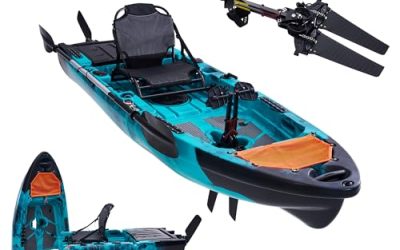
Pedal drives free your hands for fishing and let you move against wind and current. The Three Waters Big Fish 108 is listed at 38 inches wide with a 450 pound capacity, and the Perception Showdown 11.5 has a 450 pound capacity and a wide, flat deck. Pedal systems add weight and cost, and they raise the total load you must include in your capacity calculation. Check the pedal mechanism’s maintenance needs in the maker’s manual.
Inflatables: Sea Eagle 385fta
The Sea Eagle 385fta FastTrack Angler is listed at 12 feet 6 inches long, 36 inches wide and 635 pounds capacity, with a weight around 45 pounds. For buyers with limited storage or a small vehicle, an inflatable is attractive. The trade-off is that inflatables can be more exposed to punctures and wind drift. Follow the maker’s care instructions and inflate to the recommended pressure.
Safety Notes for Larger Paddlers
- Always wear a properly sized personal flotation device. Many standard sizes do not fit larger frames, so look for an extended-size model and check the weight rating on its label.
- Practice re-entering a kayak in shallow, calm water before heading to deeper water.
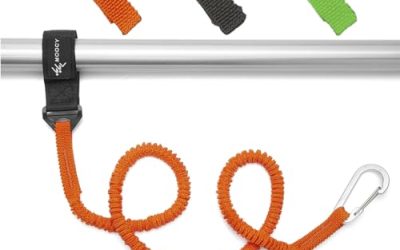
- Attach a leash to rods and tools you cannot afford to lose.
- Do not exceed the stated capacity, and remember that capacity includes gear and any motor or pedal system.
- If you have health conditions affecting balance, strength or heart health, speak with a doctor before taking up paddle fishing.
Fit, Transport and Storage
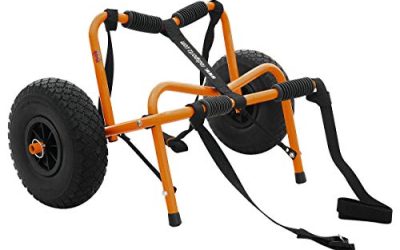
A wide hardshell kayak can be hard to fit in a garage or on a roof rack. Measure the vehicle and storage before you buy. A 38 inch beam may exceed the width of a standard roof rack’s crossbars, so many anglers use a trailer, a truck bed with an extender, or a hitch-mounted carrier. Lifting a boat of 80 pounds or more alone can cause injury, so use a kayak cart and consider a loading system.
Pick This If…
| Pick | If you want |
|---|---|
| Wilderness Systems Recon 120 | Very wide, stable platform for standing and casting |
| Wilderness Systems ATAK 140 | High capacity and a longer hull for covering distance |
| Vibe Sea Ghost 130 | High capacity with an efficient 13 foot hull |
| Old Town Topwater 120 | High capacity at a budget-friendly tier |
| Perception Outlaw 11.5 | A lower-cost wide hardshell |
| Three Waters Big Fish 108 or Perception Showdown 11.5 | Pedal drive with a wide, stable platform |
| Sea Eagle 385fta | Top capacity and compact storage in an inflatable |
Budget Tiers
| Tier | Examples | Trade-off |
|---|---|---|
| Budget | Perception Outlaw 11.5, Sea Eagle 385fta | Simpler features, or inflatable durability concerns |
| Mid-range | Old Town Topwater 120, Vibe Shearwater 125 | Paddle power only unless you add a drive |
| Premium | Wilderness Systems ATAK 140, pedal models | Higher cost and weight |
Alternatives to Consider
Jackson Kayak’s YuPik and Knarr models, the Perception Pescador Pilot 12 and the BKC Brooklyn 11.5 Pro also appear in roundups, with stated capacities from 425 to 550 pounds. A small jon boat, a pontoon-style fishing boat or a compact skiff may also suit an angler who finds even the widest kayaks too tippy. Try a kayak at a demo day or rental shop when possible, since fit and comfort are personal.
Frequently Asked Questions
What weight capacity should a big guy look for in a fishing kayak?
Reviewers suggest a capacity at least 100 pounds above your body weight plus gear. One guide says a 300 pound paddler should look for 400 pounds or more. A bigger margin keeps the hull riding higher and improves stability and tracking.
How wide should the kayak be?
One roundup recommends a beam over 30 inches, and most picks for larger paddlers range from about 33 to 38 inches. Wider hulls feel steadier but paddle slower. Match the width to how much you value stability against speed.
Can a big guy stand and fish in a kayak?
Some can, with the right boat. Wide, flat-deck models such as the Recon 120 or the Showdown 11.5 are marketed toward standing. Practice in calm, shallow water first, and use a leash or support if you feel unstable.
Are inflatable kayaks good for heavier anglers?
The Sea Eagle 385fta is listed at 635 pounds capacity, the highest among the common picks. Inflatables are lighter and easy to store. Be careful around sharp objects, oyster beds and rough bottoms, and follow the maker’s care instructions.
Is a pedal kayak better for heavier paddlers?
Pedaling uses larger leg muscles and keeps your hands free for fishing, which many anglers prefer. Pedal drives add weight and cost, so remember to include them in your capacity calculation. Check that the seat position and pedal reach suit your leg length.
How do I choose a life jacket if I am larger?
Choose a personal flotation device in an extended or oversize range that carries the right weight and chest size rating on its label. Try it on while seated in the kayak to ensure it does not ride up. Follow local regulations and the maker’s guidance.
More from Amazon
Programs that pair well with the guide above. Offers and eligibility are set by Amazon and may change.
Free shipping on eligible items, Prime Video and more. Eligible new members can start with a free trial.
Start a Prime free trialA Prime membership for ages 18-24 with a trial period. Eligibility is set by Amazon.
See Prime for Young AdultsAudiobooks and podcasts to listen to on the go. Eligible new members can start with a free trial.
Try Audible freeAd-free music streaming. Eligible new subscribers can start with a free trial.
Try Music Unlimited freeAs an Amazon Associate we earn from qualifying purchases.
Write Your Review
No reviews yet. Be the first to share your experience!