

Key takeaways
- A marine battery charger is not a car charger with a waterproof sticker. Boats carry a trolling motor bank, a starting battery.
A marine battery charger is not a car charger with a waterproof sticker. Boats carry a trolling motor bank, a starting battery, maybe a house battery for the electronics, and all of them sit in a damp, vibrating compartment for months at a time. The decision behind this keyword is how many batteries you need to feed at once, how fast you need them topped up between trips, and whether your batteries are lead-acid, AGM, or lithium iron phosphate (LiFePO4).
This guide is for anglers who run more than one battery on a bass boat, jon boat, pontoon, or skiff and want a permanently mounted unit instead of dragging a portable charger out of the garage. In 2026 the onboard multi-bank design is the clear default for that job, so the listings below focus on bank count, amps per bank, and chemistry support, judged only from what each title states.
Quick Picks
Our top picks


As an Amazon Associate we earn from qualifying purchases at no extra cost to you.
| Product | Best for | Key spec from the title |
|---|---|---|
| 2 Bank Marine Charger 5X2 | Boats with a starting and a house battery | 10A total, 5A per bank, IP68 |
| 3 Bank Marine Charger 5X3 | Trolling motor plus two others | 15A total, 5A per bank, IP68 |
| 3 Bank Marine Charger 10X3 | Large deep-cycle banks that need faster recovery | 30A total, 10A per bank |
| PZ.P 15-Amp 12V/24V Smart Charger | Garage or dockside use across 12V and 24V systems | 15A, nine-stage, LiFePO4 and lead-acid |
| Smart 2 Bank Lithium Charger | Anglers who switched to LiFePO4 | 10A total, desulfator, waterproof |
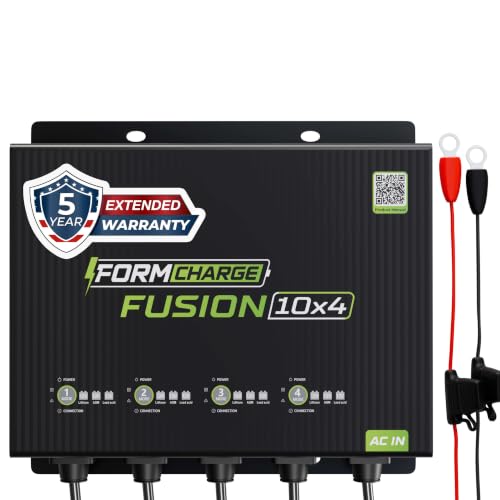
| FORM Fusion 10X4 | Big rigs with four batteries | 40A total, 10A per bank |
| WAVLINK 3 Bank 15A | Mixed-chemistry boats wanting repair mode | 5A per bank, desulfating, IP68 |
How to Choose
Count your batteries first
A bank is one independent charging output, and each bank should feed one battery. A two-bank unit suits a starter plus a house battery. A 24-volt trolling motor wired from two 12-volt batteries needs two banks just for that system, so add a third for the starter. Buying one bank fewer than you own means unplugging cables, which defeats the purpose of an onboard charger.
Match amps per bank to battery size
A rough rule is to size the charger at roughly one tenth to one fifth of the battery capacity in amp-hours. A 5-amp bank is fine for a 50 to 100 amp-hour battery that has all night to recharge. A 10-amp bank earns its money when you drain a large deep-cycle battery on a long day and need it ready by the next morning. Spending more on amps rarely helps small batteries, because they cannot accept the current anyway.
Confirm chemistry support
Lithium (LiFePO4) batteries need a different charge profile than flooded or AGM batteries, and a charger that only offers lead-acid profiles can undercharge or stress them. Look for a title or spec sheet that names LiFePO4, AGM, and deep-cycle explicitly, and confirm that the mode selector can be set per unit rather than per bank if you mix chemistries.
Waterproofing, protection, and what to ignore
An IP68 rating means the unit is sealed against dust and submersion, which matters in a bilge or a rear console. Overcharge protection and temperature compensation are worth having, since cold mornings change how a battery accepts charge. Marketing terms such as “24/7 charging” are less meaningful than a documented float stage. Budget models cut corners on cable length and ring-terminal quality, so check the included leads against the distance from your charger to each battery.
The 7 Best Options
2 Bank Marine Battery Charger 5X2
This 10-amp, two-bank unit delivers 5 amps to each of two 12-volt batteries and carries an IP68 waterproof rating, according to the title. It targets small boats with a starting battery and a single deep-cycle for the trolling motor or electronics.
- Strength: two independent outputs let each battery charge without a splitter.
- Strength: the sealed rating suits a damp console or compartment mount.
- Trade-off: 5 amps per bank recovers a large deep-cycle battery slowly after a hard day.
Skip it if you run three or more batteries or a 24-volt trolling system plus a starter, because you would outgrow it at once. The truncated title also cuts off the protection list, so confirm on the listing which safeguards are included. For a small aluminum boat that rarely leaves a single lake, this is the kind of simple, permanent setup that keeps the batteries topped up all winter without any thought.
3 Bank Marine Battery Charger 5X3
The 15-amp, three-bank version of the same design supplies 5 amps per bank and charges three batteries at once with IP68 waterproofing. It is the natural fit for a 24-volt trolling motor system (two batteries) plus a starter.
- Strength: three banks cover the most common bass-boat layout.
- Strength: the overcharge and temperature features listed in the title suit unattended charging.
- Trade-off: per-bank current is modest, so very large batteries take longer to refill.
Skip it if your trolling bank is large and you need turnaround in a few hours. Anglers with only two batteries are paying for a bank they will never use. Tournament-style anglers who launch early every weekend and plug in each evening will find the modest current perfectly adequate, because a full night on the charger is plenty for a typical day of trolling.
3 Bank Marine Battery Charger 10X3
Here the output doubles to 10 amps on each of three banks, 30 amps in total, again with IP68 waterproofing and 24/7 charging mentioned in the title. This is the pick for anglers who drain big deep-cycle batteries and want them ready by morning.
- Strength: 10 amps per bank shortens recharge time on large battery banks.
- Strength: three outputs fit a 24-volt trolling system plus a starting battery.
- Trade-off: it is a heavier-duty unit, so it asks for more mounting space and thicker wiring.
Skip it if your batteries are small, since they cannot use the extra current, or if your boat has no spare room near the batteries for a larger housing. Check the fuse and wire gauge advice on the listing before installing. A charger that can push this much current into each battery also deserves a dedicated, properly fused circuit, so plan the install rather than improvising with whatever cable is on hand.
PZ.P 15-Amp 12V/24V Smart Battery Charger
This single-output 15-amp unit is described as a 12-volt and 24-volt smart charger, maintainer, and trickle charger for LiFePO4 and lead-acid batteries, with nine-stage charging and temperature compensation. It is a portable-style charger rather than a multi-bank onboard unit, which makes it useful as a flexible shore-side or garage option.
- Strength: support for both 12-volt and 24-volt systems adds flexibility.
- Strength: nine-stage charging and lithium compatibility suit modern battery types.
- Trade-off: one output means you must move the clamps between batteries.
Skip it if you want a permanent, set-and-forget installation that charges every battery simultaneously. The title is truncated, so confirm the full feature list on the listing.
Smart 2 Bank Marine Battery Charger, 10A
This waterproof two-bank charger offers 5 amps per bank and is described as suitable for LiFePO4 lithium, AGM, and deep-cycle batteries, with maintainer and desulfator functions. It is aimed at anglers who have moved to lithium but still keep an AGM starter.
- Strength: explicit lithium support alongside AGM keeps mixed boats covered.
- Strength: the maintainer mode suits long storage periods.
- Trade-off: only two banks, so a three-battery layout needs another solution.
Skip it if you own three batteries or need quick turnaround on large banks. Anglers who keep a lithium trolling battery and an older AGM starter will get the most from the mixed-chemistry support. The title is truncated, so confirm on the listing which chemistries are covered by each mode.
FORM Fusion 10X4 4-Bank Marine Battery Charger
With 40 amps in total and 10 amps per bank across four outputs, this smart onboard unit supports lithium (LiFePO4), AGM, and deep-cycle batteries. It is built for larger boats that carry a starter, a house battery, and a 24-volt or 36-volt trolling system.
- Strength: four banks at 10 amps each cover big multi-battery rigs.
- Strength: explicit lithium and AGM support helps with mixed setups.
- Trade-off: it is overkill, and likely premium-priced, for a small jon boat.
Skip it if you only have two batteries. Buyers on a 36-volt trolling system should still confirm that the bank layout matches their wiring, and anyone mounting it should leave room for ventilation and cable routing.
WAVLINK 3 Bank 15A Marine Battery Charger
This 12-volt, three-bank onboard unit supplies 5 amps per bank with IP68 waterproofing, multi-stage charging, and a desulfating repair mode, plus multiple protections listed in the title. It is the pick for anglers with older batteries who want a recovery mode.
- Strength: multi-stage charging with a repair function suits neglected batteries.
- Strength: three banks at a modest output work well for overnight charging.
- Trade-off: 5 amps per bank limits speed on high-capacity batteries.
Skip it if you want rapid turnaround or a fully lithium-focused profile, and confirm on the listing which chemistries it supports. It also suits a boat that sits unused for weeks, since the maintenance behavior matters more than raw speed there.
Which One Fits Your Situation
Small jon boat with a starter and one deep-cycle
The 2 Bank Marine Battery Charger 5X2 covers both batteries without extra hardware. If you plan to move to lithium soon, the Smart 2 Bank unit is the safer choice.
Bass boat with a 24-volt trolling motor
The 3 Bank Marine Battery Charger 5X3 matches the three-battery layout. If you fish all day and need quick turnaround, step up to the 10X3.
Large rig with four batteries
The FORM Fusion 10X4 is the listing built for four independent banks at 10 amps each, so nothing needs to be moved between charges.
Older batteries with sulfation worries
The WAVLINK 3 Bank 15A adds a desulfating repair mode and multi-stage charging, which gives tired batteries a better chance before replacement.
Common Mistakes
- Buying fewer banks than batteries, then juggling cables between trips.
- Choosing a charger without confirming LiFePO4 support after switching to lithium.
- Ignoring wire length, so leads cannot reach the farthest battery.
- Paying for 10 amps per bank on small batteries that cannot accept that current.
- Mounting the unit low in the bilge where it can sit in standing water despite its rating.
Related guides
- Shimano Stradic Fl Vs Daiwa Bg Spinning Reel
- Polarized Sunglasses For Kayak Fishing
- How Often Should You Replace Fishing Line
Frequently Asked Questions
What does a bank mean on a marine charger?
A bank is one independent output that charges one battery. A three-bank charger can charge three separate 12-volt batteries at the same time without sharing current.
How many amps do I need per bank?
For most anglers, 5 amps per bank is enough for overnight charging of a modest battery. Choose 10 amps per bank when large deep-cycle batteries are drained hard and must be ready quickly.
Can I use one charger for lithium and AGM batteries?
Only if the charger offers separate profiles for both and lets you assign them correctly. Titles that name LiFePO4 and AGM are a good starting point, but confirm the details on the listing.
Is IP68 necessary for a boat charger?
It is not mandatory if you mount the unit in a dry console, but it gives useful margin against spray, condensation, and an occasional wet bilge.
More from Amazon
Programs that pair well with the guide above. Offers and eligibility are set by Amazon and may change.
Free shipping on eligible items, Prime Video and more. Eligible new members can start with a free trial.
Start a Prime free trialA Prime membership for ages 18-24 with a trial period. Eligibility is set by Amazon.
See Prime for Young AdultsAudiobooks and podcasts to listen to on the go. Eligible new members can start with a free trial.
Try Audible freeAd-free music streaming. Eligible new subscribers can start with a free trial.
Try Music Unlimited freeAs an Amazon Associate we earn from qualifying purchases.

Write Your Review
No reviews yet. Be the first to share your experience!