

Our Top Picks
 Venterior Portable Rechargeable Fish Finder Wireless Sonar Sensor2.75 x 2.75 x 2.75 inches0.94 poundsCheck on Amazon
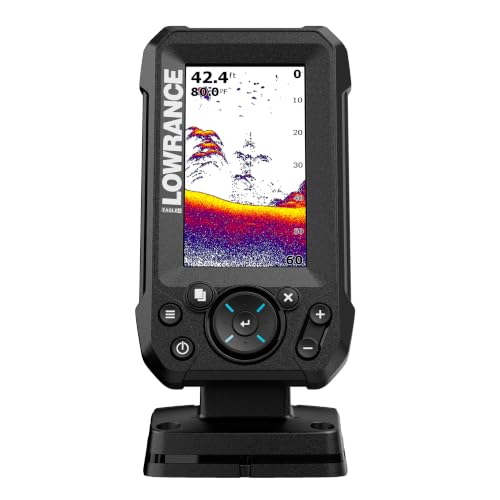 Lowrance Eagle 4X Fish Finder with Bullet Transducer4 Inch7 x 4 x 3.84 inches2.8 poundsCheck on Amazon
 Humminbird PiranhaMAX 4 Fish Finder with TransducerOne Size3.6 x 3.9 x 6.8 inches2 poundsCheck on Amazon

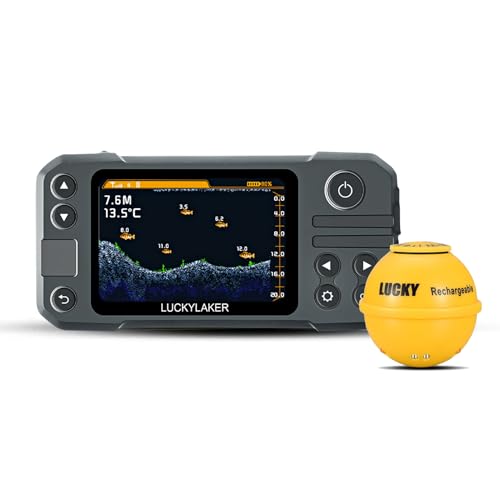

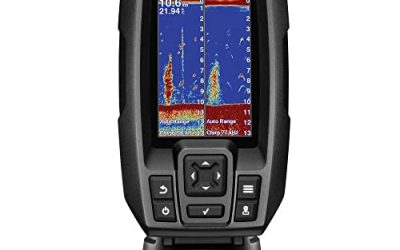
The Lowrance Eagle 4X with the Bullet transducer is the best overall depth finder here for a kayak you plan to fish seriously, because it pairs a 4-inch IPS display with wide-angle sonar and a transom-mount transducer on a proper cable. A depth finder, also called a fish finder, uses sonar pulses to show depth, bottom hardness and fish arches below the boat. If you want zero wiring and a battery of its own, the portable castable units further down are easier on a small kayak, while the Humminbird PiranhaMAX 4 is the other fixed-mount choice.
Quick List
- LUCKY Kayak Portable Fish Depth Finder FFC110 – best castable handheld for a simple setup
- Venterior Portable Rechargeable Fish Finder – best for shoreline casting and quick temperature and contour readings
- Lowrance Eagle 4X with Bullet Transducer – best overall fixed-mount unit for dedicated kayak anglers
- LUCKY Kayak Portable Fish Finder MT-202 – best rechargeable wireless-style unit with no wiring
- Humminbird PiranhaMAX 4 with Dual Beam Transducer – best fixed-mount alternative with a bigger screen
- Handheld Portable Kayak Fishfinder with LCD – best basic backup for depth checks
Which One Is Right for You?
| If you… | Choose |
|---|---|
| fish a kayak often and are willing to wire a small battery | Lowrance Eagle 4X with Bullet Transducer |
| want a larger screen on a fixed-mount unit | Humminbird PiranhaMAX 4 with Dual Beam Transducer |
| want a rechargeable unit with no cables across the deck | LUCKY Kayak Portable Fish Finder MT-202 |
| mix kayak and bank fishing and care about temperature readings | Venterior Portable Rechargeable Fish Finder |
| want a simple castable unit you can stow in a pocket | LUCKY Kayak Portable Fish Depth Finder FFC110 |
| need a minimal depth checker for occasional trips | Handheld Portable Kayak Fishfinder with LCD |
The core choice is fixed-mount versus portable. Fixed-mount units like the Eagle 4X and PiranhaMAX 4 need a 12-volt battery, a transducer mount and some wiring, but they show a bigger, clearer picture. Portable units with a built-in battery are far easier to set up on a kayak, though their screens and sonar are generally more modest.
All 6 Picks in Detail
1. LUCKY Kayak Portable Fish Depth Finder FFC110 – Best Castable Handheld for a Simple Setup
As an Amazon Associate we earn from qualifying purchases at no extra cost to you.

The FFC110 is a handheld fish depth finder with a castable sonar transducer and an LCD display, marketed for kayaks and boats. The listing mentions water-capable handheld use and a castable transducer. It is the simplest style of fish finder: you place or cast the sensor, hold the display and read the depth and fish returns.
The best practice with a castable sensor is to keep the line short and secure it to the kayak so a gust of wind or a tug does not take it away. A tether tied to a deck loop is a sensible precaution for any portable sensor.
Because this is a portable unit, confirm whether the sensor connects by cable or wirelessly, how long the cable is and how the display is powered. These details change how easily it works on a kayak, where space is tight and loose cables can tangle fishing lines.
- Handheld LCD display with castable sonar transducer
- Marketed for kayaks, boats and shore use
- Portable, no hull mounting needed
- Cable or wireless connection: confirm on listing
- Depth range and battery type: confirm on listing
Pros:
- Quick to set up and to stow
- No drilling or fixed mounting
Cons:
- Basic display with limited detail
- Cable or transducer can tangle with lines
It is the plainer cousin of the MT-202 and a step up from the generic handheld unit.
2. Venterior Portable Rechargeable Fish Finder – Best for Shoreline Casting and Contour Readings
Venterior’s portable fish finder uses a wireless sonar sensor and a rechargeable setup that, according to the listing name, reports fish size, temperature, bottom contour and uses a color display. It is a good fit for anglers who fish from a kayak one day and from a bank or pier the next, since you can cast the sensor or place it in the water and read the display in your hand.
Because it works well from a bank, it is a flexible choice for people who fish from several places. Drop the sensor from a dock to check depth under a pier, then take it onto the kayak for the open water, and compare temperature readings between spots to find where fish are likely to feed.
Bottom contour readings are useful for finding drop-offs, weed edges and humps where fish gather. Treat the fish-size icons as rough indicators, not exact measurements; sonar interprets the strength of the return, which can be affected by water conditions, depth and angle.
- Wireless sonar sensor, rechargeable, per the listing
- Reports depth, fish indication, temperature and bottom contour
- Color display, per the listing name
- Portable for kayak and shore use
- Range, depth and battery life: confirm on listing
Pros:
- Temperature and contour readings add useful context
- Rechargeable and easy to carry
Cons:
- Fish size icons are only approximations
- Limited screen size compared with fixed units
Compared with the MT-202, it emphasizes display detail and temperature reading.
3. Lowrance Eagle 4X with Bullet Transducer – Best Overall Fixed-Mount Unit
The Eagle 4X is Lowrance’s entry-level sonar unit, with a 4-inch IPS display, a Bullet Skimmer transducer, wide-angle sonar, auto-tuning, zoom and a twist-lock connector. Manufacturer information describes traditional 200 kHz broadband sonar rated to about 500 feet, a transom-mount transducer with a cable of around 6 meters, and an IPX7 rated head unit that runs on 12 volts. It does not include GPS mapping or imaging modes such as DownScan, so it is a pure depth and fish finder.
Think of it as a dependable single-purpose tool. Because it has no chart or GPS features to learn, the menus are short, and most anglers can be reading depth within minutes of powering up. Keep the head unit on a RAM-style or similar base where you can see it without twisting your body, and tuck the cable along the gunwale.
On a kayak, the practical considerations are power and mounting. You need a small 12-volt battery in a dry box, a fused power lead, and a way to attach the transducer to the hull, typically with a scupper mount or a clamp on a mounting arm. Wide-angle sonar covers more water directly below the boat but is a little less precise right under the transducer.
- 4-inch IPS display, about 480 by 272 pixels, per the maker
- Bullet Skimmer transom-mount transducer, wide-angle 200 kHz sonar
- Auto-tuning sonar with zoom, twist-lock transducer connector
- 12-volt power; IPX7-rated head unit, per the maker
- Kayak mounting hardware and battery: not included, confirm on listing
Pros:
- Clear screen and a proper transducer cable
- Auto-tuning makes it easy to use
Cons:
- Needs a battery and mounting work on a kayak
- No GPS or chart mapping
It is the closest rival to the PiranhaMAX 4, which offers a slightly bigger screen but a different sonar style.
4. LUCKY Kayak Portable Fish Finder MT-202 – Best Rechargeable Unit with No Wiring

The MT-202 is a LUCKY portable fish finder with a wireless sonar transducer, a rechargeable design and a handheld depth display. It is built for the angler who does not want to run cables, mount a battery or drill anything. The wireless transducer floats or is cast from the kayak, and the handheld unit shows depth and fish returns.
Rechargeable gear is only useful if it is charged. Top up the transducer and the display the night before, bring a short USB cable, and rinse the transducer in fresh water after salt use. Keep the display in a pocket or a small pouch on your life vest so it stays dry.
The trade-off for the convenience is range and screen quality. Wireless units usually have a limited connection distance and a smaller display, and the transducer needs to stay in the water. Check the product page for the maximum depth, the wireless range and battery runtime, since the listing name does not state them.
- Wireless sonar transducer, rechargeable
- Handheld display unit
- Marketed for kayaks and boats
- Depth range, battery runtime and wireless range: confirm on listing
- Waterproof rating: confirm on listing
Pros:
- No wiring and no separate 12-volt battery
- Easy to move between kayak and shore
Cons:
- Smaller display and shorter range than fixed units
- Two parts to charge and keep track of
It sits between the FFC110 and the Venterior in features, so compare their sensor styles and screens.
5. Humminbird PiranhaMAX 4 with Dual Beam Transducer – Best Fixed-Mount Alternative with a Bigger Screen

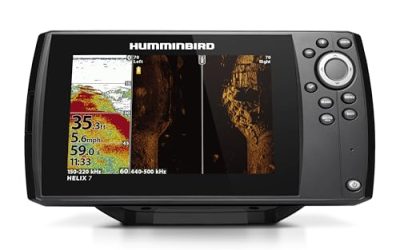
The PiranhaMAX 4 is Humminbird’s 4.3-inch fish finder with a transducer and Dual Beam sonar. Humminbird’s published specifications for the base unit list a 480 by 272 pixel color display, dual-beam 200 and 455 kHz sonar with 28-degree and 16-degree coverage, and a depth capability of about 600 feet at 200 kHz and 320 feet at 455 kHz. It does not have GPS or a memory card slot, and it is powered by 10.8 to 20 volts. The same published sheet lists a current draw of about 180 milliamps.
The two beams are the main talking point. The narrow beam gives a tighter picture of the bottom, and the wide beam covers more area for finding fish. For a kayak angler, that makes it easier to scan a flat first and then slow down over structure.
That low current draw is helpful on a kayak, where battery size matters. A compact 12-volt battery can run a unit like this for a long day, though real runtime depends on screen brightness, cold weather and battery condition. Humminbird’s listing for this model appears alongside variants such as the DI and the portable PT, so confirm which version the product page describes.
- 4.3-inch color display, 480 by 272 pixels, per the maker
- Dual Beam sonar, 200/455 kHz with 28- and 16-degree beams
- Rated depth about 600 feet at 200 kHz, per the maker
- 10.8 to 20 VDC input; built-in temperature
- Exact version and mounting hardware: confirm on listing
Pros:
- Larger screen and dual-beam sonar for separate wide and narrow views
- Low power draw suits small kayak batteries
Cons:
- Needs wiring and a transducer mount
- No GPS or mapping
It trades the Eagle 4X’s wide-angle single beam for two separate beams.
6. Handheld Portable Kayak Fishfinder with LCD – Best Basic Backup for Depth Checks

This unbranded handheld fish finder is described as portable, with a sonar depth LCD display, reliable fish and depth readings and an easy-to-use design suitable for kayaks. With such a short listing, the key specs are not stated, so you should confirm the depth range, power source, cable length and warranty before buying. It is the sort of unit that works as a backup or as a depth checker when you are learning a new lake.
If you buy a basic unit like this, try it on a calm day in water of known depth, such as beside a dock, to see whether its readings make sense before relying on it in a new lake.
Because the listing does not give much detail, treat it as a basic depth reader. Compare it with the LUCKY units on display size, battery type and whether the transducer is wired or wireless before settling on it.
- Handheld sonar with LCD display
- Marketed for kayak fishing
- Portable and easy to use, per the listing
- Depth range, battery and transducer type: confirm on listing
- Waterproof rating: confirm on listing
Pros:
- Light and simple to carry
- Suits occasional use and backup
Cons:
- Limited detail in the listing name
- Unbranded, so confirm support and warranty
It is the most basic option here, so choose it only if you want a backup depth checker.
Specs Compared
| Product | Type | Display | Sonar | Power | Mounting |
|---|---|---|---|---|---|
| LUCKY FFC110 | Portable | LCD | Castable transducer; confirm on listing | Confirm on listing | Cast or place |
| Venterior Portable | Portable | Color display | Wireless sensor; confirm on listing | Rechargeable | Float or cast |
| Lowrance Eagle 4X | Fixed mount | 4-inch IPS | Wide-angle 200 kHz, Bullet Skimmer | 12 V, external battery | Transom-mount transducer |
| LUCKY MT-202 | Portable | Handheld; confirm on listing | Wireless transducer | Rechargeable | Float or cast |
| Humminbird PiranhaMAX 4 | Fixed mount | 4.3-inch color (maker spec) | Dual Beam 200/455 kHz | 10.8-20 V | Transom-mount transducer (confirm version) |
| Handheld Kayak Fishfinder | Portable | LCD | Confirm on listing | Confirm on listing | Confirm on listing |
How We Chose These
This guide is built from research, not personal use. We began with the six depth finders in the current catalog and sorted them into fixed-mount and portable styles. For each, we compared the stated display, sonar type, power source and mounting method, using manufacturer specification sheets for the Lowrance and Humminbird units and the listing fields for the rest. Where a listing did not state a value, we wrote “confirm on listing.” We looked at how each type fits the practical limits of a kayak: space, weight, power and the ability to stay clear of fishing lines.
What to Look For
Fixed-mount versus portable
Fixed-mount units use a head unit, a separate transducer and a 12-volt battery. They give larger screens, stronger sonar and more consistent readings, but they require mounting and wiring. Portable units have a self-contained sensor and a handheld display, which is quicker to set up, easy to move between boats and free of wiring. The trade-off is smaller displays, shorter range and sometimes less reliable connections. A good rule of thumb is to choose fixed-mount if you fish from your kayak weekly, and portable if you fish occasionally or share the unit with other craft.
Sonar beams and coverage
A transducer sends a cone of sound downward. A wider cone covers more bottom but gives less detail, and a narrower cone is more precise. The width of the circle on the bottom is about the depth multiplied by twice the tangent of half the cone angle. For a 28-degree beam, that works out to about half the depth. In 20 feet of water, a 28-degree beam covers roughly 10 feet across, while a 16-degree beam covers roughly 5.6 feet. Dual-beam units let you switch between the two views. Wide-angle sonar on units like the Eagle 4X trades precision for coverage.
Power and battery planning
For fixed-mount units, a small sealed lead-acid or lithium 12-volt battery in a dry box is common. Check the unit’s current draw on the product page. For example, the PiranhaMAX 4 is published at about 180 milliamps, so a 7 amp-hour battery has enough capacity in theory for many hours, though cold weather and aging reduce real runtime. Use an inline fuse close to the battery, keep connections dry, and charge lithium batteries according to the maker’s instructions. For portable units, charge both the sensor and the display before the trip and carry a spare power bank if the units charge by USB.
Transducer mounting on a kayak
Common options include a scupper-mounted arm, a clamp on a rail or crossbar, or a transom-style mount on a flat stern. Some composite and fiberglass kayaks allow shoot-through hull mounting with epoxy or gel, but rotomolded plastic hulls generally do not work well because plastic and trapped air interfere with the signal. Position the transducer so it is submerged and faces straight down, with a clear view of the water and away from turbulence caused by paddles or rudders. Keep cables secured with ties and away from fishing lines and foot movement.
Display readability and extras
Sunlight is the enemy of small screens. A bright, high-contrast display with a sun shade is easier to read from a low seat. Look for temperature readouts, depth alarms, zoom modes and the ability to adjust sensitivity. GPS and mapping are useful features but add complexity, and none of the six products listed here are described as having GPS mapping. If you need waypoints, consider a separate handheld GPS or a phone app.
A worked example: powering a fixed-mount unit
Suppose you choose a fixed-mount unit and want it to run for a full eight-hour day. Take the current draw from the specification sheet, for example 0.18 amps, and multiply by eight hours to get about 1.4 amp-hours. Add a generous margin of two or three times for cold weather, screen brightness, backlight and an aging battery, and you land at roughly 3 to 4 amp-hours. A 7 amp-hour battery therefore leaves plenty of reserve, and it is still small enough to fit in a dry box behind the seat. Always confirm the real current draw of the unit you buy, since other models may use more.
Reading the screen on the water
Start by learning what the bottom looks like. A hard bottom such as rock or gravel produces a thick, bright return, while soft mud gives a thinner one. Fish usually show as arches or short dashes that appear when the cone passes over them, and thermoclines or weed beds can appear as faint layers or clutter. Move slowly, since paddling speed affects how the picture builds on the screen. If the screen looks noisy, reduce sensitivity or check that the transducer is submerged and facing straight down, because bubbles under it are the most common cause of broken readings.
Questions
Do I need a 12-volt battery for a kayak fish finder?
Fixed-mount units such as the Eagle 4X and PiranhaMAX 4 need external power, usually a small 12-volt battery. Portable units run on their own rechargeable batteries. Check the specification sheet for the voltage range.
Where should I put the transducer on a kayak?
Mount it where it stays submerged and faces down, such as on a scupper arm or a stern bracket. Keep it away from air bubbles and the paddle stroke. Secure the cable to avoid snagging.
Can I use a transom-mount transducer on a plastic kayak?
Yes, but with an arm or bracket rather than a shoot-through installation. Plastic hulls generally do not pass the signal well through the hull. Use a clamp or scupper mount instead.
How deep do these units read?
The maker lists about 500 feet for the Eagle 4X and about 600 feet at the lower frequency for the PiranhaMAX 4. For the portable units, confirm the figure on the product page. Most kayak fishing is in far shallower water.
Are fish icons accurate?
They are interpretations of sonar echoes, not exact images. The size shown depends on signal strength, depth and cone angle. Use them as a guide and watch the arches and bottom structure as well.
Is a fish finder worth it for a small lake?
Yes, because depth and structure information helps you find drop-offs and weed edges even on small waters. A simple portable unit is usually enough there.
Update History
- October 20, 2026 – Initial publication; product set drawn from current catalog listings.
- Check the product page for current specifications and availability before buying.
Sources
- Manufacturer product and specification pages for Lowrance and Humminbird
- Retailer listing titles and specification fields for each product
More from Amazon
Programs that pair well with the guide above. Offers and eligibility are set by Amazon and may change.
Free shipping on eligible items, Prime Video and more. Eligible new members can start with a free trial.
Start a Prime free trialA Prime membership for ages 18-24 with a trial period. Eligibility is set by Amazon.
See Prime for Young AdultsAudiobooks and podcasts to listen to on the go. Eligible new members can start with a free trial.
Try Audible freeAd-free music streaming. Eligible new subscribers can start with a free trial.
Try Music Unlimited freeAs an Amazon Associate we earn from qualifying purchases.
Write Your Review
No reviews yet. Be the first to share your experience!