

Key takeaways
- Two independent cooking wells: They keep the sandwiches separated and make portioning easier.
- A timer or clear ready indicator: This reduces overcooking while you prepare coffee or lunch.
- Stable feet and a secure latch: A full appliance should not slide when the lid is pressed down.
- Adequate lid clearance: Check whether your preferred bread and fillings can close without force.
- Accessible seams: Fewer narrow channels mean faster, more complete cleanup.
- Vertical storage capability: This matters if the maker will live in a cabinet.
- Clear care instructions: Proper treatment of the nonstick surface affects durability more than a small difference in wattage.
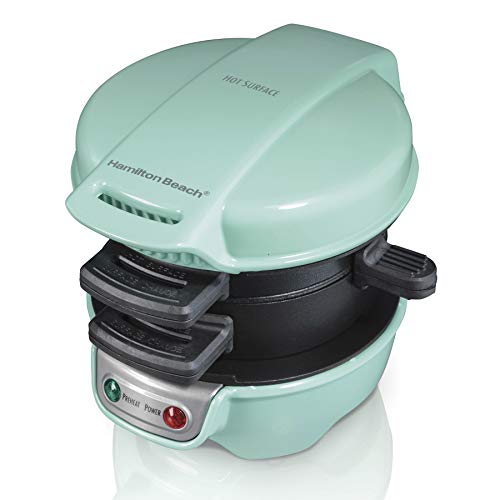
The best dual breakfast sandwich maker for most two-person households is the Hamilton Beach Dual Breakfast Sandwich Maker because it cooks two sandwiches in roughly five to six minutes, uses compact countertop space, and costs less than buying a larger breakfast station.
A dual machine is worthwhile when two people want breakfast at the same time. Its main advantage is not simply capacity: it reduces the need to cook one sandwich, wait, and reheat the second. The trade-offs are a wider appliance footprint, more difficult cleaning around egg compartments, and nonstick coatings that require gentler care than a basic skillet.
Our top picks


As an Amazon Associate we earn from qualifying purchases at no extra cost to you. Ratings are shown as listed on Amazon.
Best dual breakfast sandwich maker at a glance
| Option | Typical batch | Approximate cooking time | Counter space | Best for |
|---|---|---|---|---|
| Hamilton Beach Dual Breakfast Sandwich Maker | 2 sandwiches | 5–6 minutes after preheating | About 12–14 inches wide and 10–12 inches deep | Fast everyday breakfasts for two |
| Single breakfast sandwich maker | 1 sandwich | 4–6 minutes | About 7–9 inches wide | One person or limited counter space |
| Two-burner skillet method | 2–4 sandwiches, depending on pan size | 8–12 minutes | Pan storage instead of dedicated appliance | Maximum flexibility and easiest part replacement |
| Large griddle or panini press | 2 sandwiches | 6–10 minutes | Usually wider and heavier | Sandwiches with varied bread and fillings |
Dimensions and timing vary by model, bread thickness, filling temperature, and egg size. Treat the figures as buying benchmarks rather than guaranteed results for every appliance.
Why the Hamilton Beach dual model is the practical pick
The Hamilton Beach Dual Breakfast Sandwich Maker is designed around two separate sandwich wells. You assemble the bottom bread, egg, cheese, and top bread in each side, close the lid, and allow the appliance to cook the components together. A built-in timer and indicator lights help remove guesswork, which is useful when making breakfast before work or school.
Its strongest feature is parallel cooking. Two sandwiches generally take about the same amount of appliance time as one, although a full load can need an extra minute if the eggs are large or the bread is cold from the refrigerator. That makes it more efficient than a single sandwich maker when both portions are needed immediately.
The machine is also more compact than a full griddle. It stores upright in many cabinets, but its width and lid clearance still matter. Measure the shelf before buying, especially if the appliance will remain on the counter rather than being stored after each use.
Head-to-head: dual sandwich maker versus a skillet
Cooking speed
A dual appliance wins on repeatability. After preheating, it can produce two similarly shaped sandwiches in approximately five to six minutes. A skillet can be just as fast for an experienced cook, but it usually requires separate timing for eggs, meat, and bread. If the skillet is crowded, one sandwich may finish before the other.
Texture and flexibility
A skillet is more versatile. It accommodates English muffins, sliced bread, bagels, tortillas, and unusually thick fillings. A sandwich maker works best with bread that fits inside its wells. Oversized bread can wrinkle at the edges, while too much cheese or liquid egg can leak into the hinge area.
Cleanup
A skillet is usually simpler to wash because there are fewer channels and seams. The dedicated appliance is convenient only when it is cleaned promptly. Egg residue becomes harder to remove after it cools, particularly around the divider and lower plate.
Cost of ownership
The appliance has a modest upfront cost, but its nonstick cooking surfaces are the parts most likely to determine its useful life. A skillet has no integrated coating that is difficult to replace; a worn pan can be replaced independently. Choose the dual maker for speed and portion consistency, not because it is the most repairable cooking tool.
Decision matrix: which setup fits your routine?
| Your situation | Best choice | Why |
|---|---|---|
| Two people eat sandwiches at least three mornings per week | Dual breakfast sandwich maker | Its two-at-once capacity saves a cooking cycle every morning. |
| One person usually eats breakfast | Single sandwich maker or skillet | A dual unit uses more storage space than necessary. |
| Very limited counter or cabinet space | Skillet | No dedicated appliance is needed. |
| You regularly use bagels, thick rolls, or large fillings | Skillet or large press | Open cooking surfaces handle more shapes and heights. |
| You want predictable portions with little cooking experience | Dual breakfast sandwich maker | Separate wells and a timer simplify portioning and timing. |
| You dislike wiping small crevices | Skillet | It is usually easier to inspect and wash completely. |
How to make two sandwiches without leaks
- Preheat with the lid closed. Starting on a cold surface lengthens cooking and can leave the bread pale while the egg sets unevenly.
- Use bread that fits the wells. Standard English muffins and regular sandwich bread are safer starting points than oversized bagels.
- Keep the egg layer modest. One small or medium egg per compartment is usually easier to contain than an overfilled well. If using beaten egg, leave room for expansion.
- Warm dense fillings first. Cold sausage or thick slices of meat can reduce the center temperature and extend cooking time. Fully cooked fillings should be heated through before serving.
- Add cheese away from the hinge. Cheese that extends beyond the bread can melt into the seam and become difficult to remove.
- Let the sandwiches rest briefly. Waiting about one minute after opening allows hot cheese and egg to settle and makes removal less messy.
Do not force the lid closed. Resistance usually means the bread or filling is too large, and pressure can push egg mixture into the appliance seams.
Nonstick durability and cleaning reality
Nonstick coating is a major convenience, but it is also the component most vulnerable to misuse. Use silicone, nylon, or wooden utensils; metal forks and knives can scratch the cooking surfaces. Avoid aerosol cooking sprays when the manufacturer advises against them, because residue can build up and become sticky over time. A small amount of neutral cooking oil applied with a paper towel is often easier to control.
Unplug the unit and allow it to cool until warm, not hot, before wiping it. Use a damp nonabrasive cloth or soft sponge. For baked-on egg, place a damp cloth over the residue for several minutes rather than scraping it. Keep water away from the electrical housing, and never immerse the appliance unless the instructions specifically state that a removable part is water-safe.
The cooking plates may remain functional while the hinge, latch, indicator light, or cord becomes the practical failure point. Store the unit with the cord loosely wrapped and avoid hanging heavy objects from it. If the nonstick surface begins flaking or food consistently sticks despite proper cleaning, replacement is safer than trying to restore the coating.
A simple cost-per-use calculation
Suppose a dual maker costs $40 to $70 and is used three times per week. At four uses per week, it would receive about 208 uses in a year. The appliance cost alone would therefore be approximately 19 to 34 cents per use during the first year, before ingredients and electricity.
That calculation favors the dual model when it replaces two separate cooking cycles. If you make only one sandwich once a week, the space and cleaning burden matter more than the per-use cost. Frequency and two-person capacity are the deciding factors.
What to look for before buying
- Two independent cooking wells: They keep the sandwiches separated and make portioning easier.
- A timer or clear ready indicator: This reduces overcooking while you prepare coffee or lunch.
- Stable feet and a secure latch: A full appliance should not slide when the lid is pressed down.
- Adequate lid clearance: Check whether your preferred bread and fillings can close without force.
- Accessible seams: Fewer narrow channels mean faster, more complete cleanup.
- Vertical storage capability: This matters if the maker will live in a cabinet.
- Clear care instructions: Proper treatment of the nonstick surface affects durability more than a small difference in wattage.
Final verdict
The Hamilton Beach Dual Breakfast Sandwich Maker is the best dual breakfast sandwich maker for households that regularly need two quick, similarly sized sandwiches. It offers the best balance of roughly six-minute cooking, compact storage, simple portioning, and a moderate market price. Choose a skillet instead if you use unusual bread, dislike appliance-specific cleanup, or cook only one sandwich at a time. For the dual maker to remain a good purchase, keep fillings below the lid line, clean egg residue while it is still soft, and treat the nonstick coating as a surface that needs protection rather than aggressive scrubbing.

Write Your Review
No reviews yet. Be the first to share your experience!