

Key takeaways
- Compare the best fishing crimping tools for mono, fluorocarbon and wire leaders, with the die sizes, sleeve ranges and kit contents that matter most.
- Top Pick: Quick Comparison
- Runner-up: Quick Comparison
- Also consider: Quick Comparison
The best fishing crimping tool for most anglers is the Booms Fishing CP1, a 10 inch cup-to-cup hand crimper in high carbon steel rated by its maker for monofilament and fluorocarbon from 50 to 400 lb and for wire and cable from 100 to 600 lb, because its matched semicircular dies close oval and double barrel sleeves evenly without biting into the leader material inside them. Anglers who want a stainless steel tool instead of coated carbon steel should look at the Glarks crimping kit, a 10.24 inch swager that crimps sleeves up to 2.2 mm and arrives with 180 aluminum double barrel sleeves in three sizes. The SILANON kit is the volume pick, with 430 sleeves and beads across five sizes in aluminum and copper. The Booms Fishing CP2 is the compact specialist, a small crimper built specifically for single barrel sleeves and sold with 300 of them, and the Swpeet kit is the budget way into the category, a swager with 150 double barrel sleeves that covers the same 2.2 mm ceiling as the Glarks. Each tool below is named in the exact configuration its listing covers, because in this category the sleeve style a tool is built for matters more than the brand on the handle.
Every tool in this roundup was checked against the maker’s published specifications and current Amazon listing data before it was included. Several widely recommended fishing crimpers, including the Mustad Blueline 10 inch crimping tool, the Hi-Seas hand crimper sold inside its deluxe rigging kit, and the Booms Fishing CP4, were researched for this roundup and left out because a verifiable Amazon listing for the exact tool could not be confirmed for any of them; a crimper you cannot order in the configuration described is not a useful recommendation. Fishing crimping tools are plain hand tools with no powered parts, and no recall covers any tool named here or the category as a class. The warning that does appear in this corner of tackle is California’s Proposition 65 notice on some brass sleeve listings, and the checks section at the end covers that along with the sleeve-and-die matching checks that matter before ordering.
As an Amazon Associate, we earn from qualifying purchases.
Table of Contents
- Why Crimping Tools Are Their Own Category
- How to Choose the Best Fishing Crimping Tool
- Quick Comparison
- The 5 Best Fishing Crimping Tools
- Safety and Checks Before You Order
- Frequently Asked Questions
- Conclusion
- Product and ASIN Reference
Why Crimping Tools Are Their Own Category
A crimped connection replaces a knot with a metal sleeve. The leader material passes through the sleeve, loops through the eye of a hook, swivel or lure, comes back through the sleeve, and the sleeve is then compressed with a dedicated tool so it grips the doubled line along its whole length. Done correctly, the connection keeps nearly the full breaking strength of the leader, lies flatter than any knot tied in the same material, and can be repeated to the same standard every time, which is something no hand-tied knot in heavy line can promise.
Crimping exists because knots stop working well as leader material gets heavy and stiff. A knot that seats properly in 20 lb monofilament will not cinch down in 130 lb fluorocarbon, and in single-strand or braided wire leaders a knot is not really an option at all. That is why crimped connections are the standard build for offshore trolling leaders, for wire leaders aimed at toothy fish, for shark rigs, and increasingly for the stiff fluorocarbon boom sections used in carp and predator rigs in fresh water. The tool is not an accessory to that fishing; it is the thing that makes the connections possible.
The tool itself is more specialized than it looks. A proper fishing crimper closes a sleeve with matched dies, most often the cup-to-cup pattern in which each jaw carries half of a semicircular channel, so the sleeve is compressed evenly around the line rather than flattened between two flat faces. Flattening a sleeve with ordinary pliers concentrates the pressure on two edges, cuts into the leader inside, and produces a connection that looks closed and fails early. The dies are also sized: each position in the jaw is machined for a sleeve diameter range, and using the wrong position either under-crimpes the sleeve so it slips or over-crimpes it so the sleeve cracks and the line is nicked. This is why the roundup is organized around sleeve style and die range first and handle comfort second.
Sleeve style is the second half of the category. Single barrel sleeves are one tube, used with the line passed through twice to form the loop, and they are the common choice for lighter leaders and for wire. Double barrel sleeves carry two parallel tubes, one for each leg of the loop, and are the standard for heavier mono and fluorocarbon work. Oval sleeves are a flattened profile of the single barrel idea, shaped to sit in cup-to-cup dies. A tool built for one style does not automatically do the others well, and one pick below, the Booms Fishing CP2, is built for single barrel sleeves alone. Matching the tool to the sleeves you actually buy is the first decision in this category, ahead of size, material or kit contents.
How to Choose the Best Fishing Crimping Tool
Start With the Sleeve Style You Will Actually Crimp
Decide what you are building before you decide what to buy. If your rigging is heavy monofilament or fluorocarbon leaders for offshore or big-game work, you will be crimping double barrel and oval sleeves, and you need a cup-to-cup tool whose dies are rated for them, like the Booms Fishing CP1 or either of the swager kits below. If your rigging is wire leaders and lighter single barrel sleeves, a single-barrel specialist like the CP2 is not a compromise but the correct tool, because its dies are shaped for the smaller round sleeves the bigger tools handle worst. Kits that bundle sleeves with the tool settle this question for a first purchase: the sleeves in the box are the sleeves the dies were cut for, which removes the most common beginner mismatch in the category.
Die Range and Leader Class
Read the die range in millimetres and match it to your sleeve sizes, not to your line’s pound test alone. The swager kits in this roundup top out at 2.2 mm sleeves, which covers the great majority of recreational leader work, from light wire up to heavy mono in the 300 to 400 lb class depending on the sleeve maker. The CP1 expresses its range the other way, in line classes: 50 to 400 lb for mono and fluorocarbon, 100 to 600 lb for wire and cable. Either way, the check is the same — list the sleeve diameters you will crimp, and confirm each one falls inside a marked die position on the tool. A sleeve crimped in an oversize die position slips under load; a sleeve forced into an undersize position gets cut by the die edges. Neither failure announces itself at the rigging bench, which is why the range check happens before the purchase, not after the first lost fish.
Tool Length and Leverage
Crimping is a squeezing job, and leverage is what finishes it. The 10 inch tools in this roundup — the CP1 and the Glarks swager — exist because closing a 2.0 or 2.2 mm sleeve fully takes real force, and a longer handle delivers that force without a two-handed strain. Compact tools like the CP2 trade that leverage away for size: they live in a tackle tray or a wading belt, rig light leaders all day, and ask you to step up to a bench or a bigger tool when the sleeves get heavy. Match the length to the heaviest sleeve you will honestly crimp, not the average one, because the heaviest crimp of the season is the one that has to hold.
Material and Corrosion
The tools here split into two material camps. High carbon steel, used by both Booms Fishing tools, is hard, holds its die edges, and is the traditional crimper material; it is protected by a black oxidation finish and it will rust if it is stored wet and salty, so it wants a rinse and a wipe of oil. Stainless steel, used by the Glarks and SILANON tools, gives up a little hardness for a great deal of corrosion resistance, which suits a tool that lives on a boat. Neither choice is wrong. The honest rule is that a carbon steel tool maintained like a knife outlasts a stainless tool, and a stainless tool neglected like most boat tools outlasts a carbon one.
Kits Versus Tool Only
Four of the five picks are kits, and in this category that is the sensible default. A kit pairs the tool with the sleeve sizes its dies cover, in useful quantities: 140 sleeves with the CP1, 180 with the Glarks, 430 pieces with the SILANON, 300 with the CP2 and 150 with the Swpeet. Buying tool-only makes sense when you already own a sleeve inventory in known sizes, or when you rig one leader class exclusively and buy sleeves in bulk for it. For everyone else, the kit removes the compatibility guesswork and the second order, and the sleeves are consumed slowly enough that a starter assortment lasts most anglers several seasons.
Cutters and Extras
Some crimpers add a wire cutter at the jaw, and it is worth having for wire work, where trimming the tag end close to the sleeve with ordinary scissors is genuinely difficult. Treat it as a bonus rather than a deciding feature: the crimp dies decide whether the connection holds, and a cutter can be carried separately for a few grams. The extras that do matter are a safety lock or latch that keeps the tool closed in a tackle bag, and a handle long enough and textured enough to use with wet hands, because rigging happens on wet decks with fish slime on everything.
Quick Comparison
| Product | Type | Crimp Range | Sleeves Included | Tier |
|---|---|---|---|---|
| Booms Fishing CP1 Crimping Pliers, 10 inch, Blue | Cup-to-cup hand crimper | Mono and fluoro 50 to 400 lb; wire 100 to 600 lb | 140 | Mid-range |
| Glarks Wire Rope Crimping Tool Kit, 180 Pieces | Hand swager | Sleeves up to 2.2 mm | 180 | Premium |
| SILANON Fishing Crimping Tool Kit, 430 Pieces | Hand crimping pliers | 4 crimping sizes, sleeves 1.2 to 2.0 mm | 430 | Mid-range |
| Booms Fishing CP2 Crimping Tool with 300 Sleeves, Red | Single-barrel hand crimper | Single barrel sleeves | 300 | Budget |
| Swpeet Wire Rope Crimping Tool Kit, 150 Pieces | Hand swager | Sleeves 0.1 to 2.2 mm | 150 | Budget |


The 5 Best Fishing Crimping Tools
1. Booms Fishing CP1 Crimping Pliers, 10 Inch — Best Overall

Tier: Mid-range
The CP1 is the tool Booms Fishing builds when it starts from the question of what a general-purpose fishing crimper actually has to do, and the answer begins with the dies. They are a cup-to-cup pattern, the matched semicircular channels that close oval and double barrel sleeves evenly around the leader instead of flattening them, and that single design decision is what separates a crimping tool from a pair of pliers with notches. Onto those dies Booms Fishing fits the rest of the specification this work asks for: a 10 inch high carbon steel body with a black oxidation finish, an ergonomic rubber grip, and a rated range that covers the recreational leader spectrum — monofilament and fluorocarbon from 50 to 400 lb, and wire and cable from 100 to 600 lb.
The published numbers describe a rigging-bench tool rather than a pocket tool. Ten inches of handle is leverage, and leverage is what closes a heavy sleeve fully home with one squeeze instead of two partial ones. The listing weight is 0.5 kilograms, about 1.1 lb, which is heavy in a wading belt and irrelevant on a bench or a boat’s rigging station, and the configuration pinned here is the blue-handled version sold with 140 crimp sleeves, so the tool arrives with the consumables its dies were cut for. The same tool is sold in other handle colors and without sleeves under separate listings; the reference table at the end names the exact one described here.
What the CP1 gives up is corrosion margin and compactness. Carbon steel with a black oxidation finish resists rust the way a knife blade does — well, if it is rinsed, dried and occasionally oiled, and not at all if it is thrown wet into a sealed box. Anglers who know they will neglect the tool should read the Glarks section next. For anglers who rig at home or keep a tidy boat, the CP1’s die pattern and range make it the most complete crimper in this roundup.
Specs
- Type: Hand crimping pliers with cup-to-cup dies
- Length: 10 in
- Material: High carbon steel with black oxidation finish
- Crimps: Oval sleeves and double barrel sleeves
- Line range: Monofilament and fluorocarbon 50 to 400 lb; wire and cable 100 to 600 lb
- Included: 140 crimp sleeves
- Handle: Ergonomic rubber grip
- Weight: 0.5 kg (about 1.1 lb)
Choose the CP1 if you rig mono, fluorocarbon or wire leaders across a range of classes and want one cup-to-cup tool whose dies match the sleeves the offshore and big-game fisheries actually use. Skip it if your crimping is all light single barrel work, where the smaller CP2 is the more precise tool, or if the tool will live wet on a boat, where stainless steel is the safer material.
2. Glarks Wire Rope Crimping Tool Kit with 180 Sleeves — Best Stainless Kit
Tier: Premium
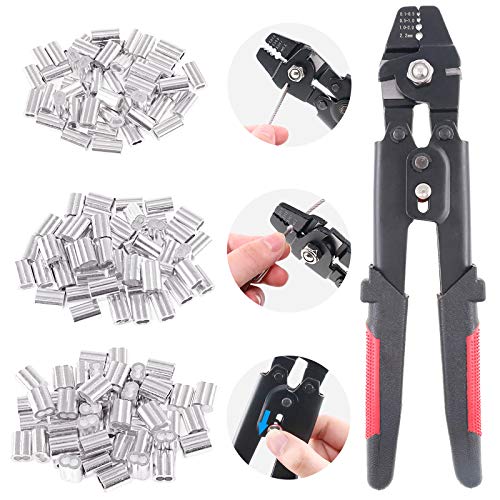
The Glarks kit is the stainless steel answer in this roundup, built around a hand swager that crimps wire rope and fishing sleeves up to 2.2 mm. The tool is 10.24 in long as published and weighs 549 grams, about 1.2 lb, which puts it in the same leverage class as the CP1 while changing the material story completely: stainless construction, a rubber handle, and a kit box that pairs the tool with 180 aluminum double barrel ferrule sleeves in the three sizes recreational rigging uses most, 1.2 mm, 1.5 mm and 2.0 mm.
That sleeve assortment is the kit’s real specification. Double barrel sleeves are the standard for looped mono and fluorocarbon leaders, and having all three sizes in the box means the die positions and the sleeves were chosen together, which is the compatibility check this category keeps demanding. The tool’s published crimp ceiling of 2.2 mm also covers single barrel and oval sleeves inside that diameter, so the kit is not limited to the double barrel work its included sleeves suggest, provided the replacement sleeves stay inside the same range.
The trade against the CP1 is die specialization. The Glarks is a general swager sold across fishing and wire rope uses, and its listing expresses its range in sleeve diameter alone, without the CP1’s line-class ratings for mono versus wire. Anglers rigging at the heavy end of the spectrum get clearer guidance from the Booms Fishing tool. Anglers who want a stainless tool that can be rinsed and put away wet, and who rig the mainstream 1.2 to 2.0 mm sleeve sizes, are exactly who this kit is built for.
Specs
- Type: Hand swager crimping tool
- Length: 10.24 in
- Material: Stainless steel
- Crimp range: Sleeves up to 2.2 mm
- Included: 180 aluminum double barrel sleeves (1.2 mm, 1.5 mm and 2.0 mm)
- Handle: Rubber grip
- Weight: 549 g (about 1.2 lb)
- Model: G-781
Choose the Glarks kit if you want stainless steel corrosion resistance and a matched three-size double barrel sleeve assortment in one box. Skip it if you rig sleeves above 2.2 mm or want a tool whose maker publishes line-class ratings for each die position, which is the CP1’s territory.
3. SILANON Fishing Crimping Tool Kit with 430 Sleeves — Most Sleeves Included
Tier: Mid-range
The SILANON kit competes on inventory. Its stainless steel crimping pliers carry four crimping sizes, and the box holds 430 pieces: 100 aluminum oval single barrel sleeves at 1.2 mm, 100 copper double barrel sleeves at 1.4 mm, 100 aluminum single barrel sleeves at 1.6 mm, 80 copper single barrel sleeves at 1.8 mm, 30 aluminum oval single barrel sleeves at 2.0 mm, and 20 fishing beads. No other pick in this roundup spans both sleeve metals and both barrel styles at once, and for an angler building a rigging kit from nothing, that breadth is the argument.
The mix matters because sleeve metal is a real choice. Aluminum sleeves are the standard partner for monofilament and fluorocarbon, soft enough to compress without cutting the line. Copper sleeves are the traditional choice for wire and for heavier work, harder and stronger in the same diameters. A kit that stocks both lets a new rigger build a light fluoro leader and a wire leader on the same evening with the same tool, and learn the difference by doing it. The four crimping sizes across the 1.2 to 2.0 mm range cover the light-to-middle of the leader spectrum rather than its heavy end.
That is also the kit’s limit. Nothing here reaches past 2.0 mm, so the heaviest offshore sleeves are outside it, and the pliers are a general fishing crimper rather than a cup-to-cup specialist of the CP1’s kind. Read it as the broad starter and club-boat kit: the tool a fishing club buys so that any member can rig any ordinary leader, and the kit an individual buys when the sleeve drawer is currently empty.
Specs
- Type: Hand crimping pliers
- Material: Stainless steel
- Crimping sizes: 4
- Included: 430 pieces — 100 x 1.2 mm aluminum oval single barrel sleeves, 100 x 1.4 mm copper double barrel sleeves, 100 x 1.6 mm aluminum single barrel sleeves, 80 x 1.8 mm copper single barrel sleeves, 30 x 2.0 mm aluminum oval single barrel sleeves, 20 fishing beads
- Sleeve materials: Aluminum and copper
- Sleeve styles: Single barrel, double barrel and oval
Choose the SILANON kit if you are stocking a rigging bench from zero and want both sleeve metals and both barrel styles in one purchase. Skip it if your leaders run to sleeves above 2.0 mm, or if you already own a sleeve inventory and only need the tool.
4. Booms Fishing CP2 Crimping Tool with 300 Sleeves — Best for Single Barrel Sleeves
Tier: Budget
The CP2 is the specialist in this roundup. Where the other tools spread their dies across sleeve styles, the CP2 is built for single barrel sleeves alone, the round sleeves used for wire leaders, light mono work and lure attachment, and it is sold with 300 of them so the pairing is settled from the first rig. Booms Fishing builds it in high carbon steel with a soft, textured grip, and the published weight is 212 grams, about 7.5 oz — less than half the CP1’s weight, in a tool meant to live where the fishing happens rather than on a bench.
That size is the point. A single barrel crimper earns its place in a tackle tray, a kayak crate or a wading belt, rigging and re-rigging light leaders at the water. The maker’s published uses for the tool are freshwater and saltwater fishing, wire leader crimping and lure attachment, which is an accurate map of the single barrel sleeve’s territory: pike and musky wire traces, light saltwater leaders, and the small crimped connections on lure rigs. The configuration pinned here is the red-handled version with the 300 sleeve bundle; the tool alone has been sold under a separate listing for years, and the reference table names the bundled one described here.
The limits follow from the specialization. Double barrel and oval sleeves for heavy mono and fluorocarbon leaders are outside this tool’s die design, and no amount of care turns a single barrel crimper into the right tool for them. Anglers whose rigging spans both worlds need the CP2 and a cup-to-cup tool, or just the cup-to-cup tool. Anglers whose rigging is single barrel all the way down get the most precise tool in this roundup for that work, and the lightest.
Specs
- Type: Hand crimping pliers for single barrel sleeves
- Material: High carbon steel
- Included: 300 crimp sleeves
- Grip: Soft, textured
- Weight: 212 g (about 7.5 oz)
- Published uses: Freshwater and saltwater fishing, wire leader crimping, lure attachment
- Color: Red
Choose the CP2 if your rigging is wire leaders and light single barrel work and you want a compact tool that travels with your tackle. Skip it if you crimp double barrel or oval sleeves for heavy leaders, which it is not built to close.
5. Swpeet Wire Rope Crimping Tool Kit with 150 Sleeves — Best Budget Kit
Tier: Budget
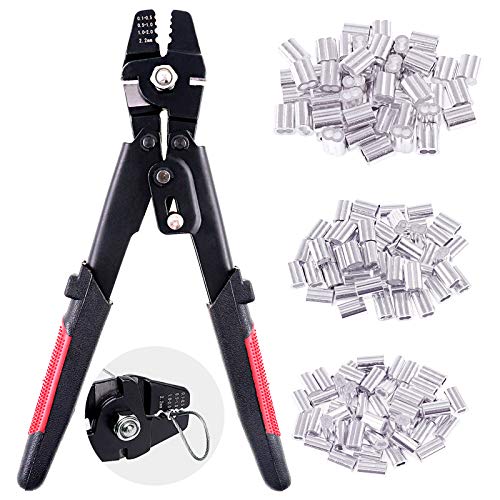
The Swpeet kit is the least expensive way in this roundup to own the full-size swager format. Its tool crimps from 0.1 mm up to a 2.2 mm maximum, the same ceiling as the Glarks, and the kit includes 150 aluminum double barrel ferrule sleeves split evenly across the three working sizes: 50 at 1.2 mm, 50 at 1.5 mm and 50 at 2.0 mm. For an angler whose leader work sits inside those sizes — which is most inshore and freshwater rigging and a good share of offshore light tackle — the functional coverage matches tools well above its tier.
The differences from the Glarks kit, its closest relative here, are assortment and finish rather than range. The Swpeet includes 150 sleeves to the Glarks kit’s 180, and its listing does not publish the tool’s weight or an overall length, so the leverage comparison has to be made on crimp range alone. What is published is the model, S421, the black finish, and the sleeve inventory, and the kit’s proposition is straightforward: the standard three double barrel sizes, a tool rated across them, and nothing else to buy before the first leader can be built.
Read it as the first crimper for an angler who is not yet sure crimping will become a habit, and as the spare for an angler who is sure and wants a second tool in the boat bag. If crimping does become the habit, the upgrade path runs to the CP1’s cup-to-cup dies or the Glarks kit’s stainless build, and the Swpeet’s sleeves remain usable with both.
Specs
- Type: Hand swager crimping tool
- Crimp range: 0.1 mm to 2.2 mm maximum
- Included: 150 aluminum double barrel sleeves (50 x 1.2 mm, 50 x 1.5 mm, 50 x 2.0 mm)
- Model: S421
- Color: Black
Choose the Swpeet kit if you want the full-size swager format and the three standard double barrel sleeve sizes at a budget tier. Skip it if you need single barrel sleeves in the box, or published line-class ratings for the tool’s dies.
Safety and Checks Before You Order
Match the sleeve to the die position, every time. The most common crimping failure is not a bad tool but a mismatched pair: a sleeve closed in the wrong die position. Before ordering, list the sleeve diameters you will use and confirm each one sits inside a marked position on the tool you are buying — up to 2.2 mm on the two swager kits, the published line classes on the CP1, single barrel sleeves only on the CP2. When the tool arrives, crimp test sleeves on scrap leader and pull them hard against a fixed point before any rig built with them goes near the water. A correct crimp holds to near the leader’s breaking point; a slipping crimp tells you the pairing is wrong while the lesson is still free.
Confirm which configuration the listing is actually selling. Crimpers are sold tool-only, with sleeves, and in several handle colors, each under its own listing. The CP1 below is the blue-handled version bundled with 140 sleeves, and the CP2 is the red-handled version bundled with 300; both tools exist in other configurations that are not the ones in the reference table. The Glarks kit also exists in a smaller 150 sleeve version under a different listing. Match the sleeve count and the configuration name on the product page to the entry in the table before ordering, not just the tool’s model name.
Never crimp braided line directly, and keep fingers behind the dies. A crimp sleeve grips mono, fluorocarbon and wire; braid’s woven surface lets a sleeve slide and then fail without warning, which is why crimped connections are built on mono, fluoro or wire, with braid joined to them by a knot or a swivel instead. On the tool itself, the pinch point is the die face: hold the sleeve in the dies with the leader, not with a fingertip, and squeeze the handles with the tool pointed away from your other hand. Wire tag ends trimmed at a sleeve are sharp enough to puncture skin, and a pair of cut-resistant gloves is standard equipment on boats that rig wire daily.
Know the warning picture for this category. No recall covers any tool named here, and fishing crimpers as a class have no recall history: they are unpowered hand tools with no mechanism to fail dangerously. The notice that does appear in this category is California’s Proposition 65 warning, which some listings for brass and copper crimp sleeves carry because brass alloys can contain lead. If that matters to you, read the warning field on the sleeve listing before ordering, wash your hands after a rigging session, and store sleeves and finished leaders away from children, which is sound practice with any terminal tackle.
Maintain the tool like the connection depends on it. Rinse salt off after boat use, dry the tool before storing it, and put a drop of oil on the pivot and across the die faces — on the carbon steel tools to hold rust off, and on the stainless tools to keep the pivot free. Check the die faces themselves once a season: a nicked or peened die edge cuts sleeves instead of closing them, and it is visible long before it costs a fish. A crimper stored dry in a rigging kit will outlast several generations of the reels it rigs for.
Frequently Asked Questions
What size crimping tool do I need for my leaders?
Match the tool to the sleeve diameter, then check that against your leader class. Most recreational rigging — inshore leaders, freshwater wire traces, light offshore work — uses sleeves from 1.2 mm to 2.0 mm, and any tool in this roundup covers that span, with the swager kits topping out at 2.2 mm. Heavy offshore leaders push into the largest sleeves, and that is where the CP1’s published line classes are the clearest guide: 50 to 400 lb in mono and fluorocarbon, 100 to 600 lb in wire. If your sleeves are single barrel, the size question is already answered by the CP2, which is built for that style alone.
Can I crimp sleeves with regular fishing pliers instead of a crimping tool?
You can close a sleeve with pliers, and the connection will look finished, but it will not be the connection a crimping tool makes. Flat plier jaws flatten the sleeve onto two edges, concentrate the pressure there, and cut into the leader material inside the sleeve, so the rig fails at a fraction of its rated strength, usually without any visible warning. A crimping tool’s matched dies compress the sleeve evenly around the line along its full length. The price of that difference is one dedicated tool; the price of skipping it is the fish that finds the weak crimp.
Should I use single barrel or double barrel sleeves?
Use the sleeve style your leaders and your tool were built around. Double barrel sleeves, with a separate tube for each leg of the loop, are the standard for monofilament and fluorocarbon leaders, especially as the line gets heavier, because they keep the two legs from crushing against each other inside one tube. Single barrel sleeves take both legs through one tube and are the common choice for wire leaders and lighter work, where the smaller finished connection matters. Oval sleeves are a low-profile form of the single barrel idea shaped for cup-to-cup dies. The practical rule is to buy the tool for the style you will crimp most — or a kit, like the SILANON, that stocks both styles so the choice stays open.
Can a crimping tool damage the line inside the sleeve?
Yes, and the two causes are both avoidable. The first is the wrong die position: a sleeve closed in an undersize position gets cut by the die edges, and the line inside is nicked at exactly the point of highest stress. The second is over-crimping, squeezing past the point where the sleeve has fully closed, which flattens the sleeve’s ends into sharp flares that saw at the leader under load. The defenses are the matched die for the sleeve size, one firm squeeze rather than repeated partial ones, and a pull test on a scrap rig before the real ones are built. A correctly made crimp fails in the line, away from the sleeve, when it is pulled to destruction — which is the whole point of the system.
Conclusion
The best fishing crimping tools are chosen by sleeve style first, die range second, and material third. The Booms Fishing CP1 is the best overall pick here, a 10 inch cup-to-cup crimper whose published range covers mono, fluorocarbon and wire across the recreational spectrum. The Glarks kit brings the same sleeve ceiling in stainless steel with a matched double barrel assortment, and the SILANON kit stocks the broadest sleeve inventory in the roundup across both metals and both barrel styles. The Booms Fishing CP2 is the compact single barrel specialist, and the Swpeet kit is the budget route into the full-size swager format. Match the tool to the sleeves you actually crimp, pull-test your first connections on scrap leader, and keep the dies clean and oiled, and any of the five will build leaders that hold the way the system promises.
More from Amazon
Programs that pair well with the guide above. Offers and eligibility are set by Amazon and may change.
Free shipping on eligible items, Prime Video and more. Eligible new members can start with a free trial.
Start a Prime free trialA Prime membership for ages 18-24 with a trial period. Eligibility is set by Amazon.
See Prime for Young AdultsAudiobooks and podcasts to listen to on the go. Eligible new members can start with a free trial.
Try Audible freeAd-free music streaming. Eligible new subscribers can start with a free trial.
Try Music Unlimited freeAs an Amazon Associate we earn from qualifying purchases.
Write Your Review
No reviews yet. Be the first to share your experience!