

Key takeaways
- Shimano Stradic FM: A refined freshwater and light inshore option, with a useful range of sizes, smooth gearing, and strong refinement-to-weight balance.
- Daiwa Ballistic MQ: A lightweight choice with a rigid monocoque-style body design and good suitability for finesse and inshore applications.
- Penn Battle IV: A heavier-duty value-oriented reel with a full-metal body, substantial drag, and models suited to saltwater and surf fishing.
Best Fishing Reels: Smooth, Durable Options by Technique
The best fishing reels are the ones whose reel type, drag, gear ratio, line capacity, corrosion protection, and weight match the way you fish—not simply the model with the most bearings. For most anglers, a quality 2500–3000 spinning reel is the easiest all-around choice; baitcasters suit accurate lure casting; conventional reels handle heavy line and offshore loads; and fly reels are specialized for balance, backing capacity, and drag control.
Quick Picks by Fishing Situation
| Fishing situation | Best reel type | Useful size or capacity | What to prioritize |
|---|---|---|---|
| Beginner, mixed freshwater | Spinning | 2500–3000; 6–10 lb mono or braid equivalent | Easy casting, sealed drag, low weight, simple maintenance |
| Bass, accurate lure placement | Low-profile baitcaster | 100–150 size; 10–17 lb line | Braking adjustment, spool control, comfortable frame |
| Surf or shore fishing | Large spinning | 5000–8000; 20–40 lb braid | Line capacity, long-cast spool, saltwater resistance |
| Bottom fishing and trolling | Conventional or lever-drag | 300–500 yards of 30–80 lb braid | Gear durability, powerful drag, metal frame, retrieve power |
| Trout and light lures | Light spinning | 1000–2000; 2–6 lb line | Low start-up inertia, balance, smooth light drag |
Spinning Reels: The Best General-Purpose Option
Spinning reels are usually the safest recommendation for new anglers and anyone fishing several techniques. They cast light lures more easily than baitcasters, tolerate imperfect thumb control, and work well with monofilament, fluorocarbon, and braided line.
Our top picks
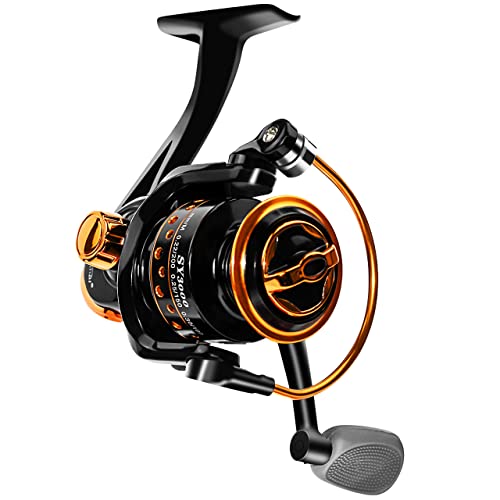


As an Amazon Associate we earn from qualifying purchases at no extra cost to you. Ratings are shown as listed on Amazon.
A 2500 or 3000 size is a practical middle ground. A representative 2500 reel may weigh about 7–9 ounces and hold roughly 140–200 yards of 8–10 pound braid, depending on the spool design. Move to a 4000–5000 size for inshore species, heavier lures, or surf work. The added spool diameter improves line pickup and casting, but the extra weight can make a light rod tip-heavy.
Strong spinning-reel choices
- Shimano Stradic FM: A refined freshwater and light inshore option, with a useful range of sizes, smooth gearing, and strong refinement-to-weight balance.
- Daiwa Ballistic MQ: A lightweight choice with a rigid monocoque-style body design and good suitability for finesse and inshore applications.
- Penn Battle IV: A heavier-duty value-oriented reel with a full-metal body, substantial drag, and models suited to saltwater and surf fishing.
Do not choose a spinning reel by bearing count alone. Four well-protected, correctly aligned bearings can feel better and last longer than ten inexpensive bearings exposed to salt and grit. Look for a sealed or shielded drag, an anti-reverse system with minimal backplay, a rigid handle connection, and a bail that does not flex excessively.
Baitcasting Reels: Control and Efficiency for Lures
Baitcasters are the better choice when you need accurate casts around cover, fast lure engagement, or direct control over a fish. They are particularly effective for bass, pike, musky, and heavier freshwater applications. Their tradeoff is a learning curve: spool tension, braking, lure weight, and thumb pressure must work together to prevent backlash.
A 100–150 size low-profile baitcaster is the common all-around format. Typical weights range from 6.5 to 8 ounces, with capacity around 100–150 yards of 12–16 pound monofilament-equivalent line. A compact 70–100 size reduces weight for finesse presentations, while a 200–300 size gives more room for thick braid, heavy leaders, or large lures.
Strong baitcasting-reel choices
- Shimano Curado MGL 150: A versatile bass and multispecies reel with a lightweight spool designed for responsive casting.
- Daiwa Tatula 100: A durable low-profile option with a comfortable frame and braking system suited to repeated lure casting.
- Abu Garcia Revo SX: A capable mid-range baitcaster for anglers wanting adjustable braking and a broad selection of gear ratios.
For beginners, magnetic or dual braking systems are more useful than an exceptionally light spool. Start with the brakes set relatively high, adjust spool tension until side-to-side movement is minimal, and reduce braking gradually as casting control improves.
Gear Ratios: Speed Is Only Half the Decision
Gear ratio describes how many times the spool turns per handle revolution. A 6.3:1 reel turns the spool 6.3 times per handle rotation, but inches-per-turn is equally important because spool diameter changes line pickup.
| Gear-ratio range | Typical retrieve speed | Best applications | Tradeoff |
|---|---|---|---|
| 5.0:1–5.9:1 | About 20–26 inches per turn | Crankbaits, deep resistance-heavy lures, powerful retrieves | Slower line recovery |
| 6.0:1–6.9:1 | About 25–31 inches per turn | General bass fishing, jigs, soft plastics, all-purpose use | Less specialized |
| 7.0:1–8.5:1 | About 29–36 inches per turn | Topwater, flipping, rapid lure pickup, burning presentations | More handle effort under heavy load |
Choose a slower ratio when the lure itself creates strong resistance or when you need controlled cadence. Choose a faster ratio when slack-line management and rapid recovery matter. High speed does not automatically mean more power.
Drag Strength, Line Capacity, and Weight
Drag strength should exceed the pressure needed to control the fish, but maximum drag numbers are not a complete performance measure. A smooth start-up at low pressure is more valuable for light line, while a rigid frame and heat-resistant drag stack matter more for large fish.
As a practical rule, set drag at roughly 20–30 percent of the line’s rated breaking strength, then adjust for knots, abrasion, rod action, and fighting conditions. For 10-pound line, that means beginning around 2–3 pounds of measured drag. Heavier braid can tempt anglers to tighten the drag too far, but the rod, leader, hook, and reel gears still have limits.
Line capacity should leave room for a long run and several imperfect casts. If a reel is rated for 150 yards of 10-pound braid, do not fill it with 150 yards of thick 30-pound braid and expect the same casting behavior. Braid diameter varies substantially by manufacturer, so diameter is more useful than pound-test alone when comparing capacity.
Weight affects comfort over a full day. A 7-ounce reel paired with a balanced rod may feel better than a 6-ounce reel whose foot sits far behind the reel seat. Balance the complete outfit before paying a premium for a small weight reduction.
Saltwater and Corrosion Resistance
Saltwater reels need corrosion management, not just a “sealed” label. Salt can enter through the line roller, handle knob, drag knob, spool lip, and body joints. Sealed bearings and protected drag systems help, but they cannot replace rinsing and drying.
After saltwater use, tighten the drag slightly, rinse the reel with a gentle freshwater stream, wipe it dry, and loosen the drag for storage. Avoid high-pressure spray, which can force salt and water deeper into the body. Lubricate the line roller and handle bearings according to the manufacturer’s schedule. Inspect braid for salt crystals and replace leaders more often than you would in freshwater.
Ownership Costs and What Wears First
The first consumables are usually line, leaders, drag washers, and small bearings—not the main gear set. Line replacement can cost roughly $15–$40 for common freshwater setups and more for large offshore reels. A mid-priced reel used twice monthly may provide several seasons of service if cleaned, stored dry, and not used as a winch to drag fish through cover.
Common mistakes shorten reel life quickly:
- Overfilling a spinning spool, causing wind knots and loose coils.
- Using the reel handle to pull a snag instead of pointing the rod safely and applying controlled pressure.
- Storing a wet reel in a sealed case, which traps corrosion-causing moisture.
- Applying heavy grease to the spool shaft or drag when the manufacturer specifies light oil.
- Leaving the drag tightly locked for months, which can compress some drag materials unnecessarily.
Bottom Line
Choose a 2500–3000 spinning reel for the broadest range of freshwater fishing, a 100–150 baitcaster for accurate lure work, a 5000–8000 spinning reel for surf and inshore use, and a conventional lever-drag reel for heavy offshore loads. Within each category, prioritize a smooth drag, adequate capacity, a rigid body, sensible weight, protected bearings, and parts support over an impressive bearing count or maximum-drag headline. The best fishing reels are durable because their specifications fit the technique and their owners maintain them consistently.




Write Your Review
No reviews yet. Be the first to share your experience!