

Key takeaways
- Choose a light 16–18-inch Latin machete for grass and general clearing, a bolo or golok for mixed brush, and a kukri-style model for heavier woody growth. Prioritize balance, handle security, a 2–3 mm working blade, and a sheath that remains safe when wet. Paying more…
The best machetes for most clearing and camp jobs are a full-size 16–18-inch model with a comfortable non-slip handle, a 2–3 mm blade, and a sheath that protects both the edge and the user; the right profile depends on whether you are slicing grass, chopping woody stems, or processing small branches.
Our top picks



As an Amazon Associate we earn from qualifying purchases at no extra cost to you. Ratings are shown as listed on Amazon.
Quick picks by cutting job
| Situation | Best profile | Useful specification | Why it fits |
|---|---|---|---|
| Grass, reeds, vines, and light brush | Latin or standard machete | 16–18 in blade; 1.5–2.5 mm thick | Fast, low-fatigue slicing with a long cutting arc |
| Mixed brush and saplings | Bolo or forward-weighted machete | 14–18 in blade; 2.5–3.5 mm thick | More momentum near the tip for chopping |
| Dense, woody vegetation | Kukri-style machete | 12–18 in blade; roughly 3 mm thick | Curved belly concentrates impact on tough stems |
| Trail work where pack weight matters | Light Latin or compact machete | 12–16 in blade; under 1.5 lb including sheath | Easier to carry and quicker for repeated cuts |
| Heavy camp chopping and batoning | Thick bolo or kukri | 14–18 in blade; 3–4 mm thick | Greater stiffness and chopping authority, at higher weight |
What makes the best machetes different?
Blade profile
A Latin machete has a relatively straight spine and a gently curved edge. It is the most efficient profile for sweeping through grass, weeds, vines, and flexible brush. Because its weight is distributed along a long blade, it feels quick rather than axe-like.
A bolo widens toward the front. That extra steel moves the balance point forward, producing stronger cuts against woody stems. The trade-off is slower recovery between strokes and more wrist fatigue during long grass-clearing sessions.
A kukri-style blade curves sharply forward, putting a large amount of cutting edge in the belly. It can outperform a straight machete on dense brush and small saplings, but it requires more attention to cutting angle. It is less convenient for trimming close to the ground or making neat, controlled slices.
A parang-style machete is also forward-weighted, often with a deep belly and a relatively thick blade. It suits chopping and trail work, while a lighter Latin pattern is usually better when the job involves hundreds of fast clearing strokes.
Steel: edge retention versus easy sharpening
Common machete steels are selected for toughness and affordable sharpening rather than maximum razor-edge retention. Plain carbon steels such as 1055, 1075, and 1095 can take a useful, aggressive edge and are comparatively easy to resharpen. They will also develop surface rust if left wet or dirty.
Stainless steels resist corrosion better, which is helpful in humid camps or near salt water, but their exact sharpening behavior varies widely. A stainless machete is not automatically tougher or longer-lasting than a carbon-steel model. For ordinary brush work, toughness and a serviceable edge are usually more important than achieving the highest possible hardness.
Look for a blade that is sharpened consistently from heel to tip. A very thin, polished edge may feel sharp out of the package but can roll or chip when it meets hidden gravel, knots, or dry hardwood. A slightly toothy, durable edge is often more useful outdoors.
Head-to-head examples
| Model or type | Blade and steel | Approx. carry weight | Best use | Main compromise |
|---|---|---|---|---|
| Tramontina 18-inch machete | About 18 in; carbon steel; commonly around 1.5–2 mm thick | Usually about 1.5–2 lb with sheath, depending on version | Budget grass, weeds, vines, and general clearing | Basic handle and sheath; carbon steel needs drying and oil |
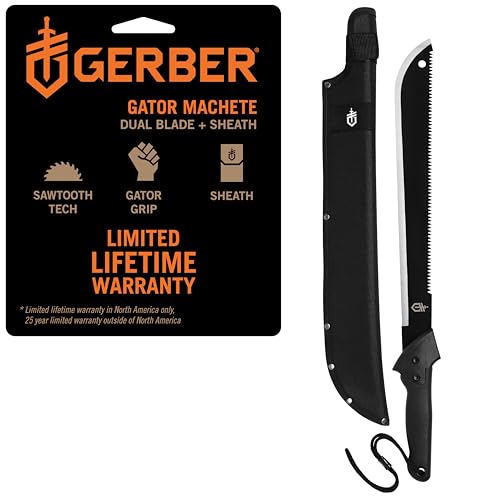
| Gerber Gator Machete | About 18 in blade; stainless-steel blade with a sawback section on many versions | Roughly 1.5–2 lb with sheath | General trail clearing when grip security matters | Sawback adds bulk but is not a substitute for a dedicated saw |
| Cold Steel Kukri Machete | About 18 in; 1055 carbon steel; roughly 2.8–3 mm thick | Approximately 2–2.5 lb with sheath | Woody brush, saplings, and forceful chopping | Heavy and less nimble for grass or extended overhead work |
| Condor Golok | Typically 14–18 in; 1075 carbon steel; about 3 mm thick | Often around 2–3 lb with sheath | Durable camp and trail chopping | Costs more and carries more weight than a basic Latin machete |
| Compact 12–14-inch machete | Usually 2–3 mm thick; carbon or stainless steel | About 1–1.75 lb with sheath | Small camps, tight trails, and users with limited reach | Shorter cutting arc and less momentum than a full-size model |
Weights and dimensions can vary by production run, handle material, and sheath, so treat the figures as buying guidelines rather than a substitute for the current specification sheet. The important comparison is relative: a thin Latin model is optimized for repeated slicing, while a thick kukri or golok carries more mass into each impact.
How to choose thickness and length
Blade length is a reach-and-control decision. A 16–18-inch blade clears more vegetation per stroke and keeps hands farther from thorns, but it needs more room to swing. A 12–14-inch machete is easier to control in cramped camps, around fences, and on narrow trails.
For flexible vegetation, 1.5–2.5 mm thickness keeps the tool light. For frequent contact with dry, woody stems, 2.5–3.5 mm is a better starting point. Blades above about 4 mm can be very robust, but they begin to overlap with lightweight axes and are tiring for high-volume grass cutting.
A practical fit check is to hold the machete in a relaxed one-handed grip with the point down. You should be able to move the blade through a controlled arc without leaning, twisting your shoulder, or allowing the handle to slide. If the balance feels far beyond the index finger and your forearm tires after several slow practice swings, choose a lighter or shorter model.
Handle comfort and sheath quality
The handle matters more than decorative blade finishes. A textured polymer or rubberized grip is usually easier to control with sweaty hands than smooth wood or hard plastic. Check that the handle has a usable guard or flare to prevent the hand sliding forward, but avoid an oversized guard that interferes with changing grip.
Full-tang construction is preferable for repeated chopping because the blade steel continues through the handle. Riveted scales should fit tightly, with no movement when you squeeze and twist the grip. A lanyard hole is useful, but a lanyard should not be wrapped around the wrist during a swing; it can complicate releasing the tool if it catches.
A good sheath should cover the entire edge, retain the machete when inverted, and offer a secure belt or pack attachment. Thin fabric sleeves protect the blade from other gear but may not protect fingers from a sharp edge. Plastic or molded sheaths are more resistant to wet vegetation, though they can trap moisture against carbon steel if stored without drying.
Decision matrix for real-world buyers
| Your priority | Choose | Avoid |
|---|---|---|
| Lowest purchase cost and occasional clearing | 16–18-inch Latin carbon-steel machete | Specialized heavy kukri unless chopping is the main task |
| First machete and uncertain technique | 12–16-inch model with moderate weight and a secure grip | Very long, tip-heavy blades that magnify poor control |
| Weekly work on woody brush | Forward-weighted bolo, golok, or kukri with a 2.5–3.5 mm blade | Ultralight blades that flex or require constant edge repair |
| Wet climate or coastal storage | Corrosion-resistant steel, or carbon steel with disciplined maintenance | Leaving any machete wet inside a closed sheath |
| Long hikes with occasional vegetation | 12–16-inch model below roughly 1.5 lb with sheath | Two-pound-plus choppers carried for a job that rarely occurs |
Maintenance that extends service life
- Clean after every session. Remove sap and plant residue with a damp cloth, then dry the full blade, especially near the handle.
- Touch up before it becomes dull. A mill file or coarse sharpening stone restores a working edge faster than trying to grind back severe damage. Follow the existing bevel rather than creating a thin knife edge.
- Protect carbon steel. Apply a thin coat of food-safe mineral oil for camp and food-adjacent use, or a suitable corrosion-inhibiting oil for general tool storage.
- Inspect the handle and sheath. Stop using the machete if scales loosen, rivets move, or the sheath no longer retains the blade.
- Store separately from the sheath when damp. A wet sheath is one of the fastest ways to encourage rust, including rust hidden along the edge.
The parts that usually wear first are the edge, handle fasteners, and sheath throat. Edge damage is normal and repairable; a cracked handle or unsafe sheath is a replacement issue. Do not chop into soil, stones, wire, or hidden metal, and do not use a machete as a splitting wedge. For substantial trunks or repeated firewood processing, a saw or axe is safer and more efficient.
Bottom line
Choose a light 16–18-inch Latin machete for grass and general clearing, a bolo or golok for mixed brush, and a kukri-style model for heavier woody growth. Prioritize balance, handle security, a 2–3 mm working blade, and a sheath that remains safe when wet. Paying more for a comfortable grip and durable sheath often improves ownership more than paying for a harder-to-sharpen steel or an elaborate blade coating.

Write Your Review
No reviews yet. Be the first to share your experience!