

Our Top Picks
- Top Pick: Quick Comparison
- Runner-up: Quick Comparison
- Also consider: Quick Comparison
The best pedal fishing kayak for most anglers is the Old Town Sportsman PDL 106: a propeller pedal drive with instant forward and reverse, a wide pontoon-style hull, a 450 lb total capacity, and a mesh seat built for full days, at a mid-range tier. Anglers who fish big open water should step up to the Wilderness Systems Recon 120 HD, the premium pick here, with its 38 inch beam and 360-degree swivel seat. At the lighter end, the Pelican Catch Kicker 110 HDII pairs a fin drive with a 59 lb hull, the Brooklyn 10.5 Pro from BKC is the budget propeller pick, and the Reel Yaks Raider 9.5 splits into two sections that fit in a car trunk.
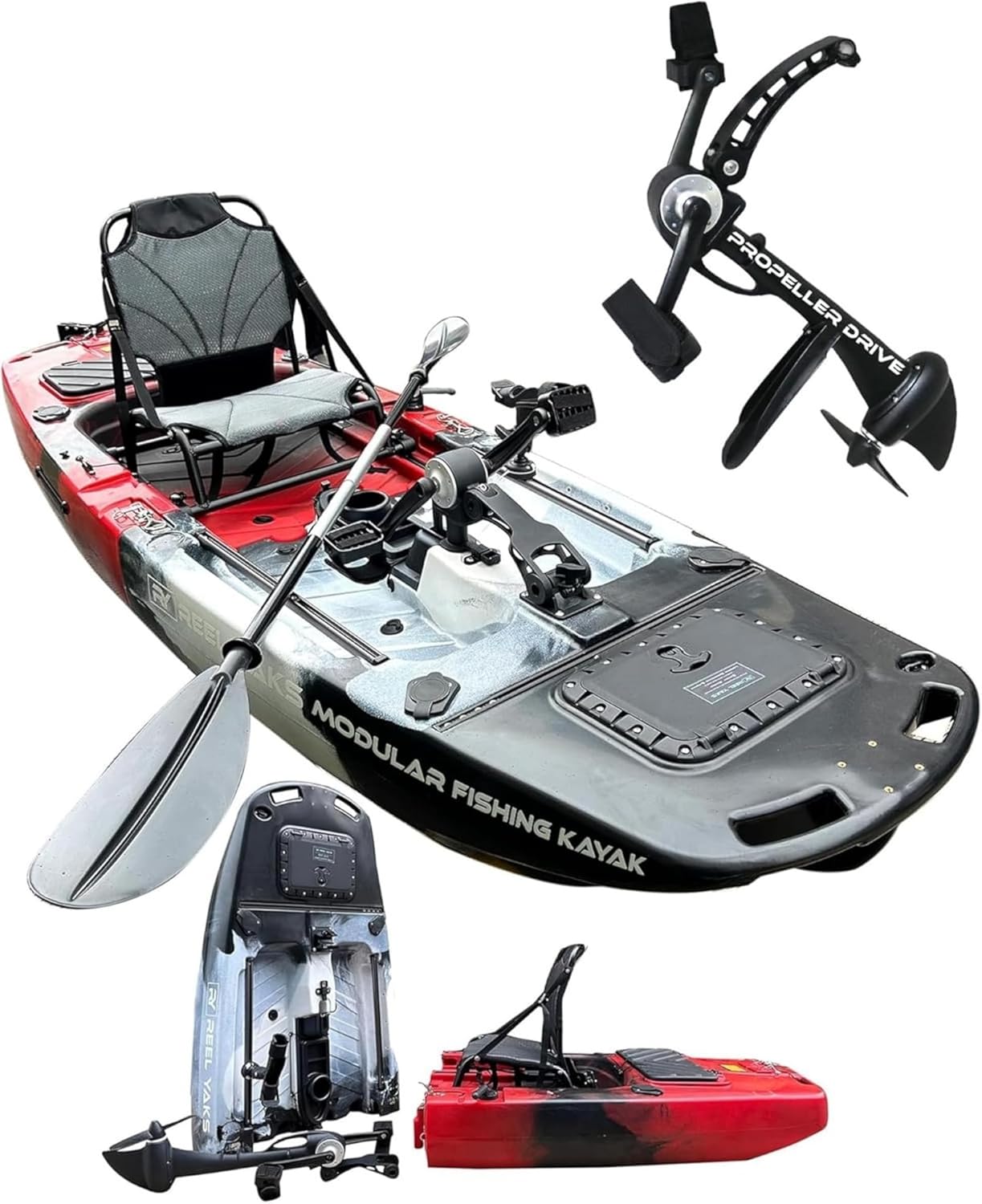
This guide compares five pedal kayaks on the specifications that decide whether a pedal boat works for your water: drive type, hull weight, capacity, stability, and how the boat travels from garage to launch. Every figure below comes from the manufacturers’ published specification charts and listing data, so you can match a kayak to the way you fish without guessing.
As an Amazon Associate, we earn from qualifying purchases.
Table of Contents
- Why Anglers Switch to Pedal Drive
- How to Choose a Pedal Fishing Kayak
- Quick Comparison
- The 5 Best Pedal Fishing Kayaks
- Safety and Checks Before You Order
- Frequently Asked Questions
- Conclusion
- Product and ASIN Reference
Why Anglers Switch to Pedal Drive
A paddle fishing kayak asks your hands to do two jobs at once: move the boat and fish. Every cast from a paddle kayak starts with the paddle across your lap, and every drift correction costs you a cast. A pedal drive moves propulsion to your legs, which are stronger and less busy, so the rod stays in your hands while the boat holds position, follows a bank, or backs away from a hooked fish. For trolling, for working a shoreline slowly, and for holding over structure in light current, that division of labor is the entire argument for the category.
Pedal drives come in two mechanical families, and the split runs through this whole guide. Propeller drives work like a bicycle: your feet turn cranks, a shaft turns a propeller under the hull, and pedaling backward drives the boat backward, which gives instant reverse for stopping and for backing out of cover. Fin drives work like a stepper: your feet push two fins back and forth under the hull in a scissoring motion, and the fins fold flat against the hull in inches of water. Propeller drives reverse instantly and push hard against current; fin drives run shallower and shrug off weeds and stumps that would foul a propeller. Neither is better in the abstract. The right one is the one that matches your depth, your cover, and how often you need reverse.
The five kayaks in this guide are all sit-on-top fishing platforms with the drive included in the listing, not hulls that need a separate drive purchase to become pedal boats. They span 9 ft 6 in to 12 ft 2 in, 59 lb to 115 lb, and capacities from 300 lb to 450 lb, and those spreads are the real story: pedal kayaks are heavy, capacity is not a suggestion, and the boat that fishes best is often not the boat that loads onto a roof rack best. The sections below take those trade-offs in order.
How to Choose a Pedal Fishing Kayak
Fin Drive or Propeller Drive
Start with the water, not the brand. If you fish shallow flats, stump fields, and weed-choked creeks, a fin drive is the safer tool: the fins sweep close to the hull, can be feathered flat with a short pedal stroke, and pull up flush when you beach. If you fish deeper lakes, rivers with current, and open inshore water, a propeller drive earns its keep with stronger thrust and true instant reverse, which is the single most useful maneuver in kayak fishing: pedal backward and the boat stops, backs off a dock, or holds while a fish runs. Propellers do hang lower and collect weeds, so propeller anglers in grass learn to lift the drive and paddle the last few yards. Every pick in this guide is one or the other, and the product sections say which and why it matters.
Weight Is a Fishing Specification
Pedal kayaks are heavy because drives, framed seats, and wide hulls are heavy. The lightest boat in this guide weighs 59 lb; the heaviest weighs 115 lb, and that spread decides how the boat gets to the water more than any other number. A removable drive helps: on the Old Town and several others the drive console lifts out, cutting the carry weight for loading. A modular hull helps differently: the Reel Yaks Raider splits into two sections of about 31 lb each, so no single lift is heavy and no roof rack is needed at all. Be honest about your launch. A 115 lb boat that needs a trailer or a cart fishes wonderfully and travels badly; a 59 lb boat that car-tops in two minutes gets used three times as often. Match the weight to your vehicle and your ramp, not to your ambitions.
Capacity Means You Plus Everything
Published capacity is the total load the hull supports: your weight, the seat and drive if they are counted separately, tackle, cooler, electronics, and the fish you hope to add. Fishing loads are heavier than paddlers expect, because a crate of tackle, a fish finder battery, and a full cooler add up fast. The sound habit is to keep your normal loaded weight comfortably under the published figure rather than at it, because a hull floating at its limit sits low, paddles sluggishly, and ships water through the scupper holes. The picks here run from 300 lb on the light fin-drive boat to 450 lb on the two big propeller platforms, and the product sections are explicit about who each ceiling suits and who it excludes.
Stability, Standing, and Hull Shape
Width is the crude proxy for stability, and these boats run from 33 to 38 inches across. Pontoon-style and tunnel hulls, like the ones under the Old Town and the Pelican, trade speed for a platform that feels planted when you turn sideways to reach a crate or stand to cast. A 38 inch beam like the Wilderness Systems boat is a standing platform first and a traveling boat second. Standing matters for sight fishing and for casting comfort on long days, but it is earned with hull weight and width, and it costs glide. If you never stand, a narrower, lighter hull will cover water more happily. If you sight-cast to redfish or bass on flats, buy the beam and accept the carry.
The Seat Is Half the Boat
Pedal anglers sit for hours in one position, pedaling, and the seat decides whether hour four feels like hour one. The category has moved to framed, elevated mesh seats, and all five picks here use some version of one: the Wilderness Systems seat swivels a full 360 degrees so you can fish off the side without turning the boat, the Pelican seat raises for a higher sight line, and the modular Reel Yaks uses a stadium-style seat. Elevation also matters for pedaling mechanics, because a very low seat makes the pedal stroke cramped for long legs. When two boats look equal on paper, the seat is usually the honest tiebreaker.
Rudder Steering and Boat Control
Most pedal kayaks steer with a hand-controlled rudder, leaving your feet to pedal and your other hand free for the rod. Check where the rudder control sits and whether it can be used from the fishing position without leaning. A rudder is not a luxury on a pedal boat: it is how you track straight across a windy lake and how you angle the boat along a bank while your legs do the moving. Boats in this guide all include rudder steering except where noted, and the modular and fin-drive picks use it to compensate for shorter hulls that would otherwise wander.
Quick Comparison
| Kayak | Best For | Tier | Drive | Length | Weight | Capacity |
|---|---|---|---|---|---|---|
| Old Town Sportsman PDL 106 | Best overall | Mid-range | Propeller, instant reverse | 10 ft 6 in | 107 lb | 450 lb |
| Wilderness Systems Recon 120 HD | Premium big-water platform | Premium | Propeller, instant reverse | 12 ft 2 in | 115 lb | 450 lb |
| Pelican Catch Kicker 110 HDII | Lightest fin drive | Mid-range | Fin drive | 10 ft 6 in | 59 lb | 300 lb |
| BKC Brooklyn 10.5 Pro Pedal Kayak | Budget propeller pick | Budget | Propeller, instant reverse | 10 ft 4 in | 65 lb | 420 lb |
| Reel Yaks Raider 9.5 | Modular, no roof rack | Budget | Propeller, forward and reverse | 9 ft 6 in | 66 lb | 380 lb |


The 5 Best Pedal Fishing Kayaks
1. Old Town Sportsman PDL 106 — Best Overall
Tier: Mid-range
The Sportsman PDL 106 is the boat this category is measured against, and the specification sheet explains why. The PDL drive is a propeller unit with instant forward and reverse: pedal forward to go, pedal backward to stop or back out, with no lever to throw and no delay. The drive console lifts out of the hull for transport and for clearing weeds, and Old Town backs the drive with a five-year warranty, the longest drive coverage in this guide. Underneath is a pontoon-style hull, 36 inches wide, that gives the boat its defining trait: it feels planted. Standing to cast, turning in the seat to reach the tankwell, and leaning on a fish all happen without the wobble that narrower hulls punish.
The numbers suit the mainstream of kayak fishing. Total capacity is 450 lb, with 343 lb published as usable capacity for the angler and gear, which covers big anglers with a full tournament load. The premium mesh seat adjusts and breathes, accessory tracks and flush rod holders are molded in, and a universal transducer mount sits under the hull for a fish finder. At 107 lb assembled it is not light, and this guide will not pretend otherwise; the honest routine is a kayak cart for the ramp and the removable drive console, about 18 lb on its own, taken out before the roof rack lift.
Choose the Sportsman PDL 106 if you want one pedal kayak that does everything well: lakes, slow rivers, inshore bays, standing casts, and trolling, with the strongest drive warranty here. Skip it if you fish water shallower than a propeller can clear all day, where the fin-drive Pelican below is the right tool, or if your launch routine cannot absorb a 107 lb boat even with a cart.
Specs
– Length: 10 ft 6 in
– Width: 36 in
– Assembled weight: 107 lb, with a removable pedal console
– Total capacity: 450 lb; usable capacity 343 lb, per Old Town
– Drive: PDL propeller pedal drive, instant forward and reverse
– Hull: pontoon-style, single-layer polyethylene
– Seat: premium mesh seat
– Color pinned in the reference table: Ember Camo
– Warranty: limited lifetime hull; five-year warranty on the PDL drive, per Old Town
2. Wilderness Systems Recon 120 HD — Premium Big-Water Platform

Tier: Premium
The Recon 120 HD is the most fishing-first hull in this guide. Its S.M.A.R.T. hull design, Wilderness Systems’ shorthand for how the hull balances stability, maneuverability, acceleration, responsiveness, and tracking, runs 38 inches wide, the broadest beam here, and the result is a genuine standing platform with room to move. The Helix PD pedal drive provides instant forward and reverse and stows up into the hull for shallow water or beaching, and the boat is built for three propulsion modes: pedal it, paddle it, or add a stern motor later through the built-in mounting interface.
The seat is the headline after the drive. The AirPro ACES seat swivels a full 360 degrees, so an angler can pedal to a spot, rotate to fish off the side or the stern, and work water that a fixed seat forces you to approach bow-first. Around it, the deck carries the StowPro storage system, dual rod troughs that lay rods flat along the hull instead of standing them up in holders, and open deck space that takes a crate and electronics without crowding. Capacity matches the Old Town at 450 lb.
The cost is weight and tier. At 115 lb the Recon 120 HD is the heaviest boat in this guide, and it is a trailer-or-cart boat for most owners, full stop. Choose it if you fish big lakes, reservoirs, and open inshore water, stand to sight-cast, and want the swivel seat and the motor-ready stern. Skip it if you car-top alone at unimproved launches, where the Pelican or the modular Reel Yaks will fish more often simply because they travel better.
Specs
– Length: 12 ft 2 in, per Wilderness Systems
– Width: 38 in
– Weight: 115 lb
– Capacity: 450 lb
– Drive: Helix PD propeller pedal drive, instant forward and reverse, stowable
– Hull: S.M.A.R.T. hull design, sit-on-top
– Seat: AirPro ACES seat with 360-degree swivel
– Fishing features: StowPro storage system, dual rod troughs, stern motor mounting interface
3. Pelican Catch Kicker 110 HDII — Lightest Fin Drive
Tier: Mid-range
The Catch Kicker 110 HDII is the fin-drive answer in this guide, and its argument is a number: 59 lb. That is roughly half the weight of the big propeller boats, in a 10 ft 6 in hull that one person can car-top without a routine. The HyDryve II system drives two fins with a push-pedal motion, and fins are the shallow-water tool: they sweep close to the hull, feather flat over oyster rakes and stump fields with a half stroke, and tuck up for beaching without a propeller to bend. For creeks, marsh, and weedy ponds, that is the correct propulsion, and no propeller boat in this guide matches it there.
The rest of the boat is built around the light brief. The Ergoboost seat raises the angler for a better sight line and a more comfortable pedal angle, two metal side handles carry integrated rigging tracks for mounting accessories, and a rudder with dual-side control keeps the short hull tracking. The trade is capacity: 300 lb is the lowest ceiling in this guide, and it is a hard limit, not a rounding error. An angler who weighs 220 lb has 80 lb left for seat, tackle, cooler, and fish, which is a light load by fishing standards.
Choose the Catch Kicker 110 HDII if you fish shallow, protected water, travel alone, and value a boat that loads in minutes. Skip it if you are a heavier angler, carry a tournament load, or fish open water where the 300 lb ceiling and short hull work against you; the Old Town and the BKC both carry far more.
Specs
– Length: 10 ft 6 in
– Width: 33 in
– Weight: 59 lb
– Capacity: 300 lb
– Drive: HyDryve II fin pedal system
– Seat: Ergoboost elevated seating system
– Material: polyethylene, per the listing data
– Steering: rudder with dual-side control
– Color pinned in the reference table: Amazonia
4. BKC Brooklyn 10.5 Pro Pedal Kayak — Budget Propeller Pick
Tier: Budget
The Brooklyn 10.5 Pro, the current version of the boat long sold as the BKC PK11, is the value route into a propeller drive with instant reverse. The bicycle-style pedal unit turns a propeller, stops and backs up on the pedals alone, and removes entirely if you want to paddle the hull or fit the optional motor in its place, a flexibility the other budget pick here does not offer. Steering is by a hand-operated rudder, the seat is an aluminum-frame design, and the hull is a single-piece roto-molded HDPE shell, which is the construction the premium brands use, at a budget tier.
The published figures are strong for the tier: 420 lb of capacity on a 65 lb dry hull, per the maker’s current specification page. Older listings and reviews of the PK11 print 60 lb and a 10 ft 6 in length against the current page’s 65 lb and 10 ft 4 in, so treat the maker’s current page as the authority and expect either figure on a given listing. The included kit is complete: pedal drive, seat, paddle, two hatches, four rod holders, accessory plates, and scupper plugs, so the boat fishes as delivered without an accessory order. BKC backs the hull for five years and the pedal drive for two, published warranty terms that match or beat several pricier boats here.
Choose the Brooklyn 10.5 Pro if you want propeller drive, instant reverse, and a complete kit at the budget tier, and your water is deep enough for a propeller. Skip it if you fish skinny, weedy water all season, where the fin-drive Pelican is the honest pick, or if the swivel seat and big-water manners of the Recon are what you actually want.
Specs
– Length: 10 ft 4 in, per the maker’s current specification page
– Width: 35 in
– Dry weight: 65 lb, per the maker (older listings print 60 lb)
– Capacity: 420 lb
– Drive: bicycle-style propeller pedal drive, instant reverse, removable
– Hull: roto-molded single-piece HDPE
– Seat: aluminum-frame seat
– Includes: pedal drive, seat, paddle, 2 hatches, 4 rod holders, accessory plates, scupper plugs
– Warranty: five-year hull, one-year parts, two-year pedal drive, per BKC
5. Reel Yaks Raider 9.5 — Modular, No Roof Rack
Tier: Budget
The Raider 9.5 solves the problem the other four boats create: getting the kayak to the water. It is a two-section modular hull that locks together with a dovetail connection and side latches, and comes apart into sections of about 31 lb each that ride in a car trunk or a closet. No roof rack, no trailer, no cart, and no 100 lb dead lift. Assembled, it is a 9 ft 6 in sit-on-top with a wide W-hull, a propeller pedal drive with forward and reverse, a stadium-style seat, and a paddle included in the box.
On the water it is a calm-water, close-quarters boat: ponds, small lakes, docks, mangroves, and tight creeks where a short hull turns in its own length and the propeller’s instant reverse backs you out of the structure you just cast into. Capacity is 380 lb on the Amazon listing data; the maker’s own page prints a higher total figure in one specification field, so plan against the lower 380 lb number, which is the one the listing in the reference table carries. The wide 35.4 inch beam makes it steadier than its length suggests, and an add-on middle section converts the same hull to a tandem, which no other pick here can do.
Choose the Raider 9.5 if storage and transport are your binding constraints, or if you fish small, tight water and want pedal drive without a rack system. Skip it for big open water and long crossings, where a 9 ft 6 in hull is slow and busy in chop, and skip it if you dislike assembling anything at the launch, because the two sections join on the bank every trip.
Specs
– Length: 9 ft 6 in (114 in)
– Width: 35.4 in
– Weight: 66 lb total; two sections of about 31 lb each
– Capacity: 380 lb, per the Amazon listing data
– Drive: propeller pedal drive, forward and reverse
– Hull: modular two-section W-hull, HDPE
– Seat: stadium-style seat
– Includes: propeller drive, paddle, 360-degree rod holder
– Color pinned in the reference table: Black White Red
– Warranty: five-year limited hull and one-year pedal drive, per the maker
Safety and Checks Before You Order
Recall status for this product class. No CPSC recall covers any of the five kayaks in this guide, and none covers pedal drives as a product class. Two adjacent records are worth naming precisely so they are not misapplied. First, Werner Paddles recalled its Stealth and Covert kayak paddles in a joint action with the CPSC and Health Canada: the blades can break off at the collar during use, a drowning hazard, on paddles sold from February 2024 to September 2025. That is a paddle recall, not a kayak recall, and no pick here is a Werner product, but it matters to pedal anglers because every pedal kayak still needs a backup paddle, and a recalled Werner should not be the one in your paddle keeper. Second, Pelican previously recalled its Predator 103 jon boat with the US Coast Guard over capacity declarations that did not comply with Coast Guard standards. The Predator 103 is a small jon boat, not a kayak and not the Catch Kicker in this guide; the transferable lesson is to trust the capacity printed for the exact model you are buying, which is why the Pelican pick above is specified at its published 300 lb and not a pound more.
Confirm the drive is included. Pedal kayaks are sold two ways: complete boats with the drive in the box, and drive-ready hulls priced without one. All five picks in this guide are complete listings with the pedal drive included, but the same model names appear elsewhere as bare hulls, so confirm the listing in the reference table shows the drive among the included components before ordering. On the Wilderness Systems especially, the base Recon 120 is a paddle boat with a drive-ready insert; the Recon 120 HD is the version with the Helix PD drive included, and the two are different products at different tiers.
Confirm the colorway and configuration. Kayak listings run many colors under one product page, and capacity or included parts occasionally differ between configurations. The reference table pins one exact configuration per boat: the Sportsman PDL 106 in Ember Camo, the Catch Kicker in Amazonia, and the Raider in Black White Red. If you choose a different color on the same listing, you are on the same product; if the listing title changes model words, you are not, so re-check the specification block against the Specs section of the pick before you pay.
Freight, inspection, and the first launch. Kayaks ship by freight, not parcel, and they arrive wrapped rather than boxed. Inspect the hull on delivery before signing, looking for gouges, a warped keel line, and a drive that cycles smoothly by hand; freight damage is far easier to resolve at the door than a week later. Register the hull number with the maker, since warranty terms in this guide run from that registration for some brands. On the first launch, pedal in shallow water near shore, practice lifting or stowing the drive, and confirm the rudder answers both ways. Wear a life jacket: pedal kayaks are stable, not unsinkable, and every capacity figure in this guide assumes a floating boat, not a swamped one.
Frequently Asked Questions
Is a pedal fishing kayak worth it over a paddle kayak?
For anglers, usually yes, and the reason is hands. A pedal drive holds the boat on a spot, follows a bank at casting speed, and backs away from cover without the paddle ever leaving its keeper, so more of the day is spent fishing and less is spent correcting drift. The costs are real: pedal boats weigh more, carry a drive that needs rinsing and occasional service, and sit at higher tiers than comparable paddle hulls. If your fishing is short trips on small ponds where you beach every twenty minutes, a light paddle kayak is the simpler tool. If you troll, work shorelines, or fish any current or wind, the pedal drive earns its weight.
What is the difference between a fin drive and a propeller drive?
A propeller drive turns a propeller with a bicycle-style circular pedal stroke, and pedaling backward drives the boat backward, so reverse is instant. A fin drive pushes two fins side to side with a stepping motion, and the fins sweep close to the hull, so it runs in shallower water and sheds weeds instead of winding them around a shaft. Propeller drives, like the Old Town, Wilderness Systems, BKC, and Reel Yaks picks here, are stronger in current and better at holding position. Fin drives, like the Pelican pick, are the shallow-water and heavy-cover choice. Pick by your shallowest normal fishing, not your deepest.
Can you stand up and fish from a pedal kayak?
From the wide picks, yes. The Wilderness Systems Recon 120 HD at 38 inches and the Old Town Sportsman PDL 106 with its pontoon hull are published as standing platforms, and standing to sight-cast is what their beams are for. The narrower and shorter boats, the Pelican at 33 inches and the modular Reel Yaks, are sit-down fishing boats for most anglers, whatever their brochures imply. Standing also raises your center of gravity in wind and chop, so the honest progression is to fish seated for the first trips, stand in calm shallows near shore, and let the hull tell you where its limit is.
How heavy is a pedal fishing kayak, really?
Heavier than the paddle kayak you are probably replacing. The five boats in this guide run from 59 lb for the Pelican Catch Kicker to 115 lb for the Wilderness Systems Recon 120 HD, and those are the figures that decide your launch routine. Removable drives cut the lift on the Old Town and others, a kayak cart turns a heavy boat into an easy roll at improved ramps, and the modular Reel Yaks avoids the problem entirely by splitting into sections of about 31 lb. Budget your transport with the same care as your capacity: a boat that is miserable to load is a boat that stays home.
Conclusion
Pedal fishing kayaks divide on drive type first and transport second, and the five picks here map those differences onto real water. The Old Town Sportsman PDL 106 is the best overall choice: instant-reverse propeller drive, a stable pontoon hull, 450 lb of capacity, and a five-year drive warranty at a mid-range tier. The Wilderness Systems Recon 120 HD is the premium big-water platform, with the widest beam, a 360-degree swivel seat, and a motor-ready stern. The Pelican Catch Kicker 110 HDII is the shallow-water fin-drive pick and the lightest boat here by a wide margin. The BKC Brooklyn 10.5 Pro brings a complete propeller-drive kit to the budget tier, and the Reel Yaks Raider 9.5 is the modular answer for anglers with a trunk instead of a rack. Match the drive to your depth, the weight to your launch, and the capacity to your real loaded weight, and any of the five will fish harder than the paddle boat it replaces.
More from Amazon
Programs that pair well with the guide above. Offers and eligibility are set by Amazon and may change.
Free shipping on eligible items, Prime Video and more. Eligible new members can start with a free trial.
Start a Prime free trialA Prime membership for ages 18-24 with a trial period. Eligibility is set by Amazon.
See Prime for Young AdultsAudiobooks and podcasts to listen to on the go. Eligible new members can start with a free trial.
Try Audible freeAd-free music streaming. Eligible new subscribers can start with a free trial.
Try Music Unlimited freeAs an Amazon Associate we earn from qualifying purchases.
Write Your Review
No reviews yet. Be the first to share your experience!