

Our Top Picks
 Korkers Triple Threat Threaded Carbide Spikes with washersOne Size13 x 10 x 0 inches0.44 poundsCheck on Amazon

As an Amazon Associate we earn from qualifying purchases.
Rubber wading soles are great on muddy banks and boat ramps, but they can skate on algae-covered boulders, slick ledge rock, and mossy cobble. Wader studs and cleats solve that problem by putting metal between your boot and the riverbed. Screw-in studs bite through the slime layer and grip the rock underneath, star cleats add several edges at once, and cleated overshoes strap a full spiked sole over boots that cannot take screws at all.
The right choice depends on your sole type first and your river second. Felt, plain rubber, Vibram-style rubber, and interchangeable soles each accept different hardware, and fitting the wrong stud can strip a lug or poke through a thin sole. The five options below cover the main approaches: a strap-on cleated overshoe, two universal screw-in stud kits, a stud set made for Vibram rubber soles, and threaded spikes for an interchangeable-sole system. Each one is purpose-built for wading traction, not borrowed from winter walking gear.
Disclosure: This article contains affiliate links. If you buy through them, we may earn a commission at no extra cost to you.
1. Korkers RockTrax Plus Cleated Overshoe

The RockTrax Plus is the answer for boots that cannot accept screw-in studs at all. Instead of modifying your soles, you strap this cleated overshoe over your existing wading boots and take it off again when you climb into a boat or walk a stretch of dry trail. Molded rubber walls at the toe, heel, and sides hold the overshoe in place, and a quick-release buckle and strap system makes it fast to fit streamside, even with cold hands.
Underfoot, push-through carbide spikes are placed under the toe, heel, and ball of the foot, the zones that carry your weight as you step and pivot in current. Carbide keeps its edge far longer than plain steel on abrasive rock, and because the spikes sit in a separate overshoe, worn traction never means worn-out boots. This is also a practical pick for jetty and surf anglers, who need aggressive grip on wet rock but may fish from boots that were never designed for studs.
The trade-offs are weight and bulk. An overshoe adds noticeable mass to each foot and can trap sand or gravel between the overshoe and the boot, so rinse both after a trip. Sizing matters too: match the overshoe size to your boot size and check the strap tension before you wade deep, because a loose overshoe in fast water is worse than none at all.
Specs
- :
- Brand: Korkers
- ASIN: B004US0MMO
- Model: FA5101-MD
- Type: Strap-on cleated overshoe, sold as a pair
- Traction: Push-through carbide spikes under toe, heel, and ball of foot
- Material: Molded rubber
- Fit notes: Quick-release buckle and strap system; boot not included
2. Orvis PosiGrip Screw-In Studs for Wading Boots
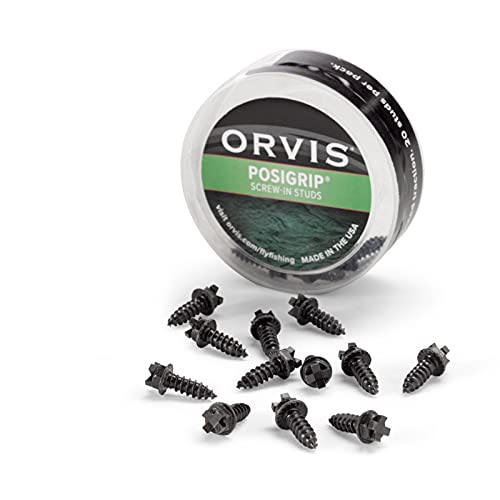
Orvis PosiGrip studs are the classic universal upgrade: tungsten carbide-tipped screws that thread directly into almost any wading boot sole with enough depth, felt or rubber. The sharp carbide crown cuts through algae film and keys into rock, while the aggressive thread holds the stud in the sole instead of working loose under lateral pressure, which is where cheap sheet-metal screws usually fail.
Installation is quick. The studs use a hex head, and an adapter for a power drill is included, so a full pair of boots can be studded in a few minutes. That said, hand-finishing the last turns gives better feel and reduces the risk of over-driving a stud into a thinner sole. A sensible pattern puts studs around the perimeter of the heel and forefoot lugs, leaving the arch mostly clear so the boot still flexes naturally.
Because the PosiGrip design is not tied to one boot brand, it is a strong choice if you own boots from several makers or want to move to a new pair later without changing your traction system. Check sole depth before ordering: Orvis intends these for soles with at least a half inch of midsole depth, and very shallow wet-wading shoes are not good candidates. Like all exposed studs, they will scratch boat decks and finished floors, so treat them as river-only footwear once fitted.
Specs
- :
- Brand: Orvis
- ASIN: B07PKJ16MB
- Type: Screw-in wading boot studs
- Pack size: 24 studs per pack
- Tip material: Tungsten carbide
- Head: Hex head, with power-drill adapter included
- Compatibility: Felt or rubber wading boot soles with adequate sole depth
3. Grip Studs Fly Fishing Wading Kit

Grip Studs take a different approach to retention. Instead of a thin screw thread, each stud uses a wide, auger-style thread that spreads the load across more rubber, so the stud resists tearing out when you twist on a boulder or push off a ledge. The tip is a solid tungsten carbide core, which stays sharp on granite and concrete far longer than hardened steel points that round over after a few rocky hikes.
This fly fishing wading kit bundles the studs with a manual installation tool, which makes it easy to build a custom pattern for your boots and your rivers. Anglers who wade big, slick freestone water often run more studs at the heel and outer forefoot, while those on smaller streams can run fewer and keep some rubber contact for quieter steps. The manual tool also makes streamside replacement of a lost stud realistic, as long as you carry a few spares.
Fit the studs so the carbide tip stands proud of the lug without turning the boot into a pair of stilts. Too much prominence concentrates your weight on the metal, which feels unstable on flat rock and wears the tips faster. Follow the sole-depth guidance for your boot, and avoid drift boats and rafts while wearing them, since the aggressive points can gouge decks and inflatable floors.
Specs
- :
- Brand: Grip Studs
- ASIN: B00GXHBAGM
- Type: Screw-in wading stud kit with installation tool
- Kit contents: 30 studs and 1 manual installation tool
- Tip material: Solid tungsten carbide core
- Thread: Wide auger-style thread for retention in rubber soles
- Compatibility: Wading boots with standard sole thickness; felt and rubber soles
4. Simms HardBite Studs for Vibram Soles
Simms HardBite studs are made specifically for rubber wading soles, including the Vibram outsoles used across much of the Simms boot line. Each stud is a hardened, zinc-plated screw with carbide gripper pellets welded to its face. Those pellets give the stud a rough, abrasive surface, so grip comes from the whole face of the stud rather than a single sharp point, which helps on smooth, water-polished stone where a point can skate before it bites.
The hex head and sharp point make installation straightforward with a nut driver or a drill run at low speed. Place studs in the thickest tread blocks, keep them clear of the thinnest parts of the sole, and snug them down without crushing the rubber. A twenty-stud pack covers one pair of boots in a typical heel-and-forefoot pattern.
HardBite studs are the natural pick if your boots are already Simms models with Vibram or StreamTread-style soles, because the stud length and thread are matched to that rubber. They are not the felt-sole version, so felt wearers should look at the universal kits above instead. As the carbide pellets are exposed metal, the same boat-deck caution applies: take the boots off before stepping onto fiberglass or an inflatable raft floor.
Specs
- :
- Brand: Simms
- ASIN: B001QVLNJ4
- Type: Screw-in wading boot studs for rubber soles
- Pack size: 20 studs per pack
- Construction: Zinc-plated hardened steel screw with welded carbide gripper pellets
- Head: Hex head
- Compatibility: Vibram and similar rubber wading boot outsoles, including Simms StreamTread platforms
5. Korkers Triple Threat Threaded Carbide Spikes
If you already wade in Korkers boots with the OmniTrax interchangeable sole system, the Triple Threat soles let you build your own traction layout, and these threaded carbide spikes are the biting component of that system. The spikes thread into the receptacles molded into Triple Threat soles and are secured with washers, so you can run spikes alone, mix them with the system’s bars and hex discs, or strip them out entirely for a boat day.
That modularity is the real advantage. A river with round, slime-coated cobble might call for a full field of spikes, while mixed rock and gravel may feel better with fewer spikes and more rubber or aluminum contact. Because the spikes are replaceable individually, a worn or damaged point does not mean replacing the whole sole, and a pack of forty gives you enough hardware to dress a pair of soles with spares left over.
The limitation is obvious: these spikes only work with Korkers Triple Threat soles. They are not screw-in studs for ordinary boots, and they will not fit the plain Kling-On or felt OmniTrax soles. If you are inside the Korkers system, though, they are the most customizable wading traction option in this guide, and they keep your studded setup and your smooth-sole setup on the same pair of boots.
Specs
- :
- Brand: Korkers
- ASIN: B07FRFJ31V
- Type: Threaded carbide spikes for interchangeable soles
- Pack size: 40 spikes per pack
- Spike length: 7 mm, supplied with washers
- Compatibility: Korkers OmniTrax Triple Threat soles only
- System: Combines with Triple Threat bars and hex discs on the same sole
How to Choose Wader Studs and Cleats
Start with your sole. Felt soles and most rubber soles with deep lugs accept universal screw-in studs such as the Orvis PosiGrip or the Grip Studs kit. Vibram-style rubber soles on Simms boots are best served by studs made for that rubber, like the HardBite set. Interchangeable-sole boots from Korkers use their own threaded hardware, and boots with thin or worn soles that cannot take a screw are better off with a strap-on overshoe like the RockTrax Plus.
Next, match the metal to the river. Carbide, whether as a solid tip, a welded pellet, or a threaded spike, is the durability choice for abrasive rock and long hikes between pools. Aluminum traction, found in some cleat and bar systems, is softer and can feel grippier on hard, smooth rock because it deforms slightly against the surface, but it wears faster. For most anglers on slick freestone rivers, carbide studs are the set-and-forget option.
Think about count and placement, not just the product. Ten to fourteen studs per boot in the heel and forefoot is a common working range for screw-in kits. Keep studs on the perimeter lugs, out of the arch, and check that no stud stands so tall that the boot rocks on it. After the first trip, re-check tightness, because new studs can settle into rubber.
Finally, plan for boats and banks. Exposed metal traction and boat decks do not mix: studs scratch fiberglass, tear inflatable floors, and slide on smooth metal ramps. If you split your time between wading and floating, an overshoe or an interchangeable sole you can swap is worth more than the grippiest fixed stud. Also check local rules before you travel, since some waters restrict felt soles, and clean and dry your boots between watersheds to avoid moving invasive species.
FAQ
How many studs do I need per boot?
Most anglers run roughly ten to fourteen screw-in studs per boot, split between the heel and the forefoot perimeter. Overshoes and interchangeable soles set the count for you, since their spikes are placed by the manufacturer.
Can I put studs in felt soles?
Yes, with a universal kit designed for felt or rubber, as long as the felt and midsole together are deep enough to hold the thread. Fit them carefully, because felt compresses, and re-check the studs after the first few trips.
Will wader studs damage my boots?
Fitted correctly into thick tread lugs, studs should not damage a boot. Damage happens when a stud is too long for the sole, driven into a thin area, or over-tightened until the rubber strips. Always match stud length to sole depth before installing.
Are studs or cleats better for wading?
Screw-in studs are lighter and always ready, which suits anglers who wade all day. Strap-on cleated overshoes give very aggressive traction and come off for boats or dry ground, but they add weight and bulk. Interchangeable studded soles sit between the two if your boots support them.
Can I wear studded boots in a drift boat or raft?
It is best not to. Exposed carbide and steel can scratch fiberglass, gouge wood, and puncture inflatable floors. Take studded boots off, choose a smooth sole, or use an overshoe system you can remove before you step aboard.
More from Amazon
Programs that pair well with the guide above. Offers and eligibility are set by Amazon and may change.
Free shipping on eligible items, Prime Video and more. Eligible new members can start with a free trial.
Start a Prime free trialA Prime membership for ages 18-24 with a trial period. Eligibility is set by Amazon.
See Prime for Young AdultsAudiobooks and podcasts to listen to on the go. Eligible new members can start with a free trial.
Try Audible freeAd-free music streaming. Eligible new subscribers can start with a free trial.
Try Music Unlimited freeAs an Amazon Associate we earn from qualifying purchases.
Write Your Review
No reviews yet. Be the first to share your experience!