

Key takeaways
- Small apartment or bedroom: Choose a 48- to 60-inch console, 12- to 16-inch depth, and at least one open or ventilated compartment.
- Average living room: A sixty- to 72-inch cabinet is the most flexible choice for 55- to 65-inch televisions.
- Large room or 75-inch TV: Look for an 80- to 96-inch console with a center support, broad cable channel, and storage that does not leave the screen visually oversized.
- Game room: Prioritize open shelving, front-accessible ventilation, and wide cable openings over concealed doors.
- Premium, furniture-first room: Consider hardwood, wood veneer, or a well-finished modular system such as West Elm or Room & Board-style cabinetry.
- Lowest-cost practical option: Flat-pack engineered wood from brands such as IKEA, Sauder, and Walker Edison can work well when correctly assembled and not overloaded.
The best media console cabinets are chosen by matching the cabinet’s usable width, ventilation, cable routing, and storage layout to your television and room—not simply by choosing the longest or most attractive unit.
Our top picks
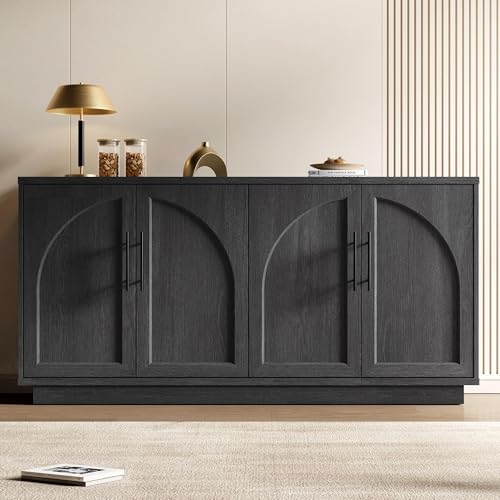

As an Amazon Associate we earn from qualifying purchases at no extra cost to you. Ratings are shown as listed on Amazon.
Quick picks by room and viewing setup
- Small apartment or bedroom: Choose a 48- to 60-inch console, 12- to 16-inch depth, and at least one open or ventilated compartment.
- Average living room: A sixty- to 72-inch cabinet is the most flexible choice for 55- to 65-inch televisions.
- Large room or 75-inch TV: Look for an 80- to 96-inch console with a center support, broad cable channel, and storage that does not leave the screen visually oversized.
- Game room: Prioritize open shelving, front-accessible ventilation, and wide cable openings over concealed doors.
- Premium, furniture-first room: Consider hardwood, wood veneer, or a well-finished modular system such as West Elm or Room & Board-style cabinetry.
- Lowest-cost practical option: Flat-pack engineered wood from brands such as IKEA, Sauder, and Walker Edison can work well when correctly assembled and not overloaded.
How wide should a media console be?
Use the television’s actual width, not its advertised diagonal measurement. A 55-inch TV is usually about 48 inches wide, while a 65-inch model is approximately 57 inches wide and a 75-inch model is approximately 65 inches wide. For balanced proportions, the cabinet should normally extend at least 3 to 6 inches beyond each side of the screen.
That produces these useful targets:
| TV size | Approximate TV width | Recommended console width | Suitable room situation |
|---|---|---|---|
| 43 inches | 38 inches | 48 to 54 inches | Bedroom, office, or compact apartment |
| 55 inches | 48 inches | 60 to 66 inches | Small or average living room |
| 65 inches | 57 inches | 66 to 72 inches | Most family rooms |
| 75 inches | 65 inches | 80 to 96 inches | Large wall and longer viewing distance |
| 85 inches | 74 inches | 96 inches or wider | Large room with substantial wall space |
Check the manufacturer’s maximum television size and weight separately. A cabinet rated for a 65-inch TV may not have enough top-panel depth or center support for a heavier 75-inch model, even if the screen physically fits.
Head-to-head: the main cabinet types
Closed-door consoles
Closed doors hide controllers, discs, routers, and household clutter. They are the best choice for a calm-looking living room, but doors can block infrared signals and trap heat. Choose doors with perforated panels, slatted fronts, or an open center bay if the cabinet will hold a game console, cable box, or AV receiver.
Engineered wood versions from IKEA BESTÅ, Sauder, and Walker Edison offer many sizes at roughly $150 to $500, depending on configuration and finish. Their weakness is usually edge damage or loosened hardware after repeated moving rather than the cabinet surface itself.
Open shelving
Open consoles are easier to wire and ventilate. They suit frequent gaming, multiple streaming devices, and equipment that needs a remote control pointed directly at it. The trade-off is visible dust and cable clutter. Look for adjustable shelves and rear cutouts instead of completely open backs, which can make cables look untidy.
Open shelving is also the safest format when a component produces noticeable heat. Leave at least 2 inches above a receiver or console and avoid pushing equipment against the rear panel.
Modular storage systems
Modular systems let you combine 23- to 47-inch sections into a custom width. IKEA BESTÅ is a familiar example, while higher-priced systems from brands such as Room & Board and USM offer more refined hardware and finishes. Modular construction is useful in rented homes or unusually shaped rooms, but total cost rises quickly when you add legs, doors, drawers, lighting, and interior fittings.
Solid wood and wood veneer
These materials provide the most convincing furniture appearance and can often be repaired or refinished. Solid wood is not automatically stronger: a well-supported veneer cabinet may carry more evenly than a poorly designed solid-wood top. Look for a thick top, reinforced center supports, metal or hardwood legs, and drawers that use full-extension runners.
Expect approximately $500 to more than $2,000 for well-finished furniture-grade consoles. Avoid placing solid wood directly against a damp exterior wall, and keep it away from radiators and strong sunlight to reduce seasonal movement and fading.
Storage layout matters more than the number of compartments
A console with eight small cubbies may hold less useful equipment than one with two wide cabinets and a drawer. Before buying, measure every device, including its power brick and cable bend radius.
- Streaming box: Usually needs about 2 inches of height, but allow extra room for airflow and cables.
- Game console: Reserve approximately 5 inches of height and 14 to 18 inches of width, depending on orientation.
- AV receiver: Often requires 7 to 9 inches of vertical clearance and more ventilation than a streaming box.
- Game controllers: A drawer at least 12 inches wide keeps them easier to access than a deep cabinet.
- Record player: A stable, level surface with no vibrating speaker directly beside it is more important than a door.
For a mixed setup, a useful layout is one open center bay for the primary console or receiver, one ventilated closed compartment for accessories, and one drawer for controllers and remotes.
Cable management and ventilation: the details that prevent frustration
Look for rear openings at least 2 inches in diameter, preferably several rather than one small hole. A full-width cable trough is better when the television, soundbar, router, and game systems all connect in the same area. Open backs simplify installation but expose cables; a rear panel with strategically placed cutouts gives a cleaner result.
Do not coil excess power cables tightly behind hot equipment. Use reusable hook-and-loop straps, label both ends of each cable, and keep power cables separate from sensitive signal cables where practical. Leave airflow around devices even when the manufacturer does not state a specific clearance.
A simple clearance calculation helps. If a receiver is 17 inches wide, 7 inches high, and 14 inches deep, a compartment only 18 by 8 by 15 inches leaves almost no room for ventilation or connectors. A more realistic opening is at least 22 inches wide, 10 inches high, and 18 inches deep.
Decision matrix: which console fits your situation?
| Your situation | Best specification | Why | Likely compromise |
|---|---|---|---|
| Budget under $300 | 60-inch engineered-wood unit with open center shelf | Good width and simple cable access without costly fittings | Laminate edges and cam-lock assembly |
| Small room under 12 feet wide | 48- to 60-inch console, no deeper than 16 inches | Preserves walking space and reduces visual bulk | Less storage for large receivers |
| Several game systems | 72- to 84-inch open or slatted console | More airflow, accessible ports, and room for controllers | More visible dust and equipment |
| Frequent moves | Modular or lightweight flat-pack cabinet | Easier to carry through doors and reconfigure | Hardware may need retightening after moves |
| Long-term furniture purchase | Wood veneer or solid wood, 72 inches or wider | Better repairability and a less temporary appearance | Higher price and greater weight |
Assembly difficulty and ownership reality
Most flat-pack consoles take two people between 60 and 150 minutes. The difficult parts are usually aligning doors, identifying similar-looking panels, and attaching the anti-tip hardware—not lifting the finished cabinet. Count the pieces first, assemble on a blanket, and do not fully tighten every cam or screw until the carcass is square.
Wall anchoring is important for tall or drawer-heavy units, especially in homes with children or pets. A low console can still tip if a child climbs on an open drawer. Use the supplied restraint when available and select the correct fastener for the wall type.
The surfaces that wear first are usually door edges, drawer runners, adjustable shelf pins, and thin laminate corners. Keep the cabinet dry, use a soft microfiber cloth, and avoid abrasive sprays. Do not drag a loaded console; remove equipment and lift it. Check leg bolts and door hinges after the first month and periodically thereafter.
Bottom line
For most homes, the best media console cabinets are 60 to 72 inches wide, 15 to 18 inches deep, and built with one ventilated equipment area, practical rear cable openings, and enough top-panel depth for the television stand. Choose a smaller 48- to 60-inch cabinet when floor space is tight, an 80-inch-plus model for a 75-inch television, and modular or furniture-grade construction when appearance and long-term repairability matter more than the lowest initial price.

Write Your Review
No reviews yet. Be the first to share your experience!