

Key takeaways
- You normally need four or fewer microphone sources.
- Your speakers are passive and rated for the amplifier’s available load.
- You value a small footprint over extensive routing.
- You mostly play rooms, cafés and community spaces rather than loud outdoor events.
The best powered mixers for small live sound are the Yamaha EMX2 for compact, low-input gigs, the Yamaha EMX5 for most bands and presenters, and the Yamaha EMX7 when you need more channels, monitor control, and output headroom.
A powered mixer combines a mixing console and speaker amplifier in one chassis. That saves space and setup time, but the right choice depends on more than the headline wattage: you must match amplifier output to speaker impedance, count the inputs you will actually use, and decide whether onboard effects and portability matter more than expansion.
Our top picks
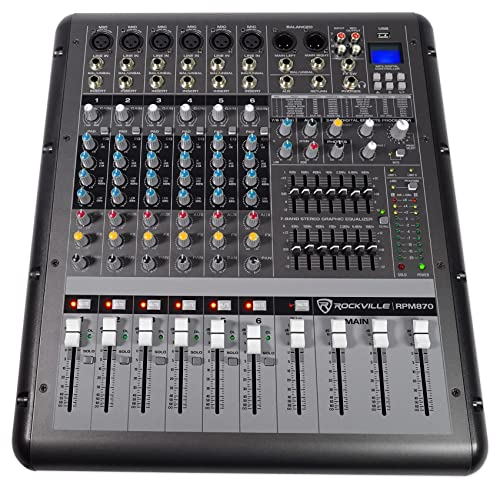


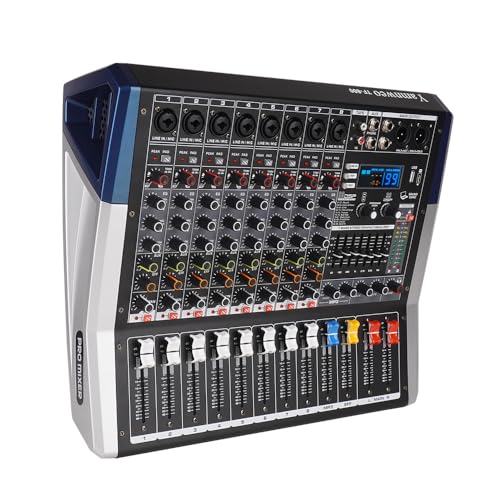
As an Amazon Associate we earn from qualifying purchases at no extra cost to you. Ratings are shown as listed on Amazon.
Best powered mixers by situation
| Situation | Best fit | Why | Typical market range in 2026 |
|---|---|---|---|
| Solo performer, speech, small acoustic duo | Yamaha EMX2 | Compact layout, built-in effects, simple setup, roughly 500 W total output depending on load | $350–$500 |
| Small band, DJ, community event | Yamaha EMX5 | More microphone inputs, stronger output section, flexible speaker and monitor connections | $700–$950 |
| Band with several monitors or more complex stage inputs | Yamaha EMX7 | Higher output headroom, more channels and routing flexibility than the EMX2 or EMX5 | $950–$1,250 |
| Lowest-cost mixer for rehearsals and occasional events | Behringer PMP6000 | Large channel count, multiple buses and onboard effects at a comparatively low price | $600–$850 |
| Portable announcements and small entertainment systems | Peavey PVi 6500 | Integrated powered mixer format with practical input and output facilities | $500–$750 |
Prices are broad street-price estimates rather than fixed quotes. Availability, regional taxes and whether the unit is new or used can change the final cost substantially.
Yamaha EMX2: best powered mixer for minimum complexity
The EMX2 is the sensible choice when the system needs to be carried by one person and the input list is short. It is suited to a singer with backing tracks, a presenter with one or two microphones, a small acoustic act, or a ceremony system using two passive speakers.
Its approximately 500-watt total amplifier rating is enough for modest rooms when paired with efficient passive speakers. The mixer includes microphone preamps, stereo line inputs and built-in SPX effects, so a separate reverb unit is unnecessary for many basic performances. The trade-off is limited expansion: it is not the natural choice for a full drum kit, several vocalists, multiple monitor mixes or a band that expects to grow.
Choose it if:
- You normally need four or fewer microphone sources.
- Your speakers are passive and rated for the amplifier’s available load.
- You value a small footprint over extensive routing.
- You mostly play rooms, cafés and community spaces rather than loud outdoor events.
Yamaha EMX5: the balanced small-gig choice
The EMX5 is the strongest all-round recommendation for many small live systems. It provides a more useful input complement than the EMX2 and considerably more room to accommodate vocals, instruments, playback and a monitor feed. Its amplifier section is commonly specified at about 630 watts per channel into a 4-ohm load, with lower available output at higher impedance.
That impedance detail matters. With two 8-ohm speakers connected in parallel to one powered output, the amplifier sees a 4-ohm load. With only one 8-ohm speaker, the available output is lower, but the amplifier is operating in a lighter-load condition. Do not connect speakers below the mixer’s minimum rated impedance simply to obtain more power; overheating and protection shutdown are possible.
The EMX5 suits a four-piece acoustic or light electric band, a small DJ setup, school performances and spoken-word events. It remains portable enough for regular transport, while offering more practical headroom than an entry-level powered mixer.
Yamaha EMX7: best for growing setups and monitor needs
The EMX7 is the better investment when a small gig has a complicated input list or when the same system must serve several types of event. Its approximately 710-watt-per-channel rating at 4 ohms provides more headroom than the EMX5, and its expanded channel and routing facilities make it more appropriate for bands, worship groups, presenters and event operators who use monitor speakers.
Extra power does not automatically mean twice the audible volume. A theoretical increase from 630 to 710 watts is only about 0.5 dB, which is barely noticeable by itself. The EMX7’s main advantage is the combination of capacity, routing and reduced strain—not a dramatic loudness jump.
Behringer PMP6000: maximum features per dollar
The Behringer PMP6000 is worth considering when channel count and bus flexibility matter more than the smallest possible case. It provides a large input complement, multiple amplifier operating modes and onboard effects, making it useful for bands with several microphones, keyboards, playback devices and monitor requirements.
Its compromises are weight, a denser control panel and a less minimalist operating experience. It is better suited to a group that has a designated operator than to a performer who must make quick changes while singing. Check the exact power specification for the intended impedance and operating mode, because powered mixers can publish different figures for bridged, 4-ohm and 8-ohm operation.
How much wattage do you need?
Start with the speakers, not the mixer. Confirm each speaker’s nominal impedance, continuous power rating and recommended amplifier range. A powered mixer should be compatible with the speaker’s impedance and should not be selected solely from a peak-wattage number.
For a small indoor event, two efficient 8-ohm passive speakers with approximately 250–500 watts of amplifier power available per channel can be adequate. A noisy room, outdoor audience or bass-heavy music requires more headroom and better speakers, not merely a larger number printed on the mixer. Speaker sensitivity, placement and room acoustics often affect perceived volume more than a modest amplifier upgrade.
Worked impedance example
Suppose each passive speaker is rated at 8 ohms and the mixer allows a 4-ohm minimum per channel. Connecting one speaker to the left output gives an 8-ohm load. Connecting a second identical speaker in parallel to the same output produces a 4-ohm load, because 8 ohms divided by two equals 4 ohms. Both speakers must be suitable for the resulting amplifier power, and the mixer must explicitly permit that connection.
Use proper speaker cables rather than shielded instrument cables. Keep the mixer ventilated, especially when driving low-impedance loads for long periods.
Channel count: leave room for real inputs
Count sources before buying:
- One channel for every vocal microphone.
- One or two channels for each stereo keyboard or playback device.
- Separate channels for kick, snare and overhead microphones if drums are amplified.
- At least one spare channel for a guest microphone or emergency playback source.
A four-person band can exceed ten mixer channels quickly: four vocals, guitar, bass, keyboard stereo and two drum microphones already requires ten source connections. A mixer that appears adequate on paper may become restrictive once monitor feeds and stereo devices are included.
Effects, inputs and portability
Built-in reverb and delay are valuable for vocals and announcements, but onboard effects are not a substitute for dedicated signal processing when you need detailed compression, feedback control or separate effects per performer. Mic inputs should offer phantom power if you use condenser microphones or active direct boxes. Stereo line inputs are useful for phones, laptops and keyboards, but check whether they accept balanced connections when cable runs are long.
For frequent transport, compare more than the mixer’s dimensions. Include speaker cables, microphones, stands and a protective case in the carrying plan. A larger powered mixer may be cheaper than separate components, but its weight can become the limiting factor. If setup regularly involves stairs or public transport, the smallest model that meets the channel requirement is often the best long-term choice.
Ownership realities and common mistakes
- Dust and heat: Keep vents clear and do not cover the amplifier section with clothing or a case while operating.
- Feedback: Place microphones behind the main speakers, not in front of them, and reduce the offending channel or frequency before increasing master volume.
- Overloading: Keep channel and master meters below sustained clipping. A smaller clean signal is safer than a loud distorted one.
- Connectors: Inspect speaker plugs, XLR sockets and power cables first; these are often the parts that suffer from repeated setup.
- Transport: Use a padded case and avoid leaving knobs exposed in a vehicle. Faders and switches are vulnerable to impact.
- Cleaning: Unplug the unit, use a soft dry brush or cloth, and keep liquid away from controls and ventilation openings.
Final buying recommendation
Choose the Yamaha EMX2 for the smallest practical system, the Yamaha EMX5 for the best balance of power, inputs and portability, and the Yamaha EMX7 when monitor routing and future expansion justify the extra size and cost. Choose a higher-channel-count model such as the Behringer PMP6000 when budget and input capacity outweigh simplicity. In every case, verify impedance, continuous speaker ratings and the mixer’s exact output mode before connecting the system.

Write Your Review
No reviews yet. Be the first to share your experience!