

Key takeaways
- One person: 3–4 place settings can work if cookware is washed separately.
- Two people: 5 place settings is the practical minimum for daily use.
- Two people who cook frequently: choose a 6-place-setting model if the counter allows it.
- Anyone using large pans, mixing bowls, or tall insulated bottles: check the rack opening rather than relying on the place-setting number.
The best countertop dishwashers for most small kitchens are a 5-place-setting model with a built-in water tank if you lack a permanent hookup, or a quieter 6-place-setting faucet-connected model if you wash dishes every day.
Our top picks


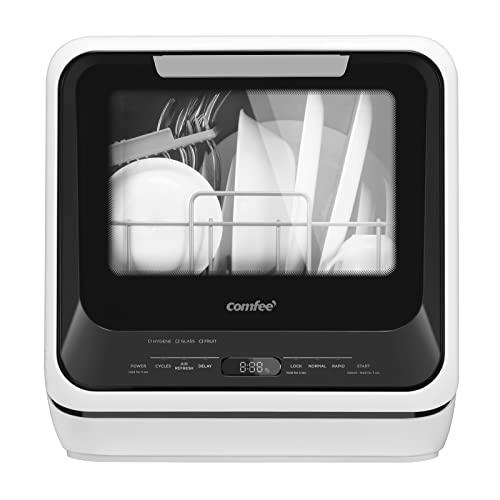
As an Amazon Associate we earn from qualifying purchases at no extra cost to you. Ratings are shown as listed on Amazon.
Best countertop dishwashers at a glance
| Best for | Model or type to consider | Approx. footprint | Capacity | Water supply | Typical noise |
|---|---|---|---|---|---|
| Most flexible setup | Farberware 5-place-setting portable dishwasher | About 17.3 × 16.5 in | 5 place settings | 5 L tank or faucet hookup | About 62 dB |
| Smallest daily load | HAVA R01-style tank dishwasher | About 17.3 × 16.9 in | 4 place settings | Built-in tank or faucet hookup | About 50 dB |
| More usable interior space | Danby DDW621WDB | About 19.7 × 17.2 in | 6 place settings | Faucet hookup | About 52 dB |
| Occasional use and lowest commitment | Basic 3- or 4-place-setting tank model | About 16–18 in wide | 3–4 place settings | Usually a built-in tank | About 50–65 dB |
Dimensions and noise ratings are manufacturer-style specifications and can vary by revision. Measure the actual appliance, including hose clearance and door travel, before buying.
Our picks by kitchen situation
Choose a tank-and-faucet model for a rental or irregular layout
A countertop dishwasher with a refillable tank is the safest choice when you cannot modify plumbing. You pour water into the top or rear reservoir, connect the drain hose to the sink, and avoid installing a permanent inlet valve. Farberware’s compact 5-place-setting design is a representative option in this category, while HAVA’s R01 is aimed at households that want a similarly flexible setup with a smaller load capacity.
The trade-off is effort. A 5 L tank takes roughly 5.3 quarts of water per cycle, so filling it is easy but not automatic. You also need to secure the drain hose every time. Tank models are particularly useful for one or two people who run the machine every one or two days rather than after every meal.
Choose a faucet-connected model for frequent washing
If you wash dishes daily, a direct-connect model is usually more convenient. Danby’s DDW621WDB is a common example: it accommodates up to six place settings, uses a faucet adapter, and provides more interior room than many tank-first designs. Once installed, you do not carry water to the machine, and the dishwasher can drain directly into the sink.
Faucet hookup is not universally simple. You may need a removable aerator, a compatible adapter, and enough counter depth for the inlet and drain hoses. A pull-down or integrated spray faucet may require a special adapter or may not be compatible at all. Check the faucet thread size before ordering.
Choose the narrowest unit only when counter space is the limiting factor
A dishwasher that is 16.5 inches deep can fit where a 19- or 20-inch unit cannot, but the lost capacity is noticeable. Smaller models often accept bowls, mugs, plates, and cutlery while rejecting large frying pans, tall stockpots, or oversized dinner plates. For a single occupant, that may be a worthwhile exchange. For two or more people, the extra few inches of footprint can reduce the number of hand-washed items substantially.
Countertop dishwasher comparison: what the specifications mean in use
| Criterion | Compact 3–4-place model | 5-place tank model | 6-place faucet model |
|---|---|---|---|
| Counter width | About 16–18 in | About 16.5–18 in | About 19–20 in |
| Typical depth | About 16–19 in | About 16.5–20 in | About 17–20 in |
| Water per cycle | About 5–6 L | About 5 L | Roughly 3–4 gal, depending on cycle |
| Normal cycle length | About 90–150 minutes | About 70–160 minutes | About 90–150 minutes |
| Drying | Usually residual-heat or air drying | Air drying; some models add ventilation | Usually residual-heat or air drying |
| Sound level | About 50–65 dB | About 50–62 dB | About 52–60 dB |
Cycle times can increase when the incoming water is cold, the load is heavily soiled, or the machine pauses to heat water. A “quick” cycle is useful for lightly used dishes, but it is not a substitute for a normal or intensive cycle when food has dried onto plates.
Drying performance is the main compromise
Most countertop dishwashers clean better than they dry. Compact machines commonly rely on residual heat, ventilation, or a short air-dry stage rather than the powerful heated drying systems found in some full-size built-ins. Plastic containers and the flat bottoms of cups may still hold water when the cycle ends.
For better results, leave space between items, angle bowls so water can run off, and open the door slightly after the cycle if the design permits it. Unload the metal items first and leave plastics in the rack for several minutes. If dry dishes matter more than speed, choose a model with a dedicated drying or ventilation option, even if that adds 20–40 minutes.
How much capacity do you really need?
A place setting is not the same as a large dinner plate, saucepan, or travel mug. Before choosing a capacity rating, measure your largest regularly used item. A useful rule is:
- One person: 3–4 place settings can work if cookware is washed separately.
- Two people: 5 place settings is the practical minimum for daily use.
- Two people who cook frequently: choose a 6-place-setting model if the counter allows it.
- Anyone using large pans, mixing bowls, or tall insulated bottles: check the rack opening rather than relying on the place-setting number.
For example, if two people create about eight dinner items, four cups, two bowls, and cutlery per day, a 5-place machine may require one evening load plus hand-washing the cookware. Running a second cycle adds roughly 90–150 minutes and another water fill. In that situation, a larger faucet-connected dishwasher can be more convenient even if its footprint is about three inches wider.
Ownership details that product listings leave out
Plan for filter and spray-arm cleaning
Food particles collect in the removable filter and can reduce cleaning performance before the machine appears broken. Rinse the filter weekly when the dishwasher is used often, and inspect the spray-arm holes for rice, labels, or mineral deposits. Hard-water scale can also coat the heating surface; use a dishwasher-safe descaling product according to the manual rather than pouring household vinegar into every cycle.
Protect the counter and cabinet
Keep the appliance on a level, water-resistant surface with room behind it for hoses and ventilation. Do not place it directly under an unprotected wooden cabinet if steam vents upward. A shallow waterproof tray can catch small drips, but it cannot compensate for a loose hose connection. Check the inlet and drain fittings during the first several cycles.
Expect consumables and replacement parts
You will need automatic dishwasher detergent, not hand dish soap. Hand soap creates excessive foam and can leak from the door. Detergent tablets are convenient, but powder makes it easier to reduce the dose for lightly soiled loads. The parts most likely to need attention over time are the door gasket, inlet hose, drain hose, filter, spray arm, and pump rather than the racks themselves.
Bottom line
Buy a 5-place-setting tank model if flexibility and rental-friendly installation matter most. Choose a Danby DDW621WDB-style faucet-connected unit if you want more capacity and run the dishwasher frequently. Select a smaller 3- or 4-place model only when the counter footprint is non-negotiable. Whichever type you choose, prioritize rack dimensions, hose compatibility, noise, and drying options over a headline place-setting number.

Write Your Review
No reviews yet. Be the first to share your experience!