

Key takeaways
- Dial systems: fastest to change and easiest to share, but they contain more moving parts and may feel less balanced.
- Pin or selector systems: convenient, although the locking part must be checked regularly for secure engagement.
- Threaded plate systems: sturdy and versatile, but slower to adjust and more likely to loosen if neglected.
- Bolted competition systems: stable and consistent, but best suited to users willing to spend time setting the load.
The best adjustable kettlebells for most home users are the Bowflex SelectTech 840 for compact, fast-changing workouts, a plate-loaded adjustable kettlebell for heavier strength work, and a competition-style adjustable model when handle consistency and swing technique matter most.
An adjustable kettlebell can replace several fixed bells, but the mechanisms differ substantially. The right choice depends on whether you value quick changes, a narrow weight progression, maximum load, or the feel of a traditional one-piece kettlebell.
Our top picks



As an Amazon Associate we earn from qualifying purchases at no extra cost to you. Ratings are shown as listed on Amazon.
Best adjustable kettlebells at a glance
| Type or product | Weight range | Adjustment method | Best for | Main limitation |
|---|---|---|---|---|
| Bowflex SelectTech 840 | 8–40 lb, approximately 3.6–18.1 kg | Dial-selected internal plates | Fast circuits, beginners, limited storage | Less natural than a fixed bell for high-repetition swings and cleans |
| Plate-loaded adjustable kettlebell | Commonly 10–40 lb or 12–32 kg, depending on plates | Removable plates secured inside or below the handle | Progressive strength training and better load value | Slower changes and more parts to maintain |
| Competition-style adjustable kettlebell | Typically about 12–32 kg | Bolted internal plates or threaded loading system | Experienced lifters, snatches, cleans, long-term progression | Often expensive and physically large at lighter settings |
| Adjustable kettlebell handle used with weight plates | Varies by handle and plates; often 10–45 lb or more | Standard weight plates locked onto a handle | Owners who already have compatible plates | Balance and clearance can be less kettlebell-like |
Our picks by training situation
Best for quick home circuits: Bowflex SelectTech 840
The Bowflex SelectTech 840 is the easiest option when several people share one kettlebell or when a workout moves rapidly between goblet squats, rows, presses, and carries. Its dial changes the selected load from 8 to 40 pounds, avoiding loose plates and lengthy reassembly.
Its compact storage footprint is a major advantage in an apartment or a small home gym. The trade-off is shape: the outer body remains relatively large as the weight changes, and the load is not identical to using a solid cast-iron bell. That matters most during cleans, snatches, and repeated swings, where a predictable shell and centered mass improve rhythm.
Choose it if convenience is worth more than competition-style feel. For mostly controlled strength circuits, the adjustment speed is difficult for plate-loaded designs to match.
Best for heavier strength progression: a plate-loaded adjustable kettlebell
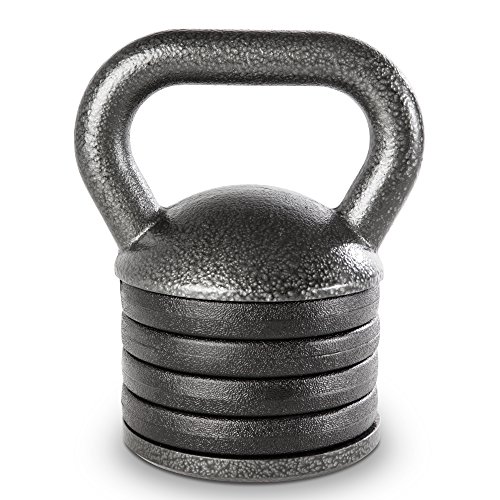
Plate-loaded models use a handle and a stack of removable plates. The exact range varies, but many home versions cover roughly 10–40 pounds, while heavier competition-style designs reach approximately 32 kilograms or more. They are usually the better long-term choice if your program includes heavy deadlifts, front-rack squats, suitcase carries, and low-repetition presses.
Before buying, check how the plates are retained. A threaded locking system or enclosed plate cavity is preferable to a loose pin that can rattle during swings. Also check whether the handle remains centered when only some plates are installed. An off-center load may be acceptable for slow movements but distracting during ballistic exercises.
Plate-loaded models generally provide more meaningful increments than a dial unit. For example, moving from 16 to 18 or 20 kilograms can be useful when a 4-kilogram jump would be too large. The cost is a slower transition and more floor space for spare plates.
Best for experienced technique work: a competition-style adjustable kettlebell
A competition-style adjustable kettlebell keeps a consistent external shape as the internal load changes. Its broad, uniform body and relatively narrow handle are designed around cleans, jerks, and snatches. This consistency helps an experienced user practice the same movement pattern at multiple weights.
These models can be excellent for strength and conditioning, but they are not automatically the best first purchase. A competition shell may feel oversized at its minimum load, and its handle can be less forgiving for large hands or high-repetition work. Buy this style when technique consistency is more important than a small storage footprint.
What to compare before buying
Weight range and increments
Look at the useful range, not only the maximum number. A 12–32-kilogram bell is powerful for an experienced lifter but unsuitable if you need a light load for presses or introductory conditioning. Conversely, an 8–40-pound model may cover general fitness but stop short of serious lower-body strength work.
For many homes, the most practical range is approximately 8–24 kilograms for a lighter unit or 12–32 kilograms for a heavier unit. Smaller increments of 1–2 kilograms make progression smoother; jumps of 4 kilograms or more can be frustrating for overhead exercises.
Adjustment mechanism
- Dial systems: fastest to change and easiest to share, but they contain more moving parts and may feel less balanced.
- Pin or selector systems: convenient, although the locking part must be checked regularly for secure engagement.
- Threaded plate systems: sturdy and versatile, but slower to adjust and more likely to loosen if neglected.
- Bolted competition systems: stable and consistent, but best suited to users willing to spend time setting the load.
Handle comfort
A usable handle should provide enough clearance that your fingers do not press against the bell during cleans. Bare steel or powder-coated steel usually allows reliable grip changes, while thick rubber coatings can become slippery with sweat and may interfere with hand rotation.
Check handle diameter, interior width, and surface finish rather than assuming every adjustable bell feels alike. A broad handle can suit two-handed swings, while a narrow handle may be better for one-handed cleans and snatches. If possible, compare the handle with the size of a fixed kettlebell you already use.
Size and balance
A fixed 16-kilogram kettlebell and an adjustable 16-kilogram kettlebell may behave differently. Adjustable shells can be taller or wider because they must contain plates and hardware. That changes the path around the wrist and may cause the bell to touch your forearm sooner during a clean.
For swings, the center of mass should remain below the handle and should not shift noticeably as plates are added. For presses and carries, a centered load reduces unwanted twisting. If the unit rattles, tilts, or changes shape substantially between settings, it may be better for slow exercises than ballistic ones.
Decision matrix: which type fits your home?
| Your situation | Recommended choice | Why |
|---|---|---|
| Very little storage space | Dial-selected 8–40 lb model | One compact unit replaces several bells and changes in seconds |
| Beginner learning basic movements | Light-range adjustable model, approximately 8–24 lb | Provides manageable loads for presses, squats, rows, and carries |
| Training three or more times per week | Plate-loaded or bolted adjustable model | More robust progression and fewer compromises at higher loads |
| Already own standard plates | Compatible adjustable handle | Can reduce the purchase cost, provided plate diameter and locking hardware match |
| Frequent snatches and cleans | Competition-style adjustable kettlebell | Consistent external dimensions and a more predictable trajectory |
| Shared family equipment | Dial or pin-adjusted model | Quick changes without searching for plates or tools |
How much equipment can one adjustable kettlebell replace?
Suppose you would otherwise buy fixed bells at 8, 12, 16, 20, and 24 kilograms. That is five separate units. If an adjustable model covers 8–24 kilograms in usable steps, it replaces roughly four transitions between training loads while taking up the footprint of one bell. The saving is greatest when storage or shipping space is limited; it is less compelling if you already own a complete rack of fixed kettlebells.
There is also a workout-time calculation. If a plate-loaded bell takes about 60 seconds to change and you adjust it six times in a session, that costs approximately six minutes. In a timed circuit, a dial model can preserve those six minutes. In a strength session where you use one weight for several sets, the faster mechanism offers little practical benefit.
Durability and ownership realities
The parts most likely to need attention are the selector dial, locking pin, threads, bolts, and protective base. Sweat and chalk can collect around moving parts, while repeated drops can damage plastic housings or deform threaded components. Adjustable kettlebells should not be dropped from overhead unless the manufacturer explicitly permits it.
- Wipe the handle and exterior after training, especially after high-sweat conditioning sessions.
- Inspect pins, collars, and bolts before every ballistic workout.
- Keep plates seated evenly; uneven loading can alter balance and stress the hardware.
- Do not use a selector while the bell is loaded or moving.
- Store the unit on its base rather than on the handle or adjustment mechanism.
- Replace damaged or visibly worn locking hardware instead of improvising repairs.
A general market range is about $100–$250 for many dial or lighter plate-loaded models, with heavier competition-style systems commonly costing more. The cheapest option is not always the lowest ownership cost if its handle is uncomfortable or its useful increments do not match your program.
Final recommendation
Choose the Bowflex SelectTech 840 when speed, compact storage, and general home conditioning are the priorities. Choose a plate-loaded adjustable kettlebell when you want more control over progression and heavier strength work. Choose a competition-style adjustable model when cleans, jerks, and snatches are central to your training and you want a consistent outer shape.
Whichever style you select, prioritize a secure locking system, a comfortable handle, centered balance, and increments that match your current exercises. Those details determine whether the bell remains useful after the novelty of replacing several fixed weights has worn off.

Write Your Review
No reviews yet. Be the first to share your experience!