

Key takeaways
- Choose fixed daily slots when the routine rarely changes.
- Choose individually programmable alarms when doses occur at irregular times.
- Check whether schedules can be edited without emptying the tray.
- Look for daylight-saving and 12-hour/24-hour clock options if the user travels.
- Confirm whether an alarm stops after a set period or continues until the dose is removed.
The best automatic pill dispensers are the ones that match the number of daily doses, the level of supervision required, and how often someone can refill the unit: a simple timed carousel suits independent users, while a locked, connected dispenser is safer when missed or repeated doses are a concern.
Our top picks


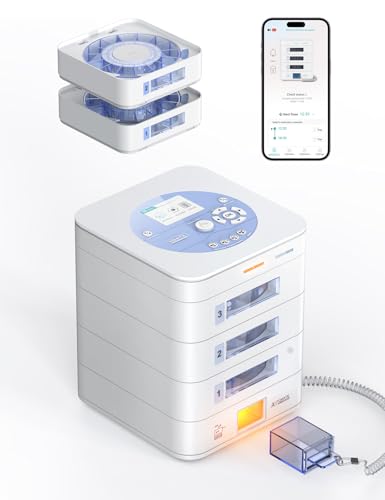
As an Amazon Associate we earn from qualifying purchases at no extra cost to you. Ratings are shown as listed on Amazon.
Best automatic pill dispensers by situation
| Situation | Best fit | Look for | Typical market range |
|---|---|---|---|
| One to four doses daily, reliable routine | Basic rotating carousel | 28-day capacity, audible and visual alarms, simple controls | $60–$130 |
| Several medicines at changing times | Programmable multi-compartment dispenser | Up to 9–24 daily alarms, adjustable dose windows, larger compartments | $100–$250 |
| Risk of double-dosing or confusion | Locked automatic dispenser | One-dose-at-a-time access, tamper-resistant lid, caregiver override | $130–$300 |
| Remote caregiver support | Connected dispenser service | App or phone alerts, cellular backup, refill notifications and subscription terms | $40–$100 per month, often plus equipment |
| Low vision, hearing loss or limited dexterity | Accessible dispenser with large controls | High-volume alarm, flashing indicator, tactile buttons, easy-open refill tray | $90–$250 |
These are broad market ranges rather than quotes for a particular model. Capacity figures also vary by tablet size: a compartment that holds 10 small tablets may hold only 3 or 4 large capsules.
What matters most when comparing automatic dispensers
Dose capacity and compartment size
Capacity is not just the number printed on the box. A 28-compartment carousel usually represents one dose per day for four weeks, or four daily doses for seven days. A unit advertised as holding 28 doses may therefore be unsuitable for somebody taking morning, midday, evening and bedtime medicines.
Estimate capacity before shopping. If there are five scheduled dose times and you want seven days between refills, the dispenser needs at least 35 dose compartments. If each dose contains several large pills, choose a deeper tray or confirm the compartment volume in milliliters. Do not combine medicines in one compartment unless the pharmacist has confirmed that storage together is appropriate.
Scheduling flexibility
The simplest devices allow four alarms per day. More flexible models may provide 9, 12 or 24 programmable alarms, but a high alarm count does not automatically make a dispenser better. It can make setup harder and increase the chance of entering the wrong time.
- Choose fixed daily slots when the routine rarely changes.
- Choose individually programmable alarms when doses occur at irregular times.
- Check whether schedules can be edited without emptying the tray.
- Look for daylight-saving and 12-hour/24-hour clock options if the user travels.
- Confirm whether an alarm stops after a set period or continues until the dose is removed.
Prescription timing should come from the prescriber or pharmacist. An automatic dispenser organizes a schedule; it does not decide whether medicines can safely be taken together.
Alarms and accessibility
A quiet beep is inadequate if the user has hearing loss, while a very loud alarm may be distressing in a shared home. The most adaptable dispensers combine a high-volume alert with flashing lights, spoken prompts or a connected notification.
For limited vision, prioritize a high-contrast display, large numbers and tactile controls. For arthritis or reduced hand strength, avoid a design that requires twisting a small key or pressing a stiff release button. A dispenser that prevents accidental access is useful only if the intended user can operate it reliably.
Lockout and missed-dose behavior
Lockout is the main difference between a reminder device and a controlled dispensing device. A locked carousel exposes only the current dose and blocks access to future doses. Some models also move a missed dose into a retrieval area; others continue alarming until the compartment is opened.
Ask these questions before buying:
- Can the user remove extra doses by turning the tray manually?
- Does the lid lock automatically after setup?
- Is there a caregiver key or emergency release?
- What happens when a dose is missed?
- Can the alarm be silenced without dispensing?
A lockout feature is not a substitute for supervision. If a missed dose could create an urgent problem, establish an escalation plan with a caregiver or healthcare professional.
Head-to-head: carousel, cartridge and connected designs
| Design | Typical capacity | Refill method | Battery backup | Main trade-off |
|---|---|---|---|---|
| Rotating carousel | 28–42 compartments | Fill each compartment directly | Often 1–3 days for alarms and clock | Good value, but small compartments and limited remote support |
| Locked cartridge | 28–90 dose positions, depending on cartridge | Load a removable tray or cartridge | Usually 8–24 hours; verify model | Better lockout, but proprietary trays may cost more |
| Connected dispenser | Usually 20–30 doses per refill | Individual loading or pharmacy-prepared packs | Commonly 4–24 hours, with cellular or Wi-Fi dependence | Remote alerts are useful, but may require a subscription |
Battery claims need careful reading. “Battery backup” may keep the clock and alarm active but not power the motor that releases a dose. A power indicator and a low-battery warning are more useful than a large battery number alone. If reliability matters, choose a model that continues dispensing during an outage and test it by unplugging the adapter after setup.
Refilling, cleaning and ownership realities
Refill ease often matters more than an extra alarm option. A good tray can be removed, filled on a stable table and returned without shifting the schedule. Avoid pouring pills directly from a bottle while the tray is attached to the machine; loose tablets can fall into neighboring compartments or into the mechanism.
A practical refill routine is:
- Compare the written medication schedule with the dispenser’s programmed times.
- Wash and dry hands, then place the tray on a clean, dry surface.
- Fill one compartment at a time and check it against the schedule.
- Inspect for tablets stuck beneath dividers or in the release opening.
- Run one manual dispensing cycle before locking the unit.
- Record the refill date and the next scheduled refill.
Most dispensers should be wiped with a slightly damp cloth and dried thoroughly. Keep liquids away from the motor, speaker and charging port. Do not wash a medication tray unless its instructions specifically permit it. Dust, crumbs and powder from split tablets can interfere with sensors and gears, so inspect the dispensing path monthly.
The parts most likely to cause trouble are the power adapter, battery, rotating tray, lid latch and small release gate. A unit with replaceable batteries is easier to maintain than one with a sealed battery, but it may lose settings during replacement. Keep the instructions, spare batteries if supported, and the manufacturer’s support contact with the device.
Features worth paying for—and features to question
- Worth paying for: one-dose-at-a-time lockout, clear low-battery warnings, adjustable alarm volume, a removable tray and a dependable backup power option.
- Useful for caregivers: missed-dose alerts, cellular connectivity that works without home Wi-Fi, and a documented escalation process.
- Worth questioning: an unusually large pill count without compartment dimensions, a subscription that is required for basic dispensing, or “smart” features with no local manual override.
- Potentially unnecessary: many programmable alarms when the user has only one or two stable daily dose times.
Bottom line
For a dependable routine, choose a 28- or 42-compartment carousel with clear alarms and an easy removable tray. For multiple daily doses, calculate the required positions rather than relying on the advertised pill count. For double-dose concerns, choose true lockout with caregiver access. For remote support, compare the ongoing service cost, cellular coverage and outage behavior—not just the app.
Before changing how medicines are stored, combined or timed, ask a pharmacist or other qualified healthcare professional whether the dispenser and refill method are appropriate for the specific medications.

Write Your Review
No reviews yet. Be the first to share your experience!