

Key takeaways
- Compare the best anchors for boats across fluke, slip-ring and aluminum designs, with sizing, bottom types and rode advice for fishing boats.
As an Amazon Associate we earn from qualifying purchases.
The right anchor is the difference between holding over a reef while the fish are biting and slowly dragging off the spot while you are busy re-rigging. Anchors for boats come in a handful of proven shapes — fluke, slip-ring, plow, claw and scoop — and each one earns its keep on a different kind of bottom. A fluke that buries beautifully in sand can skate across rock, while a heavy scoop design that laughs at weed may be far more anchor than a small center console needs on a sheltered lake.
This guide compares five purpose-built boat anchors that cover the situations most anglers actually face: sand and mud flats, weedy bays, rocky structure and mixed river bottoms. Two of the picks are complete kits that arrive with chain, rope and shackles already matched, which removes the guesswork from building a rode. The others are anchor-only designs chosen for light weight, easy storage or painless retrieval when the hook hangs up on structure.
Disclosure: This article contains affiliate links. If you buy through them, we may earn a commission at no extra cost to you.
1. SandShark Premium Fluke Anchor — Best for Easy Storage on Pontoons

The SandShark Premium Fluke Anchor takes the classic fluke shape and rebuilds it around a retractable shaft, so the whole anchor collapses down for storage instead of demanding a permanent home in the anchor locker. At under five pounds it is light enough to handle one-handed over the side of a pontoon, yet the listing rates it for boats up to 30 feet, which covers most pontoon and deck-boat fishing setups.
The aluminum construction keeps corrosion worries low in freshwater and brackish use, and the serrated fluke fins are designed to bite into sand and soft mud and keep holding when wakes and light chop work the boat around. Because the shaft retracts, it also works well as a second or stern anchor: stow it flat, deploy it to stop the boat swinging at the sandbar, and pull it without a fight when it is time to move.
Choose this one if storage space is your main headache and your anchoring happens mostly over sand or mud in protected water. It is not the tool for rock piles or heavy current, where a heavier steel anchor with chain earns its keep.
Specs
- :
- Brand: SandShark
- ASIN: B0B7FCFQW9
- Type: Fluke anchor with retractable shaft
- Material: Aluminum
- Weight: Under 5 lb
- Rated for: Boats up to 30 ft
- Best bottoms: Sand and soft mud
2. Better Boat 8.5 lb Boat Anchor Kit — Best Complete Kit for 15 to 24 ft Boats

If you want to open one box and be ready to anchor, the Better Boat kit is the straightforward answer. It pairs an 8.5-pound hot-dip galvanized fluke anchor with six feet of quarter-inch galvanized chain, two bow shackles and 75 feet of three-eighths-inch nylon rope finished with a stainless steel thimble eye. Everything is sized to work together, so there is no separate hunt for compatible chain and hardware.
The fluke design is the traditional workhorse for sand and mud: lay out proper scope, let the chain hold the shank down at a shallow angle, and the flukes dig in and bury. Hot-dip galvanizing gives the steel anchor and chain a thick zinc coating that stands up well to repeated wet-dry cycles on trailer boats. The maker rates the kit for boats from 15 to 24 feet, which spans the most common bay boats, bass boats and smaller pontoons.
This is the pick for a first complete anchoring setup on a mid-size fishing boat. Owners of heavier boats, or anyone anchoring in strong tidal current, should step up to a heavier anchor and a longer rode rather than stretching this kit past its rating.
Specs
- :
- Brand: Better Boat
- ASIN: B096YDP146
- Model: BB-ANCH-8lb
- Type: Fluke anchor kit
- Material: Hot-dip galvanized steel
- Anchor weight: 8.5 lb
- Included: 6 ft of 1/4 in chain, two 5/16 in bow shackles, 75 ft of 3/8 in nylon rope with stainless thimble
- Rated for: Boats 15 to 24 ft
- Best bottoms: Sand and mud
3. MarineNow Premium Aluminum Fluke Style Anchor EX-4 — Best Lightweight Fluke

The MarineNow EX-4 follows the lightweight aluminum fluke formula: a four-pound anchor sized for boats from 16 to 27 feet that delivers its holding through fluke area and angle rather than dead weight. Aluminum fluke anchors are popular as primary anchors on smaller boats and as stern or spare anchors on bigger ones, because four pounds is nothing to haul up by hand all day when you are moving from spot to spot.
A useful detail on this design is the dual shank angle: the fluke angle can be set to the standard position for firm sand and mud, or opened up for soft, silty bottoms where a wider angle helps the flukes bite instead of plowing a furrow. The alloy construction is corrosion-resistant and the anchor assembles and breaks down compactly, which suits boats where the anchor locker is shared with tackle and safety gear.
Pick the EX-4 when weight matters more than anything — small center consoles, skiffs and aluminum fishing boats that re-anchor often. In hard-packed sand or heavy weed, give it extra scope and a few feet of chain so the flukes get the low pull angle they need to set.
Specs
- :
- Brand: MarineNow
- ASIN: B08C82968K
- Model: EX-4
- Type: Fluke style anchor
- Material: Aluminum alloy
- Anchor weight: 4 lb
- Feature: Dual shank angles for firm and soft bottoms
- Rated for: Boats 16 to 27 ft
- Best bottoms: Sand, mud and soft silt
4. Shoreline Marine Slip Ring #7 Anchor Kit — Best for Snaggy Bottoms

Slip-ring anchors solve a specific, expensive problem: the anchor that wedges under a rock or log and refuses to come home. On the Shoreline Marine #7, a sliding ring on the shank lets you motor past the anchor and pull from the opposite direction, so the flukes back out of the snag instead of bending or staying on the bottom as a donation. For anglers who anchor over brush piles, riprap and rocky river structure, that retrieval trick pays for the anchor the first time it works.
The kit includes the galvanized slip-ring anchor, two drop-forged shackles and 50 feet of three-eighths-inch twisted nylon rope with a thimble, so it is ready to rig on smaller fishing boats, jon boats and runabouts. Galvanized steel shrugs off the knocks that come with fishing around rock and timber, and the fluke shape still sets conventionally in sand and mud when you anchor over softer ground.
Choose the slip-ring kit if you regularly anchor over structure you cannot afford to lose an anchor to. It is a fair-weather, small-boat setup rather than an overnight anchor for large craft, and the included 50-foot rode suits lakes and rivers better than deep coastal water.
Specs
- :
- Brand: Shoreline Marine
- ASIN: B00BNTZ6P6
- Model: 5709-0314, Slip Ring #7
- Type: Slip-ring fluke anchor kit
- Material: Galvanized steel anchor
- Included: Two 5/16 in drop-forged shackles, 3/8 in x 50 ft twisted nylon rope with thimble
- Best bottoms: Rock, timber and mixed structure; also sets in sand and mud
5. MARINE SYSTEM Fluke Anchor Kit — Best Ready-Rigged Kit for 17 to 21 ft Boats
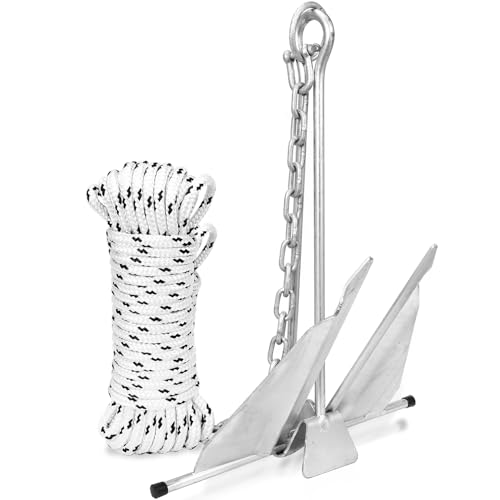
The MARINE SYSTEM kit is another complete package, built around a steel fluke anchor for boats in the 17 to 21 foot range — the heart of the freshwater and inshore fishing fleet. In the box you get the anchor, 6.5 feet of quarter-inch hot-dipped galvanized chain, two five-sixteenths-inch hot-dipped galvanized shackles, and 50 feet of three-eighths-inch nylon rope with a marine-grade stainless steel thimble protecting the splice at the connection point.
That chain section matters more than its length suggests. Chain weight keeps the pull on the anchor low and horizontal while you back down to set it, and it resists chafe where the rode meets rough bottom. The three-strand nylon adds the stretch that absorbs surge and wake action, so the anchor is not being jerked loose every time the bow lifts. Hot-dipped galvanizing on both the anchor hardware and chain is the right finish for a kit that will live wet in a locker.
This kit suits owners of 17 to 21 foot fishing boats who want a matched, no-shopping-list setup for lakes, rivers and protected bays. If your fishing takes you into deep water, plan on adding rope: 50 feet of line limits how much scope you can fish in anything beyond modest depths.
Specs
- :
- Brand: MARINE SYSTEM
- ASIN: B0DPG22D41
- Model: Fluke Anchor Kit, for boats 17 to 21 ft
- Type: Fluke anchor kit
- Material: Steel, hot-dipped galvanized hardware
- Included: 6.5 ft of 1/4 in chain, two 5/16 in shackles, 3/8 in x 50 ft nylon rope with stainless steel thimble
- Rated for: Boats 17 to 21 ft
- Best bottoms: Sand and mud
How to Choose the Right Anchor for Your Boat
Start with the bottom, not the boat. Sand and firm mud reward fluke designs, which bury their blades and hold far above their weight. Soft silt wants a wider fluke angle or a larger fluke area. Rock, timber and heavy structure favor anchors you can retrieve when they hang — a slip-ring design, or any anchor rigged with a trip line. Weed is the hardest test for lightweight anchors; a heavier steel anchor with chain usually wins there because weight and a low pull angle help the point punch through the mat.
Size by the maker’s chart for your boat length, then think honestly about conditions. Charts assume average windage and shelter. A high-sided pontoon, a T-top center console or regular anchoring in current and chop all argue for going one size up. When in doubt, the bigger anchor is the cheaper insurance.
Do not skip the rode. A few feet of chain next to the anchor keeps the shank down so the anchor sets instead of skipping, protects the rope from abrasion, and adds the catenary that softens shock loads. Nylon rope earns its place through stretch; three-strand is the traditional, easy-to-splice choice. Scope ties it together: pay out at least five times the depth from bow to bottom in calm conditions, and seven or more when wind or current picks up. Most dragging stories are really scope stories.
Finally, match the system to how you fish. If you move every twenty minutes, a light aluminum fluke you can haul by hand beats a heavy anchor you dread lifting. If you anchor once and fish a tide, weight and chain matter more. Many serious anglers carry two different types — a primary on the bow and a lighter or slip-ring anchor as backup — because no single design wins on every bottom.
FAQ
How heavy an anchor does a 20 ft fishing boat need?
For fluke designs in sand and mud, most makers rate anchors in the 8 to 13 pound range, or a four-pound aluminum fluke with generous fluke area, for boats around 20 feet in moderate conditions. Check the maker’s sizing chart for your exact model, and size up for wind, current or a high-profile boat.
How much scope should I use?
Five to one is a fair-weather minimum and seven to one is the safer working rule: for every foot from your bow down to the bottom, let out five to seven feet of rode. Add the height of the bow above the water to the water depth before doing the math.
Do I really need chain with a rope rode?
A short length of chain — roughly a foot per foot of boat length is a common guide, and the kits above include six feet or so — makes a real difference. It keeps the pull low so the anchor sets, adds chafe protection and smooths out surge. All-rope rodes work for very light duty, but chain is cheap holding power.
What is a slip-ring anchor for?
The sliding ring lets you retrieve a fouled anchor by pulling it out backwards. Motor up-current past the anchor so the ring slides down the shank, and the flukes back out of rock or timber. It is a favorite for fishing over structure where ordinary anchors get lost.
Can one anchor cover every bottom type?
Not perfectly. Flukes excel in sand and mud, struggle in rock and thick weed; scoop and plow designs are more versatile but heavier and bulkier. Most boaters pick the anchor that suits the bottoms they fish most, and carry a different style as a second anchor if they travel.
More from Amazon
Programs that pair well with the guide above. Offers and eligibility are set by Amazon and may change.
Free shipping on eligible items, Prime Video and more. Eligible new members can start with a free trial.
Start a Prime free trialA Prime membership for ages 18-24 with a trial period. Eligibility is set by Amazon.
See Prime for Young AdultsAudiobooks and podcasts to listen to on the go. Eligible new members can start with a free trial.
Try Audible freeAd-free music streaming. Eligible new subscribers can start with a free trial.
Try Music Unlimited freeAs an Amazon Associate we earn from qualifying purchases.
Write Your Review
No reviews yet. Be the first to share your experience!