

Key takeaways
- Shore: Use the manufacturer’s attachment point and a strong, abrasion-resistant leader or cord. Keep the transducer clear of floating weed and retrieve it slowly to reduce swinging.
- Kayak: A scupper, arm, or side mount should place the transducer below the hull without putting it in the path of rocks or paddle strokes. Route the cable with slack for steering but no loose loop.
- Small boat: A transom mount is usually the most practical. Keep the face level with the water and away from turbulence caused by the propeller, chines, or strakes.
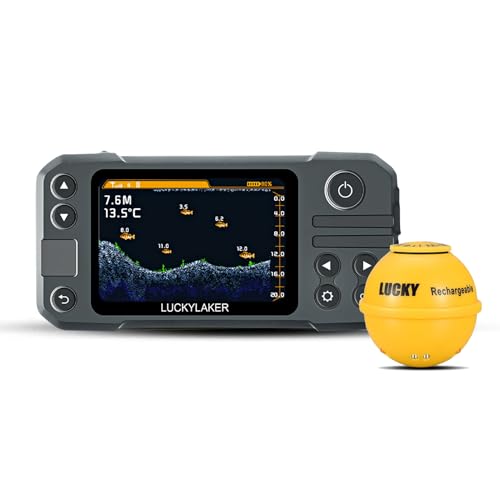
The best portable fish finders for smarter bank fishing are the Deeper CHIRP+ 2 for maximum castable sonar detail, Garmin STRIKER Cast for simple phone-based scouting, and a portable-kit unit such as the Humminbird PiranhaMAX 4 DI PT or Lowrance HOOK Reveal 5 for anglers who prefer a dedicated screen.
Your choice depends less on the deepest advertised reading than on how you fish. A shore angler needs casting range, wireless reliability, and a transducer that can be positioned away from the bank. A kayak angler benefits from compact mounting and low power use. A small-boat user usually gets more value from a dedicated display, GPS, and a transducer fixed to the hull or a trolling motor.
Our top picks



As an Amazon Associate we earn from qualifying purchases at no extra cost to you. Ratings are shown as listed on Amazon.
Best portable fish finders compared
| Model or type | Display and sonar | Battery life | Mounting and portability | Best use |
|---|---|---|---|---|
| Deeper CHIRP+ 2 | Phone or tablet display; CHIRP sonar; manufacturer-rated depth up to 330 ft in freshwater | Up to 15 hours | Wireless castable pod; about 3.5 oz; attaches to line through a mounting eye | Detailed bank fishing and kayak scouting |
| Garmin STRIKER Cast | Phone or tablet display; castable sonar; manufacturer-rated depth up to 150 ft | Up to 10 hours | Wireless castable unit; about 2.7 oz; retrieves on the fishing line | Easy depth and fish-location checks from shore |
| Deeper START | Phone or tablet display; basic sonar; manufacturer-rated depth up to 165 ft | Up to 6 hours | Wireless castable pod; about 2.2 oz | Budget-conscious, occasional bank fishing |
| Humminbird PiranhaMAX 4 DI PT | 4.3-inch color screen; dual-beam sonar and Down Imaging; up to 600 ft claimed depth capability | Typically several full outings from a small 12V battery | Portable case with transducer and battery compartment; screen remains with the angler | Shore, kayak, and small-boat use without a phone |
| Lowrance HOOK Reveal 5 with portable setup | 5-inch color screen; CHIRP and DownScan Imaging on supported transducers; GPS on applicable versions | Usually a full day from a suitable 12V battery | Portable case or custom carry setup; transducer mounts to a pole, hull, or transom | Small boats and anglers wanting mapping and a larger screen |
Depth figures are manufacturer capabilities, not guaranteed fishing depth. Water clarity, bottom composition, speed, bubbles, transducer position, and electrical interference can substantially change the image. The quoted portable-kit runtimes also depend on battery capacity, screen brightness, temperature, and whether the unit is left on between spots.
Head-to-head: castable sonar versus a dedicated screen
Castable units: maximum reach from the bank
A castable finder puts the sonar where the fish are rather than directly below your feet. That is the key advantage when the shoreline is shallow, weed-choked, or separated from the drop-off. The Deeper CHIRP+ 2 is the stronger choice for interpreting transitions, suspended targets, and bottom changes because CHIRP separates returns more effectively than a basic single-frequency unit. It also offers a longer stated battery life than most castable alternatives.
The Garmin STRIKER Cast is easier to justify if you mainly need depth, bottom shape, and a quick indication of fish. Its shorter rated depth is rarely a practical limitation on ordinary ponds, reservoirs, and many rivers. It is a good fit for someone who already carries a phone and does not want a separate display, battery box, and transducer arm.
The trade-off is dependence on a phone or tablet. Cold weather reduces phone battery performance, bright sunlight can make a screen difficult to read, and a weak wireless connection can interrupt the view. Use a waterproof phone pouch, keep the phone shaded where possible, and avoid casting beyond the reliable wireless distance simply because the tackle can reach farther.
Dedicated-screen units: clearer viewing and more control
A portable Humminbird or Lowrance setup is less elegant to carry, but its screen is ready to read without using your phone. A 4.3-inch display is adequate for basic depth and bottom reading; a 5-inch display is more comfortable when you want split views, DownScan-style imaging, GPS, or chart information. Dedicated units also make more sense in a kayak or small boat where the transducer can remain in the water while you move slowly over a location.
The PiranhaMAX 4 DI PT is the simpler, lower-cost route. It suits anglers who want a conventional display and a portable case rather than advanced navigation. A HOOK Reveal 5 setup costs more in the general portable-finder market, but the larger screen and GPS-capable configurations can repay that difference if you return to the same lakes and want to mark productive structure.
Choose by fishing situation
| Your situation | Best fit | Why | What to avoid |
|---|---|---|---|
| Occasional angler with a tight budget | Deeper START or Garmin STRIKER Cast | Low equipment burden and no separate 12V battery | Large portable kits that spend most of the year stored |
| Experienced bank angler mapping drop-offs | Deeper CHIRP+ 2 | Castable coverage and better separation of bottom features | Basic sonar if subtle depth changes are the main target |
| Kayak angler with limited deck space | Castable unit or compact 4-inch portable kit | Low weight and flexible transducer positioning | Long cables and loose battery boxes that can snag or take on water |
| Small-boat angler fishing often | Lowrance HOOK Reveal 5 or similar 5-inch portable unit | Larger display, GPS options, and a more permanent transducer mount | Phone-only sonar if sunlight, spray, and all-day use are common |
How much water can a castable finder cover?
Consider a bank angler making fan casts every 30 degrees, with the unit landing roughly 60 feet from shore. Six positions cover a broad arc, but not a continuous map. If each reading takes 20 seconds to stabilize and you make six casts, the first survey takes about two minutes, plus retrieval time. Repeat the process at 30-foot intervals along a 300-foot shoreline and you can identify a likely channel edge in roughly 20 to 30 minutes rather than fishing every spot blindly.
This is why range and repeatability matter more than the maximum depth number. A finder that produces a stable reading at practical casting distance is more useful than one rated for extreme depth that loses connection, rolls in waves, or cannot be retrieved safely.
Transducer mounting: the detail that determines image quality
- Shore: Use the manufacturer’s attachment point and a strong, abrasion-resistant leader or cord. Keep the transducer clear of floating weed and retrieve it slowly to reduce swinging.
- Kayak: A scupper, arm, or side mount should place the transducer below the hull without putting it in the path of rocks or paddle strokes. Route the cable with slack for steering but no loose loop.
- Small boat: A transom mount is usually the most practical. Keep the face level with the water and away from turbulence caused by the propeller, chines, or strakes.
Do not judge a finder’s performance from a poor mounting position. Bubbles and turbulence can create noise that resembles a weak return or hide the bottom altogether. Stop the boat or slow to a consistent pace while learning how the display changes with speed.
Battery life and ownership costs
Castable models normally win on simplicity: charge the internal battery, install the app, and fish. Portable-screen units require a rechargeable 12V battery or equivalent power source, plus charging and storage space. A small sealed lead-acid battery is inexpensive but heavy; a lithium battery costs more initially and is much lighter, which matters in a kayak.
As a practical calculation, assume a portable finder setup costs $150 to $400 in the general market and you use it 20 times per season for three years. That is 60 outings, or approximately $2.50 to $6.70 per use before replacement batteries and accessories. A castable unit may cost more than a basic sonar but can have a lower ownership burden because it eliminates the display case and 12V battery.
Durability mistakes that shorten service life
- Rinse salt and muddy water from the transducer and mounting hardware with fresh water after every trip.
- Dry charging ports and cable connectors fully before charging or sealing them.
- Do not leave lithium batteries in a hot vehicle or store them completely empty for months.
- Inspect castable attachment points for cracks and line wear before making a full-power cast.
- Carry the screen in a padded case; a portable unit often suffers more from transport damage than from sonar use.
- Replace damaged transducer cables rather than taping over a cut near the waterline.
For most shore anglers, the Deeper CHIRP+ 2 is the most capable choice when detailed, castable information matters. The Garmin STRIKER Cast is the better uncomplicated option, while the Deeper START fits occasional use. Choose the Humminbird PiranhaMAX 4 DI PT when you want a dedicated screen at a moderate equipment burden, and step up to a Lowrance HOOK Reveal 5-style portable setup when a larger display, GPS, and frequent small-boat use justify the extra weight and battery management.


Write Your Review
No reviews yet. Be the first to share your experience!