

Key takeaways
- Casting range: Treat the advertised wireless range as an upper limit in open conditions, not a guaranteed distance. Trees, steep banks, nearby wireless congestion, a low phone position and the angler’s body can reduce the usable range.
- Sonar depth: Maximum depth figures are most achievable in clear, favorable conditions. Heavy vegetation, soft sediment, turbulence and very shallow water can make readings less stable.
- Phone connection: These devices generally communicate with a phone through Wi-Fi or a proprietary wireless connection rather than cellular service. You do not need mobile coverage to view sonar, but GPS maps and software updates may depend on the phone’s location services or internet access.
- GPS: GPS is valuable for returning to a productive breakline, not just for showing current depth. A non-GPS finder can reveal structure, but you must record the location manually using landmarks or a separate mapping device.
The best castable fish finders for most shore anglers are the Deeper CHIRP+ 2 for maximum sonar detail and GPS mapping, the Deeper PRO+ 2 for lower-cost mapping, and the Garmin STRIKER Cast GPS for a simple, compact setup with dependable phone connectivity.
Our top picks
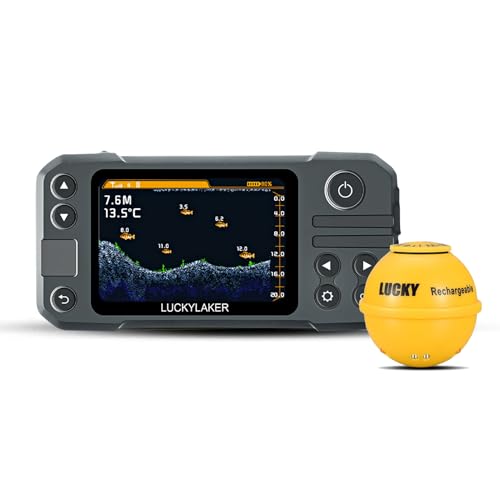


As an Amazon Associate we earn from qualifying purchases at no extra cost to you. Ratings are shown as listed on Amazon.
Best castable fish finders by shore-fishing situation
| Best for | Recommended type or model | Why it fits | Trade-off |
|---|---|---|---|
| Mapping unfamiliar banks | Deeper CHIRP+ 2 | GPS-enabled bathymetric mapping, CHIRP sonar, long casting range | Higher general market price, roughly $230–$300 |
| Best value mapping | Deeper PRO+ 2 | GPS, contour mapping and approximately 394-foot connection range | Conventional broadband sonar gives less separation than CHIRP |
| Simple fish-finding from a bank | Garmin STRIKER Cast GPS | Compact unit, straightforward app and GPS-enabled mapping | Shorter stated connection range than Deeper units |
| Occasional pond or dock use | Basic castable sonar without GPS | Lower purchase cost and fewer app features to manage | No automatic depth-map building or saved location data |
| Long sessions and repeated casting | Unit rated for 10–15 hours or more | Less charging anxiety during multi-day trips | Battery rating varies with temperature, wireless signal and sonar use |
Head-to-head: the important differences
Deeper CHIRP+ 2
The CHIRP+ 2 is the strongest all-around choice when a shore angler wants more than a live depth reading. It uses three-frequency CHIRP sonar, supports a stated wireless range of up to about 394 feet, reaches approximately 330 feet of maximum sonar depth in suitable conditions, and includes GPS for creating underwater contour maps.
Its main advantage is target separation. CHIRP sends a sweep across frequencies rather than relying on one narrow frequency, which can make it easier to distinguish fish from bottom clutter and to interpret structure. That does not make every mark a fish, but it gives an experienced user more useful information around drop-offs, weed edges and suspended bait.
The unit is compact and light enough for normal spinning tackle, but repeated full-power casts still place stress on the rod, leader knot and attachment point. Its battery is commonly specified at up to roughly 15 hours, although cold water, weak phone reception and constant sonar use can reduce real-world runtime. Expect to pay about $230–$300 depending on the package and current market pricing.
Deeper PRO+ 2
The PRO+ 2 is the value-oriented mapping option. It offers a similar stated casting range of about 394 feet, GPS bathymetric mapping and maximum depth capability around 330 feet. Its sonar is less sophisticated than the CHIRP+ 2, but it still gives shore anglers a practical way to identify depth changes and likely holding areas.
Choose it when mapping is more important than fine target separation. For example, if you fish reservoirs and need to locate a creek channel or a gradual flat, the PRO+ 2 can deliver the useful part of the answer without paying for the higher-end sonar system. General market pricing is often around $180–$230.
The PRO+ 2 is also a sensible first castable finder for an angler who is still learning sonar interpretation. A map showing a 6-foot flat dropping to 14 feet is easier to use than a screen full of ambiguous arches. The limitation is that mapping still requires repeated casts and a reasonably accurate GPS position from the phone and device.
Garmin STRIKER Cast GPS
The Garmin STRIKER Cast GPS is aimed at anglers who prefer a simple app-based setup. The GPS version can create maps and display sonar information on a compatible smartphone, while the non-GPS version is cheaper but lacks the same mapping capability. The stated wireless range is approximately 200 feet, with maximum depth commonly listed around 200 feet in freshwater conditions.
That shorter range is rarely a problem on small ponds, canals or compact lakes. It matters more on a broad reservoir, where 200 feet may not reach the far side of the area you want to investigate. Battery life is rated at up to about 10 hours, and the unit’s compact form is convenient for anglers who want to carry minimal gear.
Its best use is quick reconnaissance: cast, check depth and bottom shape, then fish the productive water with normal tackle. It is less compelling if your priority is maximum casting distance, deep-water capability or extended GPS mapping sessions.
Range, depth and phone connectivity: what the numbers mean
- Casting range: Treat the advertised wireless range as an upper limit in open conditions, not a guaranteed distance. Trees, steep banks, nearby wireless congestion, a low phone position and the angler’s body can reduce the usable range.
- Sonar depth: Maximum depth figures are most achievable in clear, favorable conditions. Heavy vegetation, soft sediment, turbulence and very shallow water can make readings less stable.
- Phone connection: These devices generally communicate with a phone through Wi-Fi or a proprietary wireless connection rather than cellular service. You do not need mobile coverage to view sonar, but GPS maps and software updates may depend on the phone’s location services or internet access.
- GPS: GPS is valuable for returning to a productive breakline, not just for showing current depth. A non-GPS finder can reveal structure, but you must record the location manually using landmarks or a separate mapping device.
A useful coverage calculation illustrates the range difference. A 394-foot casting radius covers approximately 486,000 square feet of circular water in ideal conditions, while a 200-foot radius covers about 126,000 square feet. That is almost four times as much theoretical area. In practice, shore access, casting direction and the lake’s shape reduce both figures, but the advantage of a longer-range unit is still meaningful on large water.
Battery life and ownership costs
Battery capacity matters less than charging habits. A finder rated for 10 hours can cover several short evening sessions, while a 15-hour unit is better for a full day of mapping. For a six-hour outing, a nominal 10-hour battery has a 40 percent reserve before accounting for cold temperatures and connection losses. That reserve is useful, but it is not a reason to skip charging before every trip.
Recharge the unit fully, keep the charging port or contacts clean and dry, and avoid storing it for months at either zero percent or maximum charge. Do not leave it in a hot vehicle. Internal lithium batteries gradually lose capacity, and replacement may require manufacturer service rather than a simple field swap. This is an important ownership difference from a traditional fish finder using replaceable batteries.
For frequent anglers, calculate cost per use rather than focusing only on purchase price. A $250 finder used on 50 trips costs about $5 per trip in its first season. Used on 10 trips, the same unit costs $25 per trip. If you fish infrequently and only need depth, a lower-cost non-mapping model—or a rental or borrowed unit where available—may make more financial sense.
Durability: what wears first when you cast it
The transducer body is designed to float, but it is not indestructible. The parts most likely to suffer are the attachment eye, clip, leader, knot and charging seal. A hard swing with a heavy sinker can create more stress than the sonar itself. Use the manufacturer’s recommended attachment method and match the line strength to the total casting weight.
- Rinse the unit with fresh water after fishing saltwater or muddy water.
- Inspect the eyelet and clip for cracks before every session.
- Wipe away slime and algae from the sonar surface; buildup can weaken readings.
- Dry the charging area before opening a cover or connecting a cable.
- Do not drag the finder across rocks or repeatedly bounce it off a dock.
- Keep the phone in a waterproof pouch; losing the phone connection does not help if the device itself survives.
One common mistake is attaching a castable finder to an ultralight rod with a thin leader and then making a full-power cast. The finder may weigh only around 90–100 grams, but that weight is concentrated at the end of a fast-moving rig. A medium or medium-heavy rod rated for the combined lure weight is usually a safer starting point than delicate tackle.
How to choose the right one
Choose the Deeper CHIRP+ 2 if you fish large lakes, regularly map new water, want the greatest stated range and care about interpreting structure in more detail. Choose the Deeper PRO+ 2 if GPS mapping is important but you want to limit the purchase price. Choose the Garmin STRIKER Cast GPS if you fish smaller waters and value a compact, uncomplicated app experience over maximum range.
Before buying, check four practical details: whether your phone supports the required app, whether your rod and line can cast the device safely, whether GPS mapping is included in the exact model, and whether the battery can cover your normal session. The best castable fish finders are not necessarily the deepest or most expensive; they are the ones whose range, mapping and durability match the water you can actually reach from shore.

Write Your Review
No reviews yet. Be the first to share your experience!