

Our Top Picks
 Albott Modular Fishing Kayak with Propeller Drive System9.6ft114.96 x 34.68 x 13.8 inches109.68 poundsCheck on Amazon

For most lake anglers, the best overall pick here is the Makana 100 with Impulse Drive: a 10-foot rotomolded sit-on-top with a propeller pedal drive, a rudder kit and an adjustable seat in the box. A pedal drive fishing kayak lets you move with your feet so both hands stay free for rod and net, which is the main reason lake anglers pay extra for one. The six listings below include two inflatable pedal boats, two modular hard-shell kayaks, one rotomolded kayak and one stand-alone pedal unit that is an upgrade rather than a boat.
Quick List
- Makana 100 with Impulse Drive – best overall for lakes, with a rotomolded hull and propeller pedal drive
- Reel Yaks Raptor 9.5 ft Fin Drive – best for shallow, weedy water and easy transport in two sections
- Albott Modular Fishing Kayak, Propeller Drive – best for a customizable modular hull
- Spatium Inflatable Pedal Fishing Kayak – best for anglers who need to store the boat in a closet
- Inflatable Fishing Pedal Board Kayak – best for budget-minded inflatable experimentation
- ALSUP Pedal Drive Motor – runner-up and accessory, for upgrading a compatible kayak rather than buying a boat
Which One Is Right for You?
| If you… | Choose |
|---|---|
| Want one dependable, complete pedal kayak for lakes | Makana 100 with Impulse Drive |
| Fish weedy, shallow coves and stump fields | Reel Yaks Raptor fin drive |
| Want a modular hull you can customize | Albott modular kayak |
| Have little storage space and a car without a roof rack | Spatium inflatable pedal kayak |
| Want to try an inflatable pedal setup first | Inflatable fishing pedal board kayak |
| Already own a compatible kayak and want pedal propulsion | ALSUP pedal drive unit |
The deciding factors on lakes are transport and storage, drive type and weight. A kayak you cannot lift onto your vehicle by yourself does not get used, and a drive that fouls in weeds makes shallow water frustrating. Decide first how you will carry the boat, then pick the drive that matches the vegetation and depth where you fish.
All 6 Picks in Detail
1. Makana 100 With Impulse Drive – Best Overall for Lake Fishing
As an Amazon Associate we earn from qualifying purchases at no extra cost to you.

The Makana 100 is built by Vibe Kayaks and is listed as a 10-foot fishing kayak with the Impulse Drive, a Hero Seat 2.0 and a rudder kit included. The Impulse Drive is a propeller system that pushes the boat forward smoothly and can be reversed, which helps when you need to back off a structure or hold position in wind. According to the manufacturer, the hull is rotomolded high-density polyethylene and the boat is rated for about 400 lb, with a width near 33 inches. That width gives good stability for standing casts, though you should confirm the figure on the product page.
- Length: 10 ft per the listing
- Drive: Impulse Drive, propeller pedal system
- Hull: rotomolded HDPE per the maker
- Included: Vibe Hero Seat 2.0, drive, rudder kit
- Capacity and width: roughly 400 lb and 33 in per the maker; confirm on listing
Pros
- Complete package with seat and rudder
- Reverse and steering for precise positioning
- Stable, tracked hull
Cons
- One-piece hull needs a roof rack or trailer
- Propeller drives prefer water deeper than a foot or so
Who it suits: an angler who fishes lakes and reservoirs regularly, has a way to haul a full-length kayak, and wants a ready-to-fish package instead of assembling a collection of add-ons. The included rudder kit matters on windy days, because it lets you keep a heading while your feet do the work and your hands manage a rod.
Compared with the Reel Yaks Raptor, it is a single-piece boat with a more conventional hull, while the Raptor wins on transport and shallow-water behavior.
Lake fit: a boat this size covers mid-size lakes and reservoirs comfortably. Plan on a roof rack or a trailer and a way to lift the boat to your vehicle, because the loaded weight is considerable.
2. Albott Modular Fishing Kayak With Propeller Drive – Best for a Customizable Modular Hull

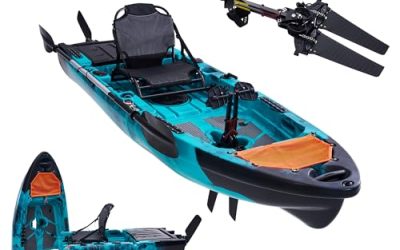
The Albott listing describes a 9.6 ft customizable, sit-on-top modular kayak made of HDPE with a propeller drive system, aimed at adults and youths. Modular hulls come in sections that connect, which makes transport simpler in a hatchback and storage easier in an apartment. Other listings from the same seller state a capacity near 400 lb and a weight around 110 lb, with differing figures between pages, so confirm the numbers before ordering. The warranty and parts support are also worth checking, since a modular kayak lives and dies by its connection hardware.
- Length: 9.6 ft per the listing
- Drive: propeller drive system
- Hull: HDPE, modular sections
- Audience: adults and youths
- Capacity and weight: confirm on listing
Pros
- Sectional design simplifies transport
- Customizable with accessories
- Propeller drive with easy reverse
Cons
- Heavy overall; check the weight per section
- Specification figures vary between pages
Who it suits: a buyer who wants to add rod holders, a fish finder mount and other accessories to a flexible platform and who needs to move the boat in sections. Because the listing and neighboring pages cite different weights and capacities, treat the modular idea as the draw, and read the final product page carefully before you commit.
It targets the same modular idea as the Reel Yaks Raptor, but with a propeller instead of a fin drive.
Lake fit: a good option for small and mid-size lakes where you launch from a ramp or a gentle bank. Inspect the joints before every outing and rinse sand from the connecting hardware.
3. Reel Yaks Raptor 9.5 ft Fin Drive – Best for Shallow, Weedy Water

The Raptor is a modular sit-on-top pedal kayak that the manufacturer lists at 9.5 feet with a 380 lb capacity, offered in a fin-drive version for adults and youths. A fin drive replaces the propeller with a pair of flapping fins, which tend to shed weeds and glide over shallow structure with less risk of fouling. The kayak splits into two pieces that join without tools, so it fits in a car trunk without a roof rack according to the maker. Different listings report different weights, so confirm the weight and section sizes before buying.
- Length: 9.5 ft
- Drive: fin drive
- Capacity: 380 lb per the listing
- Design: two-piece modular, sit-on-top
- Weight: sources differ; confirm on listing
Pros
- Fin drive handles shallow water and weeds
- Two-piece design aids transport
- Tool-free assembly
Cons
- Fins are not as efficient as a propeller for distance
- Weight and drive details vary by listing page
Who it suits: anglers who launch from a gravel bank or small ramp, who fish stumps, lily pads and shallow flats, or who drive a compact car and cannot carry a 10-foot hull on a roof. Always confirm that the listing you order is the fin-drive version, because a similar model uses a propeller.
Pick it over the Makana when you launch from small ramps or fish skinny coves and transport matters most.
Lake fit: excellent on small lakes, ponds and weedy bays. Check that the listing you buy matches the fin-drive version, since the same brand also sells a propeller-drive version.
4. ALSUP Pedal Drive Motor – Runner-Up, an Upgrade Unit Rather Than a Kayak

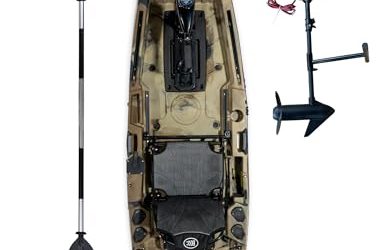
This product is not a kayak. The listing describes a high-torque foot pedal unit, an all-in-one propulsion system that fits Radar and most fishing kayaks. It belongs here only as a way to add pedal propulsion to a boat you already own. Compatibility is the whole question: drive wells, mounting hardware and hull thickness differ between kayaks, so confirm that your kayak can accept it. If you do not already own a compatible kayak, one of the complete boats in this list is the better starting point.
- Type: pedal drive unit, not a kayak
- Claim: all-in-one propulsion
- Fit: described as fitting Radar and most fishing kayaks; confirm yours
- Mount and installation: confirm on listing
- Power and speed figures: not stated
Pros
- Adds pedal power to an existing kayak
- Avoids buying a new boat
Cons
- Compatibility depends on your kayak
- Installation may require modifications
Who it suits: a handy owner of a compatible fishing kayak who would rather upgrade than replace. Because the listing does not state power or speed figures in its name, ask the seller about installation steps, required tools and warranty effects before ordering.
Choose it only if you already own a suitable kayak; otherwise, a complete boat like the Makana 100 is simpler.
Lake fit: a drive upgrade can work well on a hull you know, but modifying a kayak can affect warranty and stability, so read the installation notes carefully.
5. Spatium Pedal Fishing Inflatable Kayak – Best for Compact Storage and a Rotating Seat

The Spatium is an inflatable sit-on-top pedal fishing kayak for one adult, with a 360-degree rotatable seat. Rotating seats let you turn toward a fish or a cast without twisting your hips, which is a pleasant feature in a drifting boat. Inflatables roll into a bag, so they suit apartment dwellers and anglers without roof racks. The trade-offs are inflation time and the need to watch for punctures from hooks and brush. The listing does not state the dimensions or capacity in its name, so check them on the product page.
- Type: inflatable sit-on-top pedal kayak
- Seat: 360-degree rotatable
- Capacity: one adult per the listing
- Drive details: confirm on listing
- Dimensions and weight limit: confirm on listing
Pros
- Packs down for storage and transport
- Rotating seat helps with casting angles
Cons
- Needs inflation and drying time
- Punctures are a risk around hooks
Who it suits: a solo angler with limited storage who fishes calm lakes in good weather. Allow time to inflate and dry the boat at the end of the day, store it clean, and use a pressure gauge if one is supplied so the hull is firm but not overinflated.
Next to the generic inflatable pedal board kayak, its seat feature is the clearest differentiator.
Lake fit: a sensible choice for small lakes and calm days. Avoid steep rocky shores and keep a patch kit on board.
6. Inflatable Fishing Pedal Board Kayak – Best for a Budget Inflatable Trial

This is a generic inflatable fishing pedal board listed for rivers, oceans and lakes. The product name stresses that it is a sit-on-top pedal drive inflatable boat but leaves out dimensions, capacity and the drive layout. Because brand-less listings vary in build quality, check the material thickness, valve type and the included pump before you buy. It can make sense as a way to try pedal fishing without committing to a rotomolded boat, as long as you keep expectations realistic about durability.
- Type: inflatable sit-on-top pedal board
- Stated waters: rivers, oceans, lakes
- Drive and propulsion type: confirm on listing
- Capacity and size: confirm on listing
- Included accessories: confirm on listing
Pros
- Compact when deflated
- Low barrier to try pedal fishing
Cons
- Specs largely unstated in the listing name
- Durability should be confirmed
Who it suits: a curious beginner who wants to try pedal-powered fishing before spending more. Because the listing is so brief, request the dimensions, capacity and included pump from the seller, and compare them to what you plan to carry.
Between the two inflatables, choose the Spatium if you want a rotating seat and a clearer one-person description; choose this one only after verifying its details.
Lake fit: keep it to calm lakes in fair weather, wear a life jacket and stay near the shore.
Specs Compared
| Product | Type | Length | Drive | Capacity | Transport |
|---|---|---|---|---|---|
| Makana 100 | Rotomolded sit-on-top | 10 ft | Impulse Drive, propeller | About 400 lb per maker; confirm | One piece; roof rack or trailer |
| Albott modular | HDPE modular sit-on-top | 9.6 ft | Propeller | Confirm on listing | Modular sections |
| Reel Yaks Raptor | Modular sit-on-top | 9.5 ft | Fin drive | 380 lb | Two sections |
| ALSUP pedal drive | Drive unit only | Not applicable | Pedal propulsion | Not applicable | Install on compatible kayak |
| Spatium | Inflatable sit-on-top | Confirm on listing | Pedal drive | One adult | Packs into a bag |
| Inflatable pedal board | Inflatable sit-on-top | Confirm on listing | Pedal drive | Confirm on listing | Packs into a bag |
How We Chose These
We compared the six listings using the manufacturer pages and the specs stated in each listing: hull type, length, drive system, stated capacity and transport design. We looked for complete packages, because a pedal kayak that includes its seat and steering saves money on add-ons. We prioritized stated capacity and drive type over cosmetic features, and we flagged any listing that leaves dimensions or capacity unstated. One product turned out to be a drive unit rather than a boat, so we placed it as an upgrade runner-up. We treated mismatched figures between retailer pages as a reason to confirm details with the seller, not as facts.
What to Look For
Fin Drive Versus Propeller Drive
A propeller drive spins a prop under the hull and is efficient for covering distance, with easy reverse on most systems. It needs enough depth to turn freely, usually a foot or more, and weeds can wrap around it. A fin drive flaps a pair of fins and is generally better at gliding over shallows and shedding vegetation, but it is typically a bit slower and less efficient over a long distance. Choose a propeller for open lakes with long runs and a fin drive for weedy coves and stump fields.
Weight, Transport and Storage
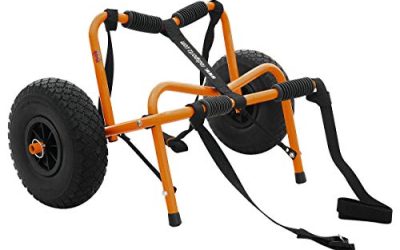
A rotomolded one-piece kayak can weigh 70 to 110 lb with the drive, which is a lot to lift alone. Modular boats split into sections that are easier to move, and inflatables pack into a bag but need an air pump. Worked example: a 100 lb kayak lifted by a 150 lb paddler is a heavy single lift, so use a trailer, a loader or a cart. Check roof-rack ratings and the vehicle’s load limit, and plan how you will get the boat from the car to the water.
Capacity, Stability and Seats
Capacity ratings include you, your gear, the fish and the drive. As a rule of thumb, keep the total load at no more than 75 to 80 percent of the rating for comfortable freeboard. Width drives stability: 32 to 36 inches suits standing casts, while narrower hulls track better but feel tippy. A high-low seat or a rotating seat improves fishing ergonomics, and you should look for adjustable foot positions so your knees stay comfortable on all-day pedals.
Safety and Lake Rules
Wear a life jacket whenever you are on the water; most US jurisdictions require one for every person aboard and a sound-producing device such as a whistle. Cold water matters even in warm weather, so dress for the water temperature. Add a light or reflective flag for low-light fishing and carry a tow strap for emergencies. Check local registration and launch rules, because some states register pedal-driven vessels differently.
Maintenance and care. Rinse the drive and hull after every outing, especially in lakes with algae or invasive species such as zebra mussels, and let everything dry fully before storage. Remove fishing line wrapped around a propeller shaft or fin hinge right away, since it can damage seals over time. Check the drive’s mounting hardware and the rudder cables regularly, and keep a basic tool kit with spare pins in your tackle bag.
Fishing features worth having. Look for flush-mount rod holders, a transducer-ready scupper or a protected port for a fish finder, accessory tracks that accept your existing gear and a rear well big enough for a crate. Anchor trolley points, paddle parks and a lightweight paddle for emergencies round out a practical setup. Remember that every accessory adds weight, so keep an eye on the total load.
Lake wind and drift. On open lakes, wind is the force that moves you most. A pedal kayak with a rudder holds a line into the wind with little effort, and reverse helps you back away from snags. Plan your route to run into the wind on the way out and with it on the way home, and keep an eye on the weather because small lakes can build chop quickly.
Range and effort. Pedaling at an easy cadence lets most anglers cover a few miles of lake without fatigue, but speed depends on the drive, the hull and the load. As a rule of thumb, plan your trip so you can turn back with a third of your energy left, and remember that headwinds can double the effort of the return leg. If you fish with a trolling motor or a second person aboard a tandem, add extra margin. Keep a paddle on board in case a pedal drive jams or loses a fin.
Questions
Is a pedal kayak better than a paddle kayak for lakes?
For fishing, usually yes, because pedaling keeps your hands free. Paddle kayaks are lighter and cheaper, so they remain a good choice if you rarely fish for long stretches.
How deep does the water need to be for a pedal drive?
Propeller drives generally need about a foot or more of water, while fin drives can handle shallower depth. Check the manufacturer’s stated minimum depth for your specific drive.
Are inflatable pedal kayaks durable enough for fishing?
Quality inflatables can be sturdy, but hooks and sharp rocks can puncture them. Carry a patch kit and avoid dragging the boat over rough ground.
Can I add a pedal drive to my existing kayak?
Some kayaks accept aftermarket drives, but compatibility depends on the hull and mounting system. Confirm that the drive is designed for your model before cutting or drilling.
Do I need a trailer or roof rack?
One-piece rotomolded kayaks usually do, since they are long and heavy. Modular and inflatable boats are easier to carry in a car.
How do I choose between a fin drive and a propeller?
Use a fin drive for shallow, weedy water and a propeller for open lakes with long runs. Both can work on mixed lakes if you pay attention to depth.
Update History
- October 20, 2026 – Initial publication; product set drawn from current catalog listings.
- Check the product page for current specifications and availability before buying.
Sources
- Manufacturer product pages for Vibe Kayaks (Makana 100) and Reel Yaks (Raptor)
- Retailer listing titles and specification fields for each product
- General life-jacket and small-vessel safety guidance for recreational boating
More from Amazon
Programs that pair well with the guide above. Offers and eligibility are set by Amazon and may change.
Free shipping on eligible items, Prime Video and more. Eligible new members can start with a free trial.
Start a Prime free trialA Prime membership for ages 18-24 with a trial period. Eligibility is set by Amazon.
See Prime for Young AdultsAudiobooks and podcasts to listen to on the go. Eligible new members can start with a free trial.
Try Audible freeAd-free music streaming. Eligible new subscribers can start with a free trial.
Try Music Unlimited freeAs an Amazon Associate we earn from qualifying purchases.
Write Your Review
No reviews yet. Be the first to share your experience!