

Key takeaways
- Wipe food and drink spills after every event, especially around edge seams and leg joints.
- Inspect feet, braces, hinges, welds, and fasteners at least monthly during active seasons.
- Do not exceed the labeled weight limit or use tables as ladders, workbenches, or platforms.
- Use a table cart for repeated transport; dragging individual tables accelerates foot and frame damage.
- Keep folded tables dry and allow damp covers or surfaces to dry before stacking.
Best Banquet Tables for Events and Parties
The best banquet tables for most events are commercial-grade folding tables with a 6-foot rectangular top: they offer a useful balance of seating capacity, durability, transportability, and storage efficiency. Choose fixed wood tables for a permanent venue, plastic folding tables for frequent mixed-use events, and metal folding tables when maximum structural toughness matters more than appearance.
Quick Picks by Venue and Situation
| Situation | Best table type | Recommended size | Why it fits |
|---|---|---|---|
| Occasional parties and a limited budget | Plastic folding | 6 ft × 30 in | Affordable, washable, and easy to store vertically |
| Wedding, conference, or banquet venue | Fixed or folding wood | 6 or 8 ft × 30 in | More formal appearance and better resistance to visible scratching |
| Rental inventory and heavy commercial use | Commercial plastic or steel folding | 6 ft × 30 in | Fast setup, replaceable hardware, and predictable handling |
| Small hall, classroom, or home garage | Half-fold plastic | 4 or 6 ft × 24–30 in | Smaller storage footprint and easier carrying |
| Buffet, registration, or display line | Rectangular folding | 6 or 8 ft × 30 in | Continuous usable surface and simple alignment |
| Round-seating dinner layout | Folding round | 48–60 in diameter | Allows conversation between guests without table corners |
Folding vs. Fixed Banquet Tables
Folding tables: the practical choice for changing layouts
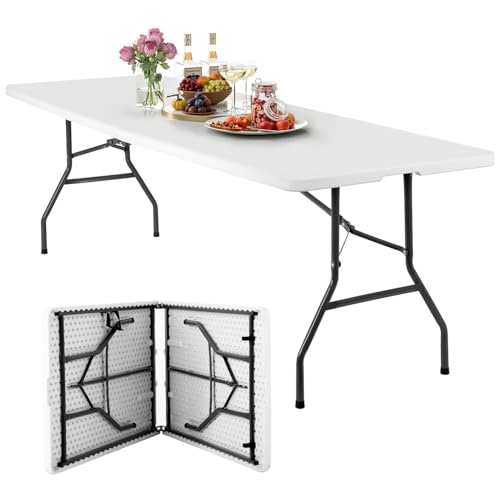
Folding tables are the better choice when a room must serve several purposes. Their legs fold beneath the top, allowing staff to move tables through doorways and store them against a wall. Most commercial models use a 1.75- to 2-inch-thick top and stand approximately 29 inches high, which matches standard banquet chairs.
Our top picks


As an Amazon Associate we earn from qualifying purchases at no extra cost to you. Ratings are shown as listed on Amazon.
A typical 6-foot folding table weighs about 35 to 55 pounds, depending on its core, frame, and leg design. A 4-foot model may weigh 25 to 40 pounds, while an 8-foot model commonly reaches 45 to 70 pounds. That difference matters: one person may safely carry a smaller table, but larger tables are easier and safer with two people.
The trade-off is hardware wear. Hinges, leg locks, rivets, and folding braces receive repeated stress. Before each event, check that both leg assemblies lock fully and that the tabletop does not twist when lifted from one end. A table that feels solid when flat can still be unsafe if one locking mechanism is bent or partially engaged.
Fixed tables: better for permanent installations
Fixed banquet tables make sense when the room has a dedicated layout and tables rarely need to move. They usually have stronger, simpler leg structures and can provide a more polished appearance, particularly when made from finished wood or laminate. With fewer hinges and moving parts, there are fewer mechanisms to maintain.
However, fixed tables consume more floor and storage space. A stack of non-folding 6-foot tables can require a dedicated rack or storage room, and moving them through narrow doors or around corners is more difficult. They are also less convenient when an event changes from a seated meal to a dance floor, trade display, or classroom arrangement.
Plastic, Wood, and Metal: Which Material Lasts Longest?
Plastic folding tables
Most commercial plastic banquet tables use a blow-molded polyethylene top over a steel frame. They are resistant to spilled drinks, occasional outdoor use, and routine cleaning. A textured surface can hide light scuffs, while a smooth surface is easier to wipe during rapid turnover.
The weak points are usually the underside frame, leg hinges, and edge damage caused by dropping the table on a corner. Do not drag loaded plastic tables across concrete; the feet and frame can deform even when the top still looks intact. Typical rated capacities are around 500 to 1,000 pounds distributed across the tabletop, but the actual limit varies significantly by design. A 1,000-pound evenly distributed rating does not mean the table can safely support a heavy object concentrated on one small area.
Wood and wood-composite tables
Wood banquet tables offer the most traditional appearance and are often preferred for weddings, dining rooms, and formal conference areas. Plywood or hardwood tops can be refinished or repaired, while particleboard-based tops are lighter and less expensive but more vulnerable to swelling after water reaches an exposed edge.
Wood tables need more careful cleaning. Use a damp cloth rather than saturating the surface, dry spills promptly, and avoid harsh solvents that can cloud lacquer or laminate. Corners and edge banding often wear before the center of the tabletop. A fitted protective cover during transport prevents many dents, but covers do not compensate for carrying a table by its locking hardware.
Metal tables
Metal banquet tables generally use a steel or aluminum top and frame. Steel is highly resistant to impact and can suit cafeterias, community centers, and rental operations where tables are handled roughly. Aluminum reduces carrying weight and resists rust better, but it can dent more easily and may cost more.
Metal surfaces can feel noisy and less formal, especially when chairs or serving equipment contact them. Look for powder-coated frames, capped feet, and corrosion-resistant fasteners. Inspect welds and the areas around leg pivots; cracks or elongated bolt holes are reasons to retire a table rather than attempt an improvised repair.
Capacity, Seating, and Weight Limits
For rectangular tables, allow approximately 24 inches of table edge per seated guest for a comfortable meal. A 6-foot table therefore seats six comfortably, or eight with tighter spacing. An 8-foot table seats eight comfortably and can accommodate ten in a more crowded arrangement. If guests need room for plates, drinks, notebooks, or serving dishes, reduce the count rather than relying on the table’s maximum physical seating.
| Table size | Comfortable seating | Tight maximum | Typical table weight | Common distributed load range |
|---|---|---|---|---|
| 4 ft × 24–30 in | 4 | 6 | 25–40 lb | 500–1,000 lb |
| 6 ft × 30 in | 6 | 8 | 35–55 lb | 500–1,000 lb |
| 8 ft × 30 in | 8 | 10 | 45–70 lb | 700–1,000 lb |
| 48 in round | 4 | 6 | 35–55 lb | 500–1,000 lb |
| 60 in round | 6 | 8 | 45–75 lb | 700–1,000 lb |
These are planning ranges, not substitutes for the manufacturer’s label. Capacity ratings normally assume a level floor and an evenly distributed load. A person standing on a table, a concentrated stack of equipment, or a table placed on an uneven surface creates a different load case and should be avoided.
Storage Footprint: The Calculation That Changes the Choice
Storage is where folding tables usually outperform fixed tables. Suppose a venue owns ten 6-foot folding tables. If each folded table occupies roughly 36 by 30 inches of floor space when stacked in a rack, the rack footprint is about 7.5 square feet, excluding access space. The same ten unfolded tables require approximately 150 square feet if placed side by side, before allowing aisles.
For safe handling, leave roughly 30 to 36 inches of clearance in front of the rack. Store tables upright or in a purpose-built cart, secure the stack against tipping, and avoid leaning tables loosely against a wall where they can slide onto people or equipment.
Ownership Costs and Maintenance
General market prices for commercial banquet tables commonly range from about $60 to $150 for basic 4- to 6-foot plastic folding models, $120 to $300 for heavier-duty or premium-finish folding tables, and $150 to $500 or more for fixed wood or specialized commercial tables. A cheaper table may cost more over time if its hinges fail early or it cannot tolerate the venue’s cleaning routine.
For a venue using a table 40 times per year, a $200 table that lasts eight years costs about 63 cents per use before labor and cleaning. A $90 table that lasts three years costs about 75 cents per use at the same frequency. This simple calculation favors durability when setup volume is high, even if the initial purchase price is greater.
- Wipe food and drink spills after every event, especially around edge seams and leg joints.
- Inspect feet, braces, hinges, welds, and fasteners at least monthly during active seasons.
- Do not exceed the labeled weight limit or use tables as ladders, workbenches, or platforms.
- Use a table cart for repeated transport; dragging individual tables accelerates foot and frame damage.
- Keep folded tables dry and allow damp covers or surfaces to dry before stacking.
Final Buying Recommendation
Choose 6-foot plastic folding tables for the best all-purpose value, particularly when events vary and storage space is limited. Select heavier commercial models with steel frames and positive leg locks for frequent rental or venue use. Choose fixed wood tables when appearance and permanent placement matter most, and metal tables when impact resistance and institutional durability take priority. Before buying, measure doorways, storage height, cart clearance, and the route staff will use—those practical dimensions often matter more than a small difference in tabletop material.



Write Your Review
No reviews yet. Be the first to share your experience!