

Key takeaways
- Moon: craters, ridges, mountain shadows, and changing terminator detail are visible in every telescope listed here.
- Jupiter: the four large Galilean moons and, with adequate aperture and steady air, several cloud bands.
- Saturn: its rings are an achievable target with even a modest telescope; the Cassini Division requires more aperture, sharper optics, steady air, and good focus.
- Venus: phases are visible, but its cloud tops do not usually show much visual detail.
- Mars: small and difficult except near favourable oppositions; do not buy a telescope expecting a large, detailed red planet.
- Deep sky: open clusters and the Orion Nebula are rewarding from suburban locations. Galaxies and faint nebulae need dark skies and will usually appear as dim, grey structures rather than colourful photographs.
The best beginner telescopes are usually simple, stable 80–130 mm instruments that can be set up in minutes, rather than the most powerful-looking telescope on a box.
For a first telescope, prioritize aperture, a steady mount, and a design you will actually carry outside. A modest tabletop Dobsonian can show more than a larger-looking department-store telescope with a shaky tripod, while a compact computerized refractor may be the better choice for someone who wants guided locating instead of manual star-hopping.
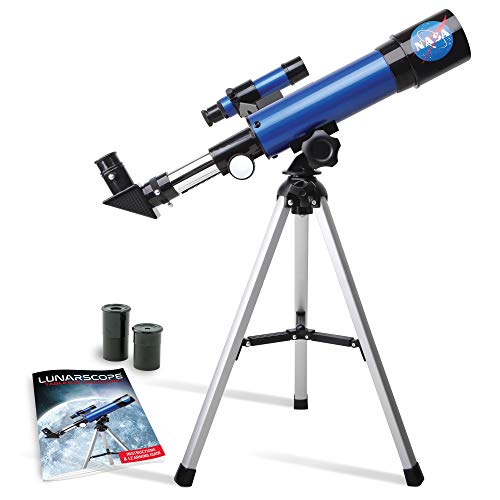
Our top picks



As an Amazon Associate we earn from qualifying purchases at no extra cost to you. Ratings are shown as listed on Amazon.
Best beginner telescopes by situation
| Situation | Best telescope type | Useful specification | Why it fits |
|---|---|---|---|
| Lowest-cost visual observing | Tabletop Dobsonian | 114–130 mm aperture, 650–750 mm focal length | Large light-gathering area and simple, stable operation |
| Small apartment or frequent travel | Short-tube refractor | 70–90 mm aperture, 400–650 mm focal length | Compact, sealed optics and quick setup |
| Easy object locating | Phone-guided or computerized telescope | 80–125 mm aperture; motorized or app-assisted mount | Reduces the difficulty of finding unfamiliar targets |
| Moon and planets as the main targets | Longer-focus refractor or tabletop Dobsonian | 80–130 mm aperture, approximately 650–1,200 mm focal length | Sharper high-power views and easier focusing |
| One telescope for a family | 130 mm tabletop Dobsonian | 130 mm aperture, about 650 mm focal length, 6–10 kg total system | Bright views, intuitive controls, and no batteries required |
What matters most when choosing a beginner telescope
Aperture: the specification that controls brightness and detail
Aperture is the diameter of the telescope’s main lens or mirror. It determines how much light the telescope collects and sets a practical limit on fine detail. A 130 mm mirror has an area of roughly 13,273 square millimetres, while an 80 mm lens collects about 5,027 square millimetres. Dividing those figures shows that the 130 mm instrument gathers about 2.6 times as much light as the 80 mm one.
That difference is noticeable on faint star clusters, galaxies, and nebulae. It also helps planetary views, although atmospheric turbulence can prevent any telescope from delivering its theoretical maximum sharpness.
For most first-time observers, 70–90 mm is a sensible minimum for a portable refractor. A 114–130 mm reflector or Dobsonian is often the better value when the telescope can be stored and transported easily. Be cautious with exaggerated “maximum magnification” claims. A useful rule is approximately 2× the aperture in millimetres under excellent conditions, but beginners will more often use 30× to 150×.
Focal length: field of view versus high-power ease
Focal length affects magnification and the width of the sky visible through an eyepiece. The calculation is simple:
Magnification = telescope focal length ÷ eyepiece focal length.
For example, a 650 mm telescope with a 25 mm eyepiece gives 26× magnification. The same telescope with a 10 mm eyepiece gives 65×. A 1,000 mm telescope with that 10 mm eyepiece gives 100×.
Short focal lengths, commonly 400–650 mm, make it easier to frame large targets such as the Pleiades, the Andromeda Galaxy, and wide star fields. They also produce lower magnification with ordinary eyepieces, which is forgiving when learning to aim. Longer focal lengths make the Moon and planets easier to view at moderate magnification and can reduce the apparent effect of inexpensive eyepiece flaws.
There is no universally best focal length. Choose a shorter instrument for broad, low-power views and portability; choose a longer one if the Moon, Jupiter, Saturn, and double stars are your priority.
Mount stability is more important than an impressive optical tube
At high magnification, a mount that vibrates for several seconds after every touch can make a good telescope frustrating. A stable alt-azimuth mount or Dobsonian base is generally easier for beginners than a complicated equatorial mount.
Tabletop Dobsonians are particularly effective because their low center of gravity resists shaking. The trade-off is that they need a solid table, bench, or observing platform. Tripod-mounted refractors are more flexible, but a lightweight tripod with thin legs may be the weakest part of the package.
When checking a tripod, extend it only as high as necessary and avoid fully raising a narrow center column. For a manual telescope, smooth tension controls and slow-motion adjustment cables are more valuable than a large accessory count.
Beginner telescope picks worth considering
Best value: a 114–130 mm tabletop Dobsonian
A telescope such as the Sky-Watcher Heritage 130P or a comparable 130 mm tabletop Dobsonian offers a strong balance of aperture, simplicity, and cost. These instruments usually have a collapsible or compact optical tube, a manually operated base, and focal lengths near 650 mm.
The Heritage 130P is especially attractive where storage space is limited. It can show lunar craters, Jupiter’s cloud bands and moons, Saturn’s rings, bright open clusters, the Orion Nebula, and several brighter galaxies under a darker sky. The main ownership requirement is a stable support surface and careful handling of the open or partially open tube design.
Best for compact grab-and-go use: an 80 mm short-tube refractor
An 80 mm refractor on a suitable alt-azimuth mount is quick to carry outside and requires little maintenance. Refractors have sealed optical tubes, so dust rarely reaches internal surfaces. They are excellent for the Moon, bright planets, double stars, terrestrial views, and large star clusters.
The limitation is light gathering. An 80 mm refractor will not show faint deep-sky objects as brightly as a 130 mm reflector. Very inexpensive short refractors may also show coloured fringes around bright objects, especially at high magnification. A well-built mount matters more than a long list of included accessories.
Best for guided locating: Celestron StarSense Explorer LT 80AZ
The Celestron StarSense Explorer LT 80AZ combines an 80 mm refractor with a smartphone-assisted locating system. The phone is used as a guide rather than as the camera or optical sensor. This can shorten the learning curve for observers who do not yet recognize constellations.
It remains a relatively small-aperture telescope, so it is best suited to the Moon, planets, bright clusters, and brighter nebulae. The mount is still important: smartphone guidance can help you find an object, but it cannot remove vibration or make a poorly aligned tripod steady.
Best for planetary detail on a tighter budget: a 114–130 mm reflector
A longer-focus 114 or 130 mm reflector can provide sharp views of the Moon and planets while retaining enough aperture for bright deep-sky targets. It may be less compact than a collapsible tabletop design, but the tube can be easier to balance and protect during storage.
Reflector mirrors occasionally need alignment, known as collimation. This is not a major repair, but it is a skill worth learning. A basic collimation cap or sight tube is useful, and the process should be checked after transporting the telescope rather than adjusted constantly.
Setup time, portability, and the likelihood of regular use
A telescope that takes 20 minutes to assemble may be used less often than one that takes two minutes, even if the larger instrument is optically superior. Use this practical comparison:
| Design | Typical setup time | Storage footprint | Carrying reality | Main compromise |
|---|---|---|---|---|
| 70–80 mm tabletop refractor | 2–5 minutes | About 0.5–0.8 m of shelf space | Easy for one person | Limited faint-object performance |
| 80–90 mm tripod refractor | 5–10 minutes | Tube plus folded tripod | Portable, but tripod adds bulk | Stability varies by tripod quality |
| 130 mm tabletop Dobsonian | 2–5 minutes | Roughly 0.7–1 m of shelf or cupboard space | Usually manageable in two pieces | Needs a firm table or stand |
| Motorized computerized mount | 10–20 minutes | Several separate components | More equipment and batteries | Locating is easier, setup is slower |
If you expect to observe from a balcony, check the rules and available space first. A tabletop Dobsonian on a narrow or unstable balcony table is a poor match. For a garden or driveway, portability may matter less than aperture.
What you can realistically see
- Moon: craters, ridges, mountain shadows, and changing terminator detail are visible in every telescope listed here.
- Jupiter: the four large Galilean moons and, with adequate aperture and steady air, several cloud bands.
- Saturn: its rings are an achievable target with even a modest telescope; the Cassini Division requires more aperture, sharper optics, steady air, and good focus.
- Venus: phases are visible, but its cloud tops do not usually show much visual detail.
- Mars: small and difficult except near favourable oppositions; do not buy a telescope expecting a large, detailed red planet.
- Deep sky: open clusters and the Orion Nebula are rewarding from suburban locations. Galaxies and faint nebulae need dark skies and will usually appear as dim, grey structures rather than colourful photographs.
Ownership details beginners often overlook
Keep the telescope capped when it is not in use, let a cold telescope warm gradually in a dry place, and do not wipe optics after every session. Loose dust is usually less harmful than repeated cleaning. If cleaning becomes necessary, use the manufacturer’s optical-cleaning instructions; household glass cleaner and paper towels can damage coatings or leave residue.
Eyepieces are the accessories most likely to be replaced. A useful first upgrade is often one comfortable 8–12 mm eyepiece for medium-to-high power, not an extreme 3 mm eyepiece. Batteries in computerized mounts are another consumable, while reflector collimation is a recurring adjustment rather than a defect.
Before observing, allow a reflector’s mirror to reach outdoor temperature, use the lowest-power eyepiece first, and focus carefully. Start with the Moon or a bright star, then move to planets and deep-sky objects. These habits reduce frustration and reveal whether a problem is caused by the atmosphere, focus, alignment, or the telescope itself.
Bottom line
For most beginners, the best beginner telescopes are a stable 114–130 mm tabletop Dobsonian for maximum visual capability, an 80 mm refractor for fast and low-maintenance observing, or a phone-guided 80 mm telescope for easier object finding. Choose the one that matches your storage space and observing routine, then judge every extra feature against the question that matters most: will it make you more likely to take the telescope outside?

Write Your Review
No reviews yet. Be the first to share your experience!