

Key takeaways
- Compare five fly fishing flies sets for trout and bass, from a 32-fly starter box to a 122-fly premium collection, with patterns, hook sizes and storage.
The best fly fishing flies for most anglers are the Ventures Fly Co. 122 Premium Hand Tied Fly Fishing Flies Assortment: a 122-fly collection in 48 patterns with two fly boxes, fly identification cards, and hook sizing and knot tying guides, covering dry flies, wet flies, nymphs, streamers, woolly buggers, and terrestrials for trout and bass. Anglers who want a smaller premium set should look at the Ventures Fly Co. 40 Premium Hand Tied Fly Fishing Flies Assortment, a 40-fly set in 15 patterns with a fly box included, in hook sizes 8 to 18. Anglers who want the widest variety in one compact box should look at the Bassdash Fly Fishing Assorted Flies Kit, a 64-fly kit in 16 patterns with a magnetic fly box and high-carbon steel hooks in sizes 4 to 12. Anglers who want a simple starter set built around proven patterns should look at the Fishing On The Fly 32 Essential Flies for Trout Kit, a 32-fly set in a waterproof fly box covering dry flies, nymphs, and streamers for trout, salmon, bass, and panfish. Anglers who want the lightest box that still covers the core patterns should look at the Ansnbo 36 pcs Fly Fishing Flies Kit, a 36-fly set in 18 patterns with a waterproof ABS fly box sealed with silicone, in hook sizes 8 to 16.
A fly is a small deception tied on a hook, and the deception only works when it matches what the fish expects to see. A trout rising to mayflies will ignore a streamer dragged through the same run, and a bass holding under a log will ignore a size 18 midge drifted past its nose. That is why fly anglers carry boxes of flies instead of a single lure. The box is a library of insects, baitfish, and terrestrials, and the angler reads the water, picks the pattern that fits the moment, and ties it on. Buying flies one pattern at a time is slow and costly, and it leaves gaps in the library at the worst moment, when a hatch starts and the right fly is sitting in a shop forty miles away. A pre-tied assortment solves that problem by putting the core patterns in one box, ready to fish.
This guide compares the five fly sets on the figures that decide whether a set gets fished all season or sits in a drawer: the fly count and the number of patterns, the range of fly types, the hook sizes, the quality of the tying and the hooks, and the box that carries them. Every figure below comes from the manufacturers’ published specification data and listing data, so you can match a set to the way you fish without guessing. This guide covers pre-tied fly assortments only. Fly tying vises, tying materials, and fly boxes sold empty are different tools, covered in the site’s other fly fishing guides.
As an Amazon Associate, we earn from qualifying purchases.
Table of Contents
- Why a Fly Assortment Matters
- How to Choose Fly Fishing Flies
- Quick Comparison
- The 5 Best Fly Fishing Flies
- Care and Storage After the Trip
- Safety and Checks Before You Order
- Frequently Asked Questions
- Conclusion
- Product and ASIN Reference
Why a Fly Assortment Matters
A fly assortment matters because fly fishing is a matching game, and the match changes through the day. In the morning, trout feed on nymphs drifting just under the surface, and the right fly is a bead-head nymph in a size the fish can see without spooking. By midday, a mayfly hatch brings fish to the surface, and the right fly is a dry fly that floats on the film and looks like the insect the fish are eating. In the evening, a bass in a pond will take a woolly bugger stripped past a weed edge, and the right fly is a streamer that moves like a small baitfish. No single fly covers all three moments, and an angler with one pattern fishes one moment and watches the other two. An assortment puts a dry fly, a nymph, a wet fly, a streamer, and a terrestrial in the same box, so the angler can change tactics when the water changes instead of packing up and going home.
The second reason an assortment matters is that flies are lost. A fly snags on a branch, breaks off on a rock, or gets chewed beyond use by a toothy fish, and the loss is part of the sport. A box with one of each pattern leaves the angler with nothing when the best pattern of the day is lost on the second cast. A box with duplicates of each pattern, such as the Bassdash kit in this guide with about four flies per pattern, lets the angler lose a fly and tie on another of the same pattern without changing the plan. A big box, such as the Ventures 122-fly set in this guide, gives the angler room to lose flies all season and still have the pattern that is working.
The third reason is that an assortment teaches the angler what works. A beginner who buys one pattern learns one pattern. A beginner who buys a 36-fly set with 18 patterns, such as the Ansnbo kit in this guide, fishes dry flies, wet flies, nymphs, and streamers in one season and learns which ones the local water answers. The fly identification cards in the Ventures sets in this guide speed that learning, because the angler can name the pattern in the hand and remember it for the next trip.
A fly assortment matters because it turns fly selection from a guess into a choice. The angler who opens a box with dry flies, nymphs, streamers, and terrestrials can read the rise, the depth, and the light and pick the fly that fits, instead of fishing the one fly that happens to be on the leader. This guide stays with pre-tied assortments that arrive ready to fish, and every set here is judged on how well it covers the water the angler actually fishes.
How to Choose Fly Fishing Flies
Start With Fly Count and Pattern Count
Fly count and pattern count are the first decisions, because they fix how much water the set covers and how long it lasts. Fly count is the total number of flies in the box, and pattern count is the number of different patterns those flies represent. A set with a high fly count and a low pattern count gives many duplicates of a few patterns, which suits an angler who fishes one kind of water and loses flies often. A set with a high pattern count gives a wide library with fewer duplicates, which suits an angler who fishes many kinds of water and needs the right pattern more than a spare of the same pattern. The sets in this guide run from 32 flies to 122 flies, and from 15 patterns to 48 patterns, so the choice is real.
The Ventures 122-fly set in this guide is the widest library here, with 122 flies in 48 patterns, which suits an angler who fishes trout streams, bass ponds, and everything between and wants the pattern for each situation in one purchase. The Ventures 40-fly set is a smaller library, with 40 flies in 15 patterns, which suits an angler who wants a premium set without carrying a large box. The Bassdash kit gives 64 flies in 16 patterns, with about four flies per pattern, which suits an angler who fishes hard and loses flies, because the duplicates keep the working pattern in the box. The Ansnbo kit gives 36 flies in 18 patterns, which suits a beginner who wants to learn the range of patterns without a large box. The Fishing On The Fly kit gives 32 flies built around time-tested patterns, which suits an angler who wants a compact starter set for trout, salmon, bass, and panfish.
Fly Types: Dry, Wet, Nymph, Streamer and Terrestrial
Fly type is the second decision, because each type fishes a different part of the water column. Dry flies float on the surface and imitate insects sitting on the water, and they suit rising fish in a hatch. Wet flies sink just under the surface and imitate drowned insects and emerging nymphs, and they suit fish feeding below the film. Nymphs sink deeper and imitate the underwater stage of insects, and they suit fish holding near the bottom, which is where trout spend most of their feeding time. Streamers imitate baitfish, leeches, and large prey, and they suit aggressive fish such as bass and large trout that chase a moving target. Woolly buggers are the most versatile streamer in the box, and they appear in the Ventures sets in this guide because they catch trout, bass, and panfish in still water and moving water alike. Terrestrials imitate ants, beetles, grasshoppers, and other land insects that fall into the water, and they suit summer fishing along grassy banks, where a foam hopper can be the best fly of the day.
Check the mix before ordering, because a set that is all dry flies leaves the angler with nothing when the fish are feeding deep, and a set that is all streamers leaves the angler with nothing when the fish are rising to a hatch. The sets in this guide all mix types: the Ventures sets cover dry flies, wet flies, nymphs, streamers, woolly buggers, and terrestrials; the Bassdash kit covers dry flies, wet flies, streamers, nymphs, terrestrials, and leeches; the Ansnbo kit covers dry flies, wet flies, nymphs, and streamers; and the Fishing On The Fly kit covers dry flies, nymphs, and streamers. A set with leeches, such as the Bassdash kit, adds a pattern that works in still water for bass and panfish. A set with terrestrials, such as the Ventures sets and the Bassdash kit, adds summer patterns for bank fishing. Match the mix to the water: a trout stream needs dries and nymphs first, a bass pond needs streamers and terrestrials first, and a mixed trip needs all of them.
Hook Size and Hook Quality
Hook size is the third decision, because a fly that is too large spooks a selective trout, and a fly that is too small will not hold a bass. Fly hook sizes run in numbers, and the larger the number, the smaller the hook: a size 8 hook is large and suits streamers and bass flies, while a size 18 hook is small and suits midges and tiny mayflies on a clear trout stream. The sets in this guide cover a useful range. The Ventures 40-fly set lists hook sizes 8 to 18, which covers streamers at the large end and small dries at the small end. The Ansnbo kit lists hook sizes 8 to 16 in five sizes, which covers the core trout and bass range without the very small hooks that are hard to tie on in low light. The Bassdash kit lists hook sizes 4 to 12, with streamers and leeches on the larger hooks and dries, nymphs, and wet flies on the smaller hooks, which suits bass and panfish water where larger flies are the norm. Check the size range against the fish: small trout streams need the small end of the range, bass ponds need the large end, and a mixed set needs both.
Hook quality matters as much as size, because a dull hook misses fish and a soft hook straightens under a strong fish. The Bassdash kit lists high-carbon steel hooks with a spear point, which is the standard for a working fly set: the steel holds an edge, and the point penetrates with light pressure. The Ansnbo kit lists spear-point hooks as well, in sizes 16 to 8. Check the hook eye before fishing a new fly, because a fly with varnish clogging the eye will not take a tippet, and a fly with a bent point will not hook cleanly. Carry a small hook file or a pair of forceps on the water, because a hook that has been dulled on a rock can be touched up, while a hook that is bent should be replaced from the box.
Tying Quality and Materials
Tying quality is the fourth decision, because a fly is thread, feather, dubbing, and wire wrapped on a hook, and the wrapping decides whether the fly survives a day of fishing. A well-tied fly has clean thread heads, dubbing that holds its profile through casting, and hackle that stands without collapsing. A poorly tied fly unravels on the first fish, sheds its materials in the current, and wastes the cast. The sets in this guide are hand tied, and the listing data describes the tying as professional work with quality materials. The Bassdash kit uses dubbing, marabou, hackle feather, wire ribbing, foam, and hair substitute across its patterns, with brass-tone metal beads on the bead-head flies for weight and flash. The Ansnbo kit is tied by fly fishing professionals with quality materials, and its patterns include Adams and Elk Hair Caddis, two of the most proven dry flies in trout fishing. The Ventures sets are tied with natural materials and include woolly buggers, which rely on marabou and hackle to move in the water.
Look at the fly in the hand before it goes on the leader. The thread head should be smooth and sealed, the hackle should wrap evenly around the hook, and the tail and wing should sit straight rather than twisted. A bead-head nymph should have the bead seated firmly behind the eye, and a streamer should have its materials tied in so they do not slide down the shank on the cast. A fly that looks rough in the hand will look worse in the water, and it should be replaced from the box rather than fished.
The Box That Carries Them
The box is the fifth decision, because flies are small, sharp, and easy to lose, and the box is what keeps them sorted and dry between trips. A good fly box holds the flies by their hooks in foam or slits, keeps them from tangling, and closes securely enough to survive a vest pocket and a tumble on the bank. The boxes in this guide differ in useful ways. The Ventures 122-fly set includes two fly boxes with 24 compartments each, which suits an angler who wants the set sorted by type, with dries in one box and nymphs and streamers in the other. The Ventures 40-fly set includes one fly box, which suits a single-box angler who fishes from a vest. The Bassdash kit uses a magnetic fly box in ABS plastic, with a two-point magnetic closure that opens and closes quickly, even with cold hands, and the box measures 3.94×2.76×1.18 inches, which fits a vest pocket. The Ansnbo kit uses a waterproof ABS box with a silicone seal, which keeps moisture out even when the box is dropped in shallow water or carried in a wet vest, and the box measures 4.1×2.9×0.9 inches and weighs 1.6 ounces. The Fishing On The Fly kit uses a waterproof fly box, which suits wading anglers who expect the box to get wet.
Check the box before the first trip, because a box that does not close will spill flies on the bank, and a box that is not waterproof will rust hooks after a wet day. A magnetic closure, such as the one on the Bassdash box, is fast but should be checked for a firm latch, because a weak magnet lets the box open in a pocket. A silicone seal, such as the one on the Ansnbo box, keeps water out but should be checked for grit in the seal, because a grain of sand breaks the seal and lets water in. A box with compartments, such as the Ventures boxes, keeps patterns apart, but the compartments should be checked for size, because a large streamer will not fit a compartment sized for a midge.
Quick Comparison
| Product | Fly Count | Patterns | Fly Types | Hook Sizes | Box |
|---|---|---|---|---|---|
| Ventures Fly Co. 122 Premium Hand Tied Fly Fishing Flies Assortment | 122 flies | 48 | Dry, wet, nymph, streamer, woolly bugger, terrestrial | Assorted | Two 24-compartment boxes, ID cards |
| Ventures Fly Co. 40 Premium Hand Tied Fly Fishing Flies Assortment | 40 flies | 15 | Dry, wet, nymph, streamer, woolly bugger, terrestrial | 8 to 18 | One fly box |
| Bassdash Fly Fishing Assorted Flies Kit | 64 flies | 16 | Dry, wet, nymph, streamer, terrestrial, leech | 4 to 12 | Magnetic ABS box |
| Fishing On The Fly 32 Essential Flies for Trout Kit | 32 flies | Essential patterns | Dry, nymph, streamer | Assorted | Waterproof fly box |
| Ansnbo 36 pcs Fly Fishing Flies Kit | 36 flies | 18 | Dry, wet, nymph, streamer | 8 to 16 | Waterproof ABS box, silicone seal |
The 5 Best Fly Fishing Flies
1. Ventures Fly Co. 122 Premium Hand Tied Fly Fishing Flies Assortment — Best All-Around Fly Set
The Ventures Fly Co. 122 Premium Hand Tied Fly Fishing Flies Assortment is the best all-around fly set because it answers the three hardest fly problems at once: it covers the water column, it covers the species, and it lasts the season. The set holds 122 premium flies in 48 different patterns, which is the widest library in this guide by a wide margin, and it covers dry flies, wet flies, nymphs, streamers, woolly buggers, and terrestrials, so the angler can fish a mayfly hatch in the morning, a nymph under an indicator at midday, and a woolly bugger past a weed edge in the evening without changing boxes. The flies are hand tied and picked by fly fishing professionals, and the set is built for trout and bass, which covers the two species most fly anglers chase. Two fly boxes with 24 compartments each carry the set, so the patterns stay sorted instead of tangling in one crowded box, and the fly identification cards name each pattern, so the angler learns the box instead of guessing at it.
The 122-fly count is the practical strength of this set, because flies are lost and a large set absorbs the losses. A streamer snagged on a branch, a nymph broken off on a rock, and a dry fly chewed by a trout are all normal losses, and a set with 122 flies still holds the working pattern after a hard morning. The 48 patterns mean the angler is rarely without a close match for the hatch, and the range from small dries to large streamers means the set fishes a mountain creek, a tailwater, a farm pond, and a bass lake without a second purchase. The hook sizing guide and the knot tying guide included with the set help the beginner most, because they show which hook size fits which situation and how to tie the fly on without wasting tippet. The two boxes split the load, so the angler can carry one box on a short walk and both boxes on a full day.
The 122-fly set is the largest box in this guide, so it weighs more and takes more vest space than the 32-fly or 36-fly sets, and an angler who walks miles between spots should carry one of the two boxes rather than both. The set covers trout and bass first, and an angler who fishes only saltwater or only panfish will find patterns here that are not needed, though the streamers and woolly buggers still catch fish in warm water. The listing data for this set showed no featured offers at the most recent crawl, so the angler should check that the set is in stock before ordering, and if it is not, the Ventures 40-fly set in this guide is the same tying and the same pattern family in a smaller box.
Specs
- Fly count: 122 premium flies
- Pattern count: 48 different patterns
- Fly types: dry, wet, nymph, streamer, woolly bugger, terrestrial
- Target species: trout, bass
- Boxes: two fly boxes, 24 compartments each
- Included guides: fly identification cards, hook sizing guide, knot tying guide
- Tying: hand tied, picked by fly fishing professionals
2. Ventures Fly Co. 40 Premium Hand Tied Fly Fishing Flies Assortment — Best Premium Starter Set
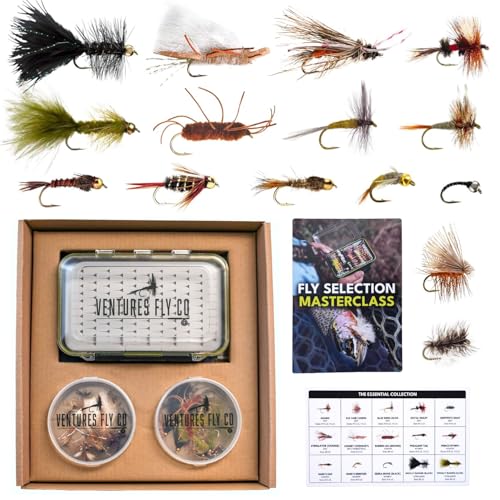
The Ventures Fly Co. 40 Premium Hand Tied Fly Fishing Flies Assortment is the best premium starter set in this guide because it gives the same tying, the same pattern family, and the same identification cards as the 122-fly set in a box that fits a vest pocket. The set holds 40 premium flies in 15 patterns, covering dry flies, wet flies, nymphs, streamers, woolly buggers, and terrestrials for trout and bass, and the hook sizes run from 8 to 18, which covers large streamers at one end and small dries at the other. One fly box is included, so the set arrives ready to fish, and the flies are hand tied by professionals with quality materials, which shows in clean thread heads and hackle that holds its shape through casting.
The 40-fly set suits the angler who wants premium flies without a large box. A beginner who is learning the water benefits from 15 patterns instead of 48, because the choice is simpler and each pattern gets fished enough to learn. An experienced angler who already owns a box of nymphs benefits from a compact set of dries, streamers, and terrestrials that fills the gaps without duplicating the whole library. The hook size range is the quiet strength of this set: size 8 streamers and woolly buggers for bass and large trout, size 12 and 14 dries and nymphs for most trout water, and size 16 and 18 dries for clear, slow water where the fish inspect the fly. The fly box keeps the set sorted, and the identification cards name each pattern, so the angler can note which patterns worked and restock them by name.
The 40-fly set has fewer duplicates than the Bassdash kit in this guide, so losing the working pattern of the day hurts more, and an angler who fishes snaggy water should carry a second set or restock the working patterns. The single box holds the whole set, which is convenient on the walk but means the box is the only storage, and a box dropped in the river takes the whole set with it. The set is a premium set, so the angler who fishes rough water and loses flies by the dozen should look at the Bassdash kit for its duplicates and its lower count of patterns per fly.
Specs
- Fly count: 40 premium flies
- Pattern count: 15 patterns
- Fly types: dry, wet, nymph, streamer, woolly bugger, terrestrial
- Hook sizes: 8 to 18
- Target species: trout, bass, panfish
- Box: one fly box included
- Tying: hand tied, quality hooks and feathers
3. Bassdash Fly Fishing Assorted Flies Kit — Best Variety Fly Kit

The Bassdash Fly Fishing Assorted Flies Kit is the best variety fly kit in this guide because it puts 64 flies in 16 patterns in a single magnetic box, with about four flies of each pattern, so the working pattern survives the morning. The kit covers mayfly dries, streamers, leeches, wet flies, terrestrials, miscellaneous dries, and caddisfly dries in assorted sizes and colors, which is a mix that fishes a trout stream, a bass pond, and a panfish lake without a second box. The flies are tied on high-carbon steel hooks with a spear point, and the hook sizes run from 4 to 12, with streamers and leeches on the larger hooks and dries, nymphs, and wet flies on the smaller hooks. The magnetic fly box is made from ABS plastic with a two-point magnetic closure, and the box measures 3.94×2.76×1.18 inches, which slides into a vest pocket without bulk.
The duplicate count is what separates this kit from the others in this guide. Four flies of each pattern means the angler can lose a fly to a branch, break one off on a rock, and still tie on the same pattern for the third cast, which matters when the hatch is on and the fish are taking one pattern. The materials across the kit are broad: dubbing, marabou, hackle feather, wire ribbing, foam, and hair substitute, with brass-tone metal beads on the bead-head flies for weight and flash. The leech patterns add a still-water option that the other sets in this guide do not emphasize, and leeches catch bass, panfish, and trout in ponds where insect hatches are thin. The magnetic closure opens and closes with one hand, even with cold hands, which matters when the angler is changing flies in a rising hatch and the fish are still feeding.
The Bassdash kit includes no pattern labels and no identification guide, so the beginner cannot name the pattern in the hand without learning it first, and the angler who wants to restock by name should photograph the patterns or keep the Ventures identification cards from another set as a reference. The magnetic closure is light, and the box should be checked for a firm latch before it goes in a pocket, because a box that opens in a vest spills flies. The hook sizes run large at the top end, with size 4 streamers that suit bass water, so the angler who fishes only small trout streams will find the smallest hooks here are larger than the tiny midges that selective trout demand.
Specs
- Fly count: 64 flies
- Pattern count: 16 patterns, about 4 flies per pattern
- Fly types: mayfly dry, streamer, leech, wet, terrestrial, caddisfly dry
- Hook material: high-carbon steel, spear point
- Hook sizes: 4 to 12
- Box: ABS plastic magnetic fly box, two-point magnetic closure
- Box dimensions: 3.94×2.76×1.18 inches
- Body materials: dubbing, marabou, hackle feather, wire ribbing, foam, hair substitute
4. Fishing On The Fly 32 Essential Flies for Trout Kit — Best Starter Fly Set

The Fishing On The Fly 32 Essential Flies for Trout Kit is the best starter fly set in this guide because it is built around 32 essential, time-tested patterns instead of a large count of unfamiliar ones. The kit holds 32 premium hand-tied flies in a waterproof fly box, covering dry flies, nymphs, and streamers for trout, salmon, bass, and panfish, and every pattern in the box is one that has caught fish for years, which is why the maker calls them essential rather than experimental. The flies are hand tied, and the set is aimed at the angler who wants to start fly fishing with a box that works on the first trip, without studying entomology first.
The 32-fly count is the right size for a starter set, because it is large enough to cover the water column and small enough to learn. A dry fly for the surface, a nymph for the drift, and a streamer for the chase are the three presentations a beginner needs, and this kit gives all three in patterns that are proven rather than fashionable. The waterproof fly box keeps the hooks dry between trips, which matters for a beginner whose box rides in a vest through rain and spray, and the compact size fits a vest pocket or a small pack without taking the space of a tackle tray. The species range is broad: trout first, but salmon, bass, and panfish as well, so the same box fishes a mountain stream in the morning and a farm pond in the afternoon.
The 32-fly set is the smallest count in this guide, so it has the fewest duplicates, and losing the working pattern of the day leaves the angler without a spare of that pattern. The set covers dry flies, nymphs, and streamers, but it does not emphasize wet flies or terrestrials, so the angler who fishes summer bank water with grasshoppers should add a terrestrial pattern from another set. The pattern list is not published in the listing data with the same detail as the larger sets, so the angler who wants to restock by name should note the patterns as they are fished. For the beginner who wants a small, proven box that fishes on the first trip, the 32-fly set is the right pick, because it holds the essential patterns and nothing that distracts from them.
Specs
- Fly count: 32 flies
- Pattern focus: essential, time-tested patterns
- Fly types: dry, nymph, streamer
- Target species: trout, salmon, bass, panfish
- Box: waterproof fly box included
- Tying: premium hand tied
5. Ansnbo 36 pcs Fly Fishing Flies Kit — Best Compact Fly Kit

The Ansnbo 36 pcs Fly Fishing Flies Kit is the best compact fly kit in this guide because it packs 36 hand-tied flies in 18 patterns into a waterproof box that weighs 1.6 ounces and measures 4.1×2.9×0.9 inches, which is the lightest and smallest package here. The kit covers dry flies, wet flies, nymphs, and streamers in hook sizes 8 to 16, with five hook sizes across the set, and the patterns include Adams and Elk Hair Caddis, two dry flies that have caught trout on every continent where trout swim, along with green woolly buggers for bass and panfish. The flies are hand tied by fly fishing professionals with quality materials, and the box is made from ABS plastic with a silicone seal, so the flies stay dry even when the box is dropped in shallow water or carried in a wet vest.
The compact size is the strength of this kit, because a fly box that fits a vest pocket gets carried, and a fly box that does not gets left in the truck. At 1.6 ounces, the Ansnbo box adds almost no weight to a vest, and the palm-sized shape fits a shirt pocket, a wader pocket, or a small pack. The 18 patterns across 36 flies give two flies of most patterns, which is enough to learn the range without carrying a large library, and the five hook sizes from 8 to 16 cover the core trout and bass range, from a size 8 streamer to a size 16 dry fly. The silicone seal is the feature that separates this box from the magnetic box in this guide, because it keeps water out even when the box is submerged, and a box that has been dropped in the river comes back with dry flies instead of rusted hooks.
The Ansnbo kit has fewer flies than the Bassdash kit and fewer patterns than the Ventures 122-fly set, so the angler who fishes a hatch that needs a specific pattern may not find it here, and the two-per-pattern count means a lost fly leaves only one spare. The flies are solid working flies rather than premium-grade patterns, so the angler who ties flies or buys single premium patterns will notice the difference in finish, though the patterns themselves are proven. The box is small, which is a strength on the walk and a limit on the water, because a large streamer will not fit a compartment sized for a dry fly. For the angler who wants a light, waterproof box that covers the core patterns for trout and bass in one pocket, the Ansnbo kit is the right pick, because it carries the flies that matter without the weight of a collection.
Specs
- Fly count: 36 flies
- Pattern count: 18 popular patterns
- Fly types: dry, wet, nymph, streamer
- Hook sizes: 8, 10, 12, 14, 16
- Hook style: spear point
- Target species: trout, bass
- Box: waterproof ABS plastic, silicone seal
- Box dimensions: 4.1×2.9×0.9 inches
- Weight: 1.6 ounces
- Tying: hand tied by fly fishing professionals
Care and Storage After the Trip
A fly does not clean itself, and the routine after the trip matters more than the fly. Take the box out of the vest as soon as the trip ends, open it, and let the flies dry before the box is closed again, because a wet fly in a closed box rusts its hook and mats its hackle. A fly that has been fished should be dried with a few false casts on the water before it goes back in the box, and a fly that has been chewed by a fish should be checked for a bent point and a loose thread head before it is stored. A fly with a bent hook should be replaced from the box rather than straightened, because a straightened hook is weaker than a new one, and a fly with unraveling thread should be retired, because it will come apart on the next fish.
Check the box on the same routine. Look at the foam or the slits that hold the hooks, because a slit that has been widened by a large hook will not hold a small fly, and a foam insert that is torn will let flies slide and tangle. Check the seal on a waterproof box, such as the Ansnbo box in this guide, for grit in the silicone, because a grain of sand breaks the seal and lets water in. Check the magnetic closure on a box such as the Bassdash box for a firm latch, because a weak magnet lets the box open in a pocket. Wipe the box dry before it goes back in the vest, and store it open in a ventilated place between trips, not sealed in a damp tackle bag.
Restock the box by pattern, not by count, because a box with 64 flies and no Adams is worse than a box with 20 flies and the pattern that is hatching. Note which patterns were fished, which were lost, and which caught fish, and replace those first. The identification cards in the Ventures sets in this guide make that restocking easy, because the angler can name the pattern that worked. Keep a small supply of the working patterns in a separate compartment, so a lost fly on the water is replaced from the box instead of ending the pattern for the day.
Safety and Checks Before You Order
Check the hook size before ordering, because a fly that is too large for the water will spook selective fish, and a fly that is too small will not hold a strong fish. The Ventures 40-fly set in this guide lists hook sizes 8 to 18, the Ansnbo kit lists sizes 8 to 16, and the Bassdash kit lists sizes 4 to 12, so check the size range against the fish before buying. A small trout stream needs the small end of the range, a bass pond needs the large end, and a mixed trip needs both. Read the specification block for the set being bought, not the specification block for a similar-looking set from the same brand, because fly count, pattern count, and hook sizes change between sets.
Check the box before the first trip, because a box that does not close will spill flies on the bank, and a box that is not waterproof will rust hooks after a wet day. A magnetic closure should latch firmly, a silicone seal should be free of grit, and a compartment box should hold the largest fly in the set without crushing it. Check the flies themselves in the hand before they go on the leader, because a fly with varnish clogging the hook eye will not take a tippet, and a fly with a bent point will not hook cleanly. Barbless hooks, where the set offers them, are the fish-friendlier choice for catch and release, and they come out of a fish faster than a barbed hook.
The fly sets in this guide are hand-tied hook assortments, and none of them falls under the recalls scoped for this article. The Rapala rechargeable fillet knife recall covers rechargeable fillet knives only, not flies or fly boxes. The Shimano Stella FJ reel recall from 2018 covers only that reel model, not fly assortments. The Lil Anglers children’s rod combo recall from April 2023 covers only children’s rod combos, not flies. Check the product name and the model on the listing before ordering, because a similarly named product from the same brand may be a different item with a different recall status.
Frequently Asked Questions
How many flies do I need in a starter set?
A starter set of 32 to 40 flies in 15 to 18 patterns covers the water column for trout and bass without overwhelming the beginner, and the Fishing On The Fly 32-fly set and the Ansnbo 36-fly set in this guide are both built for that range. A set of 64 flies with duplicates, such as the Bassdash kit, suits an angler who fishes snaggy water and loses flies, because the working pattern stays in the box after a loss. A set of 122 flies, such as the Ventures set, suits an angler who fishes many kinds of water and wants the pattern for each situation in one purchase.
What is the difference between a dry fly, a nymph, and a streamer?
A dry fly floats on the surface and imitates an insect sitting on the water, and it suits rising fish in a hatch. A nymph sinks below the surface and imitates the underwater stage of an insect, and it suits fish holding near the bottom, where trout spend most of their feeding time. A streamer imitates a baitfish or a leech and moves through the water on the retrieve, and it suits aggressive fish such as bass and large trout that chase a moving target. A good set carries all three, because the fish change depth through the day.
Do I need a waterproof fly box?
A waterproof fly box is worth having when the box rides in a wader pocket, a vest in the rain, or a kayak hatch, because wet hooks rust and wet hackle mats. The Ansnbo box in this guide uses a silicone seal that keeps water out even when the box is dropped in shallow water, and the Fishing On The Fly box is waterproof as well. A magnetic box, such as the Bassdash box, opens fast with cold hands but should be checked for a firm latch. Dry the box open after a wet trip, whatever the seal, so the hooks dry before they rust.
How do I know which fly pattern to use?
Read the water first: rising fish mean a dry fly that matches the insect on the surface, no rise with fish holding deep means a nymph under an indicator, and aggressive chases near weed edges mean a streamer such as a woolly bugger. The fly identification cards in the Ventures sets in this guide name each pattern, which helps the beginner match the fly to the hatch. When nothing is rising and no pattern is working, change depth first, then size, then pattern, because a fly at the wrong depth will not catch fish no matter how well it matches the hatch.
Conclusion
The best fly fishing flies are the ones that match the water, the fish, and the way the angler loses them. The Ventures Fly Co. 122 Premium Hand Tied Fly Fishing Flies Assortment is the best all-around pick, because its 122 flies in 48 patterns cover the water column for trout and bass, and its two boxes and identification cards keep the set sorted and teachable. The Ventures Fly Co. 40 Premium Hand Tied Fly Fishing Flies Assortment is the best premium starter pick, because it gives the same tying and pattern family in a single vest-sized box with hook sizes 8 to 18. The Bassdash Fly Fishing Assorted Flies Kit is the best variety pick, because its 64 flies in 16 patterns with about four of each pattern keep the working fly in the box after a loss, and its magnetic box opens fast with cold hands. The Fishing On The Fly 32 Essential Flies for Trout Kit is the best starter pick, because its 32 proven patterns cover dry flies, nymphs, and streamers for trout, salmon, bass, and panfish in a waterproof box. The Ansnbo 36 pcs Fly Fishing Flies Kit is the best compact pick, because its 36 flies in 18 patterns ride in a waterproof box that weighs 1.6 ounces and fits a vest pocket. Check the fly count, the pattern mix, the hook sizes, and the box before ordering.
More from Amazon
Programs that pair well with the guide above. Offers and eligibility are set by Amazon and may change.
Free shipping on eligible items, Prime Video and more. Eligible new members can start with a free trial.
Start a Prime free trialA Prime membership for ages 18-24 with a trial period. Eligibility is set by Amazon.
See Prime for Young AdultsAudiobooks and podcasts to listen to on the go. Eligible new members can start with a free trial.
Try Audible freeAd-free music streaming. Eligible new subscribers can start with a free trial.
Try Music Unlimited freeAs an Amazon Associate we earn from qualifying purchases.
Write Your Review
No reviews yet. Be the first to share your experience!