

Key takeaways
- Shoulders: armor should cover the joint and remain centered when your arms are extended toward the handlebars.
- Elbows: the protector should stay over the elbow while your arm is bent, not slide toward the forearm.
- Back: a longer protector is generally more useful than a small pad that covers only the upper spine.
- Chest: optional divided protectors can add coverage, but they should not restrict breathing or steering.
- Hips: a motorcycle jacket cannot protect them; pair it with riding trousers when coverage matters.
The best motorcycle jackets in 2026 are the ones that match your riding conditions: leather for abrasion resistance and a close fit, textile for weather versatility, and mesh for hot-weather airflow—provided the jacket has properly positioned armor and fits snugly enough to stay in place.
Our top picks
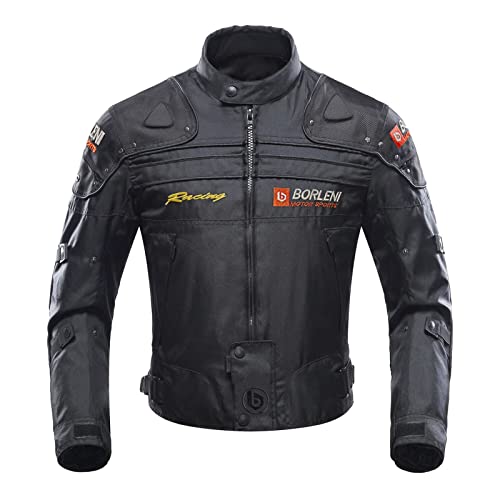


As an Amazon Associate we earn from qualifying purchases at no extra cost to you. Ratings are shown as listed on Amazon.
Quick picks by riding situation
| Rider or use case | Best jacket type | What to prioritize | Typical market range |
|---|---|---|---|
| Daily commuting in changing weather | Waterproof textile, 2- or 3-layer | Removable liner, waterproof membrane, reflective panels, adjustable waist | $180–$450 |
| Hot-weather urban riding | Certified mesh textile | Large impact-resistant mesh areas, CE-rated armor, secure cuffs | $130–$300 |
| Sport riding and short dry trips | Leather sport jacket | 1.0–1.3 mm leather, shoulder and elbow armor, back protector pocket, connection zipper | $300–$900 |
| Long-distance touring | Adventure or touring textile | Ventilation, waterproofing, multiple adjustment points, long tail, cargo storage | $300–$900+ |
| Occasional rider on a limited budget | All-season textile | Removable thermal liner, basic rain protection, replaceable armor | $150–$300 |
Leather versus textile: which construction is better?
Leather jackets
Leather remains the strongest choice when dry-road abrasion resistance and a close, stable fit matter most. Motorcycle-specific cowhide or kangaroo leather is commonly about 1.0–1.3 mm thick, substantially different from thin fashion leather. A good leather jacket usually has fewer loose layers, less flapping at speed, and a natural fit for sport riding.
The trade-off is limited weather flexibility. Untreated leather can absorb water, become heavy, and dry slowly. Ventilation is usually modest unless the jacket has perforated panels, and a heavily perforated jacket is not a good substitute for a waterproof shell. Leather also needs more ownership care: clean road grime promptly, use a product intended for motorcycle leather, and avoid household oils that can damage the finish or soften the material unpredictably.
Examples of established leather product families include the Dainese Racing 4 Leather Jacket and Alpinestars GP Plus R v3 Leather Jacket. Check the exact revision and certification label, because armor packages and construction can change between model years.
Textile jackets
Textile is the more versatile choice for commuting, touring, and mixed conditions. Polyester, nylon, and high-tenacity woven fabrics can be combined with waterproof membranes, thermal liners, stretch panels, and large vents. Textile jackets are also easier to design with long cuts, external pockets, and adjustable expansion points.
They are not automatically cooler or safer than leather. A waterproof textile jacket may become warm in summer, while a lightweight mesh jacket can provide excellent airflow but less coverage against rain and cold. Look for a jacket certified as motorcycle protective clothing under EN 17092, and consider its class: higher classes generally indicate more demanding garment testing, but comfort and actual fit still matter.
Well-known textile examples include the REV’IT! Sand 4 H2O, Dainese Carve Master 3 Gore-Tex, Klim Induction Pro, and Alpinestars Andes v3 Drystar. These represent different priorities rather than one universal winner: adventure versatility, waterproof touring, hot-weather airflow, and budget-oriented all-season use.
Armor coverage matters more than pocket count
At minimum, look for included armor at the shoulders and elbows, with a properly sized back-protector pocket. A back pocket alone is not back armor. Some jackets include a basic foam insert; others accept a separate CE-rated protector. If a jacket has chest pockets, confirm whether compatible chest armor is available before assuming the area is protected.
- Shoulders: armor should cover the joint and remain centered when your arms are extended toward the handlebars.
- Elbows: the protector should stay over the elbow while your arm is bent, not slide toward the forearm.
- Back: a longer protector is generally more useful than a small pad that covers only the upper spine.
- Chest: optional divided protectors can add coverage, but they should not restrict breathing or steering.
- Hips: a motorcycle jacket cannot protect them; pair it with riding trousers when coverage matters.
Armor should be CE marked and should fit the jacket’s retention pockets. A loose protector can move away from the impact area, while an excessively stiff insert can create pressure points that make you remove the jacket on short rides—the exact trips where protective equipment is still valuable.
Weather protection and ventilation: choose the compromise deliberately
A waterproof membrane keeps rain out, but it does not guarantee comfort in warm weather. A useful touring jacket should have direct-to-body vents at the chest or shoulders, exhaust vents at the back, and zippers that can be operated with gloves. Waterproof zippers and storm flaps improve rain resistance but can reduce airflow and add bulk.
Removable liners are practical but not magic. Removing a thermal liner creates room for air, yet a waterproof membrane may still feel hot in humid weather. For consistently hot climates, a dedicated mesh jacket is often more comfortable than an all-season shell with its liner removed.
Mesh has its own compromise: open fabric cannot provide the same wind and rain barrier as a solid shell. If you ride through variable weather, carry a compact rain shell designed to fit over the jacket, or choose a hybrid jacket with mesh zones and a removable waterproof layer.
Fit: the safety feature riders most often compromise
Try a jacket in the posture you use on the motorcycle, not standing upright in a store. Zip it fully, sit with your elbows bent, and check that the shoulder and elbow armor stays in place. The cuffs should close over or under your gloves without leaving a large opening.
- The torso should be close enough that armor cannot rotate, but not so tight that it restricts a deep breath.
- The sleeves should cover the wrists when your arms reach the bars.
- The rear hem should overlap your riding trousers in a forward-leaning position.
- Adjustable waist and upper-arm straps are preferable to relying on a loose jacket that fits everywhere.
- Allow space for a base layer, but do not size up so far that the armor hangs below the joints.
Measure your chest while wearing the layer you normally ride in, then compare that measurement with the manufacturer’s garment chart. A jacket labeled “large” may differ substantially between brands. If your chest and waist fall into different sizes, prioritize armor position and look for waist adjusters or a cut designed for your shape.
Touring versus commuting
For commuting
Commuters usually benefit from a simpler textile jacket with a waterproof membrane, reflective details, easy pocket access, and a liner that can be removed without dismantling the garment. A shorter cut is convenient on and off the bike, but it should still overlap your trousers when seated. Avoid choosing solely by the number of pockets; a secure inner pocket for keys and a glove-friendly main closure are more useful than a dozen shallow compartments.
For touring
Touring jackets justify their extra bulk with longer coverage, stronger weather sealing, better vent routing, and more adjustment. Look for a tall collar, waterproof pocket construction, generous sleeve movement, and a connection zipper for riding trousers. Multiple liners can be valuable on a long trip, but test the jacket with every layer installed: shoulder armor can shift when the thermal liner is removed or when a mid-layer is added.
Ownership costs and maintenance
A $250 textile jacket used twice a week for three years costs about $0.80 per wearing before maintenance: 2 uses × 52 weeks × 3 years equals 312 uses, and $250 divided by 312 is approximately $0.80. A more expensive $600 touring jacket used four times weekly for the same period costs about $0.96 per wearing. Frequent use can make better ventilation, waterproofing, and comfort worth more than a lower purchase price.
The parts that commonly wear first are zipper sliders, hook-and-loop cuff tabs, pocket openings, liner attachment points, and the fabric around the collar. Keep zippers free of grit, close hook-and-loop tabs before washing, remove armor if the care label permits, and wash according to the manufacturer’s instructions. Do not machine-dry waterproof membranes or leather unless specifically permitted. Reapply leather conditioner sparingly, and inspect seams and armor after any crash; replace the garment if its protective structure or abrasion panels have been compromised.
Bottom line
Choose a leather jacket for dry sport riding and maximum abrasion-focused construction, a waterproof textile jacket for commuting and touring, and a certified mesh jacket for sustained heat. Whichever category you choose, prioritize correctly positioned CE-rated armor, a stable riding fit, usable ventilation, and coverage that remains intact when seated on the motorcycle. The best motorcycle jackets are not the most heavily featured—they are the ones you will wear correctly on every ride.



Write Your Review
No reviews yet. Be the first to share your experience!