

Key takeaways
- Hammer drill/driver: useful for wood, metal, and occasional masonry drilling. A current high-output M18 FUEL drill can deliver roughly 1,200 in-lb of peak torque, though real drilling performance depends on the bit, material, and speed setting.
- Impact driver: faster for structural screws and repeated fastening, with substantially less wrist twist than a drill.
- Reciprocating saw: the most versatile demolition tool, but blades are a major part of ownership cost.
- 6-1/2-inch circular saw: the kit’s production tool for framing lumber, sheet goods, and trim stock. Typical brushless models run around 5,000–5,800 rpm.
- Work light: useful, but not equivalent in value to a multi-tool or grinder if you already have adequate lighting.
Best Milwaukee Combo Kits: Top Tool Sets Compared
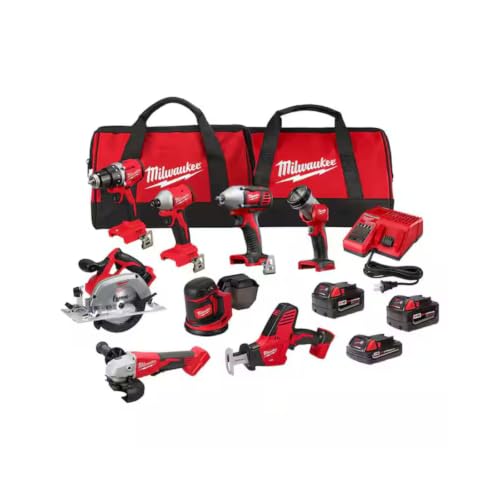
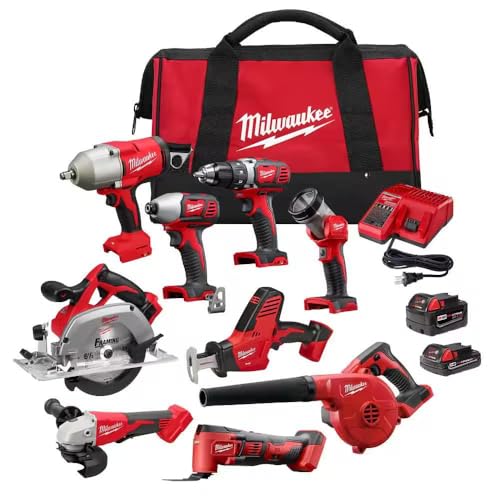
The best Milwaukee combo kit for most trades is an M18 FUEL set with a drill/driver, impact driver, reciprocating saw, circular saw, two 5.0Ah batteries, and a charger; choose an M12 FUEL kit for compact repair work, or add a larger 8.0Ah battery when cutting and grinding matter more than weight.
Milwaukee combo kits are easiest to compare by platform first, then by motor type, tool count, battery size, and the work each tool can actually cover. A six-tool kit is not automatically better than a five-tool kit: an included light or multi-tool may be useful, while a bare tool you already own simply increases the price.
Our top picks


As an Amazon Associate we earn from qualifying purchases at no extra cost to you. Ratings are shown as listed on Amazon.
Quick comparison of the main Milwaukee kit types
| Kit type | Typical tools | Battery configuration | Best for | Typical market range |
|---|---|---|---|---|
| M12 FUEL compact kit | Drill/driver, impact driver, sometimes multi-tool or installation driver | Two 2.0Ah or 4.0Ah batteries; 12V class | Service work, cabinetry, electrical and light maintenance | $250–$500 |
| M18 brushed starter kit | Drill, impact driver, reciprocating saw, circular saw or light | Two compact or 5.0Ah batteries; 18V class | Occasional home repair and light construction | $350–$650 |
| M18 FUEL five-tool kit | Drill/driver, impact driver, Sawzall reciprocating saw, circular saw and light | Two 5.0Ah batteries and charger are common | Framing, remodeling, general construction and serious DIY | $600–$1,000 |
| M18 FUEL larger kit | Five core tools plus multi-tool, grinder, vacuum or additional saw | 5.0Ah, 6.0Ah or 8.0Ah batteries, depending on kit | Contractors who need several tools immediately | $900–$1,500+ |
Prices vary substantially with promotions and whether a kit includes a hard case, soft bag, or extra battery. Compare the contents rather than relying on the tool count printed on the box.
Best overall: an M18 FUEL five-tool combo kit
An M18 FUEL five-tool set is the strongest all-round choice for a working carpenter, remodeler, or property maintenance professional. The usual combination covers drilling, fastening, demolition, cross-cutting, and job-site illumination without paying for highly specialized tools.
- Hammer drill/driver: useful for wood, metal, and occasional masonry drilling. A current high-output M18 FUEL drill can deliver roughly 1,200 in-lb of peak torque, though real drilling performance depends on the bit, material, and speed setting.
- Impact driver: faster for structural screws and repeated fastening, with substantially less wrist twist than a drill.
- Reciprocating saw: the most versatile demolition tool, but blades are a major part of ownership cost.
- 6-1/2-inch circular saw: the kit’s production tool for framing lumber, sheet goods, and trim stock. Typical brushless models run around 5,000–5,800 rpm.
- Work light: useful, but not equivalent in value to a multi-tool or grinder if you already have adequate lighting.
Look for two 5.0Ah batteries rather than two small compact packs. An 18V, 5.0Ah battery stores approximately 90 watt-hours before conversion losses. In mixed work, that usually provides enough energy for a productive shift when one battery is charging while the other is in use. Heavy sawing, long masonry drilling, or grinding will reduce runtime quickly.
Best compact choice: M12 FUEL combo kits
M12 FUEL kits are the better decision for technicians who spend more time fastening, drilling small holes, installing hardware, and working in cabinets or mechanical spaces than cutting framing lumber. The tools are substantially smaller than M18 models, making them easier to carry up ladders and use overhead.
A compact 12V-class drill and impact driver can handle cabinet screws, electrical fittings, small anchors, and general service work. The limitation is not usually build quality; it is sustained power. Large hole saws, long structural screws, thick steel, and demolition work are better assigned to M18.
Choose an M12 kit when:
- Most fasteners are small or medium-sized.
- You value low weight and access over maximum speed.
- Your work involves service calls, cabinetry, trim, or installations.
- You already own larger cutting tools and need a portable secondary platform.
Brushless versus brushed: when the upgrade pays
Brushless motors generally offer better efficiency, lower routine wear, and improved electronic control. Their advantages become more noticeable in high-use tools such as impact drivers, reciprocating saws, grinders, and circular saws. A brushless tool can often complete more work from the same battery, but runtime is affected by material, blade sharpness, pressure, and battery age.
Brushed kits can still make sense for occasional users. If a drill is used for a few household projects each year, the lower purchase price may outweigh efficiency gains. For daily trade use, however, a brushless kit is usually the more sensible ownership choice because motor brushes are consumable parts and high-load tools benefit most from the efficient design.
Decision matrix: match the kit to the job
| Your situation | Recommended direction | Why | Avoid paying for |
|---|---|---|---|
| First power-tool purchase, occasional repairs | M18 entry-level kit or small M18 FUEL kit | Provides a useful base without committing to specialty tools | Large batteries and multiple saws |
| Cabinetry, electrical or HVAC service | M12 FUEL drill/impact combination | Lower weight and better access in confined spaces | Heavy demolition tools |
| Framing or remodeling several days per week | M18 FUEL five-tool kit | Core tools cover drilling, fastening and cutting | A kit with duplicate drills |
| Deck building, roofing or demolition | M18 FUEL kit with 5.0Ah or larger batteries | Higher sustained output and better cutting endurance | Only compact 2.0Ah batteries |
| Limited storage or frequent travel | Compact M12 kit or a small M18 kit with a structured bag | Less bulk and easier transport | Oversized multi-tool bundles |
Battery capacity matters more than the printed tool count
Battery size is a practical trade-off between runtime and handling. A 2.0Ah M18 battery stores about 36 watt-hours, a 5.0Ah pack about 90 watt-hours, and an 8.0Ah pack about 144 watt-hours. The larger pack can keep a circular saw or grinder working longer, but it also adds noticeable weight and may make a compact drill less comfortable.
For example, suppose a circular saw averages 500 watts while cutting and is actively loaded for 8 minutes during a work period. That consumes about 67 watt-hours after allowing for approximate system losses: 500 × 0.133 hours ÷ 0.8. A 5.0Ah pack may therefore cover that cutting workload, but not necessarily a full day of continuous cutting. This is why two medium batteries are often more useful than one very large battery: one can cool and charge while the other works.
Accessories, cases and what the kit may omit
Combo kits commonly include a charger, contractor bag, belt clip, side handle, and basic blade or bit accessories. They rarely provide the complete consumable selection a trade requires. Budget separately for impact-rated driver bits, drill bits matched to the material, circular-saw blades, reciprocating-saw blades, and appropriate grinder discs.
A soft bag is lighter and stores oddly shaped tools well, but tools can become mixed together and the bag offers limited impact protection. A hard case protects equipment and makes inventory easier, although it takes more room and may not fit tools added later. For mobile service work, a structured bag with separate battery pockets is often the best compromise.
Durability and ownership realities
The first parts to wear are usually consumables and interfaces rather than the motor: saw blades become dull, impact bits twist or chip, drill chucks collect dust, and battery contacts accumulate grime. Do not use a dull blade to compensate with extra pressure; it increases heat, slows the cut, and drains the battery.
- Blow dust from vents and battery contacts with clean, dry air; avoid forcing debris deeper into the tool.
- Keep batteries out of direct heat and allow a hot pack to cool before charging.
- Use the correct speed and clutch setting instead of running every task at maximum power.
- Inspect reciprocating-saw blade clamps and circular-saw guards for packed debris.
- Do not store batteries fully discharged for long periods.
A useful value calculation is cost per core tool. A $750 five-tool kit costs $150 per included tool before assigning value to the batteries and charger. If you would buy four of those tools separately, the kit is attractive; if two will remain unused, a smaller kit plus individual bare tools may cost less overall.
Final buying recommendation
Choose an M18 FUEL five-tool kit with two 5.0Ah batteries for the broadest trade coverage and the best balance of power, runtime, and value. Choose M12 FUEL when compact size and low weight dominate your work. Choose a larger M18 kit only when you will use the extra grinder, multi-tool, vacuum, or saw regularly. Before purchasing, list the jobs you perform most often, count the batteries you already own, and price the required blades and bits; that comparison is more reliable than selecting the kit with the largest number on the box.



Write Your Review
No reviews yet. Be the first to share your experience!