

Key takeaways
- Angler: 190 lb
- Electric motor and controls: 25 lb
- Battery: 55 lb
- Tackle, anchor, safety equipment, and drinks: 70 lb
- Total operating load: 340 lb
The best inflatable fishing boats for most anglers are a purpose-built drop-stitch or reinforced-PVC boat with at least 400 pounds of usable capacity, multiple air chambers, fishing rod holders, and a transom or motor-mount system if you plan to use an electric motor.
Our top picks
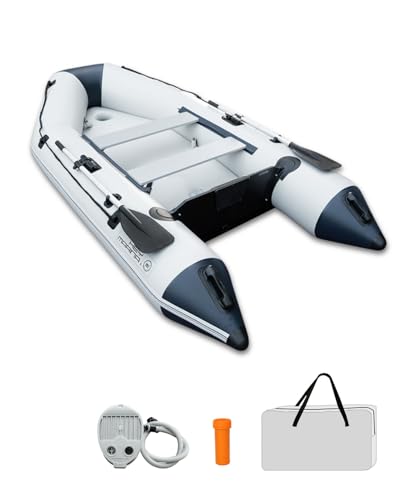
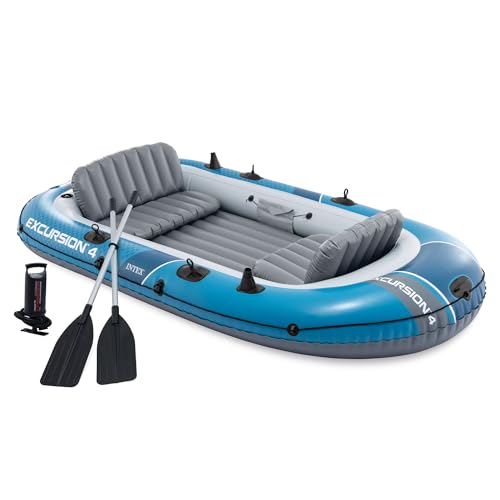

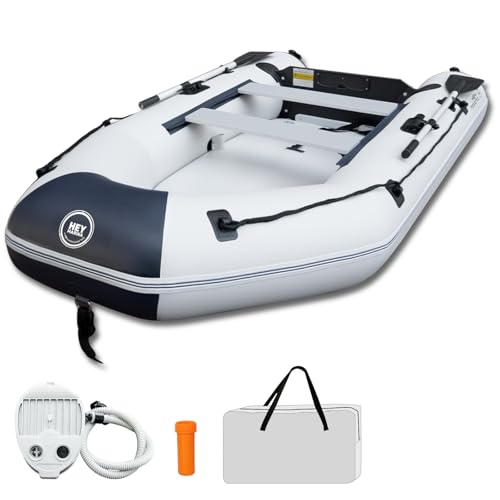
As an Amazon Associate we earn from qualifying purchases at no extra cost to you. Ratings are shown as listed on Amazon.
Best inflatable fishing boats by situation
| Angler and use case | Best boat type or example | Why it fits | Main compromise |
|---|---|---|---|
| Solo angler with limited storage | Frameless pontoon such as the Sea Eagle 285 | Light, compact, elevated seat, and suitable for calm lakes and slow rivers | Less room for camping gear and less protection from waves |
| Two anglers on sheltered water | 12- to 13-foot reinforced-PVC sport boat such as the Intex Excursion Pro K2 | Good carrying capacity, wide interior, and reasonable packed weight | Accessory fittings and motor compatibility are more limited than on a dedicated fishing boat |
| Solo bass or panfish angler wanting fishing-specific features | Purpose-built fishing dinghy such as the Sea Eagle Stealth Stalker 10 | High load rating, swivel seating, rod holders, and a motor-ready transom | Heavier and bulkier to transport than a basic inflatable |
| Frequent user who values rigidity | Drop-stitch floor boat | Stiffer standing platform, improved trim, and better support when casting | Usually costs more and requires careful inflation to the specified pressure |
Head-to-head comparison
The figures below are representative published specifications for commonly available models and configurations. Confirm the exact 2026 specification before buying, because included seats, oars, pumps, and motor mounts can change by package.
| Boat | Hull material | Approx. length | Rated capacity | Boat weight | Packed or storage consideration | Motor compatibility | Fishing features |
|---|---|---|---|---|---|---|---|
| Sea Eagle 285 Frameless Pontoon | 30 mil PVC with separate pontoon chambers | 9 ft | 450 lb | About 42 lb | Compact enough for a car trunk; frame-free design | Optional motor-mount accessories; best with a small electric motor | Elevated seat, stripping apron, storage, and fishing-oriented layout |
| Intex Excursion Pro K2 | Super-tough laminated PVC with high-pressure drop-stitch floor | 12 ft 7 in | Approximately 880 lb | About 44 lb | Long package; rolls for storage but occupies more floor space | Compatible with an optional motor-mount system and small electric motor | Rod holders, adjustable seats, gear storage, and removable skegs |
| Sea Eagle Stealth Stalker 10 | Heavy-duty reinforced PVC | 10 ft | Approximately 1,200 lb | About 78 lb | Large carry bag and more components; usually a two-person lift | Built-in transom for a small outboard or electric motor, within the maker’s limits | Rod holders, swivel seats, fish-box space, and motor-ready stern |
Hull material: what you are actually choosing
Standard reinforced PVC
PVC is common because it is relatively affordable, waterproof, and easy to patch. A multi-layer or reinforced PVC hull is preferable to thin recreational pool-boat material. Look for abrasion protection on the underside and seams that are welded or otherwise reinforced. PVC becomes less flexible in cold weather and can degrade if stored inflated in strong sunlight, so shade and correct storage matter.
Drop-stitch construction
Drop-stitch floors connect the upper and lower surfaces with thousands of internal threads. When inflated to higher pressure, the floor becomes much stiffer than a conventional air floor. This improves standing stability and makes it easier to shift weight while casting, but it does not turn an inflatable boat into a hard-shell bass boat. A drop-stitch floor still needs protection from hooks, knife points, and rough gravel.
Pontoon designs
Frameless pontoon boats put the angler above two inflated tubes. They are often easier to carry than a full dinghy and use less water, making them useful for solo fishing. Their narrow footprint and open cockpit are less suitable for two people, large tackle loads, or exposed water with wind-driven waves.
Capacity and stability: do not spend the entire weight rating
A capacity rating is not a comfortable fishing target. Subtract the angler’s body weight, then account for the motor, battery, fuel if applicable, tackle, anchor, cooler, water, and clothing. For example:
- Angler: 190 lb
- Electric motor and controls: 25 lb
- Battery: 55 lb
- Tackle, anchor, safety equipment, and drinks: 70 lb
- Total operating load: 340 lb
In a boat rated for 400 lb, that leaves only 60 lb of nominal capacity. A boat rated for 600 lb or more gives substantially better freeboard and handling. Keep dense items low and centered, and place the battery near the middle rather than at the stern. Stability comes from beam width, floor stiffness, tube spacing, load distribution, and water conditions—not from capacity alone.
Inflation time and setup reality
A 9- to 10-foot boat with two or three chambers commonly takes about 8 to 15 minutes with a 12-volt or rechargeable high-volume pump. A drop-stitch floor adds roughly 3 to 6 minutes because it needs higher pressure. Hand pumps work, but they make pressure consistency and setup time more dependent on the operator.
- Spread the hull on a clean surface and check that valves are free of grit.
- Inflate the main chambers evenly, stopping below the final pressure while the boat is being positioned.
- Install the floor, seats, motor mount, and accessories.
- Bring each chamber to its specified pressure with a gauge; do not guess by touch.
- Load the boat on level ground and check that the drain plug, oarlocks, and motor hardware are secure.
- Perform a short shoreline leak and steering check before traveling away from the launch.
Air pressure changes with temperature. A boat inflated in cool morning air can become over-pressurized in direct afternoon sun, while a boat inflated on hot pavement may feel soft after entering cold water. Follow the manufacturer’s pressure range and keep the boat out of unnecessary heat during setup.
Motor compatibility and battery planning
Motor compatibility depends on more than whether a mount can be attached. Check the boat’s maximum motor horsepower or thrust, transom design, total load limit, and the mounting hardware’s security. A small electric motor is usually the practical choice for an inflatable fishing boat because it produces little vibration and avoids carrying fuel.
For a rough battery estimate, multiply motor current by the hours you expect to operate. A motor drawing 20 amps for three hours needs about 60 amp-hours in ideal conditions. In practice, reserve capacity for wind, weeds, current, battery age, and the fact that many lead-acid batteries should not be deeply discharged. A 100 amp-hour lithium battery may therefore provide a more usable day than a similarly labeled lead-acid battery, but it costs more and must be compatible with the charger and motor system.
Fishing features worth paying for
- Rod holders: Useful when changing lures or handling a fish, but they should not interfere with paddling or the motor tiller.
- Swivel or adjustable seats: Improve comfort and help distribute weight, especially when a motor is mounted behind the angler.
- Removable skeg: Helps a long inflatable track in a straight line while paddling; protect it when dragging the boat.
- Multiple air chambers: A puncture in one chamber should not eliminate all flotation. Separate floor and tube chambers are particularly valuable.
- Gear attachment points: D-rings and mounting strips are more useful than a crowded molded accessory panel because they allow flexible positioning.
- Self-bailing drain: Helpful in rain or splash, but it may not remove every drop of water when the boat is heavily loaded.
Ownership costs and durability
The hull is not usually the first part to fail. Valve seals, seat fittings, oar hardware, carry handles, adhesive-backed accessories, and the underside exposed to gravel often wear first. Budget for a repair kit, spare valve parts where available, a pressure gauge, and a protective storage bag. Consumables include patch adhesive, cleaning supplies, battery charging equipment, and—on motorized setups—propellers or shear pins.
Rinse off salt, mud, and plant fragments after each trip. Dry the boat completely before rolling it, because trapped moisture encourages odor and mildew. Remove hooks from the cockpit before packing, keep sharp tackle in closed containers, and never drag a loaded inflatable across concrete. Store it loosely rolled in a cool, dry place rather than tightly compressed for months.
Final buying recommendation
Choose a frameless pontoon if portability and solo fishing matter most. Choose a reinforced-PVC sport boat if you need two seats and a moderate price. Choose a purpose-built transom boat if a motor, rod holders, swivel seating, and substantial gear are central to your trips. Whichever design you select, prioritize a realistic load margin, multiple air chambers, a floor that is stiff enough for your fishing style, and a packed size you can actually carry from the vehicle to the water.




Write Your Review
No reviews yet. Be the first to share your experience!