

Key takeaways
- Prefer metal-to-metal threaded joints over purely friction-fit connections for a heavily loaded rack.
- Check crossbars and diagonal supports. They resist side-to-side sway, which is a more common problem than a bar breaking.
- Tighten every fastener after the first load. Tubing can settle slightly, leaving bolts loose after a day or two.
- Install feet or casters evenly. A single uneven foot can make a rack rock and gradually loosen its joints.
- Use caster locks when stationary. A locked wheel improves usability but does not replace a broad, stable base.
Best Clothing Racks for Small Spaces & Storage
The best clothing rack for a small room is usually a narrow, height-adjustable rack with a stated load rating of at least 50 pounds (23 kg), and the right choice depends on whether you need a compact daily wardrobe, extra hanging storage, or a rack that can move between rooms.
Quick picks by situation
| Small-space need | Best rack type or example | Why it fits | Main compromise |
|---|---|---|---|
| Lowest-cost permanent rack | IKEA MULIG | About 39 in wide and 18 in deep, with a simple fixed frame | Less capacity and flexibility than heavier rolling racks |
| Adjustable height in a bedroom | IKEA RIGGA | About 43 in wide, 20 in deep, height-adjustable, and rated up to 77 lb | Its footprint is not the smallest front-to-back |
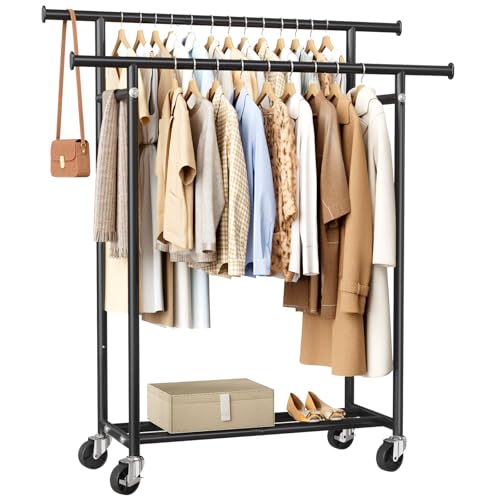
| Frequent moving between rooms | Two-tier rolling garment rack | Usually includes casters, two hanging levels, and 100–200 lb capacity | Wheels and extra bars increase depth and wobble risk |
| Corner or narrow-wall storage | Single-bar adjustable rack | Often 30–36 in wide and roughly 16–19 in deep | Limited room for long garments and heavier loads |
| Heavy seasonal wardrobe | Commercial steel rack | Thicker tubing, locking casters, and commonly 200 lb or more capacity | Costs more and can overwhelm a small room visually |
Head-to-head: the rack specifications that matter
Width is only one part of the fit. A rack that is 36 inches wide may still be inconvenient if its feet extend 24 inches into a walkway. Measure the complete base, including wheels and stabilizing feet, rather than relying only on the hanging-bar width.
Our top picks


As an Amazon Associate we earn from qualifying purchases at no extra cost to you. Ratings are shown as listed on Amazon.
| Rack | Approximate dimensions | Weight capacity | Construction and adjustment | Assembly profile |
|---|---|---|---|---|
| IKEA MULIG | 39 in W × 18 in D × 59 in H | About 44 lb | Powder-coated steel; fixed-height frame | Basic screw assembly; typically under 15 minutes with household tools |
| IKEA RIGGA | 43 in W × 20 in D × 49–69 in H | Up to 77 lb | Steel frame; adjustable hanging height; lower shoe shelf | Simple bolt-and-screw assembly; roughly 15–25 minutes |
| Whitmor adjustable garment rack | Approximately 36–60 in W × 19.5 in D × 42–66 in H | Up to about 90 lb, depending on configuration | Chrome-finished steel; width and height adjustment | Tool-light push-fit or screw assembly; check each joint before loading |
| Honey-Can-Do two-tier rolling rack | Approximately 47 in W × 20 in D × 63.5 in H | Up to about 200 lb on selected models | Steel tubing, two bars, and casters; some models include a shelf | Moderate assembly; usually 20–35 minutes |
| Commercial steel rolling rack | Typically 48–60 in W × 20–24 in D × 60–72 in H | 200–400 lb, depending on tubing and shelf design | Heavier steel, locking wheels, reinforced crossbars | More parts and a longer assembly; a second person can help |
These figures are useful comparisons, but capacities are not interchangeable. A manufacturer may state a total evenly distributed load, while another may specify a per-bar limit. Treat a rack’s advertised maximum as a ceiling, not a target, especially when the rack is on carpet or has narrow feet.
Best choices for different small rooms
For a bedroom with one narrow wall: IKEA MULIG
The MULIG is a sensible choice when the rack will stay in one place and the wardrobe is moderate. Its roughly 18-inch depth is easier to fit beside a dresser or behind a door than deeper commercial racks. The fixed height keeps the design simple, but it also means you should verify clearance for dresses, coats, and garment bags before buying.
Choose it for light to medium clothing loads: shirts, trousers, skirts, and a limited number of jackets. Avoid concentrating all the weight in the center of the bar. Evenly spaced hangers reduce bending and make the rack feel more stable.
For mixed clothing and shoes: IKEA RIGGA
The RIGGA is more versatile because its hanging bar can be adjusted and its lower shelf can hold shoes or storage boxes. The shelf is valuable in a small room: it uses space that would otherwise become dead floor area. Its roughly 20-inch depth is still compact, but measure carefully if the rack will sit in a passage.
This is the better pick when users of different heights share the rack, or when you alternate between short garments and longer coats. Keep the shelf load within its own stated limit; the total rack capacity does not automatically apply to every component.
For movable overflow storage: a two-tier rolling rack
A rolling rack is useful for laundry day, guest clothing, or rotating seasonal items. Two levels can nearly double hanging space without doubling the floor width, but the lower bar may interfere with long coats and dresses. Caster locks are important: unlocked wheels allow the rack to drift when hangers are pulled from the bar.
For a small apartment, select a model with four casters, at least two locking wheels, and a horizontal base that does not narrow sharply at the corners. A narrow frame with tall, heavy clothing can tip more easily than a wider one, even if its published weight capacity looks high.
How much hanging space do you actually need?
Use a practical estimate before choosing capacity. Standard hangers usually consume about 1.5 inches of bar space for thin shirts and 2–2.5 inches for bulky sweaters, jackets, or padded hangers.
For example, 30 everyday garments at an average of 1.75 inches each require:
30 × 1.75 inches = 52.5 inches of bar space.
That means a 36-inch rack will not hold those garments comfortably on one level. You could reduce the load, use a two-tier rack for shorter items, or choose a rack about 48–60 inches wide. Leave several inches empty so hangers can slide; packing the bar tightly makes clothes harder to remove and transfers more force to the center of the rack.
Assembly details that predict stability
- Prefer metal-to-metal threaded joints over purely friction-fit connections for a heavily loaded rack.
- Check crossbars and diagonal supports. They resist side-to-side sway, which is a more common problem than a bar breaking.
- Tighten every fastener after the first load. Tubing can settle slightly, leaving bolts loose after a day or two.
- Install feet or casters evenly. A single uneven foot can make a rack rock and gradually loosen its joints.
- Use caster locks when stationary. A locked wheel improves usability but does not replace a broad, stable base.
For a rack assembled with push-fit tubes, press each tube fully into its connector before loading it. Do not hammer chrome-finished tubes directly; use a soft mallet or protect the surface with a cloth if the instructions permit it.
Durability and ownership realities
The first parts to show wear are usually plastic caster housings, threaded knobs, rubber feet, and thin shelf wire—not the main steel uprights. On rolling models, hair and lint can collect around wheel axles and stop them from turning smoothly. Clean the wheels periodically and replace damaged casters rather than dragging the loaded rack across the floor.
Dust the bars with a dry or slightly damp cloth. Avoid leaving wet clothing on an unprotected steel rack, particularly where the finish is chipped. Do not exceed the capacity by stacking heavy boxes on a shelf while also filling every hanging bar. Weight placed high on the rack raises the center of gravity and makes tipping more likely.
A common mistake is judging strength by the thickness of the hanging bar alone. The joints, feet, base width, and cross-supports determine how the rack behaves in use. For a child’s room, a crowded hallway, or any location where the rack could be pulled, anchoring it to a wall is a sensible extra safety measure when the design allows it.
Final buying decision
Choose the IKEA MULIG for the smallest fixed footprint and a modest wardrobe. Choose the IKEA RIGGA when adjustable height and shoe storage matter more than the last few inches of depth. Choose a two-tier rolling rack for flexible overflow storage, but prioritize locking casters and cross-bracing over an impressive headline capacity. For coats, uniforms, or frequent heavy use, spend more on a commercial steel rack with a wide base and reinforced joints.
Before purchasing, measure the available floor rectangle, the ceiling height, and the path needed to carry the rack into the room. Then compare the usable bar length—not just the overall width—with the number and type of garments you plan to hang.




Write Your Review
No reviews yet. Be the first to share your experience!