

Key takeaways
- Factory fixed points: Usually the preferred method when your van has threaded mounting locations under roof plugs or trim. It offers repeatable positioning and avoids clamping directly to painted edges.
- Gutter or rain-gutter clamps: Common on older vans and some commercial bodies. They can be strong, but the gutter must be sound, clean, and free of rust. Uneven tightening can deform the gutter.
- Clamp-on systems: Convenient for some low-roof vans, but they must use the correct foot pack, rubber pads, and door-frame contact points. They are not automatically compatible with sliding doors or thick weather seals.
- Drilled or bonded mounting: Suitable for permanent professional installations. Drilled holes need corrosion protection, correct sealant, and access to the roof structure. Avoid improvising holes in a thin unsupported panel.
- Internal reinforcement: Heavy platforms, roof tents, and long commercial racks may require backing plates or a vehicle-specific reinforcement kit. Spreading the load prevents localized roof distortion.
The best van roof racks are the ones that match your van’s roof rating, mounting points, cargo shape, and driving speed: a modular aluminum platform suits frequent mixed loads, while two or three crossbars are lighter and quieter for occasional ladders, kayaks, or fishing rods.
Our top picks


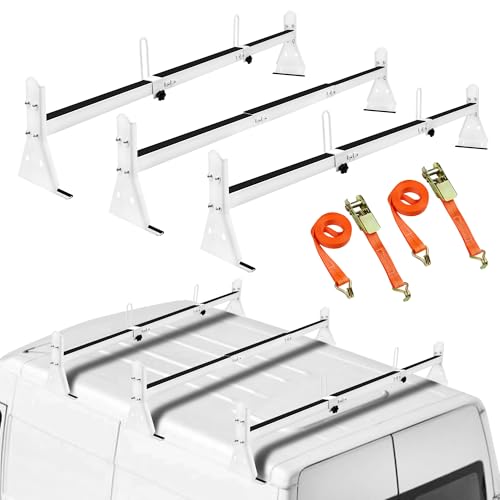
As an Amazon Associate we earn from qualifying purchases at no extra cost to you. Ratings are shown as listed on Amazon.
Best van roof racks by use case
| Best for | Rack type or example | Typical capacity | Approximate weight | Main advantage | Main drawback |
|---|---|---|---|---|---|
| Frequent commercial use | Full aluminum platform, such as Rhino-Rack Pioneer or Front Runner Slimline II | Vehicle-limited; commonly 150–300 lb dynamic | 45–100 lb, depending on size | Flexible tie-down points and accessory mounting | Higher cost, more wind exposure |
| Occasional cargo | Two or three aluminum crossbars | Commonly 100–165 lb dynamic | 15–35 lb | Lower price, less weight, easier removal | Less support for small or irregular loads |
| Work van with factory fixings | Fixed-point commercial rack, such as Thule TracRac or a vehicle-specific system | Often 150–250 lb dynamic | 30–75 lb | Uses engineered roof locations instead of clamps | Fit is vehicle- and roof-configuration-specific |
| Long ladders and lumber | Three-bar steel or heavy-duty aluminum rack | Often 200–300 lb dynamic, subject to van rating | 45–90 lb | Stable support at multiple points | Heavier and usually louder than two bars |
These figures are useful comparison ranges, not permission to exceed your van’s roof rating. The lower number always wins: the vehicle roof, mounting kit, rack, bars, and accessories each have limits, and the permitted load includes the rack’s own weight.
What to check before choosing
1. Dynamic and static load limits
Dynamic load is the maximum moving load while driving. It includes the rack, cargo, mounts, baskets, awnings, solar panels, and anything else attached above the roof. For example, if your van permits 165 lb and your platform weighs 55 lb, only 110 lb remains for equipment.
Static load is the stationary limit and may be several times higher. It matters for roof tents or people-supported accessories, but a high static rating does not increase the safe driving load. Never infer the rating from the rack alone; read the van manufacturer’s roof-load specification for your exact wheelbase, roof height, and body style.
A useful sizing calculation is:
Available cargo = vehicle dynamic limit − rack weight − accessory weight.
With a 165 lb roof limit, a 52 lb platform, a 14 lb awning bracket, and a 28 lb solar panel, the remaining cargo allowance is only 71 lb. That may be enough for rods and tackle but not for a loaded storage box and a kayak.
2. Bar dimensions and spacing
Common crossbar lengths run from roughly 50 to 80 inches, while full platforms for large vans may be 60 to 100 inches long and 40 to 60 inches wide. Measure the usable roof, not the body panels: antennas, roof vents, air-conditioning units, skylights, and rear doors can reduce the practical footprint.
Bars around 2.5 to 3.5 inches wide generally provide good support for cargo boxes and kayak saddles. Narrower round bars can be economical but may require different clamps. T-slot bars and platforms accept sliding nuts for awnings, recovery boards, light brackets, and rod tubes without drilling new holes.
Bar spacing matters as much as length. Two bars positioned 24 to 36 inches apart work for many boxes and kayaks, but long ladders, canoes, and lumber benefit from three support points. Follow the accessory manufacturer’s minimum bar-spacing requirement; a load that overhangs substantially can twist the rack even when its weight is below the stated limit.
3. Mounting method
- Factory fixed points: Usually the preferred method when your van has threaded mounting locations under roof plugs or trim. It offers repeatable positioning and avoids clamping directly to painted edges.
- Gutter or rain-gutter clamps: Common on older vans and some commercial bodies. They can be strong, but the gutter must be sound, clean, and free of rust. Uneven tightening can deform the gutter.
- Clamp-on systems: Convenient for some low-roof vans, but they must use the correct foot pack, rubber pads, and door-frame contact points. They are not automatically compatible with sliding doors or thick weather seals.
- Drilled or bonded mounting: Suitable for permanent professional installations. Drilled holes need corrosion protection, correct sealant, and access to the roof structure. Avoid improvising holes in a thin unsupported panel.
- Internal reinforcement: Heavy platforms, roof tents, and long commercial racks may require backing plates or a vehicle-specific reinforcement kit. Spreading the load prevents localized roof distortion.
Compatibility with common van roofs
Ford Transit and Transit Custom: Vehicle-specific fixed-point kits are widely available, but roof height, wheelbase, and factory roof rails change the required feet and bar length. Check whether your van has plugs, rails, or a bare roof before ordering.
Mercedes-Benz Sprinter: High-roof and super-high-roof versions need different feet, brackets, and sometimes different platform lengths. A roof rack that fits a standard-height Sprinter may interfere with roof curvature or service panels on another version.
Ram ProMaster: The broad, relatively flat roof is well suited to long platforms, but roof vents and air-conditioning units can consume valuable space. Confirm that mounting points are intended for your specific roof configuration.
Ford Transit Connect and compact vans: These have lower roof ratings and shorter usable bar spans. A lightweight two-bar system is often a better choice than a full platform unless you regularly need many tie-down points.
Rivian, electric vans, and vans with solar roofs: Pay particular attention to manufacturer-approved mounting zones, roof-panel construction, and total vehicle payload. Do not drill into a roof containing concealed wiring, sensors, or high-voltage components. For unusual roofs, use a qualified installer.
Wind noise, fuel use, and daily usability
Noise usually comes from exposed bar slots, blunt bar ends, loose rubber strips, and accessories rather than the rack frame alone. An aerodynamic wing-shaped bar with a fitted slot cover is generally quieter than an uncovered square bar. A full platform can be quieter than several separate accessories if its perimeter is streamlined, but a large flat platform also adds more frontal area.
Expect some increase in fuel or energy consumption, especially with an empty platform, ladder, basket, or rooftop box. Remove unused crossbars when practical. Tighten every fastener after the first few trips, then inspect periodically; a rack that is secure at low speed can still produce vibration and noise if a slot cover or end cap is missing.
Decision matrix: which rack fits your situation?
| Your situation | Best choice | Why | What to avoid |
|---|---|---|---|
| Budget-conscious, fewer than 10 trips per year | Two removable aluminum crossbars | Lowest rack weight and simpler installation | Oversized platform that stays empty |
| Weekly fishing, camping, or trade work | Three crossbars or a medium modular platform | Better support and more tie-down positions | Two widely spaced bars under long flexible loads |
| Many accessories changed throughout the year | T-slot platform from Rhino-Rack, Front Runner, or a comparable vehicle-specific system | Brackets can be repositioned without drilling | Single-purpose permanently drilled mounts |
| Low roof rating or limited payload | Lightweight bars with only the needed accessory | Preserves capacity for cargo inside the van | Steel rack, basket, awning, and box combined |
| Roof tent or stationary sleeping setup | Vehicle-approved heavy-duty platform with reinforcement where specified | Designed around static and dynamic loads | Assuming a high static rating makes driving safe |
Installation and maintenance that prevent expensive problems
- Confirm the exact van variant. Record make, model year, wheelbase, roof height, doors, factory rails, vents, and existing roof equipment.
- Calculate the loaded weight. Weigh the rack and every accessory, then leave a margin rather than designing to the absolute limit.
- Clean all contact surfaces. Grit under a rubber pad can damage paint and encourage corrosion.
- Use the supplied hardware and torque values. Under-tightening permits movement; over-tightening can crush a roof rail, strip threads, or deform sheet metal.
- Center and balance the load. Keep heavy items low, distribute weight between bars, and keep the center of gravity near the vehicle centerline.
- Secure each item independently. Use rated straps or clamps, protect sharp edges, and tie down long loads at the front and rear where appropriate. Do not rely on a thin cargo-box latch alone.
- Recheck after the first drive. Inspect fasteners, pads, end caps, slot covers, and any sign of paint rubbing or roof movement.
The parts that usually wear first are rubber pads, weather seals, plastic end caps, exposed fasteners, and accessory clamps. Rinse salt, mud, and fish slime from the rack, especially around T-slots and stainless-steel hardware. Do not mix incompatible metals without the supplied isolation washers or paste, because galvanic corrosion can seize bolts and stain the roof.
Final buying recommendation
Choose lightweight crossbars for occasional transport and a vehicle-specific modular platform for frequent, changing gear. Prioritize the van’s certified roof limit and mounting method before brand, then select bar length and spacing around the equipment you actually carry. For most fishing vans, three aerodynamic aluminum bars or a medium platform provide the best balance of rod tubes, tackle boxes, kayaks, and tie-down flexibility without the unnecessary weight of a full commercial steel rack.

Write Your Review
No reviews yet. Be the first to share your experience!