

Key takeaways
- For travel, fishing trips, and general backups: Pick the Samsung T7 Shield if you want a protective exterior and a stated IP65 rating. It is a sensible option for carrying files between locations, but it is not waterproof for submersion, and its cable and ports still need protection from water and grit.
- For a USB 3.2 Gen 2×2 Windows workstation: Compare the Crucial X10 Pro and SanDisk Extreme PRO. Their higher interface ceilings are useful for transferring large folders, provided the computer supports Gen 2×2. If not, a less expensive Gen 2 drive may deliver similar practical results.
- For a very small everyday drive: The Kingston XS1000 is light and straightforward to pack. Its lack of a published IP rating makes it a less reassuring choice for dusty or wet environments; use a case and keep it dry.
- For regular video editing: Favor a 2TB or 4TB drive with a fast connection, then test it with a representative project. Editing performance depends on the video format, software, and connection as well as the SSD. A fast external drive is not a substitute for an adequate backup.
The best external SSDs for 2026, by situation
The best external SSD for most people is a rugged USB 3.2 Gen 2 model with a 1TB or 2TB capacity: it is fast enough for large photo and video transfers, compact enough to carry, and less expensive than a top-speed Thunderbolt drive. Choose a faster USB4 or Thunderbolt model only if your computer supports it and your work regularly moves very large files.
For a reliable shortlist, consider the Samsung T7 Shield for everyday durability, the SanDisk Extreme PRO Portable SSD for a faster USB 3.2 Gen 2×2 connection, and the Crucial X10 Pro for compact, high-speed transfers on compatible USB-C systems. Exact performance depends on the host port, workload, drive capacity, free space, and temperature; headline sequential speeds are not guaranteed sustained write speeds.
Our top picks
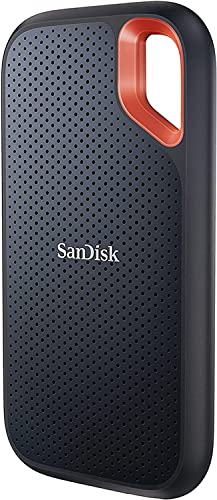


As an Amazon Associate we earn from qualifying purchases at no extra cost to you. Ratings are shown as listed on Amazon.
Shortlist: what you get for the money
Figures below are manufacturer-published specifications or typical product-line details, not promises of real-world results. Model revisions and regional versions can vary, so check the exact product listing and warranty terms before buying.
| Drive | Common capacities | Interface and advertised peak | Weight | Protection and security |
|---|---|---|---|---|
| Samsung T7 Shield | 1TB, 2TB, 4TB | USB 3.2 Gen 2, up to 1,050 MB/s read and 1,000 MB/s write | About 98 g | Rubberized exterior; IP65 dust and water resistance; AES 256-bit hardware encryption support |
| SanDisk Extreme PRO Portable SSD | 1TB, 2TB, 4TB | USB 3.2 Gen 2×2, up to 2,000 MB/s read and write | About 77 g | Aluminum chassis and silicone shell; IP55 water and dust resistance; password protection with AES 256-bit encryption |
| Crucial X10 Pro | 1TB, 2TB, 4TB | USB 3.2 Gen 2×2, up to 2,100 MB/s read and 2,000 MB/s write | About 42 g | IP55 dust and water resistance; password protection with AES 256-bit hardware encryption |
| Kingston XS1000 | 1TB, 2TB | USB 3.2 Gen 2, up to 1,050 MB/s read and 1,000 MB/s write | About 29 g | Compact metal-and-plastic enclosure; no comparable published IP rating |
These drives connect over USB-C, but USB-C describes the connector, not the speed. A Gen 2×2 drive can fall back to a slower connection if the computer lacks USB 3.2 Gen 2×2 support. Many Macs, for example, do not provide Gen 2×2, so the SanDisk or Crucial may not reach its advertised interface peak there. Check the computer’s specifications, not just the shape of its port.
Choose by workload, not by the biggest speed number
- For travel, fishing trips, and general backups: Pick the Samsung T7 Shield if you want a protective exterior and a stated IP65 rating. It is a sensible option for carrying files between locations, but it is not waterproof for submersion, and its cable and ports still need protection from water and grit.
- For a USB 3.2 Gen 2×2 Windows workstation: Compare the Crucial X10 Pro and SanDisk Extreme PRO. Their higher interface ceilings are useful for transferring large folders, provided the computer supports Gen 2×2. If not, a less expensive Gen 2 drive may deliver similar practical results.
- For a very small everyday drive: The Kingston XS1000 is light and straightforward to pack. Its lack of a published IP rating makes it a less reassuring choice for dusty or wet environments; use a case and keep it dry.
- For regular video editing: Favor a 2TB or 4TB drive with a fast connection, then test it with a representative project. Editing performance depends on the video format, software, and connection as well as the SSD. A fast external drive is not a substitute for an adequate backup.
Real-world speed: the connection is only part of the story
USB 3.2 Gen 2 has a 10-gigabit-per-second signaling rate, while Gen 2×2 reaches 20 gigabits per second. Those are link rates, not file-copy speeds: protocol overhead and the computer’s controller reduce the usable throughput. In practice, a good Gen 2 portable SSD may copy large files at roughly 700–1,000 MB/s under favorable conditions. A Gen 2×2 drive on a compatible system can be substantially quicker, but the result varies with the workload and can drop during a long write.
Small files, a nearly full drive, a slow source disk, and a congested hub can all make a transfer slower than the box suggests. For a fair comparison, connect the SSD directly to a compatible port, use the supplied or a certified cable, and copy the same large folder in both directions. For recurring work, check performance over a long write rather than relying on a brief benchmark burst.
Many portable SSDs use a fast cache to handle short transfers. Once that cache fills, write speed can fall, sometimes sharply. The size and behavior of the cache may vary by capacity and firmware, and manufacturers do not always publish sustained-write figures. If you routinely write hundreds of gigabytes at once, look for independent long-duration tests of the exact capacity, leave free space on the drive, and consider a desktop-class SSD if portability is not essential.
Capacity and cost: a quick planning calculation
Estimate usable capacity from your actual files rather than buying only for today. As a rough planning example, suppose one fishing-video trip produces 120GB of footage and you want to keep six trips on the drive. That is 720GB before adding photos, exports, and working space. A 1TB drive may feel cramped; 2TB gives room to organize and edit without filling it immediately.
Compare options using the cost per terabyte: divide the price by the drive’s stated capacity. As a broad market guide, 1TB portable SSDs often fall around $60–$120, 2TB models around $100–$220, and 4TB models around $200–$400. Fast interfaces, rugged construction, and sales can shift those ranges considerably. A larger drive can be better value per terabyte, but capacity is not a backup strategy: keep a second copy on a separate device or service.
Durability, encryption, and warranty realities
Rugged ratings have limits. An IP rating describes resistance under defined test conditions, not immunity to damage. Water or dust resistance can be compromised by wear, impact, a damaged port, or an improperly seated cover. Shock protection helps with accidental bumps, but an SSD can still fail electronically or suffer file-system corruption if disconnected during a write.
Keep the drive in a padded case, use a short tether or secure pocket outdoors, and avoid leaving it in a hot vehicle or direct sun. Unplug it with the operating system’s eject function after writes finish. For important footage, copy files to a second destination before formatting cards or deleting originals.
Hardware encryption can protect data if the drive is lost, but it may require the manufacturer’s software and may not work identically across operating systems. Set a strong password, store recovery information separately, and confirm that your workflow can unlock the drive on every computer you use. Encryption does not prevent accidental deletion or drive failure.
Warranty length is not the same as data recovery coverage. Samsung’s portable SSD warranty terms vary by model and region; Crucial and Kingston product warranties are commonly limited warranties, while SanDisk coverage depends on the exact product and market. Check the current terms for the specific capacity and region, including any time or total-bytes-written limits. Assume the warranty will replace hardware, not restore lost files.
Bottom line
For a durable all-rounder, start with the Samsung T7 Shield. For large, frequent transfers, choose the Crucial X10 Pro or SanDisk Extreme PRO only if your computer supports USB 3.2 Gen 2×2. For a tiny, lighter-duty option, consider the Kingston XS1000 and protect it from the elements. In every case, match the interface to your computer, choose enough capacity to leave working space, and keep a separate copy of anything you cannot afford to lose.

Write Your Review
No reviews yet. Be the first to share your experience!