

Key takeaways
- 1/4 cup: 2 tablespoons
- 1/3 cup: 5 tablespoons plus 1 teaspoon
- 1/2 cup: 8 tablespoons
- 1 cup: 16 tablespoons
Best Stainless Steel Measuring Cup Sets
The best stainless steel measuring cup set for most everyday kitchens is a four- or six-piece set with 1/4-, 1/3-, 1/2-, and 1-cup measures, welded or strongly riveted handles, permanently stamped markings, and a nesting design that stores in roughly 3 inches of vertical space.
Stainless steel is a strong choice when you want measuring cups that will not retain food odors, stain easily, or crack like plastic. However, sets vary more than their similar appearance suggests. Handle attachment, marking visibility, rim shape, and the way the cups nest determine whether a set remains pleasant to use after years of washing.
Our top picks


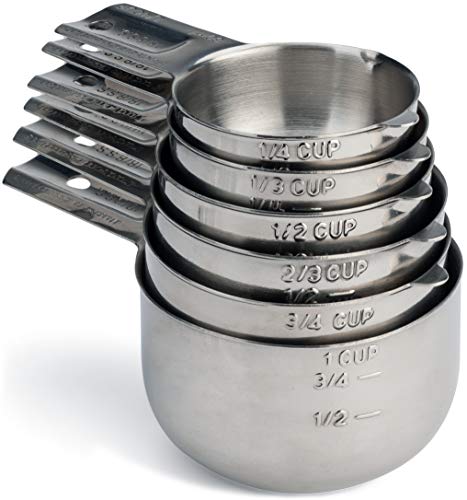

As an Amazon Associate we earn from qualifying purchases at no extra cost to you. Ratings are shown as listed on Amazon.
Best stainless steel measuring cup sets by situation
| Best for | Recommended set type | Useful capacities | Typical 2026 price range | Why it fits |
|---|---|---|---|---|
| Most home kitchens | Four-piece stainless steel set | 1/4, 1/3, 1/2, 1 cup | $15–$35 | Covers common baking and cooking quantities without unnecessary pieces |
| Frequent bakers | Six-piece set with extra 2/3- and 3/4-cup measures | 1/4, 1/3, 1/2, 2/3, 3/4, 1 cup | $25–$55 | Reduces awkward conversions and repeated partial fills |
| Small kitchens or drawers | Flat-sided nesting set with removable ring | 1/4 through 1 cup | $15–$40 | Stores compactly and can be separated when several cups are needed |
| Heavy daily use | Thicker-gauge stainless steel with welded handles | 1/4, 1/3, 1/2, 1 cup | $30–$70 | Better resistance to bent handles, dents, and repeated dishwasher cycles |
| Lowest initial cost | Lightweight stamped-steel set | 1/4, 1/3, 1/2, 1 cup | $10–$20 | Affordable, provided the handles are firmly attached and markings are clear |
Head-to-head: what separates the leading set types
OXO stainless steel measuring cups
OXO’s stainless steel measuring cups are aimed at comfortable everyday handling. The broad, soft-grip-style handles used on many OXO kitchen tools are easier to hold when your hands are wet or covered in flour, while the cups are designed to nest. They are a strong choice for cooks who value handling comfort over the lowest price.
Check the exact package before buying, because OXO sells different measuring products and configurations. A good OXO-style set should have clearly identified fractions, a stable base, and enough clearance between nested handles to remove one cup without pulling out the entire stack.
Cuisipro stainless steel measuring cups
Cuisipro sets typically appeal to bakers who want a polished, substantial-feeling tool and a complete group of fractional measures. The main advantage of a six-piece configuration is practical: measuring 3/4 cup directly is quicker and less error-prone than filling a 1/2-cup and 1/4-cup measure separately.
Look closely at how the markings are applied. Laser-etched or stamped fractions generally outlast printed ink, especially when the cups are washed frequently. A polished interior also makes sticky ingredients easier to release, although a mirror finish can show fingerprints.
All-Clad stainless steel measuring cups
All-Clad’s kitchen tools are positioned toward buyers who prefer a heavier, more premium-feeling construction. A set in this category can be worthwhile for frequent use, but the brand name alone should not decide the purchase. Compare the handle attachment, the actual pieces included, and whether the capacity markings are engraved rather than printed.
Heavier cups are not automatically better. Extra metal can make a set more durable, but it also takes up more drawer space and may feel cumbersome when measuring large quantities of flour or sugar. For occasional cooking, a well-made mid-priced set may offer better value.
Norpro and other budget stainless steel sets
Norpro and similar budget-oriented brands offer many basic stainless steel cup sets. These can be good practical purchases when the cups have smooth rolled rims, secure handles, and readable permanent markings. The main compromises are often thinner metal, narrower handles, and less refined nesting rather than unsafe materials.
Before choosing a low-cost set, hold each handle if possible or inspect close-up photographs. Reject any design where the handle visibly flexes at the attachment point, the rim feels sharp, or the cup cannot sit flat. Those small weaknesses tend to become noticeable long before the stainless steel itself corrodes.
Capacity: four pieces or six?
A standard four-piece set covers the most common US volume measures:
- 1/4 cup: 2 tablespoons
- 1/3 cup: 5 tablespoons plus 1 teaspoon
- 1/2 cup: 8 tablespoons
- 1 cup: 16 tablespoons
A six-piece set adds 2/3 and 3/4 cup. This matters most when following baking recipes, where repeatedly combining smaller measures can introduce rounding or leveling errors. It also saves time when doubling recipes.
For a household that cooks three times per week, a six-piece set costing $40 may be reasonable. Assuming five years of use, that is about 780 uses at three uses per week, or approximately 5 cents per use. A $15 four-piece set used just as often costs under 2 cents per use. The more expensive set earns its keep through convenience and construction, not through capacity alone.
Handle strength and nesting design
Handles are usually the first part to become irritating and, in cheaper sets, the first part to fail. Look for handles that are welded to the cup or attached with substantial rivets. A thin tab joined at a single small point is more likely to bend when the cup is packed into dense brown sugar or pulled from a tight storage ring.
Long handles provide better knuckle clearance but occupy more drawer space. Short handles nest more compactly but can put your fingers close to the ingredient. For most kitchens, handles around 2.5 to 4 inches long offer a useful balance, depending on the cup size.
A nesting set should meet three tests:
- Each cup should sit inside the next without rocking excessively.
- The handles should remain accessible instead of forming an inseparable bundle.
- The included ring should be removable, so the cups can be used independently.
Flat-sided or oval cups are useful for scooping from narrow ingredient containers. Round cups are easier to rinse but can waste a little space in crowded pantry bins.
Measurement markings and real-world accuracy
Permanent engraved or stamped markings are preferable to ink. Printed markings may fade from abrasive powders, scouring pads, and dishwasher detergents. Markings should appear on the handle, exterior wall, or both, and should remain readable when the cup is full.
Do not assume that a cup marked “1 cup” is suitable for liquid measuring. Dry measuring cups are intended to be filled to the rim and leveled, while liquid measuring cups provide headspace for pouring. Stainless steel cup sets are excellent for flour, sugar, grains, chopped ingredients, and other dry or semi-solid foods, but a separate liquid measuring jug is still useful.
For flour, spoon it lightly into the cup and level the top rather than compressing it. Packing flour can produce a substantially heavier quantity than a recipe expects. For brown sugar, follow the recipe’s instruction about packing; the measurement method is part of the ingredient specification.
Corrosion resistance and ownership realities
Food-grade stainless steel resists rust well, but “stainless” does not mean impossible to stain or corrode. Salt, acidic residues, harsh chemicals, and prolonged moisture can damage a poor-quality surface or leave discoloration. Type 304 stainless steel is a common, suitable choice for kitchen utensils; the product description should identify the steel grade when the manufacturer provides it.
To extend the life of any set:
- Rinse off salt, tomato, citrus, and vinegar residues rather than leaving them on the metal overnight.
- Dry the cups fully if they nest tightly, since trapped moisture can encourage spotting.
- Use a soft sponge instead of steel wool, which can scratch the surface and transfer particles.
- Do not use a bent handle as a lever to pry frozen or compacted ingredients.
- Check welded seams and rivets occasionally for looseness or food buildup.
Dishwasher compatibility is convenient, but repeated high-heat cycles may dull polished surfaces and can expose weaknesses in handles or decorative markings. Hand washing is not essential for quality stainless steel, but it is gentler on finishes and lets you inspect the attachment points.
Final buying recommendation
Choose a four-piece stainless steel set if you want the best balance of price, storage, and everyday usefulness. Choose six pieces if you bake often or regularly prepare doubled recipes. Prioritize permanently marked capacities and strong handle joints over decorative finishes. OXO is a sensible comfort-focused choice, Cuisipro suits shoppers wanting a fuller baker’s set, All-Clad is appropriate for a premium construction preference, and Norpro-style sets can deliver good value when their seams and markings are sound.
The best stainless steel measuring cup set is therefore not simply the heaviest or most expensive one. It is the set whose capacities match your recipes, whose handles stay rigid under pressure, whose cups separate easily from the nesting stack, and whose markings remain legible after years of cleaning.

Write Your Review
No reviews yet. Be the first to share your experience!